 How to resolve AdBlock issue?
News
But an advocate for the contractor counters that the percentage of Army reservists medically ready to deploy within 72 hours actually has jumped over the last several years, from 24 percent to 62 percent.
Rep. Joe Heck (R-Nev.) says he has watched with rising frustration as an arrangement with Logistics Health Inc. (LHI) of La Crosse, Wis., has handcuffed his Reserve medical staff on weekend drills from providing basic preventive health services to fellow reservists.
Heck charges that this has cut training opportunities for reserve medics. And LHI contract rules create barriers to using reserve medical personnel effectively, to give flu shots, for example, or to do preventive dental care.
Heck also contends that thousands of reservists every year are wrongly classified as medically nondeployable because LHI relies too heavily on soldiers’ responses to health questionnaires to assess fitness for duty.
On written responses alone LHI will lower medical readiness profiles of soldiers needlessly, sometimes for conditions that medical boards already have reviewed and deemed soldiers fit and deployable, Heck says.
An advocate for LHI, who asked not to be identified, says Heck seems not to understand that the Army Reserve was and is incapable of providing enough health services on its own to bring overall readiness rates higher.
Besides being a freshman member of Congress, Heck commands the Western Area Medical Support Group in San Pablo, Calif., one of four such groups in the Army Reserve. He oversees 2200 medically trained reservists assigned to 13 units across six states.
LHI does important work to ensure reservists stay medically fit, Heck says. “The problem is it doesn’t really accomplish that in a timely, cost-effective manner.”
“I would send a soldier who was well to a PHA” – Periodic Health Assessment conducted by LHI – “and he would come back broken, this is, medically nondeployable for an issue that was really not an issue,” Heck said. “But it would take six months to a year for us to clear it up.”
Heck estimated that 10,000 Army Reservists currently have a “P-3 profile” from LHI “that renders them medically nondeployable. And most of those, I am sure, will be adjudicated as not valid.”
Army Reserve Mobilization Support Units still are responsible for medical processing of reservists when mobilized and on return. But if the same personnel “want to do soldier readiness processing at my unit, they can’t do it on a drill weekend for my soldiers even though that’s their job should they be mobilized,” Heck said.
Heck raised these issues last week at House military personnel subcommittee hearing where senior defense health officials and the military surgeons general testified on TRICARE fees.
He expanded on his concerns in a phone interview for this column. Heck says he has asked Defense and Army medical leaders to answer a number of questions including whether LHI adds value for the government and whether contract changes are planned.
LHI, in a statement, said that neither the company nor the Reserve Health Readiness Program it services prohibits reserve components “from performing their medical readiness services organically.”
LHI said it only follows guidance from the Army Reserve Surgeon’s office and the office for Force Health Protection and Readiness under the assistant secretary of defense for health affairs. And “LHI only initiates” the annual health profile for drilling reservists.
“LHI is not the final authority on eligibility. For Army Reserve, the regional support command surgeon’s office has the authority to override any issue identified.”
LHI said in the last three years the Army Reserve “has witnessed historical medical and dental readiness improvement.”
Heck said he has been raising questions about the LHI contract for at couple of years based on “my firsthand experience. Now it’s just that I’m in a position to maybe get some answers.”
Maj. Gen. Richard A. Stone, deputy surgeon general of the Army for mobilization, readiness and reserve affairs, said in a statement that readiness of the Army Reserve and Army National Guard “has steadily improved with the growth of the Reserve Health Readiness Program.”
He notes that the two reserve components “have taken different approaches” to achieve soldiers’ medical fitness. “The Army Reserve has used LHI, thus freeing their medical providers for collective training during a time of intense utilization of the Army Reserve medical force,” Stone said.
Donald J. Weber, a former Marine and Vietnam veteran, is CEO and chairman of LHI. He started it in 1999 and soon landed a contract with DoD to help with mass immunization of military members against anthrax. Weber previously had founded National Health Screenings, which provided preemployment drug testing services, a business he sold before starting LHI.
When Reserve and National Guard mobilizations after 9/11 found many members nondeployable because of dental and medical issues, the departments of Defense, Veterans Affairs and Health and Human Services formed the Federal Strategic Health Alliance (FEDS_HEAL), a joint initiative to provide medical support to reserve units.
LHI’s business boomed under FEDS_HEAL. It hired prominent names in government health. Tommy G. Thompson, former governor of Wisconsin and former HHS secretary for President George W. Bush, became company president in 2005. In 2007, William Winkenwerder Jr., former assistant secretary of defense for health affairs, joined the LHI executive team.
Later that year the FEDS_HEAL contract was restructured as the RHRP, and a five-year contract worth up to $790 million was awarded to LHI. It now has 839 full-time employees at its La Crosse headquarters and uses a nationwide network of 25,000 medical and dental providers.
To comment, send e-mail to
Follow Lake County News on Twitter at http://twitter.com/LakeCoNews , on Facebook at http://www.facebook.com/pages/Lake-County-News/143156775604?ref=mf and on YouTube at http://www.youtube.com/user/LakeCoNews .
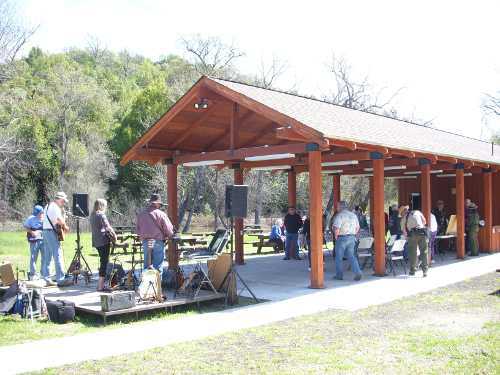
KELSEYVILLE, Calif. – As volunteers, park officials, elected representatives and community members looked on Saturday afternoon, the State Parks Department formally received an important gift – the new Clear Lake State Park Education Pavilion.
Clear Lake State Park Interpretive Association President Madelene Lyon not only officially handed over the seven-year labor of love to State Parks Director Ruth Coleman, she also topped off the gift with a hug.
That gesture captured not just personal warmth but also pointed to the greater cooperation that has formed between private and public interests in accomplishing the pavilion's completion.
The new building sits across from the park's visitor center. It features a covered area with an outdoor sink, counter and power outlets, and a secure enclosed portion where equipment can be stored.
CLSPIA's goal, the group said, was to create an outdoor educational space for young people, to keep them engaged and to make sure “no child was left inside.”
The vision turned into action in 2004, and Lyon and the group pursued years of fundraising, planning and lobbying to turn ideas into sketches, and sketches into a structure.
Along the way, one of the worst economic climates in memory hit, which has had critical impacts on state funding and, especially, the state parks.
Clear Lake State Park itself was on a list of parks former Gov. Arnold Schwarzenegger proposed for closure, but a local grassroots campaign by the group and the community at large spared the park.
It was the community's very vociferous defense of its park – as well as CLSPIA's ongoing commitment to offering educational programs like the Junior Rangers, park tours and bird walks – that kept the park open, officials said Saturday.
Coleman had been a staffer for Mike Thompson when he was in the state Legislature, before he moved into Congress. Noting, “Once you work for Mike you always work for Mike,” Coleman recalled Thompson calling her in about 2005 to ask if she had money to devote to the pavilion project.
The state did put aside funding for the project before leaner times arrived. While it took a lot of time and more than the estimated $20,000 to build it, Coleman said the pavilion was nonetheless an important example of what private and public entities can do when they work together.
She said the park would not be nearly as successful as it is if it weren't for its nonprofit partner, CLSPIA, adding that partnership “is the reason this park is still open.”
Thompson, who along with wife Jan came over for the afternoon for the dedication, credited Lyon's tenacity with pushing the project forward, which he said made “absolute perfect sense” in its goal of reaching young people, whose ability in science will be crucial to the country.
With so many partners – the community, the government and the organization – pushing in the same direction, it spelled success, he said.
Assemblyman Wes Chesbro – who Saturday afternoon was heading back to Sacramento and back to work in the Legislature – said it's seemed like a dark time for the state, with its budget woes.
However, Chesbro was heartened by the hope he said he saw expressed in the project's cooperative nature.
It was an example that Chesbro said could be used to confront other problems.
Chesbro said when a community supports a state park, it makes it easier for their government representatives to push to keep them open.
“I'd say this park is in good hands,” said Chesbro, who noted he loved the park and had visited it with his family many times.
Lauding Lyon, Coleman and Thompson, Chesbro added, “Really, the whole community deserves the credit.”
Clear Lake Section Superintendent Bill Salata also spoke, thanking CLSPIA. “What they did was just incredible.”
He also thanked the California Conservation Corps, which built the pavilion.
Lyon, before she turned over the pavilion and the hug to Coleman, thanked everyone, agreeing with others who had spoke that it took the entire community to make it possible.
“We saw such a huge need for this,” she said.
CLSPIA reported that major donors to the project included the Keeling-Barnes Family Foundation, Wildhurst Vineyards, Brad and Kathy Barnwell, William and Roberta Beat, the California State Park Foundation, D.A. and Leona Butts, Henry and Dorothy Hurkett, Madelene and Walt Lyon, Ernie Mendes, Dorothy Meyer, Tom and Val Nixon, Brad Onorato, the Priest Family Charitable Fund, Rotary Club of Lakeport, Grant Cary Family, Thrivent, Neil and Bobbi Towne, and Tom and Tina Wasson.
The dedication ceremony also coincided with the opening of the park for the season. Officials reported that a new ranger was on temporary assignment for the summer to assist at the park.
E-mail Elizabeth Larson at


A generous grouping of delicate, white fingerling potatoes was among the organic bounty in last week’s Community Supported Agriculture (CSA) box from my local food co-op.
The varied shapes of these long, slender potatoes captured not only my eyes, but my imagination, beginning a train of vegetable rumination that hasn’t quite stopped.
We are a nation of potato eaters. Each year more than a million acres of farmland in the U.S. are devoted to growing potatoes, and our per capita consumption each year is a whooping 126 pounds.
Worldwide, the potato is the fourth largest food crop, following rice, wheat and maize (known to us as corn).
Much of the potato’s popularity in the U.S. is due to the fast food industry and the deep-fried potatoes served up in these neon bright establishments. Snack foods such as potato chips also contribute their share.
But despite these not-so-healthy offerings, the potato stripped of such fatty preparation is a surprisingly healthy food choice.
I’m not sure if I meet the average per capita consumption of 126 pounds – especially since I stay away from fast food restaurants and rarely eat potato chips – but I do know that I enjoy nearly every potato I consume. They’re among my favorite foods; there’s just something about them that’s immensely nurturing.
Being a favorite comfort food for many – myself included – it’s not surprising that its scientific name, Solanum tuberosum, is derived, in part, from a Latin word that means soothing.
The potato's name also reflects that it belongs to the Solanaceae family, otherwise known as nightshades, whose members include tomatoes, eggplants, peppers and tomatillos.
The potato is a tuber, rather than a root, meaning the edible portion underground is a swollen part of the stem that develops to feed the leafy green portion of the plant. If allowed to flower and bear fruit, some varieties will yield small, inedible, green tomato-like globes.
There are more than 100 varieties of potatoes (some sources claim more than 1,000), and they come in varied colors such as golden yellow, deep blue, lavender or rosy red. Size and shape varies, as well, with the aptly-named fingerling potatoes in my CSA box a fraction of the size of heavy, lumpy, brown Russets stacked high in supermarket bins.
The potato wasn’t always such a popular fellow, however, and its history is a checkered one.
Potatoes originated in the Andes mountain range in South America, and the Inca Indians of what is now Peru were the first to cultivate them. Not many other cultivated foods were able to withstand the high altitudes of this area, making potatoes the staple food crop of the people there.


LAKE COUNTY, Calif. – On Saturday morning, after more than a week of flood warnings, Clear Lake's waters receded back to below flood stage.
The lake's waters went below the flood stage mark, 9 feet Rumsey, early Saturday. By the end of the day the level had gone down to 8.92 feet Rumsey, with the Cache Creek Dam releasing at 3,340 cubic feet per second, according to the US Geological Survey.
The National Weather Service subsequently ended its flood warning, which had been in effect since last week, with Lake County the only area in the state to be under such a warning during the last few days.
The Rumsey gauge is the special measure used to determine Clear Lake's depth. Lake County Water Resources said it's based on the natural lake level maintained by the Grigsby Riffle, a rock sill located at the confluence of Cache and Seigler Creeks near Lower Lake.
Last Friday, the lake had gone into flood stage for the first time since 1998, according to Water Resources officials.
The lake peaked at 9.37 feet Rumsey on Monday and then began its decline, which during the last several days was aided by no rain, warm spring days and continued high releases from the Cache Creek Dam.
The dam was built in 1914, and since then it has been used to manipulate the lake level, according to Water Resources.
Over the 97 years since the dam was built, only 15 of those years have seen the lake above 9 feet on the Rumsey gauge, according to US Geological Survey records on Clear Lake.
Besides 2011, the records show those years in which the lake was in flood stage include 1914, 1915, 1927, 1938, 1942, 1956, 1958, 1965, 1970, 1974, 1980, 1986, 1995 and 1998.
Lake County News correspondent Ed Oswalt contributed research on lake levels for this story.
E-mail Elizabeth Larson at
The crash, involving a pickup into a ditch, occurred on the Dry Creek Cutoff near Middletown at around 6:20 p.m., according to radio reports.
The California Highway Patrol said one person was ejected from the pickup's bed while another person was trapped inside.
The names of those involved were not immediately available.
An air ambulance transported one subject to Santa Rosa Memorial Hospital and the CHP indicated the other subjects were transported to St. Helena Hospital, Clearlake.
The CHP reported a blood draw was ordered as part of the investigation.
Follow Lake County News on Twitter at http://twitter.com/LakeCoNews , on Facebook at http://www.facebook.com/pages/Lake-County-News/143156775604?ref=mf and on YouTube at http://www.youtube.com/user/LakeCoNews .

What are the signs of spring? They are as familiar as a blooming daffodil, a songbird at dawn, a surprising shaft of warmth from the afternoon sun.
And, oh yes, don't forget the meteors.
“Spring is fireball season,” said Bill Cooke of NASA's Meteoroid Environment Center. “For reasons we don't fully understand, the rate of bright meteors climbs during the weeks around the vernal equinox.”
In other seasons, a person willing to watch the sky from dusk to dawn could expect to see around 10 random or “sporadic” fireballs.
A fireball is a meteor brighter than the planet Venus. Earth is bombarded by them as our planet plows through the jetsam and flotsam of space – i.e., fragments of broken asteroids and decaying comets that litter the inner solar system.
In spring, fireballs are more abundant. Their nightly rate mysteriously climbs 10 percent to 30 percent.
“We've known about this phenomenon for more than 30 years,” said Cooke. “It's not only fireballs that are affected. Meteorite falls – space rocks that actually hit the ground--are more common in spring as well1.”
Researchers who study Earth's meteoroid environment have never come up with a satisfactory explanation for the extra fireballs. In fact, the more they think about it, the stranger it gets.
Consider the following: There is a point in the heavens called the “apex of Earth's way.” It is, simply, the direction our planet is traveling. As Earth circles the sun, the apex circles the heavens, completing one trip through the Zodiac every year.
The apex is significant because it is where sporadic meteors are supposed to come from. If Earth were a car, the apex would be the front windshield. When a car drives down a country road, insects accumulate on the glass up front. Ditto for meteoroids swept up by Earth.
Every autumn, the apex climbs to its highest point in the night sky. At that time, sporadic meteors of ordinary brightness are seen in abundance, sometimes dozens per night.
Read that again: Every autumn.
“Autumn is the season for sporadic meteors,” said Cooke. “So why are the sporadic fireballs peaking in spring? That is the mystery.”
Meteoroid expert Peter Brown of the University of Western Ontario notes that “some researchers think there might be an intrinsic variation in the meteoroid population along Earth's orbit, with a peak in big fireball-producing debris around spring and early summer. We probably won't know the answer until we learn more about their orbits.”
To solve this and other puzzles, Cooke is setting up a network of smart meteor cameras around the country to photograph fireballs and triangulate their orbits.
As explained in the Science@NASA story “What's Hitting Earth?”, he's looking for places to put his cameras; educators are encouraged to get involved. Networked observations of spring fireballs could ultimately reveal their origin.
“It might take a few years to collect enough data,” he cautioned.
Until then, it's a beautiful mystery. Go out and enjoy the night sky. It is spring, after all.
Dr. Tony Phillips works for the National Aeronautics and Space Administration.
Follow Lake County News on Twitter at http://twitter.com/LakeCoNews , on Facebook at http://www.facebook.com/pages/Lake-County-News/143156775604?ref=mf and on YouTube at http://www.youtube.com/user/LakeCoNews .
Education
Health
Business
Obituaries
Veterans
Recreation
Religion
Arts & Life
Government & Politics