 How to resolve AdBlock issue?
News
The cost is steep, however, with the premium set at $186 a month, or $2,232 a year, for coverage under the fee-for-service TRICARE Standard plan or the preferred provider network offered under TRICARE Extra.
No other standard and extra beneficiaries have to pay a premium. But in approving TRICARE Young Adult (TYA) Congress mandated that premium be set high enough to cover the entire cost. That includes both for medical services and internal administrative costs. So TRICARE officials said they had no other choice than to set premiums at these levels.
Given the premiums, TRICARE officials project only a modest “take rate” the first year of about six percent, or about 14,000 participants out of an eligible population of 233,000 young adult dependents.
For now, TRICARE Standard will be the only TYA option. TRICARE Prime will become another option for TYA enrollees effective Oct. 1, start of the new fiscal year. But to use Prime, young adults will have to live in areas where a TRICARE managed-care network is available.
The monthly premium for TYA Prime will be $213, or $2,556 a year, not counting Prime co-pays. That is more than five times what a military family pays to enroll in TRICARE Prime.
There will be no retroactive coverage back to January 2011 offered under the TYA Prime option when it begins next October.
Families with multiple children between age 21 and 26 won’t get a discount either. Each participant will have to pay the full monthly premium, under either Prime or Standard. Additional features – cost-shares, deductibles and catastrophic cap protection – will be based on the sponsor’s status and the type of coverage selected.
Retired Navy Chief Hospital Corpsman Henry Popell of Vista, Calif., had wanted TYA Prime to cover his 20-year-old son, Colin, when he completes his studies in a few years.
But Popell is reconsidering, given the premium rates, which would total more than $10,000 over four years of coverage eligibility.
“Wow!” said Popell, when we shared with him the rate. “That’s a hell of a jump” from what he now pays for covering Colin as a fulltime student. “It puts me in a pickle.”
In better economic times, Popell said, he would count on his son landing a job with health benefits after graduate school. In this economy, that’s not at all certain.
“The burden’s going to be on me to provide him with health care because I won’t let him go without,” he added. “TRICARE Prime would be the best way to go. But if we’re talking about $2,500 a year, that’s a good hunk of money. There would have to be some very compelling reasons for me to continue that [coverage] after he got out of college.”
Details on the TYA program were published April 27 in the Federal Register as an “interim final rule.”
Though the department solicits comments from beneficiaries and interest groups, the program is starting immediately to accept applications and to extend coverage as applications are approved.
The rule explains that assistant secretary of defense for health affairs, Dr. Jonathan Woodson, “had determined that following the standard practice,” to delay implementation until after a 60-day comment period, “is unnecessary, impractical and contrary to the public interest.”
The final details confirm that Congress failed to deliver to military families what was gained for other families on young adult coverage under the 2009 Patient Protection and Affordable Care Act.
As that controversial health reform package moved toward enactment, opponents had warned that it had better not impact prized military health care coverage in any way.
That protectionist posture, however, left military families behind. The health reform law directed other health insurance plans to extend coverage of dependent children out to age 26. TRICARE coverage continued to end at age 21 or age 23 for children attending college full-time.
Last year the armed services committees considered but rejected the idea of adding TYA as another subsidized feature of the TRICARE benefit. That would have added $300 million a year to TRICARE costs, which defense officials complained long have complained are rising dramatically.
So lawmakers opted instead for a full-cost, premium-based TRICARE Young Adult program to take effect Jan. 1, 2011.
Congress imposed two other limitations unique to young adult TRICARE users versus other American young adults: 1) only unmarried dependents are eligible for TYA and 2) young adult dependents are disqualified if they are eligible for medical coverage through an employer-sponsored insurance program.
TRICARE officials needed longer than expected to write implementing regulations. But TYA applicants who pay premiums of $186 back as far as January can qualify for retroactive coverage under TRICARE Standard coverage if young adults can show their medical receipts.
TYA applicants can find more information, including application forms, online at www.tricare.mil/tya.
The rule refers to “various premiums” depending on whether the dependent's sponsor is active duty, retired or eligible under another plan such as TRICARE Reserve Select or TRICARE Reserve Retired.
But Austin Camacho, a spokesman for the TRICARE Management Activity headquartered in Falls Church, Va., said there are no different premiums “at this time.”
The Department of Health and Human Services estimates that 1.2 million young adults have taken advantage of expanded dependent coverage to age 26 under national health reform law.
Spread across all plan participants, the new coverage likely bumped up insurance premiums for family coverage by $60 to $150 a year, according to HHS estimates.
That’s in sharp contrast to what military families will experience.
Proponents on Capitol Hill argue that TYA still will be more affordable than many commercial health insurance plans available for young adults, and that TRICARE will provide more comprehensive coverage too.
To comment, e-mail
Follow Lake County News on Twitter at http://twitter.com/LakeCoNews, on Facebook at http://www.facebook.com/pages/Lake-County-News/143156775604?ref=mf and on YouTube at http://www.youtube.com/user/LakeCoNews.
A report from public health nurse Erika Nosera of the Mendocino County Health and Human Services Agency's Public Health Branch said Mendocino County has had three confirmed cases of measles so far this year.
Those three cases in Mendocino County are among 11 cases reported statewide so far this year, health officials said. Nearly all of the cases have been linked to travelers to or from Europe and Asia, as well as their contacts.
The Monday report from Mendocino County said more than 5,000 cases have been reported this year in France, where one patient died and eight had neurological complications.
In the case of Mendocino County, a French traveler visiting the coast became ill and the infection was spread to two unimmunized county residents, Nosera's report explained.
Lake County has so far not experienced any measles cases, according to Public Health Officer Dr. Karen Tait.
“We've been spared,” said Tait, noting that it's been several years since a case has been reported locally, which she attributed to vaccinations.
However, measles appears to be having a resurgence, in part, due to people not being vaccinated against the disease. “Some people are resisting vaccination for personal reasons and that leaves them vulnerable,” she said.
The World Health Organization reported that the United States has had 44 confirmed measles cases so far this year, compared to 64 confirmed cases in 2010.
The last time California experienced a severe measles epidemic due to an imported case and due to low vaccination rates was 1988 to 1990 when 16,400 Californians contracted measles, 3,390 people were hospitalized and 75 died, according to Nosera's report.
The highly contagious viral disease is spread through coughs and sneezes, and in indoor settings the virus can stay in the air for as long as two hours after the infected person has left the area, Mendocino County health officials reported.
Symptoms begin with a fever that lasts a couple of days followed by a cough, runny nose, red, watery eyes and a rash that typically appears first on the face, along the hairline, and behind the ears and then affects the rest of the body. Nosera reported that infected people are usually contagious for about eight days – four days before their rash starts and four days after.
Those who think they have measles should call their doctor first before entering a health facility and potentially infecting others, Nosera said.
Complications from measles can include diarrhea, ear infection and pneumonia, Nosera reported. Children younger than age 5 and adults over 20 are more susceptible to complications from measles.
While most cases come through fine, “It can be very serious occasionally,” said Tait.
Mendocino County health officials said death can occur from severe complications.
Nosera said children should get their first dose of measles, mumps and rubella vaccine at 12 months of age or later, with the second dose usually administered before the child begins kindergarten.
Anyone born since 1957 who has not had two doses of vaccine may still be vulnerable to measles and should ask their doctor about getting immunized, she said.
E-mail Elizabeth Larson at
LAKE PILLSBURY, Calif. – A 3.1-magnitude earthquake was recorded near Lake Pillsbury early Monday morning.
The quake occurred at 3:53 a.m., according to the US Geological Survey.
It was centered four miles north northeast of Lake Pillsbury, 17 miles southwest of Alder Springs and 21 miles north of Upper Lake, at a depth of 9.9 miles, the survey reported.
No shake reports were submitted on the quake, according to US Geological Survey records.
The Lake Pillsbury area experienced two quakes measuring 4.3 and 4.2 in magnitude on Feb. 22, as Lake County News has reported.
E-mail Elizabeth Larson at
But snowpack water content is still 144 percent of the April 1 full season average.
The readings will help hydrologists forecast spring and summer snowmelt runoff into rivers and reservoirs. The melting snow supplies approximately one-third of the water used by Californians.
“All indications are that we’re moving toward summer with a good water supply for our farms and cities,” said state Department of Water Resources Director Mark Cowin. “We must be aware, however, that California can quickly turn from wet to dry, and we can’t afford to forget the lessons of conservation that we learned in the 2007-09 drought.”
Snowpack water content is measured manually on or near the first of the month from January to May, and in real-time by electronic sensors.
Electronic readings indicate that water content in the northern mountains is 159 percent of the April 1 seasonal average. Electronic readings for the central Sierra show 144 percent of the April 1 average. The number for the southern Sierra is 127 percent. The statewide number is 144 percent.
The first of April is normally when snowpack water content is at its peak.
California's reservoirs are fed both by rain and snowpack runoff.
A majority of the state's major reservoirs are above normal storage levels for the date. Lake Oroville in Butte County, the State Water Project's principal reservoir, is 112 percent of average for the date (93 percent of its 3.5 million acre-foot capacity).
Lake Shasta north of Redding, the federal Central Valley Project's largest reservoir with a capacity of 4.5 million acre-feet, is at 108 percent of average (94 percent of capacity).
DWR estimates it will be able to deliver 80 percent of requested State Water Project (SWP) water this year.
In 2010, the SWP delivered 50 percent of a requested 4,172,126 acre-feet, up from a record-low initial projection of 5 percent due to lingering effects of the 2007-2009 drought. Deliveries were 60 percent of requests in 2007, 35 percent in 2008, and 40 percent in 2009.
The last 100 percent allocation – difficult to achieve even in wet years due to pumping restrictions to protect threatened and endangered fish – was in 2006.
The SWP delivers water to more than 25 million Californians and nearly one million acres of irrigated farmland.
Statewide snowpack readings from electronic sensors are available on the Internet at http://cdec.water.ca.gov/cgi-progs/snow/DLYSWEQ .
Follow Lake County News on Twitter at http://twitter.com/LakeCoNews, on Facebook at http://www.facebook.com/pages/Lake-County-News/143156775604?ref=mf and on YouTube at http://www.youtube.com/user/LakeCoNews.
LAKE COUNTY, Calif. – Lake County's state senator will hold a virtual town hall focusing on the state's budget this week.
Sen. Noreen Evans is hosting the event from 6:30 p.m. to 7:30 p.m. on Wednesday, May 4.
“As we all know, these are hard times and California is facing some very difficult decisions about how to balance our budget,” Evans said in a statement released by her office. “I rely on your input to make decisions in the Capitol that are best for Senate District 2 and the state of California as a whole.”
Community members will be able both to watch the forum online and post questions at http://senweb03.senate.ca.gov/focus/townhall/sd02/.
Evans said she's looking forward to hearing from community members “and maximizing this opportunity to work together.”
Constituents can visit Evans' Web site at http://sd02.senate.ca.gov/.
Follow Lake County News on Twitter at http://twitter.com/LakeCoNews , on Facebook at http://www.facebook.com/pages/Lake-County-News/143156775604?ref=mf and on YouTube at http://www.youtube.com/user/LakeCoNews .
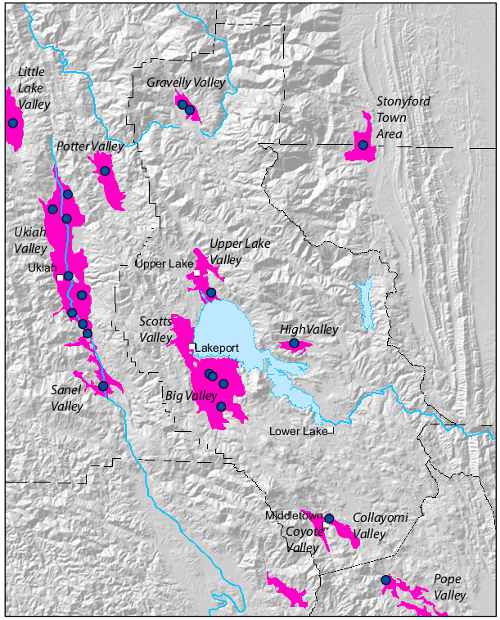
LAKE COUNTY, Calif. – The US Geological Survey is conducting a study that's assessing the quality of water in the state's many aquifers, including groundwater basins around Lake County.
The study is part of the US Geological Survey's National Water Quality Assessment (NAWQA) program and the State Water Resources Control Board’s Groundwater Ambient Monitoring and Assessment Program, officials reported.
NAWQA tracks the status and trends in the quality of freshwater streams and aquifers to provide a sound understanding of the natural and human factors that affect the quality of these resources, according to a US Geological Survey statement.
The study says 40 percent of the state's drinking water comes from groundwater.
Despite the availability of water from Clear Lake – which must be purchased through Yolo County Flood Control and Water Conservation District – wells are a major sources of water in the county. The US Environmental Protection Agency reports that of the 52 water districts in the county, 31 use groundwater as their source.
Miranda Fram, a US Geological Survey research chemist, said the study is assessing the water quality of aquifers that are used for public water supply.
“We've been going around the state sampling groundwater in groundwater basins,” she said.
The US Geological Survey reported that the sampling of untreated groundwater in more than 2,000 California wells began in 2004, and will continue through this year. Local water agencies and well owners are cooperating voluntarily with the study.
Fram said there are 35 study units around California, with the Northern Coast Ranges study unit the 30th to be sampled.
The US Geological Survey said the Northern Coast Ranges study unit includes California Department of Water Resources-defined groundwater basins in Mendocino, Lake, Napa, Colusa, Glenn, Del Norte, Trinity and Humboldt counties.
The unit includes 58 wells and cells – 29 California Department of Public Health wells, 23 domestic or irrigation wells, five miscellaneous wells and one spring.
Fram said scientists analyzed the groundwater for numerous materials, including pesticides, solvents, gasoline nutrients, radioactivity and microbial indicators such as coliforms.
She said they analyzed those materials at very low concentrations, lower than typically is done for regulatory sampling.
“One of the interesting things about this study unit is the detection frequencies were pretty low compared to many of the other places we've looked at in the state,” Fram said.
Fram said there were a few pesticide detections in the study unit, but they were at low levels of commonly used pesticides.
Those findings were in the inland basin areas of the unit, around Clearlake and Ukiah, with no detections in coast basins, Fram said.
Findings of volatile organic compounds – like chloroform, MTBE and some common solvents – were scattered, and were detected in 10 percent of the 58 wells sampled in the Northern Coast Ranges unit, according to the study. Chloroform was detected most frequently.
Fram said all of those compounds were found at “really, really low concentrations.”
Maps of the area showed that gasoline additives and trihalomethanes – the latter reportedly used as refrigerants and solvents, and believed to be cancer-causing – were found in some Lake County wells.
She said they also looked at naturally occurring inorganic constituents, like nitrates and arsenic. Fram said they didn't find any high nitrate concentrations, such as they found in other more heavily used basins along the California coast.
Some inland basin wells have arsenic and boron, but the detections were few, Fram said.
Detections of pesticides occurred in agricultural areas but only 18 percent of the time in the study unit. Only a few Lake County wells appeared to have tested positive for the materials, according to a map of study results.
Detections of perchlorate – a contaminant that can be both natural and manmade – also weren't very frequent, and only one Lake County well appeared to have them, the study showed. Barium, arsenic and boron were found in some Lake County wells.
There were “no detections at all” when it came to mercury, Fram said. “Mercury is not something that we see commonly in groundwater anywhere, in any of the places that we've looked at” so they weren't expecting to see it, she added.
One material commonly found in the coastal and interior basins is manganese, which Fram said is found in levels high enough to stain materials but not high enough to cause health issues.
She said the mineral may cause some people to notice a sulfurous smell. Low oxygen levels allow manganese to be present, Fram explained.
Mark Dellinger, administrator of Lake County Special Districts, said a US Geological Survey staffer took samples in July 2009 from a well in Big Valley that is one of five that supply the Kelseyville water system.
He said the district made special arrangements for her so the well could be a flowed in a certain way to allow her to take the kinds of samples she needed.
The full report on the study is expected to be available this spring. The scientists involved with gathering the data have been traveling around the state to discuss their initial findings, the US Geological Survey reported.
The Northern Coast Ranges unit preliminary findings were presented at a Jan. 27 meeting in Eureka, as Lake County News has reported.
“It went really well,” Fram said of the gathering. “It was a small crowd but a very interested crowd.”
The more comprehensive report that's scheduled to come out, complete with tabulated data, will look more at water quality issues in an effort to understand why the water quality is the way it is, Fram said.
One of the neat things about the program is the use of environmental “tracers,” Fram said. Those include stable isotopes and certain elements used to help date the age of the water to show when a well was recharged.
“Age dating has been around for a while, but it's unusual to have age dating on so many samples,” she explained.
Dellinger said that tracer information is of particular interest to him. Being able to know the recharge cycle of an aquifer, he said, is very important in relation to the resource's sustainability.
The project's next phase is to look at the data to see when the water is recharged. That report will take a few more years to be completed, said Fram.
E-mail Elizabeth Larson at