How to resolve AdBlock issue?
Refresh this page
How to resolve AdBlock issue?
Refresh this page
Lake County News,California
  • Home
    • Registration Form
  • News
    • Education
    • Veterans
    • Community
      • Obituaries
      • Letters
      • Commentary
    • Police Logs
    • Business
    • Recreation
    • Health
    • Religion
    • Legals
    • Arts & Life
    • Regional
  • Calendar
  • Contact us
    • FAQs
    • Phones, E-Mail
    • Subscribe
  • Advertise Here
  • Login

News

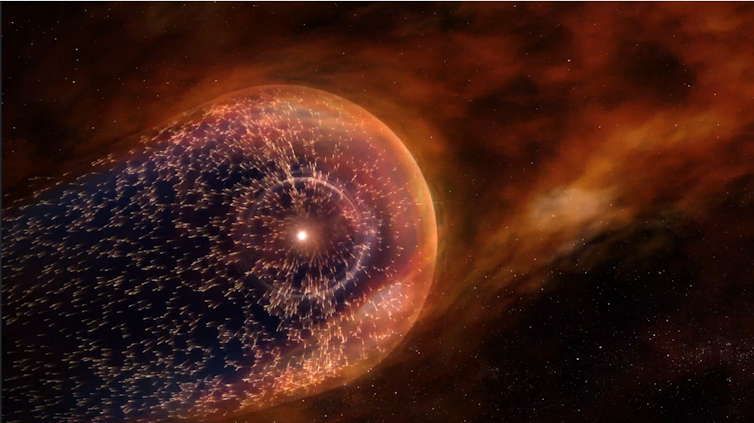
Space News: Scientists call the region of space influenced by the Sun the heliosphere – but without an interstellar probe, they don’t know much about its shape


An artist’s depiction of the heliosphere, the Sun’s region of influence in space. Little is known of the actual shape of the heliosphere. NASA

The Sun warms the Earth, making it habitable for people and animals. But that’s not all it does, and it affects a much larger area of space. The heliosphere, the area of space influenced by the Sun, is over a hundred times larger than the distance from the Sun to the Earth.

The Sun is a star that constantly emits a steady stream of plasma – highly energized ionized gas – called the solar wind. In addition to the constant solar wind, the Sun also occasionally releases eruptions of plasma called coronal mass ejections, which can contribute to the aurora, and bursts of light and energy, called flares.

The plasma coming off the Sun expands through space, along with the Sun’s magnetic field. Together they form the heliosphere within the surrounding local interstellar medium – the plasma, neutral particles and dust that fill the space between stars and their respective astrospheres. Heliophysicists like me want to understand the heliosphere and how it interacts with the interstellar medium.

The eight known planets in the solar system, the asteroid belt between Mars and Jupiter, and the Kuiper Belt – the band of celestial objects beyond Neptune that includes the planetoid Pluto – all reside within the heliosphere. The heliosphere is so large that objects in the Kuiper Belt orbit closer to the Sun than to the closest boundary of the heliosphere.

A comparison of the distance an interstellar probe could reach beyond the boundary of the heliosphere relative to Voyager and New Horizons.
An artist’s depiction of the heliosphere and its place in the local interstellar medium and in the Milky Way galaxy. An interstellar probe could travel farther than any previous spacecraft and help scientists get a good look at our heliosphere – the Sun’s influence in space – from the outside. JHU/APL

Heliosphere protection

As distant stars explode, they expel large amounts of radiation into interstellar space in the form of highly energized particles known as cosmic rays. These cosmic rays can be dangerous for living organisms and can damage electronic devices and spacecraft.

Earth’s atmosphere protects life on the planet from the effects of cosmic radiation, but, even before that, the heliosphere itself acts as a cosmic shield from most interstellar radiation.

In addition to cosmic radiation, neutral particles and dust stream steadily into the heliosphere from the local interstellar medium. These particles can affect the space around Earth and may even alter how the solar wind reaches the Earth.

Supernovae and the interstellar medium may have also influenced the origins of life and the evolution of humans on Earth. Some researchers predict that millions of years ago, the heliosphere came into contact with a cold, dense particle cloud in the interstellar medium that caused the heliosphere to shrink, exposing the Earth to the local interstellar medium.

An unknown shape

But scientists don’t really know what the heliosphere’s shape is. Models range in shape from spherical to cometlike to croissant-shaped. These predictions vary in size by hundreds to thousands of times the distance from the Sun to the Earth.

Scientists have, however, defined the direction that the Sun is moving as the “nose” direction and the opposing direction as the “tail” direction. The nose direction should have the shortest distance to the heliopause – the boundary between the heliosphere and the local interstellar medium.

No probe has ever gotten a good look at the heliosphere from the outside or properly sampled the local interstellar medium. Doing so could tell scientists more about the heliosphere’s shape and its interaction with the local interstellar medium, the space environment beyond the heliosphere.

Crossing the heliopause with Voyager

In 1977, NASA launched the Voyager mission: Its two spacecraft flew past Jupiter, Saturn, Uranus and Neptune in the outer solar system. Scientists have determined that after observing these gas giants, the probes separately crossed the heliopause and into interstellar space in 2012 and 2018, respectively.

While Voyager 1 and 2 are the only probes to have ever potentially crossed the heliopause, they are well beyond their intended mission lifetimes. They can no longer return the necessary data as their instruments slowly fail or power down.

These spacecraft were designed to study planets, not the interstellar medium. This means they don’t have the right instruments to take all the measurements of the interstellar medium or the heliosphere that scientists need.

That’s where a potential interstellar probe mission could come in. A probe designed to fly beyond the heliopause would help scientists understand the heliosphere by observing it from the outside.

An interstellar probe

Since the heliosphere is so large, it would take a probe decades to reach the boundary, even using a gravity assist from a massive planet like Jupiter.

The Voyager spacecraft will no longer be able to provide data from interstellar space long before an interstellar probe exits the heliosphere. And once the probe is launched, depending on the trajectory, it will take about 50 or more years to reach the interstellar medium. This means that the longer NASA waits to launch a probe, the longer scientists will be left with no missions operating in the outer heliosphere or the local interstellar medium.

NASA is considering developing an interstellar probe. This probe would take measurements of the plasma and magnetic fields in the interstellar medium and image the heliosphere from the outside. To prepare, NASA asked for input from more than 1,000 scientists on a mission concept.

The initial report recommended the probe travel on a trajectory that is about 45 degrees away from the heliosphere’s nose direction. This trajectory would retrace part of Voyager’s path, while reaching some new regions of space. This way, scientists could study new regions and revisit some partly known regions of space.

This path would give the probe only a partly angled view of the heliosphere, and it wouldn’t be able to see the heliotail, the region scientists know the least about.

In the heliotail, scientists predict that the plasma that makes up the heliosphere mixes with the plasma that makes up the interstellar medium. This happens through a process called magnetic reconnection, which allows charged particles to stream from the local interstellar medium into the heliosphere. Just like the neutral particles entering through the nose, these particles affect the space environment within the heliosphere.

In this case, however, the particles have a charge and can interact with solar and planetary magnetic fields. While these interactions occur at the boundaries of the heliosphere, very far from Earth, they affect the makeup of the heliosphere’s interior.

In a new study published in Frontiers in Astronomy and Space Sciences, my colleagues and I evaluated six potential launch directions ranging from the nose to the tail. We found that rather than exiting close to the nose direction, a trajectory intersecting the heliosphere’s flank toward the tail direction would give the best perspective on the heliosphere’s shape.

A trajectory along this direction would present scientists with a unique opportunity to study a completely new region of space within the heliosphere. When the probe exits the heliosphere into interstellar space, it would get a view of the heliosphere from the outside at an angle that would give scientists a more detailed idea of its shape – especially in the disputed tail region.

In the end, whichever direction an interstellar probe launches, the science it returns will be invaluable and quite literally astronomical.The Conversation

Sarah A. Spitzer, Research Fellow in Climate and Space Sciences and Engineering, University of Michigan

This article is republished from The Conversation under a Creative Commons license. Read the original article.


Shakespeare at the Lake plans punk rock take on ‘The Tempest’

LAKE COUNTY, Calif. — Shakespeare at the Lake, a co-production of Lake County Theatre Company and Mendocino College, announced that “The Tempest” by William Shakespeare will be its featured play for this summer’s production.

Rehearsals are in full swing for this year’s production, which organizers said will feature an exciting cast with several new faces.

“The Tempest” will be set in the vibrant and energetic 1980s punk rock scene, bringing a fresh and contemporary twist to Shakespeare’s classic tale.

“The Tempest” is a magical and enchanting play that explores themes of love, forgiveness and redemption.

The story follows Prospero, the rightful Duke of Milan, who has been exiled to a remote island with his daughter Miranda.

With the help of his spirit servant Ariel, Prospero conjures a tempest to bring his enemies to the island and ultimately reunite with his family and reclaim his rightful place as duke.

How will this fit into the punk rock scene of the 80s? Come on out and find out.

Shows are July 27 and 28 in Library Park in Lakeport, and Aug. 2 and 3 in Austin Park in Clearlake. All shows begin at 7 p.m.

Admission is free, as it has always been, and there is plenty of space.

Bring a blanket, chair, sun hat and some friends. Grab a bite to eat or a cold drink from one of our vendors, or bring your own. Organizers promise it will be a good time.

For more information, please visit www.laketheatre.org.

Kirk named Veterans Home deputy administrator

LAKE COUNTY, Calif. — Gov. Gavin Newsom has appointed a Lake County man to a key post at the Veterans Home of California in Yountville.

On Friday, Newsom’s office said he has named Jeremy Kirk of Hidden Valley Lake as the facility’s deputy administrator.

Kirk has been direct construction supervisor II for the California Department of Veterans Affairs since 2023 and has served in several positions there since 2015, including stationary engineer and plumber, water and sewage plant supervisor, and chief engineer II, the Governor’s Office reported.

Kirk was a general contractor/project foreman with RNW Construction & JK Home Services from 2005 to 2015.

This position does not require Senate confirmation and the compensation is $147,132. Kirk is a Democrat, the Governor’s Office said.

Clearlake man arrested in Mendocino County sexual assault case

Christopher Neil Kiger. Mendocino County Jail photo.

NORTH COAST, Calif. — Mendocino County officials have arrested a Clearlake man following a nearly yearlong investigation into a sexual assault case involving a minor.

Christopher Neil Kiger, 40, was taken into custody on Thursday, according to a report from Sgt. Jason Logan of the Mendocino County Sheriff’s Office.

Logan explained that in July of 2023, the Mendocino County Sheriff's Office initiated an investigation into the sexual assault of a minor.

Throughout the nearly year-long investigation, the agency’s detectives established that the suspect, Kiger, had committed multiple acts of sexual abuse against a juvenile victim. These acts included the continuous sexual abuse of a child, lewd or lascivious acts upon a child under the age of 14, unlawful sexual intercourse with a minor, oral copulation of a minor under 14 and sexual penetration with a foreign object.

Mendocino County Sheriff's detectives learned that Kiger, upon learning of this investigation, fled the state of California to avoid arrest, Logan said.

Logan said this case was submitted to the Mendocino County District Attorney's Office for consideration of an arrest warrant against Kiger. The case was filed with the Mendocino County Superior Court and an arrest warrant was subsequently issued for Kiger's arrest.

In May, sheriff's detectives learned Kiger had possibly returned to the area. Detectives attempted to locate Kiger in Lake County where he has family members, Logan said.

During these attempts, Logan said sheriff's detectives learned that Kiger knew he was wanted and somehow knew the bail amount of his arrest warrant.

Logan said sheriff's detectives learned that Kiger was avoiding capture until he could obtain the required amount of money for a bail bond. It should be noted that the bail had been set at $425,000, pursuant to the State of California bail schedule for the above offenses.

On Thursday, sheriff's detectives were able to utilize investigative tools to track down and locate Kiger at a remote location on Williams Ranch Road near Willits, where Logan said Kiger was believed to be staying and working on an illegal cannabis operation.

Sheriff's detectives located Kiger, who fled the area on foot into a nearby wooded area. After a short foot pursuit, Logan said sheriff's detectives were able to capture Kiger and take him into custody without any injuries sustained to Kiger or the pursuing detectives.

Kiger was booked into the Mendocino County Jail for the arrest warrant, which included charges of continual sexual abuse of a minor, lewd or lascivious acts upon a child under the age 14, oral copulation of a minor under 14 and penetration with a foreign object with victim under 14, Logan said.

Logan said sheriff's detectives contacted a Mendocino County Superior Court judge and requested an increase for Kiger's bail as a result of his past fleeing of the state of California and his avoidance of being arrested once he returned.

This request was granted and Kiger's bail was set at $1 million, Logan said.

Space News: What’s Up for June 2024


What's up for June? Saturn and Mars meet up with the Moon, Jupiter returns at dawn, and tips for identifying some common objects seen in the sky.

On June 2 in the hour before sunrise, reddish Mars hangs beneath the crescent Moon. Find the pair low in the east with Saturn lurking nearby. The following morning, on June 3rd, the Moon has moved so that it sits beneath Mars.

During the last week of June, giant Jupiter re-emerges as a morning planet, after passing behind the Sun, from our point of view on Earth, over the past couple of months. By June 24, you can find it about 10 degrees above the horizon as the morning sky begins to brighten. It climbs a little higher each morning after that as July approaches.

Then on June 27, look for the Moon with Saturn. The pair rise around midnight, and by dawn you'll find them high in the southern sky. They appear super close together this morning – close enough to appear in the same field of view through binoculars.

When you spot bright or moving objects in the night sky, it might not be immediately clear what you're looking at. Is that a planet, or just a bright star? Is it a satellite, or maybe just an airplane? Here are a few quick tips on how to tell the difference.

First, there are five planets that are easily observed with the unaided eye. Of these, two planets – Venus and Jupiter – can sometimes appear incredibly bright, like shining beacons in the sky. The other planets are much less bright, but still generally shine as brightly as bright stars.

The big tipoff that you're looking at a star and not a planet is that planets tend to shine steadily, whereas stars twinkle. Stars are so far away that they're just points of light, and ripples in our atmosphere easily distort them, causing the familiar flicker.

The planets are relatively closeby, being here in our solar system. Through binoculars or a telescope, instead of a single point, planets show us a tiny disk or crescent that's illuminated by the Sun. So even though they appear star-like to the eye, the light from a planet is coming from a slightly more spread-out area, making planets appear more constant in brightness.

Both planets and stars rise in the east and set in the west, and they move very slowly across the sky during the night.

But what if you see an object that's moving? Distant aircraft are usually pretty easy to identify, because they follow a slow, steady path that's straight or gently curving. They have exterior lights that flash in a regular pattern, often including a red beacon.

Satellites tend to be most visible in the hour or so after dark or before dawn, when it's night here on the surface, but the satellites are high enough in the sky to be illuminated by sunlight. They're generally fainter than aircraft, and move in slow, very steady, very straight paths. They might briefly flare in brightness, but they don't have lights that blink.

The International Space Station is an exception, because it's very bright, and is often visible for long enough to observe the curving path of its orbit. But it doesn't have flashing lights you can see from the ground, and it does something else satellites do: Satellites often fade out of view as they travel into Earth's shadow, or fade into view as they emerge. And occasionally you might see a train of satellites moving slowly and silently in formation.

One other sight that's sometimes confusing is rocket launches that happen soon after sunset or before sunrise. Similar to spotting satellites, this is when it's darker here on the ground, but launching rockets climb high enough to be illuminated by sunlight. When rockets launching at these times of day get really high in altitude, their exhaust can be brilliantly illuminated, and sometimes you might even see spiral or circular shapes that slowly grow and then dissipate, as a spent rocket stage empties its propellant into space.

With so much to see in the night sky, it's helpful to be familiar with some of these common sights, so you can get on with your skywatching and investigate whatever mysteries and wonders you're in search of.

Preston Dyches works for NASA's Jet Propulsion Laboratory.

Clearlake Animal Control: ‘Harper,’ ‘Archie’ and ‘Blake’

“Harper.” Photo courtesy of Clearlake Animal Control.

CLEARLAKE, Calif. — Clearlake Animal Control has many dogs ready to go home for the summer.

The Clearlake Animal Control website lists 39 adoptable dogs.

The available dogs this week include “Harper,” a female terrier mix with a black and white coat.

“Archie.” Photo courtesy of Clearlake Animal Control.

There also is “Archie,” a 4-month-old Carolina dog mix with a tan and white coat.

“Blake,” another adoptable dog, is a male terrier mix with a black and tan coat.

“Blake.” Photo courtesy of Clearlake Animal Control.

The shelter is located at 6820 Old Highway 53. It’s open from 9 a.m. to 6 p.m. Tuesday through Saturday.

For more information, call the shelter at 707-762-6227, email This email address is being protected from spambots. You need JavaScript enabled to view it., visit Clearlake Animal Control on Facebook or on the city’s website.

This week’s adoptable dogs are featured below.

Email Elizabeth Larson at This email address is being protected from spambots. You need JavaScript enabled to view it.. Follow her on Twitter, @ERLarson, or Lake County News, @LakeCoNews.


  • 435
  • 436
  • 437
  • 438
  • 439
  • 440
  • 441
  • 442
  • 443
  • 444

Community

  • Lake County Wine Alliance offers sponsor update; beneficiary applications open 

  • Mendocino National Forest announces seasonal hiring for upcoming field season

Public Safety

  • Lakeport Police logs: Thursday, Jan. 15

  • Lakeport Police logs: Wednesday, Jan. 14

Education

  • Woodland Community College receives maximum eight-year reaffirmation of accreditation from ACCJC

  • SNHU announces Fall 2025 President's List

Health

  • California ranks 24th in America’s Health Rankings Annual Report from United Health Foundation

  • Healthy blood donors especially vital during active flu season

Business

  • Two Lake County Mediacom employees earn company’s top service awards

  • Redwood Credit Union launches holiday gift and porch-to-pantry food drives

Obituaries

  • Rufino ‘Ray’ Pato

  • Patty Lee Smith

Opinion & Letters

  • The benefits of music for students

  • How to ease the burden of high electric bills

Veterans

  • CalVet and CSU Long Beach team up to improve data collection related to veteran suicides

  • A ‘Big Step Forward’ for Gulf War Veterans

Recreation

  • Wet weather trail closure in effect on Upper Lake Ranger District

  • Mendocino National Forest seeking public input on OHV grant applications

  • State Parks announces 2026 Anderson Marsh nature walk schedule 

  • BLM lifts seasonal fire restrictions in central California

Religion

  • Kelseyville Presbyterian to host Ash Wednesday service and Lenten dinner Feb. 18

  • Kelseyville Presbyterian Church to hold ‘Longest Night’ service Dec. 21

Arts & Life

  • Auditions announced for original musical ‘Even In Shadow’ set for March 21 and 28

  • ‘The Rip’ action heist; ‘Steal’ grounded in a crime thriller

Government & Politics

  • Lake County Democrats issue endorsements in local races for the June California Primary

  • County negotiates money-saving power purchase agreement

Legals

  • March 3 hearing on ordinance amending code for commercial cannabis uses

  • Feb. 12 public hearing on resolution to establish standards for agricultural roads

How to resolve AdBlock issue?
Refresh this page