 How to resolve AdBlock issue?
News
First-ever wildfire risk map showing where insurance companies need to write more coverage
There is hope on the horizon for Californians whose options for fire insurance coverage have been severely curtailed over the past decade.
On Wednesday, Insurance Commissioner Ricardo Lara released further details of his plan to increase the writing of homeowners and commercial insurance policies in areas of the state with high wildfire risk and so transform the insurance market, which has forced many homeowners — including some in Lake County — into an extremely expensive, last-resort option.
Lara’s office said this action is the next step of his Sustainable Insurance Strategy that will help restore coverage options for Californians across the state while safeguarding the integrity of the state’s insurance market.
“Commissioner Lara is keeping California on course for the most significant insurance reform in 30 years by releasing regulatory text outlining the commitments that insurance companies must make in order to use forward-looking catastrophe models for ratemaking,” his office reported in the Wednesday statement.
The release of this regulatory text and announcement of a June 26 public workshop is part of the package of regulatory language designed to incorporate the use of catastrophe models in California ratemaking.
“Californians in every corner of our state are frustrated with outdated regulations and desperate for change,” said Commissioner Lara. “Whether you live in the Sierra or the foothills, along the coast or in a city, California is not a 'one-size-fits-all' place, and we need to be inclusive. We are enacting a major reform that will result in insurance companies writing more policies, so if you are stuck on the FAIR Plan because of your unique wildfire risk, there will be help for you.”
Under Proposition 103 enacted by voters in 1988, insurance companies are legally free to choose where they will write policies in California.
As a result, insurance companies are writing more and more in areas of the state deemed less risky, especially with the continued threat of climate change.
This most affects residents and business owners in areas with wildfire risk where the California FAIR Plan has become the only option for insurance, not the last resort as it was intended.
Under Commissioner Lara’s strategy, insurance companies will be allowed to use forward-looking catastrophe models if — and only if — they increase writing of policies in these wildfire distressed areas, helping fix a fundamental shortcoming of Prop. 103.
“We are addressing this crisis of insurance availability head-on. For the many Californians who live anywhere where wildfires are a threat, my strategy will increase their options while requiring insurance companies to take their wildfire safety actions seriously,” Lara said. “This builds on my first-in-the-nation Safer from Wildfires regulation by requiring insurance companies take into account wildfire mitigation efforts at the individual property, community, and regional level.”
Gov. Gavin Newsom on Wednesday offered his support for Lara’s plan. “This is another critical action to help fix California’s decades-old insurance crisis. It will help homeowners who face higher threats of wildfire get the coverage they need, while also easing pressure off of the state’s FAIR Plan. As the climate crisis has rapidly intensified, the insurance system hasn’t been seriously reformed in 30 years – this is part of our strategy to strengthen our marketplace and get folks the coverage they need.”
Last year, Newsom called for swift regulatory action to strengthen and stabilize California’s marketplace with a focus on creating a better rate approval process, building a stronger FAIR Plan, and accelerating the implementation of regulations.
In May, the Newsom Administration released a proposal to increase the transparency and speed of rate change application approval timelines, while remaining consistent with Proposition 103’s consumer protections from excessive, inadequate, and unfairly discriminatory insurance rates.
Insurance rates nationwide have been on the rise due to the impacts of the climate crisis. Newsom’s office reported that California rates have been below the national average and significantly less than some other states, with the average yearly cost for $300,000 homes at:
• California – $1,405;
• National – $2,601;
• Texas – $3,851;
• Florida – $4,419.
Under this regulatory package, insurance companies must detail where they are writing policies in submitted rate filings and the department will use its existing enforcement authority to hold them accountable.
Insurance companies using catastrophe models also will be required to take into account the steps taken by policyholders to mitigate wildfire risk.
“Technology is harming consumers, not helping them when it comes to making insurance more available and affordable. I commend the Department for insisting that there be a tangible benefit for consumers,” said Amy Bach, executive director of United Policyholders, a nonprofit organization founded in 1991 that informs and advocates for insurance consumers across the country. “The department is intent on this being a two-way street where consumers are better served. We need a public model as a benchmark and strong regulations to prevent overcharges and unfair underwriting practices.”
Sen. Bill Dodd, D-Napa, who formerly represented Lake County in the State Assembly, also is supporting Lara’s plan.
“We all know the status quo in the insurance market isn’t acceptable,” Dodd said in a Wednesday statement. “I appreciate Commissioner Lara’s thoughtful leadership and partnership to protect consumers while ensuring insurance availability and affordability throughout California. We’ve got to attack this problem from multiple angles by reducing wildfire risk and addressing the impacts of inflation and ratemaking on the insurance market. Advancing and refining these proposed regulations is another piece of the puzzle for creating a functional, fair, sustainable insurance system in California. As the state achieves needed reforms, we need to hold insurers accountable for stepping up and offering insurance, and these regulations would help do that.”
First-ever insurance map shows where increased coverage is needed
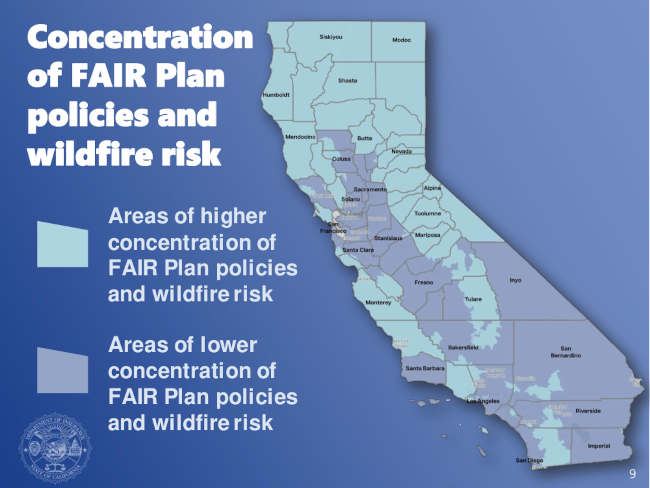
As part of Wednesday’s announcement, the Insurance Department released a statewide map that it developed showing areas where wildfire risk and FAIR Plan policies are concentrated.
Lake County is shown as one of the areas with a higher concentration of both risk and FAIR plan policies.
Lake also is No. 12 on a preliminary list of 28 distressed counties for which Lara is seeking insurer commitments for increased policy writing.
The county’s commercial and residential ZIP codes also are on separate preliminary lists of undermarketed ZIP codes for insurer commitments.
With this map, insurance companies will have direct knowledge of where they need to write more policies in the state in order to utilize catastrophe modeling in their rates that are subject to department approval.
The department took a hybrid approach due to the state’s large population and complex geography.
It used insurance data first to identify ZIP codes in areas of wildfire hazard where more than 15% of policies are written by the California FAIR Plan, the state's insurer of last resort, as well as ZIP codes where incomes are low and but insurance premiums are high, namely above $4 per $1,000 of coverage.
To be more inclusive, the department also identified counties where greater than 20% of policies are considered high risk by a review of that county’s aggregate fire risk scores.
Finally, as part of new growth benchmarks, insurance companies must take FAIR Plan policies facing wildfire risk from more urban areas.
The map aligns with recent work by Cal Fire identifying fire hazard zones where mitigation resources are targeted, thus amplifying those efforts. The department will update this information from time to time but no less than once every year.
“This type of coordination and alignment between state agencies is a critical part of our success in preparing communities for wildfire,” said State Fire Marshal Daniel Berlant. “Commissioner Lara’s work aligns with Cal Fire’s wildfire mitigation efforts and builds on major investments the state is making to protect residents.”
Insurance companies must write more policies
This hybrid approach enacts an agreement that Commissioner Lara reached with insurance companies last year to cover at least 85% of properties in distressed areas.
The new regulatory text also recognizes the complexity of California’s insurance marketplace which is made up of large and small companies, including some serving geographical regions with fewer homes at risk of wildfires.
Larger insurance companies with a major presence in distressed areas will need to write no less than 85% of properties within two years of a rate filing being adopted and report their progress to the Department.
Companies already meeting the threshold will be required to maintain those policies in force for three years. Smaller companies, new entrants, and companies that largely write outside of wildfire risk areas and cannot meet the 85% requirement will need to expand their writings by at least 5%.
Companies will be able to craft plans subject to the department’s review and approval that expand policy writing in areas of wildfire risk anywhere in the state, helping all parts of California benefit from greater insurance options.
Commercial insurance companies will need to increase coverage by 5% in wildfire distressed ZIP codes statewide, which will increase coverage options for farms and wineries, homeowners and condo associations, and other businesses.
“California Farm Bureau members applaud Commissioner Lara's continued commitment to restore competition to the insurance market by bringing insurers back to write residential and commercial policies in our state,” said Shannon Douglass, president of the California Farm Bureau. “Competition is the first step to guide the market to a place where pricing reflects ongoing wildfire mitigation efforts undertaken by Californians, including by our farmers and ranchers who work to remove fuels and safeguard properties. Our productive agricultural lands provide important buffers that can reduce the risk of catastrophic fire events. We hope our members can obtain comprehensive, affordable coverage through improved insurance offerings that recognize their contributions to protecting California from wildfires.”
Continued progress toward enacting transformative insurance reforms
The regulatory text that Commissioner Lara announced Wednesday is part of his strategy enabling insurance companies to use “forward-looking” catastrophe modeling in rate making when they commit to writing and maintaining more policies.
This is a companion to draft text that he released in March before receiving public input at an April workshop.
Following the public workshop on June 26, the department will review public input before issuing the full catastrophe modeling regulation for adoption by year end.
Commissioner Lara detailed another part of his strategy in February when he published a “complete rate application” regulation that creates clarity in the rate review process for all participants.
This regulation is a critical part of reducing unnecessary delays that can cause rate filings to take more than a year. It holds insurance companies accountable for providing the complete information that the department needs to make informed and timely decisions on these filings, and also helps prevent delays caused by intervenors raising issues not relevant to the rate review process.
The department plans to introduce another major part of the strategy with proposed regulation text in July to allow insurance companies that take on greater risks in California to incorporate a reinsurance cost component in their rate filings to cover those risks.
That same month, Commissioner Lara also plans to require the FAIR Plan to increase coverage to $20 million per structure for larger homeowners’ associations, condo associations, farms, and other businesses. He also will require the FAIR Plan to have a sounder financial sustainability structure.
“We have been surviving with 20th century regulations for 21st century problems. We are compressing decades of deferral and delay into a one-year timeline of action,” Lara told the Assembly Insurance Committee on May 15. “We have to remain flexible. We have to be responsive. The lesson of the past is that we cannot be locked into another 30 years of stagnant regulations.”
Headache, chills, tiredness may be evidence of a supercharged defense, according to UCSF-led study.
Fewer than 1 in 4 people in the U.S. have received last year’s updated COVID-19 vaccine, despite a death toll of more than 23,000 Americans this year.
One of the most common reasons for bypassing the COVID vaccine is concern about side effects like tiredness, muscle and joint pain, chills, headache, fever, nausea and feeling generally unwell.
But a new study, led by UC San Francisco, has found that the symptoms indicate a robust immune response that is likely to lessen the chances of infection.
The study, which appears online June 10 in Annals of Internal Medicine, is based on symptom reports and antibody responses from 363 people, who had the Pfizer-BioNTech or Moderna mRNA vaccines when they were first introduced.
After the second dose of the vaccine, the researchers found that those with seven or more symptoms had nearly double the antibody levels of those who did not have symptoms. The participants were mainly in their forties to sixties and had not had the virus.
About 40% of the people in the study also wore a device to monitor their temperature, breathing and heart rate. The researchers found that those whose skin temperature increased by 1 degree Celsius after the second dose had three times the antibody levels six months later, compared to those whose temperature did not increase.
An absence of side effects does not mean the vaccine is not working
“Generally, we found that the higher the number of side effects, the higher the level of antibodies,” said first author Ethan Dutcher, MD, PhD, a postdoctoral researcher in the UCSF Department of Psychiatry and Behavioral Sciences, and the Weill Institute for Neurosciences. “But this wasn’t a hard rule: some people without side effects had better antibodies than some people with side effects.”
As the virus has evolved and fatality rates have fallen, many people are underestimating its impact.
“The toll of COVID is still high for some – sickness, lost work, lasting fatigue and the dreaded long COVID,” said co-senior author Elissa Epel, PhD, a vice chair in the UCSF Department of Psychiatry and Behavioral Sciences. “While the symptoms from vaccination can be very unpleasant, it’s important to remember that they don’t come close to the disease’s potential complications,” she said.
“With COVID-19 vaccines likely here to stay, identifying what predicts a strong antibody response will remain important,” said co-senior author Aric Prather, PhD, professor in the UCSF Department of Psychiatry and Behavioral Sciences.
The latest recommendations from the Centers for Disease Control and Prevention are that everyone 6 months and older should receive the updated vaccine, and those 65 and older should receive an additional dose.
Co-Authors: Ashley Mason, PhD, and Frederick Hecht, MD, of UCSF; James E. Robinson, MD, of Tulane University; and Stacy Drury, MD, PhD, of Tulane University and Boston Children’s
Hospital.
Funding: National Institutes of Health (R24AG048024, 5U24AG066528 and U54CA260581).
Disclosures: Epel is on the scientific advisory boards of Meru Health and Oura Health. Mason has receiving consultancy fees from Oura Health. Prather is an advisor to NeuroGeneces and L-New Co.
Suzanne Leigh writes for UCSF.

LAKEPORT, Calif. — After a decade and a half of delays and financial challenges, the construction of a new courthouse in Lakeport is about to begin.
The Lake County Superior Court reported that the working drawings phase of the new Lakeport courthouse project is now complete.
With that key phase finished, the drawings for the project will soon be submitted for final permits, court officials said.
That will clear the way for construction, which court officials said is anticipated to begin this summer — pending environmental regulatory approval.
The new $83.8 million facility will be built at 675 Lakeport Blvd.
The Judicial Council of California purchased the site in 2010 for $1.1 million following what the agency said was “a lengthy site selection process,” which included input from justice partners, local government and the public.
The new building will include four courtrooms, a jury assembly room, self-help center,
attorney/client meeting rooms, and on-site parking with solar generation. Court officials said it will be a safe, secure and fully accessible building, with 45,300 square feet of space.
The main court facility in Lakeport is now located on the fourth floor of the courthouse at 255 N. Forbes St. There, the courts have 15,332 square feet; they also lease a separate space for records storage.
The crowded conditions at the Lakeport Courthouse placed the need for a new courthouse in the Trial Court Capital Outlay Plan's “Immediate Need Project Priority Group” in 2009.
Since then, the project hit headwinds due to the financial impacts of the Great Recession, which stalled many such projects.
However, in 2019 it was placed back at the top of the courthouse project list, and has continued to rank at the top of the statewide list of projects most in need of replacement based on significant overcrowding, security concerns and accessibility challenges.
Also on that list, at No. 6, is a new courthouse for the city of Clearlake.
The Superior Court reported that the project originally was approved in the 2021-22 fiscal year budget.
If construction is underway this summer, the Judicial Council said the project is anticipated to be completed in early 2026.
The Judicial Council reported that Lakeport’s new courthouse project is the first in the construction program to utilize the design build method, which calls for one entity, the design build team, to work on a project from concept to completion.
Email Elizabeth Larson at

MIDDLETOWN, Calif. — Chanele Hellwege has been named the grand marshal for the 2024 Middletown Days parade.
Known for her unwavering dedication to family and community, event organizers said Hellwege epitomizes the spirit of Middletown, making her a fitting choice for this honor.
“Chanele Hellwege represents the heart and soul of Middletown,” the Middletown Days Committee said in its announcement about her selection. “Her dedication to her family, her business, and her community is truly inspiring. We are thrilled to honor her as our grand marshal.”
She is a young mother of six children and the life partner of Dan Knudsen. The couple share their dream home on a stunning 56-acre ranch in Anderson Springs, lovingly built by Dan.
Their bustling household is filled with joy, hard work, and the satisfaction of creating a nurturing environment for their children.
Over the past five years, Chanele Hellwege has transformed a small shipping venture into a thriving business, Middletown Mail & More.
Catering to the diverse needs of Middletown and Lake County residents, her business has become an essential local hub.
Hellwege’s entrepreneurial journey began under the mentorship of Margaret Greenley, whose guidance helped her turn a simple idea into a successful enterprise. Hellwege saw a need and filled it.
She is deeply embedded in the community fabric, actively participating in the Middletown Area Merchants Association. This group is instrumental in organizing cherished local events such as Christmas in Middletown, Movie in the Park and Career Day at the high school.
Hellwege's commitment to these activities underscores her belief in community involvement. “If everyone does one thing for our community, it will continue to be a better place,” she said, emphasizing her philosophy of collective effort.
Her dedication extends to local education initiatives as well. She and Dan played pivotal roles in starting the school garden at Minnie Cannon Elementary and were instrumental in building the school’s playground. These contributions reflect their deep-seated belief in improving community resources and fostering a nurturing environment for future generations.
Raised in a family with a strong work ethic, Hellwege's roots in Lake County run deep.
She is one of five siblings, all of whom were brought up in the well drilling business — a family tradition that her brother, Khrom Hellwege of JAK, continues today.
Chanele Hellwege, a graduate of Kelseyville High School, has always valued the importance of hard work and community spirit, principles instilled in her from a young age.
As grand marshal, Hellwege will lead the Middletown Days parade, an event that brings together residents and visitors to celebrate local heritage and community spirit.
Organizers said her selection as grand marshal is a testament to her impactful contributions and the admiration she has garnered from her fellow residents.
Hellwege’s guiding philosophy, "You get more out of life by saying 'Yes'," continues to inspire those around her.
Her story is a powerful reminder of what can be achieved with dedication, hard work and a commitment to community.
“As she leads the parade, Chanele stands as a beacon of the values that make Middletown a wonderful place to live and thrive,” the Middletown Days Committee said in its announcement.
LAKE COUNTY, Calif. — On Tuesday the Board of Supervisors made another key department head appointment, this time selecting the new director of Water Resources.
Pawan Upadhyay, PhD, will take over the position on July 1, the county of Lake reported.
“I am excited to get started, and grateful for the support of the Board of Supervisors,” said Upadhyay. “Clear Lake is Lake County’s defining feature, and it must be thoughtfully managed. Further, few communities present similar opportunities to deepen our collective understanding of how water resources contribute and respond to broader ecological trends. This is a special opportunity, and I look forward to contributing as Water Resources director.”
Dr. Upadhyay most recently served as Water Resources director for the Shoshone-Paiute Tribes in Owyhee, Nevada.
There, he managed a $10 million annual budget and supervised 24 staff, while providing executive-level oversight of water resources, including management of irrigation water data, water supply assessment and projection of future water demand.
Prior to that leadership position, Upadhyay held research, data modeling and geographic information systems-focused roles with the University of Kansas, Mississippi State University and Iowa State University.
The county said multi-disciplinary scholarly works to which he has contributed have become influential, garnering hundreds of citations.
“We trust that Dr. Upadhyay has the ability to bring the data-driven leadership necessary to assess and respond to our water needs and challenges in Lake County,” said Bruno Sabatier, chair of the Lake County Board of Supervisors. “With the depth of his expertise in water related issues, including water quality, we are grateful he has chosen Lake County as his next step in his career joining a team with tremendous strengths and passions for everything water.”
Upadhyay succeeds Scott De Leon, who has concurrently served as Public Works and Water Resources director, and is retiring following nearly 23 total years of county service, including 14 years in director-level roles.
Last month, the board hired Glen March for the Public Works director job, as Lake County News has reported.
Pawan Upadhyay, PhD, will take over the position on July 1, the county of Lake reported.
“I am excited to get started, and grateful for the support of the Board of Supervisors,” said Upadhyay. “Clear Lake is Lake County’s defining feature, and it must be thoughtfully managed. Further, few communities present similar opportunities to deepen our collective understanding of how water resources contribute and respond to broader ecological trends. This is a special opportunity, and I look forward to contributing as Water Resources director.”
Dr. Upadhyay most recently served as Water Resources director for the Shoshone-Paiute Tribes in Owyhee, Nevada.
There, he managed a $10 million annual budget and supervised 24 staff, while providing executive-level oversight of water resources, including management of irrigation water data, water supply assessment and projection of future water demand.
Prior to that leadership position, Upadhyay held research, data modeling and geographic information systems-focused roles with the University of Kansas, Mississippi State University and Iowa State University.
The county said multi-disciplinary scholarly works to which he has contributed have become influential, garnering hundreds of citations.
“We trust that Dr. Upadhyay has the ability to bring the data-driven leadership necessary to assess and respond to our water needs and challenges in Lake County,” said Bruno Sabatier, chair of the Lake County Board of Supervisors. “With the depth of his expertise in water related issues, including water quality, we are grateful he has chosen Lake County as his next step in his career joining a team with tremendous strengths and passions for everything water.”
Upadhyay succeeds Scott De Leon, who has concurrently served as Public Works and Water Resources director, and is retiring following nearly 23 total years of county service, including 14 years in director-level roles.
Last month, the board hired Glen March for the Public Works director job, as Lake County News has reported.
LAKE COUNTY, Calif. — The Lake County Sheriff’s Office has released the name of the West Sacramento man killed in a Saturday evening ATV wreck that also injured his son.
Sheriff’s spokesperson Lauren Berlinn identified the man who died as a result of the crash as Yan Gilmeev, 41.
At around 7:20 p.m. Saturday Gilmeev was riding an ATV along Bartlett Springs Road near Forest Route 15 with his 13-year-old son when the ATV rolled off the roadway, the CHP said.
The CHP said both Gilmeev and his son were thrown from the ATV, and Gilmeev died of his injuries.
Gilmeev’s son was injured but managed to walk to the road, where he was picked up shortly after 9 p.m.
The teen was later flown out of the county for treatment of his injuries, the CHP said.
Email Elizabeth Larson atThis email address is being protected from spambots. You need JavaScript enabled to view it. . Follow her on Twitter, @ERLarson, or Lake County News, @LakeCoNews.
Sheriff’s spokesperson Lauren Berlinn identified the man who died as a result of the crash as Yan Gilmeev, 41.
At around 7:20 p.m. Saturday Gilmeev was riding an ATV along Bartlett Springs Road near Forest Route 15 with his 13-year-old son when the ATV rolled off the roadway, the CHP said.
The CHP said both Gilmeev and his son were thrown from the ATV, and Gilmeev died of his injuries.
Gilmeev’s son was injured but managed to walk to the road, where he was picked up shortly after 9 p.m.
The teen was later flown out of the county for treatment of his injuries, the CHP said.
Email Elizabeth Larson at