 How to resolve AdBlock issue?
News
LAKE COUNTY, Calif. – The State Water Resources Control Board is holding a series of meetings around the state to discuss proposed new rules for septic tanks.
The next meeting will take place from 1 p.m. to 4 p.m. and from 6 p.m. to 9 p.m. Wednesday, Nov. 2, at the Wells Fargo Center's Ruth Finley Person Theater, 50 Mark West Springs Road, Santa Rosa.
The state's previous attempt to draft new septic tank rules in 2009 was greeted with protests from landowners around the state because of the costs and requirements, causing the state to redraft the guidelines, as Lake County News has reported.
The draft guidelines outline four septic tank system levels:
Tier 0: Existing system, in good working order, not included in a total maximum daily load implementation – or TMDL – program, more than 600 feet from specifically identified nitrate-impaired water bodies and more than 100 feet from a specifically identified pathogen-impaired water bodies.
Tier 1: System is not installed or needs to be replaced, and local agency does not have an approved Tier 2 program.
Tier 2: System is not installed or needs to be replaced, and local agency has an approved Tier 2 program.
Tier 3: New or existing system is included in TMDL program and must comply with it, or where there is no TMDL in place and an existing system is located within 600 feet from a specifically identified nitrogen-impaired body or within 100 feet from a specifically identified pathogen-impaired body; or where no TMDL is in place and a new system is within 600 feet of any nitrogen- or pathogen-impaired body.
Tier 4: Existing system is failing and found to be polluting groundwater or surface water to a degree that it affects drinkability or other beneficial uses. System must be modified or upgraded as appropriate to the situation.
The water board has created a mapping tool to help property owners determine how they may be affected by the new rules, which can be found at http://gispublic.waterboards.ca.gov/webmap/owts/owtsmap.html.
If a property is not within 2,000 feet of a nitrogen- or pathogen-impaired water body, the mapping tool's explanation says it is “likely” that a property owner only will need to consult a local permitting agency for what requirements they have to meet if their system fails, or they plan to upgrade or replace their system.
Clear Lake is not a nitrogen- or pathogen-impaired water body; however, it is under a TMDL for nutrients, according to state officials.
Under the new draft policy, there would not be mandatory solids or water well testing for every tank, and property owners wouldn't be required to provide operating manuals at the time of a property sale.
The estimated cost over 10 years for owners of existing, functioning septic tank systems not near impaired waters would be $0, whereas it was expected to cost as much as $1,000 under the 2009 proposed guidelines.
The state's draft septic tank rules says that only 2,755 of Lake County's 857,072 acres – or 0.3 percent – is suitable for septic tank absorption fields based on California soil surveys, one of the lowest percentages of the state's survey areas.
In comparison, in neighboring Sonoma County, soils on 61,451 acres – or 6.1 percent – of its approximately 1,010,560 acres are suitable for septic tank absorption fields, the report shows.
According to state estimates, about 15,000 Lake County homes have septic tanks, although Lake County Environmental Health Director Ray Ruminski told Lake County News in a previous interview that his agency does not have a precise county on just how many homes in the county use septic tanks.
E-mail Elizabeth Larson at
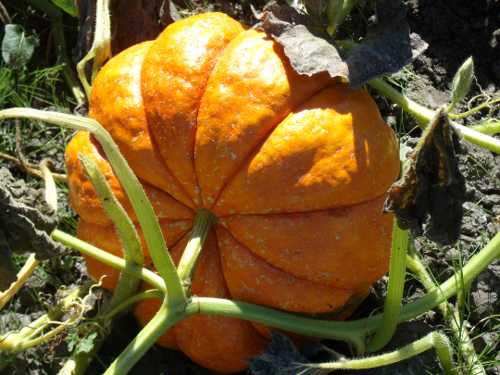
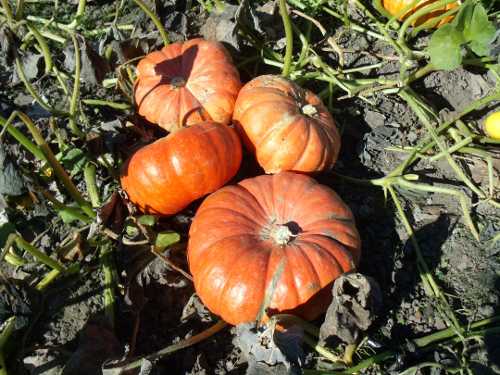
After yesterday’s final farmers’ market of the season, I walked through soil and frost-bitten leaves to photograph pumpkins for today’s column at a local farm, Leonardis Organics in Kelseyville, Calif.
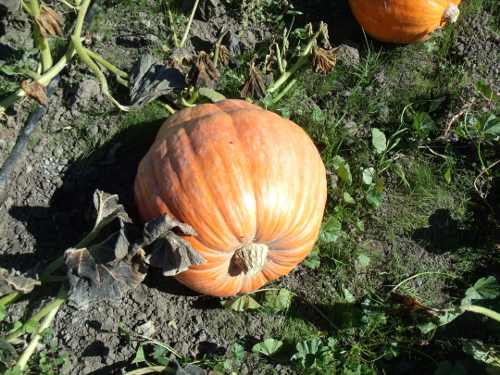
The result of the season’s first frost is that these mostly orange orbs were exposed in the field, no longer hidden by their large living leaves.
Pumpkins and other winter squash will ripen off the vine, so those that are not quite ripe when their vine dies will continue to develop color and flavor, both in the field and after they’re picked.
There are dozens of varieties of pumpkins and a fair number of them are represented in Leonardis’ crop, from large ones with thin flesh for carving Jack-O-Lanterns to small ones with sweet, dense flesh for pies.
Pumpkins are a type of winter squash and share a family tree with summer squashes, cucumbers, and gourds.
In other parts of the English-speaking world, such as Australia, the word “pumpkin” refers to any type of thick-skinned winter squash, rather than the orange-skinned varieties that are exclusively referred to by the moniker here in the United States.
The word itself has an interesting history. It originates from the Greek word for large melon, pepon, which the French adapted to pompon. The British morphed the French word into pumpion, and, finally, American colonists changed that to the word we know today, pumpkin.
The exact origin of pumpkin is not known, but they are believed to be native to North America. The oldest evidence for this are ancient pumpkin-like seeds found in Mexico that are estimated to be from sometime between 7000 to 5500 B.C.
The ancestor of today’s pumpkin was elongated with a crooked neck and was cultivated in ancient American cultures along creek banks in companion plantings with sunflowers and beans.
These pumpkin relatives were cultivated before maize, the ancestor of modern-day corn. Once maize became a staple crop, ancient farmers grew it with pumpkins and beans using a method known as the “Three Sisters.”
In this tradition, maize stalks served as trellises for the climbing beans, the beans provided stability for the maize and added nitrogen to the soil, and the squash plants sheltered the shallow roots of the corn and shaded the ground, which discouraged weeds and preserved moisture.
These Native American peoples relied on the pumpkin as a food source that sustained them through the winter. They utilized the entire fruit, including the flesh, which they roasted, baked, boiled, and dried; the seeds, which they ate and used medicinally; and the blossoms, which they added to stews.
In addition, the flesh which was dried was ground into flour, and pumpkin shells were dried for bowls and storage containers. Strips of dried pumpkin were even made into mats that could be used for trading.
Pumpkins are grown successfully on every continent save Antarctica. They’re enjoyed in cuisines throughout the world, including China, where, for example, the leaves are used as a vegetable or an ingredient in soup; India, where it’s used in a variety of regional cuisines and sometimes cooked with butter and spices; Thailand, where its flesh is used in curry dishes and small, custard-filled pumpkins comprise a dessert; the Middle East, where it’s enjoyed in sweet dishes; Japan, where it’s used in tempura; Mexico and the southwestern U.S, where the blossoms are enjoyed; Italy, where it stuffs ravioli and flavors beverages; and Kenya, where pumpkin flesh is boiled and the leaves are called seveve and used in popular dishes.
This list, of course, is partial, both in terms of the cuisines listed and the manner in which pumpkin is used, but it serves to show the diversity of ways pumpkin can be prepared. All parts of the pumpkin, its flesh, seeds, leaves, and blossoms, are edible.
Pumpkin seeds, also known as pepitas, are especially healthy. They may be slippery and hard to handle when scooped out of the hollow of a pumpkin, but they’re easily transformed into a delicious toasted snack.
Wash them to remove the bits of fiber that may be clinging to them and pat them dry. Toss them with a bit of oil, lightly salt them, and spread them out on a baking sheet.
Bake them in a low oven, about 250 degrees F, until they’re golden, crisp, and dry, which takes about an hour. Stir them every 10 minutes or so to prevent scorching.
Alternatively, they may be toasted on the stove top in a skillet or in a hotter oven. In both cases, they’ll cook much more quickly, but should be hovered over to prevent burning.
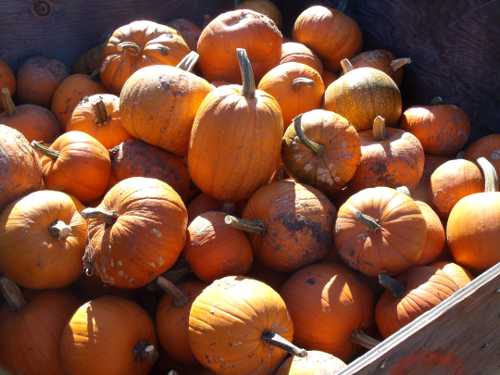
Canned pumpkin is quick and convenient for things such as pies, soups, or custards; however, when fresh squashes are available, a bit of effort will yield a lovely home-made puree. If doing this, be sure to use pumpkins that are intended for use in pies or cooking. Pumpkins grown for carving Jack-O-Lanterns have little flesh, and since they’re not bred for eating, the taste is inferior.
To make fresh pumpkin puree, cut a pumpkin into wedges of about 4 or 5 inches and brush the flesh sides with melted butter or olive oil. Arrange them flesh side down in a roasting pan and cover with aluminum foil.
Roast the pumpkin pieces in a 400 degree Fahrenheit oven until the flesh is very tender and may be pierced with a fork, about two hours, turning after the first hour. Remove the foil and let the pumpkin cool.
Once cool, discard any liquid that may have collected, scoop out pumpkin flesh, and puree in batches in a food processor. Transfer the puree to a large sieve or colander with several layers of cheesecloth set over a large bowl. Cover with plastic wrap and place in the refrigerator to drain at least 8 hours or overnight.
Pumpkin is low in calories and sodium, but high in fiber, and the seeds are rich in protein, iron, and B vitamins. The flesh has high stores of beta-carotene, an antioxidant that converts to vitamin A. Research has shown that beta-carotene is helpful in preventing heart disease and some cancers, and even helps delay the aging process.
Today’s recipe is adapted from the medley of roasted vegetables I offered in a culinary demo at yesterday’s Lake County Farmers’ Finest final market of the season. The original recipe utilizes butternut squash, but pumpkin will substitute well.
Use a small to medium-sized cooking pumpkin, cut it into wedges, and then cut into cubes. I find it’s easier to remove the outer skin by cutting it off once the pumpkin’s been cubed. Enjoy!
Roasted pumpkin with apples, onion, and crispy sage
About six cups of cubed fresh pumpkin, skin removed
3 large or 4 medium apples, any variety other than the most tart, peeled and cubed
2 large onions, peeled and cubed
20 or more fresh sage leaves, stems removed
Extra virgin olive oil, ½ cup to crisp sage plus more for roasting
Kosher salt and cracked black pepper
Toss the pumpkin, apple, and onion together in a large bowl with just enough olive oil to coat so each piece is glossy.
Spread mixture on a baking sheet (you may need more than one) and roast in a 400 degree F oven for an hour or so, stirring every 15 minutes, until cubes are fork tender and caramelized. Typically, they will be tender after 30 minutes, but will need to stay in longer to brown.
Meanwhile, heat olive oil over medium-high heat in a small saucepan on stovetop until hot. (It’s ready when a drop of water makes it sizzle.)
Throw in a few sage leaves in the hot oil and cook for a few seconds until crispy. (Be careful as oil may splatter!) The leaves are ready when their green color deepens and they become crisp. If they become brown, they lose flavor. Remove leaves to a paper towel to drain. Repeat until all leaves are crispy.
When roasting process is complete, turn roasted cubes into a large bowl. Crumble sage leaves over mixture and toss to combine. Taste and add more salt and/or pepper, if needed.
Serve warm as a side dish or at room temperature as an autumn salad.
Esther Oertel, the “Veggie Girl,” is a culinary coach and educator and is passionate about local produce. Oertel gives private cooking lessons. She welcomes your questions and comments; e-mail her at
Follow Lake County News on Twitter at http://twitter.com/LakeCoNews, on Tumblr at www.lakeconews.tumblr.com, on Facebook at http://www.facebook.com/pages/Lake-County-News/143156775604?ref=mf and on YouTube at http://www.youtube.com/user/LakeCoNews.

NASA's Messenger spacecraft has discovered strange hollows on the surface of Mercury.
Images taken from orbit reveal thousands of peculiar depressions at a variety of longitudes and latitudes, ranging in size from 60 feet to over a mile across and 60 to 120 feet deep.
No one knows how they got there.
“These hollows were a major surprise,” said David Blewett, science team member from the Johns Hopkins University Applied Physics Laboratory. “We've been thinking of Mercury as a relic – a place that's really not changing much anymore, except by impact cratering. But the hollows appear to be younger than the craters in which they are found, and that means Mercury's surface is still evolving in a surprising way.”
Mars Reconnaissance Orbiter spotted similar depressions in the carbon dioxide ice at Mars' south pole, giving that surface a "swiss cheese" appearance. But on Mercury they're found in rock and often have bright interiors and halos.
“We've never seen anything quite like this on a rocky surface,” said Blewett.
If you could stand in one of these “sleepy” hollows on Mercury's surface, you'd find yourself, like Ichabod Crane, in a quiet, still, haunting place, with a black sky above your head.
“There's essentially no atmosphere on Mercury,” explained Blewett. “And with no atmosphere, wind doesn't blow and rain doesn't fall. So the hollows weren't carved by wind or water. Other forces must be at work.”
As the planet closest to the Sun, Mercury is exposed to fierce heat and extreme space weather. Blewett believes these factors play a role.
A key clue, he said, is that many of the hollows are associated with central mounds or mountains inside Mercury's impact craters.
These so-called “peak rings” are thought to be made of material forced up from the depths by the impact that formed the crater. Excavated material could be unstable when it finds itself suddenly exposed at Mercury's surface.
“Certain minerals, for example those that contain sulfur and other volatiles, would be easily vaporized by the onslaught of heat, solar wind, and micrometeoroids that Mercury experiences on a daily basis,” Blewett said. “Perhaps sulfur is vaporizing, leaving just the other minerals, and therefore weakening the rock and making it spongier. Then the rock would crumble and erode more readily, forming these depressions.”
Messenger has indeed proven Mercury unexpectedly rich in sulfur. That in itself is a surprise that's forcing scientists to rethink how Mercury was formed.
The prevailing models suggest that either very early in Solar System history, during the final sweep-up of the large planetesimals that formed the planets, a colossal impact tore off much of Mercury's rocky outer layering; or a hot phase of the early Sun heated up the surface enough to scorch off the outer layers. In either case, the elements with a low boiling point – volatiles like sulfur and potassium – would have been driven off.
But they're still there.
“The old models just don't fit with the new data, so we'll have to look at other hypotheses,” said Blewett.
To figure out how the planets and Solar System came to be, scientists must understand Mercury.
“It's the anchor at one end of the Solar System,” said Blewett. “Learning how Mercury formed will have major implications for the rest of the planets. And Messenger is showing that, up to now, we've been completely wrong about this little world in so many ways!”
What other surprises does Mercury hold? The sleepy hollows of the innermost planet may be just the beginning.
Dauna Coulter works for the National Aeronautics and Space Administration.
Follow Lake County News on Twitter at http://twitter.com/LakeCoNews, on Tumblr at www.lakeconews.tumblr.com, on Facebook at http://www.facebook.com/pages/Lake-County-News/143156775604?ref=mf and on YouTube at http://www.youtube.com/user/LakeCoNews .
The lifting of the suspension is effective Monday, Oct. 31, at 8 a.m.
Until fire season has been declared closed by Unit Chief Tim Streblow all burn piles in the State Responsibility Area must be inspected by Cal Fire personnel, prior to ignition.
The recent wet weather has alleviated the dry fuel conditions which triggered the permit suspension earlier in the summer, Cal Fire reported.
“Although the suspension has been lifted, permits are still required, and that despite the welcomed rainfall, a period of dry windy condition could dry fuels to the point where wild land fires are possible,” said Unit Chief Tim Streblow.
With the lifting of the burn suspension in State of Responsibility Areas, residents who hold a Cal Fire permit may resume burning, subject to the regulations of their local fire departments and air quality districts. Burn restrictions still exist in areas of the unit.
Check with you local fire official prior to burning, or call Lake County Air Quality Management District, 707-263-7000.
Property owners who burn outside of the regulations, or allow a fire to escape, may be subject to citations by Cal Fire.
Follow Lake County News on Twitter at http://twitter.com/LakeCoNews, on Tumblr at www.lakeconews.tumblr.com, on Facebook at http://www.facebook.com/pages/Lake-County-News/143156775604?ref=mf and on YouTube at http://www.youtube.com/user/LakeCoNews .
John Wesley Dunn, 27, received the not guilty verdict on one count of rape on Thursday.
“The jury saw and heard all the evidence and we are grateful to the them for seeing through this accuser and for finally vindicating Mr. Dunn with the not guilty verdict. They heard Mr. Dunn testify and they heard the accuser testify and they saw the truth of this case,” said his attorney, Stephen Carter, of the Law Offices of Carter & Carter in Lower Lake.
Prosecutor Ed Borg could not be reached for comment on Friday.
Dunn was arrested on Aug. 7, 2009, for rape, kidnap with intent to commit rape and assault with the intent to commit rape after a 25-year-old Hidden Valley Lake woman who was a casual acquaintance accused him of sexually assaulting her, according to the original sheriff's report.
Following Dunn's December 2009 preliminary hearing, the additional charges were dropped due to insufficient evidence, but the prosecution was allowed to pursue the rape charge, as Lake County News has reported.
The woman who made the allegations to sheriff's officials claimed that she did not remember anything that happened because she was too intoxicated from drinking at Twin Pine Casino the evening before, on July 31, 2009.
According to testimony, the woman pulled Dunn onto the dance floor at the casino and began “freak dancing,” and she reportedly begged him to leave the casino and have sex with her. Dunn took her home and they exchanged amicable texts the next day, but later – after her young child's birthday party – she contacted authorities to report that she had been raped.
Evidence presented at trial included a casino surveillance video that showed Dunn carrying the woman to his car. Carter demonstrated to the jury – based on additional casino video – that the woman and Dunn walked to his car after he carried her a short way, at her request, because her feet hurt from dancing in heels all night and she had removed her shoes. The jury viewed this video again during deliberations.
The woman also was unable to recall the sex act itself or whether or not she asked to have sex with Dunn, according to testimony.
While the prosecution argued that the woman was too intoxicated to consent to sex, the defense countered that there was no reliable evidence of her intoxication level or Dunn's, and that they were consenting adults.
“Is it rape when two intoxicated people have sexual relations? If so, how is it determined which one raped the other?” Carter asked.
When he initially was arrested and charged, Dunn – who has no criminal record – was facing life in prison, and he was held on $350,000 bail.
However, after three weeks in jail and following a lengthy bail hearing on Aug. 28, 2009 – in which 15 friends and community members stepped forward to testify to his character – Dunn was released on his own recognizance.
Since then, Dunn and his family have faced numerous hardships because of the case, according to his attorney.
Dunn, who was the assistant golf pro at the Hidden Valley Lake Golf Course at the time of his arrest, lost his job as a result of the case. Likewise, his father – who shares the same name – also lost his job because of the allegations against his son, Carter said.
Carter said Dunn should have never been arrested or changed with anything.
He added that there was no evidence of anything resembling rape on Dunn's part.
“This case is government overreaching at its absolute worst,” Carter said.
E-mail Elizabeth Larson at

LUCERNE, Calif. – Community members are invited to a special town hall meeting in Lucerne on Thursday, Nov. 17.
District 3 Supervisor Denise Rushing will host the gathering, which begins at 4:30 p.m. in the main hall of the historic Lucerne Hotel – also known as “The Castle – located at the end of 13th Avenue and Country Club Drive.
Topics will include community redevelopment status, county projects and issues, an update on the Lucerne Hotel, the new Lake County Mental Health offices on 13th Avenue, a law enforcement update and an open forum.
Free tables will be set up for local groups, businesses or organizations wishing to distribute literature.
For more information, contact 707-263-2368 or email
Follow Lake County News on Twitter at http://twitter.com/LakeCoNews, on Tumblr at www.lakeconews.tumblr.com, on Facebook at http://www.facebook.com/pages/Lake-County-News/143156775604?ref=mf and on YouTube at http://www.youtube.com/user/LakeCoNews .