 How to resolve AdBlock issue?
News
“Be patient and attentive while traveling on the roadways this holiday season,” said CHP Commissioner Joe Farrow. “People are eager to see friends and loved ones, but it’s important to get to your destination safely.”
The CHP will be keeping a watchful eye on the motoring public as they head out on their road trips during the Thanksgiving Maximum Enforcement Period (MEP), which begins Wednesday, Nov. 23 at 6:01 p.m. and continues through Sunday, Nov. 27 at 11:59 p.m.
This MEP coincides with the “Click It or Ticket” seat belt enforcement campaign which begins tomorrow in California.
“Our goal is to encourage motorists to make safe choices to prevent tragedies,” said Commissioner Farrow.
The CHP reminds all motorists to buckle up, observe the speed limit and not to drink and drive.
During the 2010 Thanksgiving weekend, 21 people were killed in collisions throughout California.
Among the five vehicle occupants killed in CHP jurisdiction, one person was not wearing a seat belt.
It’s also important to remember to designate a non-drinking driver before the celebration begins.
Last year during the Thanksgiving holiday, CHP made 1,546 arrests for driving under the influence, a nearly 6 percent increase from the same time the previous year.
“Whether it’s impaired or distracted driving, speeding because you’re in a hurry or you forget to buckle up, a careless decision made in an instant can hurt a family for a lifetime,” added Farrow.
Follow Lake County News on Twitter at http://twitter.com/LakeCoNews, on Tumblr at www.lakeconews.tumblr.com, on Facebook at www.facebook.com/pages/Lake-County-News/143156775604?ref=mf and on YouTube at www.youtube.com/user/LakeCoNews .
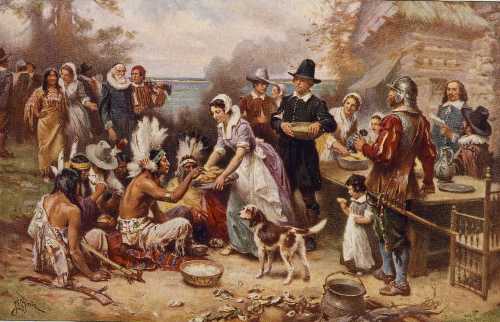
Hello, readers! This Thursday is Thanksgiving, and in honor of the holiday, I thought it would be fun to look back on a column I wrote last year at this time about the evolution of the Thanksgiving meal. I enjoyed digging up these facts and learned a lot when I researched it.
Several months after I wrote it, I discovered quite by chance that the column was picked up by a newspaper in Plymouth, Massachusetts, which means what you’re about to read has also been read by those who live near the site of the first Thanksgiving meal.
I’ve kept the recipe I offered last year, a colonial recipe for pumpkin pie, and have added another, my own pumpkin-apple soup. That way you’ll have recipes to open and close your Thanksgiving dinner, should you want to try them.
Sit back, relax, and enjoy the column … and most of all, I hope you have a wonderful Thanksgiving!
In four days, most of us will be celebrating the quintessential American holiday, Thanksgiving. Roasted turkey with stuffing, bowls of sweet and white potatoes, gravy, cranberry sauce, and pumpkin pies will fill our tables.
While we consider this delicious fare traditional for the Thanksgiving feast, the truth is that what we serve on this day has evolved over time. What the Pilgrims and Indians ate in 1621 New England bears little resemblance to what we serve today.
In 1841, more than 200 years after what we now refer to as “the first Thanksgiving,” New England historian Alexander Young discovered a letter from Edward Winslow, one of the original colonists, mentioning the 1621 feast. It was Young that gave that feast the moniker mentioned above.
Winslow describes four hunters killing enough fowl to feed the camp for a week. While turkey was plentiful in North America – and eaten by the colonists and Wampanoag Indians – it’s speculated that the “fowl” mentioned in the letter consisted of seasonal waterfowl such as ducks and geese.
Turkey eventually became the fowl of choice on Thanksgiving menus, but not right away. A menu for a New England Thanksgiving dinner circa 1779 mentions roast turkey, but only as one of the meats offered at the meal, not as the star. Also listed are venison, pork, pigeon, and goose. In contrast, this year more than 240 million turkeys will have been raised as the mainstay of our Thanksgiving dinners.
What about the stuffing? Historians tell us that the practice of stuffing the cavities of fowl and other animals with mixtures of breads, spices, and other items is ancient. Romans and Arabs employed this cooking technique. The terms “stuffing” and “dressing” as they relate to cookery derive from Medieval European culinary practices.
The English settlers and Wampanoag did occasionally stuff birds and fish, but if stuffing was used, it likely consisted of herbs and onions, rather than bread.
Any cranberries served at the harvest celebration were likely only in Wampanoag dishes. They enjoyed them raw or sweetened with maple sugar. It would be 50 years before an Englishman mentioned boiling this New England berry with sugar for a “sauce to be eaten with … meat.” Since sugar was expensive in England in 1621, it’s quite possible that there was not any of this imported sweet in New Plymouth at that time.
Today turkey and cranberries are a much-loved food marriage.
The tradition of serving fruit with meat, particularly citrus fruit with fatty meat, goes back thousands of years, likely originating in the Middle East. Examples are found in many cultures and cuisines. The acid in the fruit cuts the fat in the meat. In the case of lean meats such as turkey and chicken, cranberries add flavor to what is generally considered a bland food.
Other classic meat and fruit combos include pork and applesauce, goose and cherry sauce, fish and lemon and duck l’orange.
It’s hard to imagine Thanksgiving without mashed potatoes, but the original feast didn’t include them. Potatoes, which originated in South America, had made their way across the Atlantic to Europe, but had not been generally adopted into the English diet.
The potato was virtually unknown there in the 17th century. At that point they were not included in the diet of the Wampanoag Indians, either (though they did eat other varieties of local tubers).
Today’s Thanksgiving meals typically include a version of a sweet potato (or yam) dish, but that wouldn’t have been included in the original harvest meal.
The sweet potato, which originated in the Caribbean, had also made its way to Europe, but was rare and available only to the wealthy.
King Ferdinand and Queen Isabella of Spain liked them and had them planted in their court gardens. Their nephew, King Henry VII of England, liked them as well, and considered them to be an aphrodisiac.
Yams are native to Africa and are often confused with sweet potatoes. Most sweet potato dishes – pies included – are just as successfully made with yams.
Like the white potato, neither yams nor sweet potatoes were part of the diet of the Wampanoag Indians or, for the most part, the English at the time of the first feast.
Have you ever wondered why marshmallows are so often paired with sweet potatoes on the Thanksgiving table?
During the late 19th and early 20th centuries, marshmallows were very trendy. They were mass produced, plentiful, and very inexpensive, and were aggressively marketed by the companies that manufactured them.
The earliest recipes found pairing marshmallows and sweet potatoes date to the 1920s. There were typically casseroles where marshmallows were layered with the potatoes. To a lesser extent, they were also paired with candied yams.
Often signature dishes from the 1920s were very sweet, and some historians speculate that this is a reaction to Prohibition.
Pumpkin, native to the New World, was likely available as part of the harvest feast, but not in the form of pie. It may have been baked, possibly by placing it in the ashes of a dying fire, then mixed with animal fat, maple syrup, or honey, and made into a soup, a common way of using it by American Indians.
As for our beloved Thanksgiving pumpkin pie, recipes for stewed pumpkin tempered with sugar, spices, and cream wrapped in pastry have roots in Medieval times, when similar pies were made with squash and gourds.
Corn was part of the earliest Thanksgiving feast, though it was hard Indian corn, unlike the corn we know today.
American Indians were cooking with corn long before European settlers arrived, and the English colonists learned to grind it for use in breads, pancakes, porridge, and puddings as a substitute for the grains they were used to.
While we don’t know exactly what was served at the first Thanksgiving, historians can be pretty certain about it included at least some of the bounty available to them, such as cultivated parsnips, carrots, collards, turnips, parsley, spinach, cabbage, sage, thyme, onions and marjoram, as well as native cranberries, pumpkin, nuts, grapes, lobster, oysters and other seafood.
In the spirit of the colonial U.S., I’ll leave you with a modern interpretation of Abigail Adams’ Pumpkin Pie, courtesy of “The Thirteen Colonies Cookbook” by Mary Donovan, et al, as well as a more modern recipe, my own “Thanksgiving Pumpkin Soup with Apples and Sage.” Enjoy!
Abigail Adams' Pumpkin Pie
1 1/2 cups pumpkin
3/4 cup brown sugar, firmly packed
1/2 teaspoon fresh ginger root, grated
1 teaspoon freshly grated nutmeg
1/2 teaspoon salt
1 cup heavy cream
3/4 cup milk
1/4 cup dark rum, or brandy
3 eggs, lightly beaten
Pecans
Whipped cream
10-inch pie shell, unbaked
Mix all ingredients together and our into the prepared pastry shell. Bake at 425 degrees Fahrenheit for 10 minutes. Reduce heat to 350 degrees F and bake for 40 minutes more, or until a knife inserted in center comes out clean. Garnish with pecans and whipped cream flavored with rum or brandy.
Thanksgiving pumpkin soup with apples
2 tablespoons extra virgin olive oil
1 tablespoon butter (unsalted preferred)
1 medium yellow onion, peeled and diced
4 sweet, flavorful apples (such as Fuji), peeled, cored, and diced
2 large garlic cloves, peeled and minced
1 quart vegetable or chicken broth
1 large (29 ounce) can pure pumpkin
1 cup apple juice (unfiltered preferred)
1 teaspoon salt
½ teaspoon nutmeg
½ cup half and half
Heat olive oil and melt butter in a Dutch oven or large stockpot.
Add onions and apples and cook over medium heat until tender and caramelized to a golden brown color, about 15 to 20 minutes, stirring to prevent burning.
Add garlic and cook a minute longer, stirring to prevent burning.
Add about a cup of broth to deglaze pot, stirring to pick up caramelized bits of apple and onion. Add the rest of the broth and the pumpkin and stir to combine.
Bring to a boil, then reduce heat and simmer for about 10 minutes, stirring to prevent burning. Remove from heat.
Puree the soup in batches in a blender until smooth, being sure not to overfill blender. (Note: Be sure blender lid is sealed well and hold it tight with a towel when blending soup. Hot liquids in a blender can cause the lid to blow off.)
Return soup to pot over low heat to keep warm. Add apple juice, nutmeg, and salt and stir to combine. Taste and adjust seasonings, if necessary.
Just before serving, add half and half and stir to combine.
This makes over two quarts of soup, plenty for six to eight servings.
Recipe by Esther Oertel.
Esther Oertel, the “Veggie Girl,” is a culinary coach and educator and is passionate about local produce. Oertel gives private cooking lessons. She welcomes your questions and comments; e-mail her at
Follow Lake County News on Twitter at http://twitter.com/LakeCoNews, on Tumblr at www.lakeconews.tumblr.com, on Facebook at http://www.facebook.com/pages/Lake-County-News/143156775604?ref=mf and on YouTube at http://www.youtube.com/user/LakeCoNews.
How can a world without air have an ionosphere? Somehow the Moon has done it.
Lunar researchers have been struggling with the mystery for years, and they may have finally found a solution.
But first, what is an ionosphere?
Every terrestrial planet with an atmosphere has one. High above the planet’s rocky surface where the atmosphere meets the vacuum of space, ultraviolet rays from the sun break apart atoms of air. This creates a layer of ionized gas – an “ionosphere.”
Here on Earth, the ionosphere has a big impact on communications and navigation.
For instance, it reflects radio waves, allowing shortwave radio operators to bounce transmissions over the horizon for long-range communications.
The ionosphere also bends and scatters signals from GPS satellites, sometimes causing your GPS tracker to misread your position.
The first convincing evidence for an ionosphere around the Moon came in the 1970s from the Soviet probes Luna 19 and 22.
Circling the Moon at close range, the orbiters sensed a layer of charged material extending a few tens of kilometers above the lunar surface containing as many as 1,000 electrons per cubic centimeter – a thousand times more than any theory could explain.
Radio astronomers also found hints of the lunar ionosphere when distant radio sources passed behind the Moon’s limb.
The idea of an “airless Moon” having an ionosphere didn't make much sense, but the evidence seemed compelling.
As a matter of fact, the Moon isn't quite as airless as most people think.
Small amounts of gas created by radioactive decay seep out of the lunar interior; meteoroids and the solar wind also blast atoms off the Moon's surface.
The resulting shroud of gas is so thin, however, that many researchers refuse to call it an atmosphere, preferring instead the term “exosphere.”
The density of the lunar exosphere is about a hundred million billion times less than that of air on Earth – not enough to support an ionosphere as dense as the ones the Luna probes sensed.
For 40 years, the Moon's ionosphere remained a mystery until Tim Stubbs of the Goddard Space Flight Center published a possible solution earlier this year.
The answer, he proposes, is moondust.
Stubbs – a 30-something scientist who wasn't even born when the Moon's ionosphere was discovered – read the accounts of Apollo 15 astronauts who reported seeing a strange glow over the Moon’s horizon. Many researchers believe the astronauts were seeing moondust.
The Moon is an extremely dusty place, naturally surrounded by a swarm of dust grains – think PigPen in Charlie Brown.
When these floating grains catch the light of the rising or setting sun, they create a glow along the horizon.
Stubbs and colleagues realized that floating dust could provide the answer. Ultraviolet rays from the sun hit the grains and ionize them.
According to their calculations, this process produces enough charge – positive grains surrounded by negative electrons – to create the observed ionosphere.
An ionosphere made of dust instead of gas is new to planetary science. No one knows how it will behave at different times of night and day or at different phases of the solar cycle, or how it might affect future radio communications and navigation on the Moon.
NASA's ARTEMIS probes, orbiting the Moon now, and the LADEE spacecraft, scheduled to launch in 2013 specifically for the purpose of studying the lunar exosphere, may yet reveal its habits.
Updates may be expected in less than 40 years.
Follow Lake County News on Twitter at http://twitter.com/LakeCoNews, on Tumblr at www.lakeconews.tumblr.com, on Facebook at www.facebook.com/pages/Lake-County-News/143156775604?ref=mf and on YouTube at www.youtube.com/user/LakeCoNews .
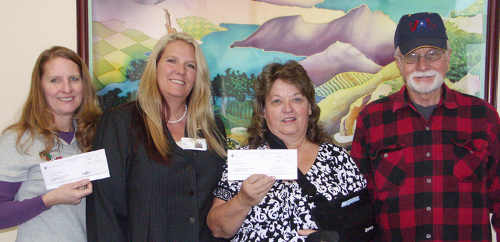
LAKE COUNTY, Calif. – Sutter Lakeside Hospital and Sutter Health have donated $5,000 to the Lakeport Free Kitchen and $5,000 to the Hunger Task Force of Lake County.
The funds are a portion of a $250,000 donation by the Sutter Health network to 29 food banks throughout Northern California, which will help provide more than a million healthy meals to families in need.
Food banks say that monetary donations help maximize the amount of food available for the hungry – in many instances, a $1 donation can translate to over $5 worth of distributed food.
“Many of our patients and neighbors are still struggling to afford healthy, regular meals,” says Pat Fry, president and chief executive officer of Sutter Health. “We hope that by supporting our local food banks we can provide some comfort this holiday season.”
Fry added, “We recognize that health care extends beyond the walls of our care centers. Wellness begins in our communities with a healthy meal on the kitchen table.”
The Sutter Health network of care has donated $762,500 over the past three years to food banks in local communities.
The donations are provided on behalf of the health care network’s 48,000 employees, physicians, staff and volunteers as an extension of Sutter’s not-for-profit mission.
In addition to ongoing community commitments, last year, Sutter Health’s investment in care and services for the poor and underserved and benefits for the broader community amounted to $751 million.
In 2010 alone, Sutter Lakeside Hospital’s community benefit programs provided more than $8.1 million in charity care to patients and helped fund programs that address health access issues and overall health improvement in the broader community.
If you would like to make a donation or volunteer to help distribute food, please call Mel and Lynn Goos with the Lakeport Free Kitchen at 707-263-0993 or Lorrie Gray with the Hunger Task Force at 707-277-9227.
Sutter Lakeside Hospital is a community based, not-for-profit hospital serving the health care needs of Lake County residents and its surrounding communities. For more information visit www.sutterlakeside.org.
Follow Lake County News on Twitter at http://twitter.com/LakeCoNews, on Tumblr at www.lakeconews.tumblr.com, on Facebook at www.facebook.com/pages/Lake-County-News/143156775604?ref=mf and on YouTube at www.youtube.com/user/LakeCoNews .
CLEARLAKE, Calif. – One of the three men accused of taking part in a June shooting that killed a child and wounded five others has reached a plea agreement with the District Attorney’s Office.
On Friday afternoon, during a hearing to determine trial dates for the three suspects in a fatal June 18 shooting – Kevin Ray Stone, 29, of Clearlake, and Paul William Braden, 21, and Orlando Joseph Lopez, 23 – District Attorney Don Anderson told Judge Stephen Hedstrom that a plea agreement had been reached with Stone.
All three of the men are charged with murder, mayhem, attempted murder, assault with a deadly weapon and numerous special allegations for the late-night shooting that killed 4-year-old Skyler Rapp, and wounded his mother, Desiree Kirby, her boyfriend, Ross Sparks and his brother, Andrew Sparks; and friends Ian Griffith and Joseph Armijo.
Anderson explained that he would be filing an amended complaint that would allow for Stone to plead to charges of conspiracy to commit a robbery, a special allegation of being armed at the time of the crime and being an accessory after the fact in a homicide.
During a preliminary hearing for the three men held last month, a video was presented of an interview with police in which Stone insisted he had known nothing about plans for a shooting at Kirby and Sparks’ home, and that he had only given Lopez and Braden a ride to the scene. Still other evidence suggested Stone may have taken a weapon with him to the scene.
Based on further investigation, Anderson concluded that Stone’s story checked out, thus the agreement for the pleas.
Hedstrom had been preparing to render a verdict on Anderson’s motion to join all three of the men’s cases in a single trial, as well as motions from the defense attorneys to sever the cases.
The judge was concerned about time constraints, as the trial was set to start on Dec. 7. However, attorneys Doug Rhoades and Stephen Carter – representing Braden and Lopez, respectively – indicated they would waive time constraints in order to give the court additional time to work though the motions.
Rhoades added that he did not want to start the trial on Dec. 7 with the prospect of having the proceedings interrupted by the holidays.
Hedstrom ruled that with all of the defendants in the case facing virtually the same allegations, “A joint trial is basically the rule and a separate trial is the exception.”
Based on the cases, “One trial as to all three in the court’s view would be appropriate,” he said.
While there may be one trial, because there is the possibility of the codefendants submitting testimony that could go against each other, there will be separate juries for each of the men on trial.
Anderson would tell Lake County News after the hearing that no one can remember the last time such a multijury trial was held in the county.
Hedstrom said he had considered how to deal with as many as 45 jurors for the three defendants.
“You can imagine the complications,” he said, with six opening statements and nine final arguments.
However, he said two juries – now the scenario due to Stone’s plea agreement – would be more manageable.
Hedstrom granted Anderson’s consolidation motion and ordered a joint trial for Braden and Lopez, with a jury for each man.
While Anderson and Stone’s attorney, Komnith Moth, were prepared to submit Stone’s plea agreement on Friday, because it was well past 5 p.m. and the documents required corrections, Hedstrom ordered them to come back on Monday, Nov. 21, at 10:30 a.m. in Department One in Lakeport in order to submit the plea.
He also set the trial for Braden and Lopez to being on Jan. 11 in a department yet to be determined.
Anderson said after court that having two juries in the case will save time and allow his office to present the case all at once rather than having to run separate, lengthy trials.
E-mail Elizabeth Larson at
The nonprofit organization reported that it served 35,000 people in Northern California counties through 22 programs – including food distribution – last year, and has offices Santa Rosa, Napa and Middletown.
Questions about the program arose earlier this week when it was announced that, due to budget cuts, the regional director position at the Middletown office was eliminated. The job had been held by Hedy Montoya.
In the wake of that important layoff, there were concerns that the office at 21085 Bush St. in Middletown – where the office had moved earlier this year – might close.
However, on Friday, in response to questions from Lake County News, Catholic Charities Executive Director Chuck Fernandez issued an “unequivocal” statement that the organization has no intention of closing its Middletown office.
“We are not closing this office and did not intend to do so,” he said. “We will continue to distribute food in Kelseyville and Middletown with the help of volunteers.”
While affirming that the agency has had some layoffs due to budget constraints, he reinforced that the Rural Food Program will continue to collect, buy and distribute food to feed people in need in Lake County.
“The program has always operated primarily on volunteer energy and community donations,” Fernandez said. “We still need the charitable donations of time and funds from people in Lake who want to help their neighbors in need. They will still see our Rural Food truck come over the mountain with food resources twice each month to distribute in Kelseyville and Middletown.”
Catholic Charities’ Rural Food distributions take place from 4 p.m. to 6 p.m. at 21085 Bush St. in Middletown, on the third Wednesday of every month, and from 4 p.m. to 6 p.m. at Glebe Hall at St. Peter’s Catholic Church in Kelseyville, 4085 Main St., on the fourth Monday of every month. The November Kelseyville distribution will take place on Monday, Nov. 21, due to the Thanksgiving holiday.
For information about the program call Linda at 707-528-8712, Extension 103.
Follow Lake County News on Twitter at http://twitter.com/LakeCoNews, on Tumblr at www.lakeconews.tumblr.com, on Facebook at http://www.facebook.com/pages/Lake-County-News/143156775604?ref=mf and on YouTube at http://www.youtube.com/user/LakeCoNews .