 How to resolve AdBlock issue?
News
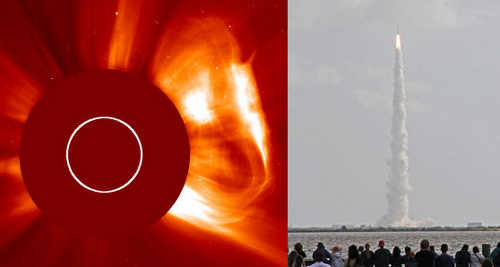
On Nov. 26, Curiosity blasted off from Cape Canaveral atop an Atlas 5 rocket.
Riding a plume of fire through the blue Florida sky, the car-sized rover began a nine month journey to search for signs of life Mars.
Meanwhile, 93 million miles away, a second lesser-noticed Mars launch was under way.
Around the time that Curiosity’s rocket was breaking the bonds of Earth, a filament of magnetism erupted from the sun, hurling a billion-ton cloud of plasma (a “CME”) toward the Red Planet.
There was no danger of a collision – Mars rover versus solar storm. Racing forward at 2 million miles per hour, the plasma cloud outpaced Curiosity’s rocket by a wide margin.
Next time could be different, however. With solar activity on the upswing (Solar Max is expected in 2012-13) it’s only a matter of time before a CME engulfs the Mars-bound rover.
That suits some researchers just fine.
As Don Hassler of the Southwest Research Institute (SWRI) in Boulder, Colorado, explained, “We look forward to such encounters because Curiosity is equipped to study solar storms."
Hassler is the principal investigator for Curiosity's Radiation Assessment Detector – "RAD" for short.
The instrument, developed at SWRI and Christian Albrechts University in Kiel, Germany, counts cosmic rays, neutrons, protons and other particles over a wide range of energies.
Tucked into the left front corner of the rover, RAD is about the size of a coffee can and weighs only three pounds, but has capabilities of Earth-bound instruments nearly 10 times its size.
Encounters with CMEs pose little danger to Curiosity. By the time a CME reaches the Earth-Mars expanse, it is spread so thin that it cannot truly buffet the spacecraft. Nevertheless, RAD can sense what happens as the CME passes by.
"RAD will be able to detect energetic particles accelerated by shock waves in some CMEs1," says Arik Posner of NASA’s Heliophysics Division in Washington DC. "This could give us new insights into the inner physics of these giant clouds."
There’s more to this, however, than pure heliophysics. Future human astronauts will directly benefit from RAD’s measurements during the cruise phase.
"Curiosity is nestled inside its spacecraft, just like a real astronaut would be," notes Frank Cucinotta, Chief Scientist for NASA’s Space Radiation Program at the Johnson Space Center. "RAD will give us an idea of the kind of radiation a human can expect to absorb during a similar trip to Mars."
Of particular interest are secondary particles. Galactic cosmic rays and solar energetic particles hit the walls of the spacecraft, creating an inward spray of even more biologically dangerous neutrons and atomic nuclei. RAD will analyze the spray from the only realistic place to make such measurements – inside the spaceship.
In this way, “RAD is a bridge between the science and exploration sides of NASA,” says Hassler. “The two objectives are equally exciting.”
RAD was activated on Dec. 6. Of the rover's ten science instruments, it will be the only one active during the cruise to Mars. Daily transmissions to Earth will let Hassler and colleagues monitor what's going on "out there."
"We're very excited about the possibility of more solar storms," he added.
As important as RAD’s cruise phase measurements are, the instrument’s primary mission doesn’t really begin until it lands on the Red Planet.
Mars has a very thin atmosphere and no global magnetic field to protect it from space radiation. Energetic particles reaching ground level might be dangerous to life – both future human astronauts and extant Martian microbes.
RAD will find out how much shielding human explorers need on the surface of Mars. RAD will also help researchers estimate how far below ground a microbe might have to go to reach a radiation “safe zone.”
Solar storms are just for starters. Stay tuned for the second installment of this story: Curiosity and the Habitability Mars.
Dr. Tony Phillips works for the National Aeronautics and Space Administration.
Follow Lake County News on Twitter at http://twitter.com/LakeCoNews, on Tumblr at www.lakeconews.tumblr.com, on Google+, on Facebook at www.facebook.com/pages/Lake-County-News/143156775604?ref=mf and on YouTube at www.youtube.com/user/LakeCoNews .
“Most importantly, we urge everyone to not drive while impaired,” said Lt. Greg Baarts, the commander of the CHP's Clear Lake Area office.
“We are committed to making the roadways safe for everyone,” he added. “The holiday season is a time for family and friends; unfortunately, it is also a time when we see too many alcohol-related fatalities.”
According to the National Highway Traffic Safety Administration, in 2010 a Record low 791 persons were tragically killed in DUI crashes on California roadways, down from 950 in 2009.
“That means we are making great progress, but there is still a lot of work to be done” Baarts said. “We can not do it alone and we need everyone’s help. Make your plans to get home before you start celebrating. Have a non-drinking designated driver or someone you can call. The consequences are not worth it.”
It is estimated that a DUI conviction can cost over $10,000 when you combine the costs of fines, attorney fees and insurance premium increases. In 2010 the CHP arrested 91,492 persons for DUI statewide.
“In Lake County we have seen a drop in most DUI-related incidents and we hope this trend continues. We also hope the message of ‘Don’t Drink and Drive’ is making people think twice before getting behind the wheel,” Baarts said.
“We would like to wish everyone a safe and happy holiday season” Baarts continued. “We will be out there patrolling, giving up quality time with our families to ensure holiday travelers arrive at their destinations safely. All we ask in return is cooperation from the public to drive safely and not to get behind the wheel impaired.”
Follow Lake County News on Twitter at http://twitter.com/LakeCoNews, on Tumblr at www.lakeconews.tumblr.com, on Google+, on Facebook at www.facebook.com/pages/Lake-County-News/143156775604?ref=mf and on YouTube at www.youtube.com/user/LakeCoNews .
Mark Knaup, 52, who took the stand during his trial, had faced four felony counts of lewd and lascivious acts with a child and one count of sexual penetration with a victim under 16, according to Deputy District Attorney Ed Borg.
“We’re thrilled with the verdict,” said Knaup’s attorney, Stephen Carter of Carter & Carter in Lower Lake.
Carter added that Knaup was grateful for the verdict as well.
Knaup did not respond to messages Lake County News left on Wednesday seeking comment.
The trial included three days of testimony before it wrapped up on Wednesday, Borg said.
Borg said they delivered closing arguments and jury instructions on Wednesday and handed the case over to the jury, which he said was only out about an hour.
Afterward, he said jurors indicated that they weren’t sure of exactly what happened based on the evidence presented. He said that uncertainty is the definition of reasonable doubt, so they did the right thing in making the acquittal.
Knaup was arrested in April 2009 after his girlfriend’s then-15-year-old daughter accused him of fondling her several times in late 2008 and early 2009, Borg said.
Carter said the defense was a complete denial of the charges. “When we pled not guilty we meant it.”
The defense pointed out what they believed were serious conflicts in the teen’s story, but Borg countered, “There were discrepancies but I wouldn’t characterize it as telling different stories.”
A challenge for the prosecution was that there was no physical evidence. “It rises and falls on the credibility of the victim. That makes it difficult for juries,” said Borg.
Testifying for the prosecution were two witnesses, the alleged victim, now 18, and a doctor who discussed Child Sexual Assault Accommodation Syndrome, which is a therapeutic tool used to explain why sexual assault victims don’t always immediately report abuse, Carter said.
“I cross-examined the doctor who testified and got him to confirm that this does not take into account those allegations,” said Carter.
As for his approach to cross-examining Jane Doe, Carter said his approach was to be respectful. “It’s always challenging.”
Borg credited Carter with doing a good job with the case and with the cross-examination in particular, noting that there is a fine line between badgering a witness and getting the facts.
Knaup also took the stand, which Carter said he felt would be a good idea, and Knaup agreed.
“I thought he did well,” said Carter. “It’s difficult for someone who’s never been charged with a crime like that to go up and get cross-examined.”
Knaup testified that the teen, whose mother he had dated, was motivated to make the allegations because she wanted him out of the picture. Carter argued that there appeared to be a design to lie in order to get what the teen wanted.
“There was evidence that the mother in the family often relied on Mark to help her be more consistent in terms of enforcing the rules,” said Carter, adding that the teen had been at risk of losing her car over violating such rules of behavior.
Carter also presented to the court a letter that Knaup received from the teen a few months before the first allegation in which she confessed to a pattern of lying.
“We were able to present that to the jury to help explain why there was such a doubt as to Jane Doe’s credibility,” he said.
E-mail Elizabeth Larson at
The projects, funded Dec. 1, are joint efforts by the Corporation for Education Network Initiatives in California (CENIC) and the Center for Economic Development at California State University, Chico (CED, CSU Chico), the Northeastern California Connect Consortium (NECCC) and the Upstate California Connect Consortium (UCCC). They received $449,991 and $448,184, respectively, over a period of three years.
The counties within the scope of the NECCC are Butte, Lassen, Modoc, Plumas, Shasta, Siskiyou and Tehama. The counties within the scope of the UCCC are Colusa, Glenn, Lake and Sonoma.
"There is a deep awareness at the highest level in California of the importance of broadband availability and adoption to the state's historic global position of economic and technology leadership," said Tom West, manager for the two consortia. "These two funding decisions speak volumes of the state's commitment to ensuring that California remains a global leader in all areas of 21st century life."
Kelly Cox, Lake County’s administrative officer, added, "This grant will enable us to develop a much-needed comprehensive broadband plan for our county. Such a plan will enable us to pursue providers and funds to effectively implement broadband for our citizens and help us advance the county's economic development plans."
Both the NECCC and the UCCC reported that they will work with other consortia as part of a comprehensive Northern California Broadband Plan to set the stage for a robust, integrated, and open-access fiber-optic middle-mile – and combination fiber-optic and wireless last-mile – infrastructure throughout the 11 counties listed in addition to Del Norte, Humboldt, Mendocino, Trinity and Yolo counties.
Many of these counties are rural with rugged terrain as well as relatively low population, all of which pose great challenges to the construction of such an infrastructure over which broadband services can be delivered.
As a result, the counties in the projects’ areas currently lack the broadband services that are an essential part of a healthy economy and a good quality of life in the 21st century, and which are already enjoyed in other regions of the state, according to the report from the sponsoring organizations.
The NECCC and UCCC both consist of a multi-phase, three-year planning effort.
During the first year, the two consortia will concentrate on developing and designing the 16-county Regional Middle-Mile infrastructure, as well as 11 countywide backbone systems and last-mile community plans.
The NECCC and the UCCC then will facilitate the implementation of these infrastructure plans as well as developing and implementing adoption and training programs to ensure that every citizen has the opportunity to effectively use these capabilities.
"Developing and implementing a broadband plan for Northern California will help fuel the economies of counties like Modoc by enabling us to attract investment capital to make local resources and products available to consumers across the state and nation," said Chester Robertson, chief administrative officer of Modoc County and member of NECCC.
Consortia Associate Manager Cathy Emerson of CED is passionate about giving the rural communities a collective voice.
"I learned that the northern counties want action, not more studies, and that someone was needed to guide a process, not tell them what to do or how to do it,” Emerson said. “These consortia are intended to include people from all aspects of the region, and based on the membership pledges and letters of support we are receiving, I'd say that's what we have: a group of dedicated, committed individuals who at the end of the day can say they not only were a part of something, they actually affected change, and to the collective benefit of the whole region."
More information about the NECCC and the UCCC can be found at www.necalbroadband.org and www.upcalbroadband.org. Visit the Center for Economic Development at www.cedcal.com.
Follow Lake County News on Twitter at http://twitter.com/LakeCoNews, on Tumblr at www.lakeconews.tumblr.com, on Google+, on Facebook at www.facebook.com/pages/Lake-County-News/143156775604?ref=mf and on YouTube at www.youtube.com/user/LakeCoNews .
With so much happening outside of the vehicle, the California Highway Patrol is unleashing a traffic safety campaign reminding motorists to focus on driving, and worry about all the other distractions after they have safely arrived at their destination.
“There are so many drivers who understand the dangers of distracted driving and focus their attention on the road instead of responding to a phone call or text message,” said CHP Commissioner Joe Farrow. “Unfortunately, many drivers still don’t understand the hazards, yet statistics has shown that traffic collisions caused by distracted driving are on the rise. This campaign focuses on these individuals.”
Distracted driving is one of the leading contributors to collisions and near-collisions.
According to the CHP’s Statewide Integrated Traffic Records System, in 2009, California drivers age 20 years or older were involved in more than 23,000 collisions within CHP jurisdiction in which inattention was documented as an associated factor.
“The CHP urges drivers to stay focused on the primary task of driving,” added Commissioner Farrow. “Through education and enforcement, we are dedicated to curb this dangerous behavior.”
The yearlong, grant-funded Adult Distracted Driving II campaign consists of an education component, as well as several distracted driver enforcement operations throughout the state.
By the end of the grant, Sept. 30, 2012, a minimum of 50 distracted driving enforcement operations will have been conducted, and at least 20 traffic safety presentations completed.
Funding for this program was provided by a grant from the California Office of Traffic Safety through the National Highway Traffic Safety Administration.
Follow Lake County News on Twitter at http://twitter.com/LakeCoNews, on Tumblr at www.lakeconews.tumblr.com, on Google+, on Facebook at www.facebook.com/pages/Lake-County-News/143156775604?ref=mf and on YouTube at www.youtube.com/user/LakeCoNews .
Education
Health
Business
Obituaries
Veterans
Recreation
Religion
Arts & Life
Government & Politics