 How to resolve AdBlock issue?
News
Forty light years from Earth, a rocky world named "55 Cancri e" circles perilously close to a stellar inferno.
Completing one orbit in only 18 hours, the alien planet is 26 times closer to its parent star than Mercury is to the Sun.
If Earth were in the same position, the soil beneath our feet would heat up to about 3,200 degrees Fahrenheit.
Researchers have long thought that 55 Cancri e must be a wasteland of parched rock.
Now they’re thinking again.
New observations by NASA's Spitzer Space Telescope suggest that 55 Cancri e may be wetter and weirder than anyone imagined.
Spitzer recently measured the extraordinarily small amount of light 55 Cancri e blocks when it crosses in front of its star.
These transits occur every 18 hours, giving researchers repeated opportunities to gather the data they need to estimate the width, volume and density of the planet.
According to the new observations, 55 Cancri e has a mass 7.8 times and a radius just over twice that of Earth.
Those properties place 55 Cancri e in the "super-Earth" class of exoplanets, a few dozen of which have been found. Only a handful of known super-Earths, however, cross the face of their stars as viewed from our vantage point in the cosmos, so 55 Cancri e is better understood than most.
When 55 Cancri e was discovered in 2004, initial estimates of its size and mass were consistent with a dense planet of solid rock.
Spitzer data suggest otherwise: About a fifth of the planet's mass must be made of light elements and compounds – including water. Given the intense heat and high pressure these materials likely experience, researchers think the compounds likely exist in a "supercritical" fluid state.
A supercritical fluid is a high-pressure, high-temperature state of matter best described as a liquid-like gas, and a marvelous solvent.
Water becomes supercritical in some steam turbines – and it tends to dissolve the tips of the turbine blades.
Supercritical carbon dioxide is used to remove caffeine from coffee beans, and sometimes to dry-clean clothes. Liquid-fueled rocket propellant is also supercritical when it emerges from the tail of a spaceship.
On 55 Cancri e, this stuff may be literally oozing – or is it steaming? – out of the rocks.
With supercritical solvents rising from the planet’s surface, a star of terrifying proportions filling much of the daytime sky, and whole years rushing past in a matter of hours, 55 Cancri e teaches a valuable lesson: Just because a planet is similar in size to Earth does not mean the planet is like Earth.
It’s something to rethink about.
Dr. Tony Phillips works for the National Aeronautics and Space Administration.
Follow Lake County News on Twitter at http://twitter.com/LakeCoNews, on Tumblr at www.lakeconews.tumblr.com, on Google+, on Facebook at www.facebook.com/pages/Lake-County-News/143156775604?ref=mf and on YouTube at www.youtube.com/user/LakeCoNews .
The crash occurred at 7:58 p.m. on Highway 29 south of Spruce Grove Road North, according to a report from CHP Sgt. Dave Stark.
Stark identified those who lost their lives as 53-year-old Kari Marks of Hidden Valley Lake; her 24-year-old daughter, Jena Marks, also of Hidden Valley Lake; and Jena Marks’ boyfriend, Patrick Campbell, 27, of Santa Rosa.
Kari Marks, Jena Marks and Campbell were riding in a 2001 BMW 740 with Kari Marks’ boyfriend, 50-year-old Michael Wright of Hidden Valley Lake, who was driving northbound on Highway 29 south of Spruce Grove Road North at an unknown speed, according to the report.
Driving southbound in a 2008 Ford Taurus X SUV was 53-year-old Steven Beyer of Clearlake, who also was traveling at an unknown speed, Stark reported. Riding with Beyer was his wife, 54-year-old Lezley Beyer.
Stark’s report said that Wright – for reasons that are still under investigation – lost control of his BMW and started to skid sideways into the oncoming lane of traffic, with the right side of his vehicle hitting the front end of the Beyers’ SUV.
After the collision, Wright’s car came to rest on the west dirt embankment, while the Beyers’ SUV was in the southbound lane, Stark said.
Kari and Jena Marks, and Campbell all were pronounced dead at the scene, according to Stark.
Stark’s report said Wright and the Beyers all suffered major injuries.
Wright sustained pelvic and chest trauma, Steven Beyer had fractures and contusions and Lezley Beyer also had fractures along with head trauma, the report stated.
A landing zone was set up nearby on Spruce Grove Road North so three air ambulances were able to come and pick up the Beyers and Wright after the crash, as Lake County News has reported.
Stark said all three of the surviving crash victims were taken to Santa Rosa Memorial Hospital for treatment.
All six of the individuals involved in the crash were wearing safety belts, Stark reported.
He said alcohol is not considered to be a factor, and the investigation is continuing.
E-mail Elizabeth Larson at

LOWER LAKE, Calif. – A Saturday evening head-on crash south of Lower Lake claimed three lives and sent three other people to area hospitals.
The collision between a late model SUV and an older model passenger car was reported at 8 p.m. on Highway 29 between Spruce Grove Road and C Street, according to the California Highway Patrol.
CHP, Lake County Fire, South Lake County Fire, Northshore Fire and the Lake County Sheriff’s Office were among the responding agencies, according to radio reports.
Reports from the scene indicated that CHP officers and firefighters arriving at the crash site found the car pushed up a nearby embankment and the SUV sitting in the middle of the roadway.
Three of the four people in the car had died by the time firefighters arrived, with the driver seriously injured, according to reports. The two people in the SUV also had been injured in the crash.
The car’s driver and the SUV’s occupants all reportedly had to be extricated from the badly damaged vehicles.
Radio reports indicated all three survivors were flown to out-of-county to trauma centers.
A landing zone was set up on Spruce Grove Road North. Two REACH air ambulances and one from CalStar landed there, transporting two of the victims to Santa Rosa Memorial Hospital and the third to Queen of the Valley Medical Center in Napa. Radio reports indicated the last of the helicopters lifted off shortly before 9:30 p.m.
The highway remained blocked for nearly three and a half hours as rescue personnel worked at the scene, CHP officers investigated the cause and two companies removed the totaled vehicles, the CHP reported.
Incident command at the scene was terminated at 11:17 p.m., with the roadway reopened minutes later, according to radio traffic.
The CHP investigation continued into the night. A full report on the circumstances of the crash with the names of the deceased and injured had not yet been released by 4 a.m.
E-mail Elizabeth Larson at

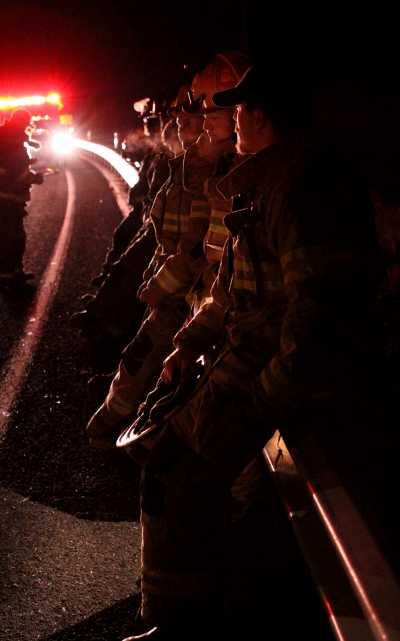

When the scent of garlic is wafting in the air, I become entranced and am tempted to follow it cartoon-like, on tiptoe, arms extended, nose following the blessed aroma trail.
Garlic is such a popular flavor that a society of its lovers exists: the Order of the Stinking Rose. The celebration of garlic is definitely a cause I can support.
This pungent plant is native to central Asia and likely made its way to points west though trading caravans on the ancient Silk Road.
Its cultivation dates back over 6,000 years, making it one of the earliest farmed vegetables.
It was known to the ancient Egyptians, Greeks, and Romans and has long been a staple in the cooking of the Mediterranean region. It’s beloved throughout the rest of Europe, as well as in Asia and Africa.
The ancient Egyptians considered garlic divine and swore their oaths on it. The slaves that built their pyramids ate it to bring strength to their task, and bulbs of garlic were found in King Tutankhamen’s tomb.
Roman soldiers believed it gave them victory in battle because it was the herb of Mars, their god of war.
Greek poet Homer’s Odysseus utilized garlic to keep a sorceress from turning him into a pig.
It was long considered a charm against evil throughout Europe, as evidenced in legends of vampires.
In addition to a belief in its magical powers, garlic has been used medicinally throughout the ages in a diverse array of cultures.
Among the cures attributed to garlic are a cough syrup made with it, a tea for relief of sore throat, a tincture for lowering blood pressure, smelling salts against hysteria, and an oil for soothing infected ears.
The truth is that modern science has found garlic to be a powerful boon to our health because of its flavor component, allicin.
It thins the blood, is important in preventing heart attack and stroke, dissolves blood clots, raises the level of HDL (good) cholesterol while lowering level of LDL (bad) cholesterol, lowers triglycerides (fats in the blood), lowers blood pressure, and protects against colon cancer.
In addition, it kills bacteria and fungus (especially yeast), as well as internal parasites.
That’s quite a list! It’s good to know that while we’re enjoying garlic’s amazing flavor, it’s providing a number of benefits to our bodies.
One way to increase (and protect) garlic’s health-enhancing properties is to allow it to rest after chopping. Let it sit a few minutes before changing its temperature through heat or its pH via things such as lemon juice or vinegar.
This enables the allinase enzymes to increase their work on our behalf. Studies show their effectiveness decreases when not allowed to sit a bit.
For maximum flavor and nutritional benefits, use garlic in its fresh form, as opposed to that which has been processed and packaged. While convenient, dried, bottled, and pre-peeled garlic don’t bring the same assets to the table or the body.
Garlic’s flavor is so pleasantly strong that it holds its own as a single seasoning in dishes.
Try adding a generous amount of chopped garlic to about a quarter inch of hot olive oil in a pan. Cook, stirring often, until garlic is golden and chewy, but not burned.
Toss this garlic-oil mixture with freshly cooked pasta, add salt and pepper to taste, and be prepared to be in culinary heaven. It’s delicious!
For those who aren’t complete purists, add a handful of chopped fresh parsley for color.
Scorched garlic is absolutely nasty, so it’s important to guard against burning when cooking with garlic. For that reason, I normally add garlic toward the end of the cooking process to dishes that are fried or sautéed.
The more garlic is crushed, the more allicin is released and the stronger it becomes. Garlic that’s squeezed through a press is far more pungent that cloves which are coarsely chopped.
In the same way, raw garlic is more robust than garlic that’s been mellowed by cooking.

When shopping for garlic, look for bulbs that are plump with unbroken skin. Avoid those which are soft, shriveled, moldy, or sprouting green shoots.
Fresh garlic is best stored in an uncovered (or loosely covered) container in a dark, cool place away from heat or sunlight. This helps protect its flavor and freshness. It’s unnecessary to refrigerate garlic.
Garlic is a component in many wonderful condiments, such as the aioli (a mayonnaise-like sauce) made with it in southern France, and Italian gremolata, a mixture of parsley, garlic, and lemon zest that’s served over osso buco, a veal dish.
When oven-roasted until tender, garlic mellows and makes a beautiful spread or companion for vegetables. Its texture becomes almost buttery.
Roasting garlic is a simple process which yields delicious results. I chop the tips off whole bulbs, brush the exposed garlic with olive oil, and turn them upside down in an ovenproof dish.
Cover with a lid or aluminum file and roast them in a moderate oven, about 375 degrees F, as a hot oven may make the garlic bitter. Check after about 30 minutes; if the cloves are soft, the garlic is done. If not, uncover the garlic and give it another five to ten minutes in the oven.
Sonoma County restaurant critic and food writer, Jeff Cox, once proposed a dish he called “garlic smooshed potatoes” on “Your Organic Garden,” a television show he hosted in the 1990s.
Mashed potatoes are prepared as usual, but with the addition of one roasted garlic bulb per potato. (That’s one whole head – not clove – of garlic per potato.) The creamy contents of each head were squeezed into the pot of drained potatoes and mashed with them.
Being a garlic lover, I tried it almost immediately, making it the next time I cooked dinner. It was delicious and not quite as garlicky as one might expect. The roasted garlic added a rich, nutty flavor to the dish.
Today’s recipe is for my homemade garlic croûtons. These are wonderful for serving over your favorite salad (I especially like them with Caesar salad), floating on soup or crushed for bread crumbs. If you’re not careful, you may end up munching on them like peanuts or potato chips.
Make a big batch and freeze them in small zipper-sealed bags so you have croûtons on hand whenever they’re needed.
And before I go, what of the bad breath that imbibing garlic causes? Or the smell on one’s skin that an evening of frenzied garlic consumption creates?
Some say that nibbling on parsley, eating a strawberry, or chewing on flavorful seeds like cardamom or fenugreek will help keep one’s breath sweet.
As to the garlic odor that seeps through the pores, a long in a hot tub is said to help evaporate the garlic oils.
Whether or not these remedies are efficacious, don’t let it stop you from enjoying the flavor of the stinking rose.
Esther’s homemade garlic croûtons
1 loaf soft French bread, cut into cubes
¾ cup extra virgin olive oil
6 garlic cloves, peeled
½ teaspoon salt (kosher salt preferred)
¼ teaspoon coarsely ground pepper
4 tablespoons fresh parsley, finely chopped
Preheat the oven to 350 degrees Fahrenheit.
Put the French bread cubes into a large bowl and set aside.
Measure the olive oil into a small bowl or large measuring cup.
Using a garlic press, squeeze the garlic cloves into the oil. Add the salt, pepper, and parsley.
Stir the olive oil mixture with a fork until ingredients are well blended, then pour evenly over the bread cubes in the bowl.
Using two large spoons, toss the bread cubes in the olive oil until all are coated. (The green specks of parsley should be well distributed.)
Spread the coated bread cubes on a baking sheet and place on the middle rack of the oven.
Give them a stir after five minutes, then let them cook until golden brown but not hard, about five minutes longer.
Note that all ovens are different and the timing for each will vary. I find that 10 minute in my oven makes a perfect croûton: crunchy, but not too hard. They’ll get a big harder as they cool.
Recipe by Esther Oertel.
Esther Oertel, a freelance writer, cooking teacher, and speaker, is passionate about local produce and all foods in the vegetable kingdom. She welcomes your questions and comments and may be reached at
Follow Lake County News on Twitter at http://twitter.com/LakeCoNews, on Tumblr at www.lakeconews.tumblr.com, on Google+, on Facebook at www.facebook.com/pages/Lake-County-News/143156775604?ref=mf and on YouTube at www.youtube.com/user/LakeCoNews .

There are a number of mixed breed adults, as well as two litters of puppies.
Dogs that are adopted from Lake County Animal Care and Control are either neutered or spayed, microchipped and, if old enough, given a rabies shot and county license before being released to their new owner. License fees do not apply to residents of the cities of Lakeport or Clearlake.
If you're looking for a new companion, visit the shelter. There are many great pets hoping you'll choose them.
The following dogs at the Lake County Animal Care and Control shelter have been cleared for adoption.

Matombo
Matombo is a 10-month-old male pit bull terrier mix.
He weighs 62 pounds and is not neutered.
Matombo is located in kennel No. 17, ID No. 31231.
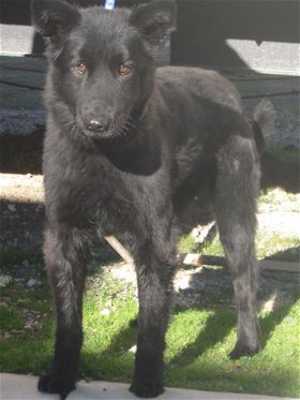
Female shepherd mix
This black female shepherd mix is 3 years old.
She has brown eyes, a long coat and weighs just under 48 pounds.
She is located in kennel No. 10, ID No. 31393.
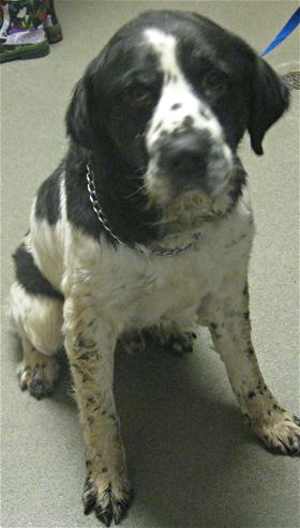
St. Bernard mix
This 7-year-old male is a St. Bernard-springer spaniel mix.
He has a long, black and white spotted coat. He is unaltered.
Find him in kennel No. 13, ID No. 31453.

Boxer-pointer puppies
These five little female puppies are 11-week-old boxer-pointer mixes.
The pups are tan and white, with brown eyes. They have short coats.
They are in kennel No. 18a, ID No. 31496.

Brindle pit bull mix
This male pit bull terrier mix has brown brindle coloring and a short coat.
An estimate of his age was not given. He is not yet neutered.
He's in kennel No. 19, ID No. 31466.

Jack Russell-beagle mix
This female Jack Russell Terrier-beagle mix is 3 years old.
She has a short, white and tan coat and floppy ears. She is not yet spayed.
She's in kennel No. 23, ID No. 31495.

Dachshund mix puppies
These little pups are 7-week-old dachshund mixes.
The litter includes three males and five females.
They have long coats, mostly black in color but with some white markings, and floppy ears.
Find the puppies in kennel No. 3, ID No. 31446.

Female shepherd mix
This female shepherd mix is 4 years old.
She has black and tan coloring, brown eyes and a short coat.
Find her in kennel No. 5, ID No. 31429.

Female pit bull mix
This female pit bull terrier mix is 3 years old.
She has black and white coloring and a short coat, with brown eyes.
Find her in kennel No. 6a, ID No. 31471.

Female pit bull terrier mix
This 3-year-old female is a pit bull terrier mix.
She has black and white coloring, a short coat and a long tail, plus floppy ears and brown eyes.
Find her in kennel No. 6b, ID No. 31472.
Adoptable dogs also can be seen at http://www.co.lake.ca.us/Government/Directory/Animal_Care_And_Control/Adopt/Dogs_and_Puppies.htm or at www.petfinder.com.
Please note: Dogs listed at the shelter's Web page that are said to be “on hold” are not yet cleared for adoption.
To fill out an adoption application online visit http://www.co.lake.ca.us/Government/Directory/Animal_Care_And_Control/Adopt/Dog___Cat_Adoption_Application.htm.
Lake County Animal Care and Control is located at 4949 Helbush in Lakeport, next to the Hill Road Correctional Facility.
Office hours are Monday through Friday, 8 a.m. to 5 p.m., and 1 p.m. to 3 p.m., Saturday. The shelter is open from 10:30 a.m. to 4:30 p.m. Monday through Friday and on Saturday from 1 p.m. to 3 p.m.
Visit the shelter online at http://www.co.lake.ca.us/Government/Directory/Animal_Care_And_Control.htm.
For more information call Lake County Animal Care and Control at 707-263-0278.
Follow Lake County News on Twitter at http://twitter.com/LakeCoNews, on Tumblr at www.lakeconews.tumblr.com, on Google+, on Facebook at www.facebook.com/pages/Lake-County-News/143156775604?ref=mf and on YouTube at www.youtube.com/user/LakeCoNews .
Comets are icy and fragile. They spend most of their time orbiting through the dark outskirts of the solar system safe from destructive rays of intense sunlight. The deepest cold is their natural habitat.
Last November amateur astronomer Terry Lovejoy discovered a different kind of comet.
The icy fuzzball he spotted in the sky over his backyard observatory in Australia was heading almost directly for the sun.
On Dec. 16, less than three weeks after he found it, Comet Lovejoy would swoop through the sun’s atmosphere only 120,000 kilometers above the stellar surface.
Astronomers soon realized a startling fact: Comet Lovejoy likes it hot.
"Terry found a sungrazer," said Karl Battams of the Naval Research Lab in Washington DC. "We figured its nucleus was about as wide as two football fields – the biggest such comet in nearly 40 years.”
Sungrazing comets aren't a new thing. In fact, the orbiting Solar and Heliospheric Observatory (SOHO) watches one fall toward the sun and evaporate every few days.
These frequent kamikaze comets, known as “Kreutz sungrazers,” are thought to be splinters of a giant comet that broke apart hundreds of years ago.
Typically they measure about 10 meters across, small, fragile, and easily vaporized by solar heat.
Based on its orbit, Comet Lovejoy was surely a member of the same family – except it was 200 meters wide instead of the usual 10.
Astronomers were eager to see such a whopper disintegrate. Even with its extra girth, there was little doubt that it would be destroyed.
When Dec. 16 came, however, "Comet Lovejoy shocked us all," said Battams. "It survived, and even flourished.”
Images from NASA's Solar Dynamics Observatory showed the comet vaporizing furiously as it entered the sun's atmosphere – apparently on the verge of obliteration – yet Comet Lovejoy was still intact when it emerged on the other side.
The comet had lost its tail during the fiery transit – a temporary setback. Within hours, the tail grew back, bigger and brighter than before.
"It's fair to say we were dumbfounded," said Matthew Knight of the Lowell Observatory and the Johns Hopkins Applied Physics Lab. "Comet Lovejoy must have been bigger than we thought, perhaps as much as 500 meters wide."
That would make it the biggest sungrazer since Comet Ikeya-Seka almost 40 years ago.
With a tail that stretched halfway across the sky, Ikeya-Seki was actually visible in broad daylight after it passed through the sun's atmosphere in October 1965.
In Japan, where observers spotted the over-heated comet only half a degree from the sun, it was described as 10 times brighter than the Full Moon.
Comet Lovejoy wasn't that bright, but it was still amazing.
Only a few days after it left the sun, the comet showed up in the morning skies of the southern hemisphere.
Observers in Australia, South America, South Africa and New Zealand likened it to a search light beaming up from the east before dawn.
The tail lined up parallel to the Milky Way and, for a few days, made it seem that we lived in a double-decker galaxy.
Astronauts on the International Space Station also witnessed the comet.
ISS Commander Dan Burbank, who has seen his share of wonders, even once flying directly through the Northern Lights onboard the space shuttle, declared Comet Lovejoy “the most amazing thing I have ever seen in space.”
An armada of spacecraft including SOHO, the Solar Dynamics Observatory, NASA's twin STEREO probes, Japan’s Hinode spacecraft, and Europe's Proba2 microsatellite recorded the historic event.
"We've collected a mountain of data," said Knight. "But there are some things we're still having trouble explaining."
For instance, what made Lovejoy's tail wiggle so wildly when it entered the solar corona? Perhaps it was in the grip of the sun's powerful magnetic field.
What caused Lovejoy to lose its tail inside the sun's atmosphere—and then regain it later? “This is one of the biggest mysteries to me,” said Battams.
And then there is the ultimate existential puzzle: How did Comet Lovejoy survive at all?
As January unfolds, the “Comet that liked it Hot” is returning to the outer solar system, still intact, leaving many mysteries behind.
“It’ll be back in about 600 years,” said Knight. “Maybe we will have figured them out by then.”
Dr. Tony Phillips works for the National Aeronautics and Space Administration.
Follow Lake County News on Twitter at http://twitter.com/LakeCoNews, on Tumblr at www.lakeconews.tumblr.com, on Google+, on Facebook at www.facebook.com/pages/Lake-County-News/143156775604?ref=mf and on YouTube at www.youtube.com/user/LakeCoNews .