 How to resolve AdBlock issue?
News
Mixes of all kinds – from spaniels to terriers, Maltese to Chihuahuas – are looking for new homes.
Dogs that are adopted from Lake County Animal Care and Control are either neutered or spayed, microchipped and, if old enough, given a rabies shot and county license before being released to their new owner. License fees do not apply to residents of the cities of Lakeport or Clearlake.
If you're looking for a new companion, visit the shelter. There are many great pets hoping you'll choose them.
The following dogs at the Lake County Animal Care and Control shelter have been cleared for adoption.

Basset hound mix puppies
These 9-week-old male puppies are basset hound mixes.
They range in colors from black and white, brown and tri-colored.
Find them in kennel No. 21a, ID No. 31549.

Winter seems to have been on hold this year in some parts of the United States. Snowfall has been scarce so far in places that were overwhelmed with the white stuff by the same time last year.
Here's a prime example.
"The Mammoth Mountain ski resort in the Sierras of California got more than 200 inches of snow last December," said NASA climatologist Bill Patzert of the Jet Propulsion Laboratory. "This December they got less than 10 inches."
Temperatures have flip-flopped too. There were 583 new heat records broken in the first five days of January in the US.
On Wednesday, Jan. 4, it was 86 degrees in Los Angeles, Patzert said. "Everyone thinks it's July! In fact, it's warmer today in LA than it was on July 4 last year. And it's been in the 60s and 70 even in the Dakotas lately."
On Thursday, Jan. 5, in Bismark, North Dakota, it was 62 degrees – a marked departure from their average 23 degrees for that day. It was 66 in Denver, Colorado, where it's usually in the low 40s on that date.
What's going on?
Patzert identifies two culprits: La Niña and the Arctic Oscillation.
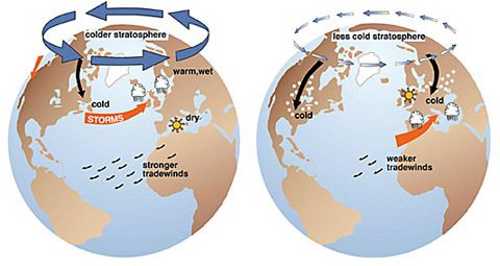
“First of all," he explained, "we are experiencing a La Niña pattern of sea surface temperatures in the Pacific Ocean. This pushes the jet stream and the cold arctic air northward."
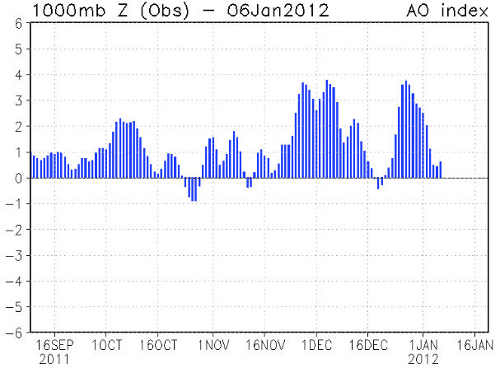
He added, "On top of that, this year's Arctic Oscillation has been stronger."
The Arctic Oscillation is a see-sawing pressure difference between the Arctic and lower latitudes. When the pressure difference is high, a whirlpool of air forms around the North Pole.
Last year, the whirlpool motion was weaker, allowing cold air to escape from the polar regions and head southward to the US.
"This year the whirlpool has been more forceful, corralling the cold air and keeping it nearer the pole,” Patzert said. “That has reinforced the La Niña impact."
While the corralling action of the Arctic Oscillation has kept snow away from parts of the contiguous United States, it has brought extra snow to places inside the whirlpool.
"The strong positive AO has kept the Jet Stream north," said Patzert. "Snow-delivering storm tracks are pounding Alaska."
Cordova, a small coastal town about 150 miles east of Anchorage, has been especially hard hit.
More than 18 feet of snow has fallen so far this winter. Snow dumps are full, roads have turned into one-lane "snow canyons," and National Guardsmen have been sent in to help residents dig out.
Even heartbroken snow-lovers of the lower 48 don't want that much white stuff. But they'd like some.
"Be patient," advised Patzert. "We haven't gotten to the heart of winter. Hold off on selling the new dogsled. There's plenty of time for snow. It ain't over till the Siberian Huskies sing."
Dauna Coulter works for the National Aeronautics and Space Administration.
Follow Lake County News on Twitter at http://twitter.com/LakeCoNews, on Tumblr at www.lakeconews.tumblr.com, on Google+, on Facebook at www.facebook.com/pages/Lake-County-News/143156775604?ref=mf and on YouTube at www.youtube.com/user/LakeCoNews .


NOAA announced that the designation of additional critical habitat to provide protection for endangered leatherback sea turtles along the U.S. West Coast.
NOAA is designating 41,914 square miles of marine habitat in the Pacific Ocean off the coasts of California, Oregon and Washington.
This designation will not directly affect recreational fishing, boating and other private activities in critical habitat.
Critical habitat designations only affect federal projects that have the potential to adversely modify or destroy critical habitat. The designations also aid the recovery of endangered and threatened species by protecting habitat that the species rely on.
NOAA and the U.S. Fish and Wildlife Service already have designated critical habitat for leatherback turtles along Sandy Point Beach at the western end of the island of St. Croix, U.S.V.I., and in adjacent Atlantic coastal waters.
NOAA is designating this additional critical habitat in the Pacific Ocean as a result of a petition to revise the existing critical habitat for leatherbacks to include important habitat off the U.S. West Coast.
Once an Endangered Species Act petition is received, NOAA Fisheries must evaluate the petition and scientific information provided to determine if the petitioned action is warranted. If it is, the agency must make a determination on how to move forward.
The newly designated critical habitat is made up of two sections of marine habitat where leatherbacks are known to travel great distances across the Pacific to feed on jellyfish.
The southern portion stretches along the California coast from Point Arena to Point Arguello east of the 3,000-meter depth contour, while the northern portion stretches from Cape Flattery, Wash. to Cape Blanco, Ore., east of the 2,000-meter depth contour.
The leatherback sea turtle, the largest marine turtle in the world, has been listed as endangered since 1970.
Leatherbacks have the largest range of any living reptile and occur throughout the oceans of the world. They feed primarily on jellyfish and lay their eggs on tropical and subtropical beaches.
Although very little is known about their lifespan, biologists estimate leatherbacks can live for 45 years or more.
Leatherbacks face many dangers both in the marine environment and on land, including bycatch in fishing gear, habitat destruction and the harvest of eggs and adults on nesting beaches.
Follow Lake County News on Twitter at http://twitter.com/LakeCoNews, on Tumblr at www.lakeconews.tumblr.com, on Google+, on Facebook at www.facebook.com/pages/Lake-County-News/143156775604?ref=mf and on YouTube at www.youtube.com/user/LakeCoNews .
Sen. Harry Reid (D-Nevada) said he would postpone the vote planned for next Tuesday of the Protect IP Act, or PIPA, which had been introduced by Sen. Patrick Leahy (D-Vermont).
The announcement came the same day as Congressman Lamar Smith (R-Texas) said he would shelve his bill, HR 3261, the Stop Online Piracy, or SOPA.
Fight for the Future, which ran the largest organizing sites for the recent SOPA protests – www.sopastrike.com and www.americancensorship.org – welcomed the announcement on the bills, which it said were about Web censorship, which would have harmed innovation.
Fight for the Future Co-founder Holmes Wilson said that “any law that lets the copyright lobby block our websites, censor our search results, or cut off our PayPal accounts – without even going through a judge – will be soundly defeated.”
“The public has spoken in no uncertain terms. And the clear message to Washington is that you can’t let corporate lobbyists dictate Internet policy, you can’t tamper with the open architecture of the Internet, and you can’t craft any future legislation without giving the public a seat at the table,” said Craig Aaron, president and chief executive officer of the Free Press Action Fund.
Reid’s and Smith’s decisions were announced two days after an estimated 115,000 Web sites took part in a strike to protest the two bills, according to the advocacy group, Fight for the Future.
In addition, the group reported that 10,000,000 people signed petitions against the bills, and 3,000,000 people sent e-mails to protest them.
Fight for the Future Co-founder Tiffiniy Cheng accused the Motion Picture Association of America of trying to quietly force SOPA through Congress.
However, Cheng added, “when Internet users started paying attention, real democracy happened. This is a watershed moment in the fight against lobbyists’ influence on politics.”
SOPA and PIPA had received backing from the Motion Picture Association of America, U.S. Chamber of Commerce, the National Sheriffs’ Association, International Union of Police Associations, the National Association of Manufacturers, the AFL-CIO, the National Songwriters Association and the National Center for Victims of Crime, and more than 100 other associations.
Supporters argued that billions of dollars are lost due to Internet piracy of copyrighted materials.
But opposition, which had grown significantly last fall – and included Internet giants Google, Facebook, Wikipedia and many others – argued the impacts could be much more serious, and could put a serious chill on innovation, business and investment.
Attention soon focused on the bill’s corporate supporters, with GoDaddy.com losing tens of thousands of Web domain registrations due to its early support of the bill. It later withdrew support.
Petitions on the bills sent to President Barack Obama resulted in his technology and cybersecurity staff posting a Jan. 14 statement that stressed that protecting intellectual property online must not come at the expense of an open and innovative Internet.
The White House analysis of some of the provisions in the legislation concluded that they posed “a real risk to cybersecurity and yet leave contraband goods and services accessible online.”
The statement continued, “While we are strongly committed to the vigorous enforcement of intellectual property rights, existing tools are not strong enough to root out the worst online pirates beyond our borders,” with the Obama Administration calling on all sides to work together to pass legislation “that provides prosecutors and rights holders new legal tools to combat online piracy originating beyond U.S. borders while staying true to the principles outlined above in this response.”
Reid said Friday that he was postponing the PIPA vote “in light of recent events.”
"There is no reason that the legitimate issues raised by many about this bill cannot be resolved,” he said in a statement released by his office.
“Counterfeiting and piracy cost the American economy billions of dollars and thousands of jobs each year, with the movie industry alone supporting over 2.2 million jobs,” Reid continued. “We must take action to stop these illegal practices. We live in a country where people rightfully expect to be fairly compensated for a day's work, whether that person is a miner in the high desert of Nevada, an independent band in New York City, or a union worker on the back lots of a California movie studio.”
Smith said the House Judiciary Committee will postpone consideration of SOPA “until there is wider agreement on a solution.”
He said he’d heard from SOPA’s critics and took their concerns seriously. “It is clear that we need to revisit the approach on how best to address the problem of foreign thieves that steal and sell American inventions and products.”
Smith said online piracy is a problem too big to ignore. “American intellectual property industries provide 19 million high-paying jobs and account for more than 60 percent of U.S. exports. The theft of America’s intellectual property costs the U.S. economy more than $100 billion annually and results in the loss of thousands of American jobs. Congress cannot stand by and do nothing while American innovators and job creators are under attack.”
On Wednesday, Pro Publica reported that there were 80 proponents of SOPA and PIPA in Congress, with 31 opponents, including Lake County’s representative in the House, Congressman Mike Thompson (D-St. Helena), as Lake County News has reported.
By Friday, that had flipped, with 61 opponents or co-sponsors, and 189 opponents or members of Congress who were leaning toward a “no” vote, Pro Publica reported at http://projects.propublica.org/sopa/.
California’s two senators, Barbara Boxer and Dianne Feinstein, remained in the supporters’ column in Pro Publica’s latest report.
On Wednesday Thompson announced the introduction of the bipartisan Online Protection & Enforcement of Digital Trade (OPEN) Act, H.R. 3782, for which he is an original co-sponsor.
According to Thompson, the OPEN Act would enable holders of intellectual property to petition the International Trade Commissions to launch investigations into whether a foreign Web site’s only purpose is to engage in infringement of U.S. copyrights and trademarks.
A timeline of the SOPA protests can be found at http://sopastrike.com/timeline.
E-mail Elizabeth Larson at
The Employment Development Department’s Friday report said that Lake County’s unemployment rate went from 16.9 percent in November to 17.1 percent in December, but was down from the 18.3 percent mark in December 2010.
California’s unemployment rate decreased to 11.1 percent in December, down from 11.3 the previous month and 12.5 percent in December 2010, numbers the Employment Development Department said were based on a federal survey of 5,500 California households.
The number of people unemployed in California was 2,021,000 – down by 37,000 over the month, and down by 252,000 compared with December of last year, the Employment Development Department said.
In December, California had an increase of 10,700 nonfarm payroll jobs for a total gain of 240,300 jobs since the start of 2011, according to data released by the California Employment Development Department that is gathered from two separate surveys.
Nationwide, December’s unemployment was tallied at 8.5 percent, down form 8.7 percent in November and 9.4 percent in December 2010. The nation’s December unemployment rate is the lowest since February 2009, according to federal Bureau of Labor Statistics records.
Dennis Mullins of the Employment Development Department’s North Coast Region Labor Market Information Division in Eureka said that in spite of seeing a small increase in unemployment, Lake County’s statement ranking improved from 54th to 52nd among the state’s 58 counties.
Employment Development Department information showed that in December Lake County had a workforce composed of 23,710 people, with 4,060 of them out of work.
Mullins said that Lake County’s total wage and salary employment increased 10 jobs between November and December and declined 200 over the year.
The biggest job losses were seen in the government category, where cutbacks resulted in a decrease of 130 jobs, or about two-thirds of the overall decline, Mullins said.
Six job sectors gained over the year and five declined, according to Mullins.
He said year-over job growth occurred in farm, 20; manufacturing, 10; trade, transportation and utilities, 10; information, 10; professional and business services, 10; and other services, 10.
Declines were seen in industry sectors including mining, logging and construction, which lost 40 jobs; financial activities, 10; private educational and health services, 60; leisure and hospitality, 20; and government, 130, Mullins reported.
The Employment Development Department report showed that surrounding counties' employment figure were as follows: Colusa, 23.3 percent, No. 57; Glenn, 15.5, No. 52; Mendocino, 10.2 percent, No. 18; Napa, 9 percent, No. 10; Sonoma, 8.9 percent, No. 8; and Yolo, 13.2 percent, No. 32.
The lowest unemployment in the state was in Marin County, 6.5 percent, while data showed Imperial County had 26.8 percent unemployment in December.
In related data, the Employment Development Department reported that there were 536,442 people receiving regular unemployment insurance benefits during the December survey week, compared with 536,294 last month and 599,221 last year.
New claims for unemployment insurance were 80,276 in December 2011, compared with 74,082 in November and 87,289 in December of last year, the agency said.
California sees small job growth in December
Nonfarm jobs in California totaled 14,199,000 in December, an increase of 10,700 jobs over the month, and 24,700 since November, according to a survey of 42,000 California businesses that measures jobs in the economy, whichd is less variable statistically than the federal household survey.
The year-over-year change – December 2010 to December 2011 – shows an increase of 240,300 jobs, up 1.7 percent, the agency said.
According to the state report, the federal survey of households, done with a smaller sample than the survey of employers, showed an increase in the number of employed people.
It estimated that the number of Californians holding jobs in December was 16,198,000, an increase of 73,000 from November, and up 320,000 from the employment total in December of last year.
The report showed that five categories – construction; information; professional and business services; educational and health services; and government – added jobs over the month, gaining 23,900 jobs. Professional and business services posted the largest increase over the month, adding 13,400 jobs.
Six categories – mining and logging; manufacturing; trade, transportation and utilities; financial activities; leisure and hospitality; and other services – reported job declines over the month, down 13,200 jobs, the report showed. Trade, transportation and utilities posted the largest decrease over the month, down 4,200 jobs.
Eight categories – mining and logging; construction; trade, transportation and utilities; information; professional and business services; educational and health services; leisure and hospitality; and government – posted job gains over the year, adding 248,200 jobs, the Employment Development Department reported.
The Friday report also showed that professional and business services posted the largest gain on a numerical basis, adding 63,500 jobs, up 3 percent. Information posted the largest gain on a percentage basis, up by 5.3 percent, an increase of 23,300 jobs.
Three categories – manufacturing; financial activities; and other services – job declines over the year, down 7,900 jobs. Manufacturing posted the largest decline on both a numerical and percentage basis, down by 4,400 jobs, a decrease of 0.4 percent, the state said.
E-mail Elizabeth Larson at

CLEARLAKE OAKS, Calif. – A vehicle stop in Clearlake Oaks on Thursday yielded methamphetamine, a glass “meth” pipe, marijuana and two arrests.
Arrested were Clearlake Oaks resident David Wayne Christensen, 55, and Kristen Cook Weiss, 22, of Lucerne, according to Sgt. Steve Brooks.
Shortly after 8 p.m. Thursday a Lake County Sheriff’s deputy on patrol conducted a vehicle stop on Keys Boulevard near Sixth Street in Clearlake Oaks, Brooks said.
The deputy contacted the driver, who he identified as Christensen, and could immediately smell the odor of marijuana coming from inside the vehicle, Brooks said. Christensen pulled a baggie of marijuana from his pants pocket and showed it to the deputy.
Brooks said the deputy then contacted the passenger of the vehicle, who he identified as Weiss. The deputy learned that Weiss was on probation for being under the influence of a controlled substance.
During a probation search of the vehicle, a glass meth pipe was located along with a baggie containing methamphetamine. Brooks said neither Weiss nor Christensen claimed ownership of the pipe or methamphetamine.
Based on the deputy’s observations and Weiss’ admission, he determined she was under the influence of a controlled substance, Brooks said.
Both Christensen and Weiss were transported to the Lake County Hill Road Correctional Facility, Brooks said.
Christensen was charged with possession of a controlled substance, possession of drug paraphernalia and possession of marijuana, Brooks said.
He said Weiss was charged with possession of a controlled substance, possession of drug paraphernalia, being under the influence of a controlled substance and for violating the conditions of her probation.
The Lake County Sheriff’s Office Task Force can be reached through its anonymous tip line at 707-263-3663.
Follow Lake County News on Twitter at http://twitter.com/LakeCoNews, on Tumblr at www.lakeconews.tumblr.com, on Google+, on Facebook at www.facebook.com/pages/Lake-County-News/143156775604?ref=mf and on YouTube at www.youtube.com/user/LakeCoNews .
Education
Health
Business
Obituaries
Veterans
Recreation
Religion
Arts & Life
Government & Politics