 How to resolve AdBlock issue?
News
This just in: The Solar System is different from the space just outside it.
Researchers announced the finding at a press conference on Jan. 31, 2012. It’s based on data from NASA’s IBEX spacecraft, which is able to sample material flowing into the solar system from interstellar space.
“We’ve detected alien matter that came into our solar system from other parts of the galaxy – and, chemically speaking, it’s not exactly like what we find here at home,” said David McComas, the principal investigator for IBEX at the Southwest Research Institute in San Antonio, Texas.
Our solar system is surrounded by the heliosphere, a magnetic bubble that separates us from the rest of the Milky Way.
Outside the heliosphere lies the realm of the stars or “interstellar space”; inside lies the sun and all the planets.
The sun blows this vast magnetic bubble using the solar wind to inflate the sun’s own magnetic field.
It’s a good thing: The heliosphere helps protect us from cosmic rays that would otherwise penetrate the solar system.
Launched in 2008, the IBEX spacecraft spins in Earth orbit scanning the entire sky.
IBEX’s special trick is detecting neutral atoms that slip through the heliosphere’s magnetic defenses. Without actually exiting the solar system, IBEX is able to sample the galaxy outside.
The first two years of counting these alien atoms have led to some interesting conclusions:
“We've directly measured four separate types of atoms from interstellar space and the composition just doesn't match up with what we see in the solar system,” said Eric Christian, mission scientist for IBEX at NASA's Goddard Space Flight Center in Greenbelt, Md.
Among the four types of atoms detected – H, He, O and Ne – the last one, neon, serves as a particularly useful reference.
“Neon is a noble gas, so it doesn’t react with anything. And it’s relatively abundant, so we can measure it with good statistics,” explained McComas.
Using data from IBEX, the researchers team compared the neon-to-oxygen ratio inside vs. outside the heliosphere.
In a series of six science papers appearing in the Astrophysical Journal, they reported that for every 20 neon atoms in the galactic wind, there are 74 oxygen atoms.
In our own solar system, however, for every 20 neon atoms there are 111 oxygen atoms.
That translates to more oxygen in any given slice of the solar system than in local interstellar space.
Where did the extra oxygen come from?
“There are at least two possibilities,” said McComas. “Either the solar system evolved in a separate, more oxygen-rich part of the galaxy than where we currently reside or a great deal of critical, life-giving oxygen lies trapped in interstellar dust grains or ices, unable to move freely throughout space – and thus undetectable by IBEX.”
Either way, this affects scientific models of how our solar system – and life – formed.
“It’s a real puzzle,” he said.
While IBEX samples alien atoms from Earth orbit, NASA’s Voyager spacecraft have been traveling to the edge of the heliosphere for nearly 40 years – and they could soon find themselves on the outside looking in.
Researchers expect Voyager 1 to exit the solar system within the next few years. The new data from IBEX suggest the Voyagers are heading for a new frontier, indeed.
Follow Lake County News on Twitter at http://twitter.com/LakeCoNews, on Tumblr at www.lakeconews.tumblr.com, on Google+, on Facebook at www.facebook.com/pages/Lake-County-News/143156775604?ref=mf and on YouTube at www.youtube.com/user/LakeCoNews .
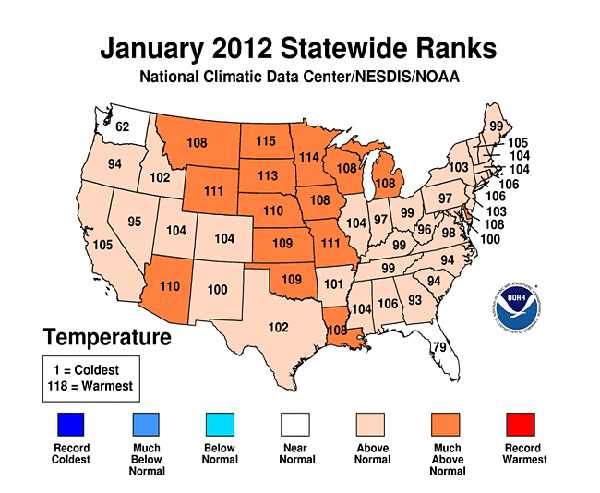
A report from the National Oceanic and Atmospheric Administration (NOAA) has identified January 2012 as the fourth-warmest January on record for the contiguous United States.
In the contiguous U.S., the average temperature for January was 36.3°F which is 5.5°F above normal range, according to the report.
This makes the month not only the fourth warmest of its kind in history, but also the warmest since 2006, the report showed.
“It's warmer this year mainly because of the jet stream pattern,” said AccuWeather.com Senior Meteorologist Michael Pigott.
“Generally, for the most part of the winter, it has been on a west-to-east pattern,” said Pigott. “Meteorologists refer to this as a 'zonal flow.' Essentially, we've seen a lot of storms moving from west to east, and not a lot traveling northward or southward. So, anything in the Arctic is staying up there, and anything in the U.S. is staying put as well. If you have north-to-south undulations in the jet stream, you do get warmer air heading northward to the poles, and colder air comes down toward the U.S. from the Arctic."
Nine states recorded their top ten warmest average temperatures for January in 2012: Wyoming, North Dakota, South Dakota, Oklahoma, Nebraska, Missouri, Minnesota, Arizona and Kansas.
It has also been the fifth-warmest, six-month period from August 2011 to January 2012 ever recorded in the contiguous U.S. Forty states have had warmer-than-average temperatures.
Even though the contiguous U.S. has seen record warmth this winter, Alaska is a different story. Several towns in Alaska have seen their coldest January on record.
“Since the jet stream isn't moving colder air southward, it's getting trapped over Alaska,” Pigott said. “It's basically creating an extreme divide in record temperatures there compared to the rest of the U.S.”
In addition to a warm January in 2012, it has also been dry. In fact, the contiguous U.S. has seen its 28th-driest January in recorded history.
The central Plains had below-average precipitation for the month, especially in Kansas. Kansas had its third-driest January in recorded history, while Nebraska saw its eighth-driest January.
“One reason the central Plains have seen less-than-average precipitation has been due to the weakening of storms coming from the West,” said Pigott. “When these storms hit the Rockies, they tend to stall out and weaken in intensity.”
However, this has not been the case for every state. Texas has actually seen above-average precipitation for the second month in a row. The state had not had two consecutive months of above-average precipitation since January-February 2010.
If March comes in like a lamb ...
The warm trend may continue through the end of February and into March, but temperatures are not expected to be as high as they were in January.
“It looks like the pattern will be similar for most of the country, but not to the same extent,” said AccuWeather.com Expert Senior Meteorologist Jack Boston. “We are getting in a pattern where we're more susceptible to cold air masses coming down. However, that doesn't mean they're going to stay. They're still going to be progressive. That means cooler temperatures will come in for only a few days, then disappear again.”
Intermittent stretches of cooler air will bring overall average temperatures closer to normal for the months ahead.
“The average will be somewhat above normal, though it won't be as above normal as January. But, it will be closer to normal,” added Boston.
Boston also stated that he thinks temperatures in the Northeast will begin to drop “just in time for spring,” with a pattern developing for cooler-than-normal weather in the Northeast starting later in March and continuing through April.
Boston also said that much of the rest of the contiguous U.S. will remain warmer with the possible exception of the Pacific Northwest.
“It may stay pretty active up there and get lots of rain and therefore keep their temperatures held down pretty well,” said Boston.
Follow Lake County News on Twitter at http://twitter.com/LakeCoNews, on Tumblr at www.lakeconews.tumblr.com, on Google+, on Facebook at www.facebook.com/pages/Lake-County-News/143156775604?ref=mf and on YouTube at www.youtube.com/user/LakeCoNews .
LAKE COUNTY, Calif. – Just three days after the state Legislature passed it, a bill that restores funding to school transportation programs statewide received the governor’s approval.
On Friday Gov. Jerry Brown signed SB 81, which replaces the $248 million midyear cut to the Home-to-School Transportation program Brown made with a smaller, more equitable reduction across all school districts in California.
SB 81 moved quickly through the Legislature and made it to the governor’s desk in just three days. The bill goes into immediate effect.
“This is a victory for every child in the state,” said state Sen. Noreen Evans (D-Santa Rosa). “Every child should have equal access to a quality education. SB 81 ensures kids will get to school so they can learn, get an education and be on track to be successful and contributing members of our society.”
Assemblyman Wes Chesbro (D-Arcata) praised Gov. Brown for taking quick action on the bill and understanding its importance to school children in rural areas.
“I am thrilled that the Legislature and governor were able to come together to restore the funding that gets California’s students to school,” Chesbro said. “Home-to-School Transportation is an essential service in my district. This bill was signed just in time to save the jobs of many school bus drivers and ensure that there is no interruption in getting kids to school.”
Lake County Superintendent of Schools Wally Holbrook told Lake County News on Friday that the governor’s midyear cuts to Home-to-School Transportation and special education transportation would have amounted to just over $1 million for Lake County's school districts.
However, SB 81 has reduced those cuts by $527,000, bringing the total reduction for the county to approximately $482,147, Holbrook said.
Konocti Unified and Kelseyville Unified, with the county’s largest transportation needs, had $263,976 and $147,140 in funding restored to them, respectively, according to Holbrook.
Holbrook said his office contacted Chesbro and Evans, with both being “really responsive” to concerns about the funding loss and writing to the governor.
Chesbro and Evans both decried the cuts, saying they were unfairly hitting the rural areas they serve.
Holbrook said the governor’s midyear cuts were not across the board, but targeted the last half of the 2011-12 fiscal year’s transportation funding, and amounted to a 50-percent cut for schools with transportation programs based on a formula developed a long time ago.
The result was that some districts were hit particularly hard. Districts with no transportation had no cuts, but schools with transportation needs were harder hit, with some cuts amounting to several hundred dollars per student, he said.
The cuts totaled more than $100 per student for the Kelseyville and Konocti districts, according to Holbrook.
With SB 81 becoming law, the cuts total about $42 per student across the board, whether their schools offer transportation or not, Holbrook said.
E-mail Elizabeth Larson at
SANTA ROSA, Calif. – A Santa Rosa man convicted of a string of burglaries that stretched across four counties, including Lake, has been sentenced to 31 years in prison by a Sonoma County judge.
Monty Allen Mullins, 46, received the sentence this week from Sonoma County Superior Court Judge Dana Simonds, according to a report from the office of Sonoma County District Attorney Jill Ravitch.
On Oct. 27, 2011, Mullins entered guilty pleas to five residential burglaries, possession of stolen property, and possession of a stolen vehicle.
In addition, Mullins admitted that he had a prior conviction for residential burglary, which is a strike offense, and also admitted that he committed two of the residential burglaries while out on bail in four pending cases.
“This defendant has proven that imprisonment is the only way to keep him from victimizing people and burglarizing their homes,” Ravitch said. “Numerous victims have had to cope with the violation of the sanctity of their homes. Particularly striking is the impact on elder victims who lost a lifetime’s worth of sentimental personal belongings. I commend the cooperative investigative efforts by multiple law enforcement agencies that lead to this defendant’s apprehension and significant sentence.”
This case was investigated by the Santa Rosa Police Department, the Sonoma County Sheriff’s Office, the Calistoga Police Department and the Novato Police Department.
The crimes in this matter spanned from Sonoma County into Napa, Lake and Marin counties, Ravitch's office reported.
In late 2009, Mullins was linked by fingerprint evidence to a residential burglary of a home owned by an elderly couple and located in the Oakmont retirement community, just outside of Santa Rosa.
When he was arrested for the Oakmont burglary, Mullins was in possession of stolen property and a window-punch burglary tool, which stolen property had been removed from a window-smash car burglary hours before Mullins’ arrest.
Ravitch's office reported that Mullins posted bail on the Oakmont residential burglary case and, on Sept. 3, 2010, while out on bail, was arrested after found fleeing from a residential burglary in Windsor, in a vehicle which had been stolen from a residential burglary in Novato days before, according to the district attorney's report.
The Sonoma County Sheriff’s Office executed a search warrant at Mullins’ home that evening and found Mullins’ girlfriend allegedly wearing jewelry from the Novato residential burglary.
In addition, Mullins’ girlfriend was arrested days later at a pawn shop in Santa Rosa while allegedly carrying a bag full of coins, also stolen from the residential burglary in Novato.
Further investigation revealed that Mullins and his co-defendant, Joseph Greathouse, had attempted to burglarize a residence in Sonoma on the evening of Aug. 29, 2010, but fled once contact was made with one of the occupants living at the residence.
Another occupant of the home was able to provide a license plate number of the getaway vehicle, which was found to be registered to Mullins’ daughter.
Video surveillance taken earlier that day at the Twin Pine Casino in Middletown showed Mullins and Greathouse leaving the casino in that same car, after attempting to use an elderly couple’s credit card that had been stolen during a residential burglary of the elderly couple’s Calistoga home earlier that same day.
He again posted bail and, on Feb. 8, 2011, was arrested after he was caught burglarizing two more homes in the Rincon Valley area of Santa Rosa.
Mullins, who was caught in the act by the elderly homeowner’s adult sons, ran from the first residence into another residence, where he committed another residential burglary before being apprehended by the Santa Rosa Police Department.
Officials said Mullins has been in custody since Feb. 8, 2011, with bail specially set at $2 million.
The lead investigators in this case were Sonoma County Sheriff’s Detective Perry Sparkman and Santa Rosa Police Detective Brett Siwy. Deputy District Attorney Robin Hammond was the prosecutor assigned to the case.
Follow Lake County News on Twitter at http://twitter.com/LakeCoNews, on Tumblr at www.lakeconews.tumblr.com, on Google+, on Facebook at www.facebook.com/pages/Lake-County-News/143156775604?ref=mf and on YouTube at www.youtube.com/user/LakeCoNews .
MENDOCINO COUNTY, Calif. – An investigation earlier this week in Mendocino County resulted in the arrests of numerous suspects from Mendocino, Lake and Sonoma counties, and the seizure of large amounts of cash and illicit drugs.
The County of Mendocino Marijuana Eradication Team (COMMET) operation, which took place on the afternoon of Monday, Feb. 6, resulted in the arrests of Megan Champion, 27, of Redwood Valley; Karen Johnanna Spencer, 39, of Ukiah; Dakota Michael Nesbitt, 19, of Kelseyville; James Kelby Shook, 30, of Kelseyville; Bogdan Gabriel Cristea, 27, of Santa Rosa; Jordan Anthony Williams, 21, of Santa Rosa; and Mia Miller, 47, of Ukiah.
Mendocino County Sheriff's Capt. Kurt Smallcomb said COMMET went to 2310 Road K in Redwood Valley just before 1 p.m. Monday to conduct followup on an ongoing investigation.
Smallcomb said deputies discovered that the residence was being used to process marijuana and the residence was secured and a search warrant was obtained.
While at the residence deputies located Spencer, Nesbitt, Shook, Cristea, Williams and Miller, Smallcomb said.
A subsequent search of the residence revealed approximately 144 pounds of marijuana drying in a detached garage, 89 pounds of processed bud marijuana packaged for sale, 17 pounds of untrimmed marijuana, scales, packaging material, records, less than a gram of MDMA – or Ecstasy – and $164,456 in US currency, according to Smallcomb's report.
Spencer was arrested for a misdemeanor probation violation and a felony probation violation, and felony charges of possession of marijuana for sale and marijuana cultivation, according to Mendocino County Jail records.
Nesbitt, Williams, Shook and Cristea all were arrested on felony counts of marijuana cultivation and possession of marijuana for sale and booked into the Mendocino County Jail, the report said.
Smallcomb said Miller was released and charges are being submitted to the Mendocino County District Attorney's Office against her.
He said Megan Champion was determined to be the person living at and renting the property and charges are being submitted to the District Attorney's Office against her.
The investigation is continuing and additional arrests are expected, Smallcomb said.
Follow Lake County News on Twitter at http://twitter.com/LakeCoNews, on Tumblr at www.lakeconews.tumblr.com, on Google+, on Facebook at www.facebook.com/pages/Lake-County-News/143156775604?ref=mf and on YouTube at www.youtube.com/user/LakeCoNews .
This week a Glenn County man convicted of selling false identification and immigration documents received a 27-month federal prison sentence.
On Friday United States District Judge Garland E. Burrell Jr. sentenced 38-year-old Camilo Reyes of Orland to prison time for transfer of false identification documents, according to a report from United States Attorney Benjamin B. Wagner.
According to Reyes' plea agreement, he sold fraudulent identification documents to undercover agents at a store in Orland between Dec. 14, 2009, and Aug. 13, 2010.
On March 12, 2010, an undercover agent met with Reyes and paid him $300 in exchange for two fraudulent resident alien registration cards – or green cards – and two fraudulent social security cards, Wagner's office reported.
The report said the cards contained fictitious identifying information and photographs that the agent had provided.
During a search of Reyes’ home, agents found tools and materials used in manufacturing fraudulent documents such as printers, card stock and lamination devices, Wagner's office said.
Wagner said Judge Burrell immediately remanded Reyes into custody to begin his sentence.
The US Attorney's Office said this case was the product of an extensive investigation by U.S. Immigration and Customs Enforcement’s Homeland Security Investigations. Assistant United States Attorney Michael D. Anderson prosecuted the case.
Follow Lake County News on Twitter at http://twitter.com/LakeCoNews, on Tumblr at www.lakeconews.tumblr.com, on Google+, on Facebook at www.facebook.com/pages/Lake-County-News/143156775604?ref=mf and on YouTube at www.youtube.com/user/LakeCoNews .