 How to resolve AdBlock issue?
News
LAKEPORT, Calif. – As the trial for two Clearlake Oaks men facing charges for a fatal 2011 shooting moved into a new week, the jury heard from six witnesses and the court set a new potential ending date for next month.
Paul William Braden, 22, and 24-year-old Orlando Joseph Lopez are on trial for the shooting on June 18, 2011, at the Lakeshore Drive home of Desiree Kirby and Ross Sparks that claimed the life of Kirby’s 4-year-old son Skyler Rapp, injured Kirby and Sparks, as well as three other family members and friends.
Visiting Yolo County Judge Doris Shockley, who is presiding over the trial, told jurors on Wednesday that, after consulting with the prosecution and defense, she was estimating testimony to be concluded by June 8.
That’s nearly a month after the original end date that Shockley had given jurors. The trial has seen numerous delays resulting from logistical issues with witnesses – some of whom did not show up on the right date – as well as motion hearings, including two mistrial motions so far.
On Wednesday, District Attorney Don Anderson called six witnesses, the most so far in a day of testimony.
They included Robert Bradley, who had visited the scene of the shooting shortly before it occurred; Leighann Painchaud, who was the girlfriend of Kevin Stone – a former codefendant in the case – at the time of the shooting; her cousin, Crystal Painchaud, in whose vehicle Stone allegedly drove Braden and Lopez to the scene; Clearlake Police Officer Andrew Jones, who responded to the shooting; Tyreshia Celestin-Willis, who had driven Crystal Painchaud to look for her car after Stone didn’t return it; and Clearlake Police Evidence Technician Victoria Estrella.
Bradley, who currently is in jail, came to court in handcuffs and a jail jumpsuit, and was accompanied by attorney Barry Melton.
Bradley goes by the nickname “Boxer,” and his brother, James Jordan, is known as “Goofy.” Both had been seen at Sparks’ and Kirby’s home that night, as well as at neighbor Curtis Eeds’ home.
According to his testimony, Bradley has an immunity agreement with the District Attorney’s Office.
He said he did not know Braden but had known Lopez for a few years, having dated Lopez’s cousin.
On the evening of the shooting Bradley said he stopped at Eeds’ home, visiting with his brother and with Eeds, before going next door to say hello to Crystal Pearls, a relative of Sparks. He said she was in the backyard, talking to someone on the phone.
“She handed me the phone and told me to talk to somebody,” he said.
When he took the phone, he recognized Lopez’s voice. He said Pearls had told him there was a problem. Bradley said he told Lopez not to bring those problems, Lopez agreed and Bradley handed the phone back to Pearls.
“That’s the whole conversation,” Bradley said, testifying that he was not there when the shooting occurred later that night.
Under cross-examination by Lopez’s attorney, Stephen Carter, Bradley admitted to being a gang member, a “Northerner.” He also said he knew Stone, who was not a member of his gang, and was acquainted with the “Avenue Boyz,” who also were not Northerners.
Leighann Painchaud, who started dating Stone in May 2011, testified that she and Stone were together on the day of the shooting.
After her children left to visit a relative, she estimated she and Stone smoked three to four bowls of methamphetamine, a drug she said she had been using heavily in the weeks before the incident.
She also admitted that her story has changed since her original interviews with police, during which she was high. “I wasn’t in a right state of mind,” she said, adding, “The whole situation was a shock to me, and scary.”
Painchaud, who now is sober, testified that at around 9:30 p.m. last June 18 she and Stone borrowed her cousin’s minivan to go to McDonald’s, Walmart and to do several drug deals around town in which Stone was the seller.
After running their errands, Stone directed her to an area along Boyles, where they stopped and picked up Lopez – who Painchaud had known for several years – and Braden, who she did not know. Both men were wearing hooded sweatshirts and dark clothing.
She drove back to her apartment, where Stone retrieved what Painchaud believed was a .22 rifle that he had kept there. She said she saw what she believed was the barrel sticking up under his sweatshirt.
Following the shooting, Stone told her what happened. “I was telling him he needed to turn himself in.”
The two later went to Santa Rosa in a vehicle that Painchaud borrowed from a neighbor but didn’t return. They were arrested in Santa Rosa, and Painchaud would be prosecuted for vehicle theft, getting out of jail last November.
Crystal Painchaud testified to her cousin borrowing the vehicle, and then texting to ask if Stone could keep the vehicle later that night for an errand.
Later, when Stone didn’t return the vehicle and after she had heard of the shooting, Crystal Painchaud called 911 to report her car missing.
She and Celestin-Willis then went looking for her vehicle, finding it blocks from the crime scene with a shotgun shell on the passenger seat. She encountered a man who said he saw three subjects get out of the vehicle and run up the street.
Under cross-examination she also admitted that she and Celestin-Willis used meth that night after they went to look for the car.
Jones testified to arriving at the shooting scene, where several people were flagging him down. About 15 to 20 people were at the scene, yelling and screaming.
“The whole scene was just very chaotic,” he said.
Jones said he saw Rapp lying in the driveway. He checked for a pulse and found none.
After going into the apartment and finding Kirby – as well as other shooting victims Joey Armijo and Ian Griffin – Jones went back outside to find that the crowd had doubled in size.
Later that night, Jones went to Crystal Painchaud’s home to interview her about her vehicle, which had become a key piece of evidence in the case.
Celestin-Willis told the court that Crystal Painchaud had asked her to help go find her vehicle.
When they did find it, she said Painchaud picked up the shotgun shell from the passenger's seat and showed it to her. Celestin-Willis told her to put the shell back and get back in her truck with her.
Estrella detailed collecting evidence from the shooting, including the little boy’s clothing.
She said she went to St. Helena Hospital Clearlake with an officer and collected the dark-colored sweat pants and a green, long-sleeved shirt, which were packaged and transported back to the police department.
Anderson showed pictures on a television screen of the clothing, as well as the child’s body on a stretcher.
Estrella also attended the child’s autopsy in Sacramento along with Officer Tim Alvarado.
During the autopsy, she collected six metal pellets taken from the boy’s body – including one that had been lodged in a rib and another from near an elbow – and also took into evidence blood, hair and organ samples collected by the pathologist.
Testimony will continue at 9 a.m. Thursday.
Email Elizabeth Larson at
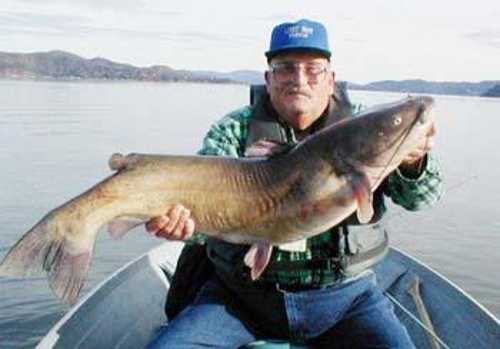
LAKE COUNTY, Calif. – On Saturday, after a long illness, a friend of mine and many other fishermen on Clear Lake passed away.
He was known simply as Catfish Ed by most but his name was Ed Nassarre.
I had the honor of meeting Ed shortly after I moved here in 1997. I pulled up to the mouth of Holiday Harbor in Nice in my car. A man I thought to be 60 or 70 was standing at the mouth of it casting a rattle trap diagonally across the opening. I yelled out, “Are they biting?”
Ed's head snapped around and he reeled in the line and walked over to my car. He said, “Oh, I see the wheelchair there. I wondered why you didn't get out. Yeah they're biting. I'm catching one about every other cast. They're all cookie-cutter bass about 3 pounds. Here, I'll show you,” and he walked back to the water's edge.
Ed made one cast and the rod doubled over. He fought the fish for little while, grabbed his line, and walked the bass over to the car.
He said, “I'm guessing this one to be about 3.2 pounds.” Then he whipped a scale out of his pocket and stuck it in the fish's mouth and showed me the scale. It weighed 3.3 pounds.
He said, “Hey, I'm getting pretty good at this. Hey, I even caught a shopping cart a little while ago.”
We talked a while and I told him about coming from Minnesota and how I'd lived in Sonoma for 14 years before moving up here to buy a home.
Ed was a very friendly and helpful guy and told me that while he liked fish for bass once in a while he really considered it a waste of time as there were big carp and catfish in Clear Lake that fought much harder than the bass.
After I bought a pontoon boat, I had the honor of fishing with Ed one Saturday.
As we were fishing at the mouth of Rodman Slough with shrimp for bait, a local fisherman and now friend of mine Cameron Cole pulled up about 100 feet away in a bass boat and started casting to the shore. Ed yelled, “You fishing a tournament?"
Cameron yelled, “Yes we are," and told the name of the tournament.
Ed yelled, “I don't know why you bass fisherman waste your time with that stuff. You spend all that gas money tearing across the lake at 70 miles an hour from here to there looking for fish that hardly put up a fight when you could be relaxing in a boat fishing for fish twice as big that fight twice as hard at 1/10 the cost.”
I got kind of nervous thinking that Ed might be offending them. But Cameron looked at his partner, threw his head back and laughed and yelled, “You know what? You just may be onto something there.”
After a little friendly banter back and forth Cameron buzzed off for the next promising spot. Ed was always good for a laugh.
I ran into Ed at breakfast a lot and we became good friends. Ed used to make a fishing report and distribute it to local tackle shops and restaurants every Friday before he became familiar with the Internet.
He started asking me about computers and soon told me that he had taken the plunge and got a PC and was learning HTML to make a Web site. He had reserved the name www.catfished.com .
Knowing I built Web sites, Ed was full of questions for a couple of weeks and not long after I started asking him questions as he was a quick learner.
Ed's Web site grew like crazy as people from around the country heard about the huge catfish in Clear Lake.
Ed started promoting the Catfish Derby at the south end of the lake on his Web site and soon all the cat fisherman started looking up his Web site for advice.
Ed was outspoken and you had no trouble hearing him across the room. He acknowledged that it got him into trouble sometimes but I told him that he was in very good company.
For a while I kept my pontoon boat in the harbor and most times when I left or when I returned Ed would be standing on his lawn leaning over the bordering fence with a line in the water.
He would be yelling at everyone around him, "They are biting over here,” and they were biting on whatever bait that Ed was catching them on.
As a joke when I went by him I would put my my finger to my pursed lips and make the “Shhhh.” He would laugh at me and yell, “We don't own the lake. It belongs to everybody.” Ed was not one for keeping secrets about fishing.
Ed was helpful to everyone and had many people coming up to his little piece of heaven which was the trailer at the mouth of Holiday Harbor to fish for mainly carp.
I never did figure out which species Ed liked to fish for most, be it carp, catfish or crappie. He was an expert at all of them although that's something he would never admit to.
Ed loved Lake County like no one else could love Lake County. He called it his paradise. He was a former postal employee who moved up here after visiting on weekends.
Ed would probably scold me if I forgot to remind everybody about the Catfish Derby taking place this weekend.
Ed's Web site will continue on so if you ever needed any advice on catching catfish, bass, carp or crappie visit www.catfished.com , sign up and there will be plenty of helpful fishermen to guide you on your way.
Everyone knew you Ed. We’ll miss you. You will become legendary.
If you'd like to read stories from fisherman about Ed, go to his Web site.
Ed is survived by his wife Mary.
Greg Cornish lives in Nice, Calif.
CLEARLAKE OAKS, Calif. – The Clearlake Oaks/Glenhaven Business Association will hold its 29th annual Catfish Derby this weekend.
The event runs from noon Friday, May 18, through noon Sunday, May 20.
Known by many as “the biggest catfish tournament west of the Mississippi,” the event features an Adult Derby and a Kids Derby for those under 16 years old.
The grand prize winner of the Adult Derby will receive a cash prize of $4,000 (based on minimum of 350 adult entries) and the winner of the Kids Derby will receive a Nintendo Wii System. In addition, each child entrant will receive a commemorative t-shirt.
Derby headquarters will be located at the Clearlake Oaks Fire Station, 12655 East Highway 20, and will be open daily from 8 a.m. to 11 p.m.
Derby headquarters also will be open for preregistration from noon to 11 p.m. on Thursday, May 17.
No registrations will be accepted after 11 p.m. Friday.
Registration for the Adult Derby is $45 ($40 for those who preregister by Thursday). Registration for the Kids Derby is $10.
Proceeds from the event benefit community projects.
For applications, call 888-CL-DERBY, 707-998-1006; for information, 707-998-3795, www.clearlakeoaks.org .
NORTHERN CALIFORNIA – Calling the most recent Bay Delta Conservation Plan delay the “last, best opportunity to stand up to … unreasonable demands,” Reps. Mike Thompson (CA-1), Jerry McNerney (CA-11), George Miller (CA-7), Doris Matsui (CA-5) and John Garamendi (CA-10) called for specific steps to be taken for the plan to move forward in a fair and transparent manner.
The five members from the California congressional delegation have been vocal in calling for changes to the Bay Delta Conservation Plan and have demanded that any plan has significant input from the Bay-Delta region.
In letters sent Wednesday to Gov. Jerry Brown and Secretary of the Interior Ken Salazar, the lawmakers said, “We recognize that some are now calling for an immediate decision, but we believe that it is critical to get this right; a rushed and inadequate Bay-Delta planning effort will lead to increased litigation, uncertainty, and expense.”
“So far in this process we’ve seen too many back-door deals that put the interests of South-of-Delta water contractors before our farmers, fishermen and local communities. Many of our families and small businesses that depend on the Delta would have their livelihood stripped away and the Delta’s diverse wildlife would be destroyed if these politically driven deals were put in place. Federal and state officials need to use this delay to come up with fair and transparent plan that is based on sound science so that our communities, businesses, fish, wildlife and environment in the Delta and north of the Delta are not harmed,” said Rep. Thompson.
“I will not accept any plan for the Delta that is harmful to the farmers, families, and small business owners in the Delta region. To date, the planning process for Delta water has been unduly influenced by wealthy water contractors from south of the Delta who would steal our water, costing us millions of dollars and countless jobs. This delay provides an opportunity for the state and federal governments to stand up to the water contractors and ensure that the BDCP includes the input of our region. I will continue to fight against any measures that would destroy the Delta and our way of life,” said Rep. McNerney.
“More than five years into this process, the Bay Delta Conservation Plan still hasn’t met basic legal or scientific requirements,” said Rep. Miller. “This is the last chance to fix it, and that’s why this delay is so important: it gives the scientists time to get it right. The Bay-Delta’s health is key to California’s future – we can either work out a good plan that reduces reliance on the Delta, or we can end up with increased litigation, uncertainty, and expense.”
“A 50-year permit needs to be done not only right, but with due diligence and equitable treatment to all those affected. I want to see the federal and state agencies take this opportunity to put forward a process and a plan for the Delta region that recognizes the input they’ve received not just from south of Delta interests, but north of Delta interests as well. Our state can’t afford to get this wrong,” said Rep. Matsui.
“As the lynchpin of California’s water system, the economic and environmental sustainability of the Sacramento-San Joaquin Delta must be made front and center in this discussion. It’s the law,” said Rep. John Garamendi. “In addition, using the best available science, we must focus on conservation, storage, and recycling to preserve our state’s ecosystems and to meet the water needs of nearly 40 million Californians.”
The full text of the letter is below and attached.
May 16, 2012
The Honorable Ken Salazar
Secretary
Department of the Interior
1849 C Street, NW
Washington, DC 20240
Dear Secretary Salazar:
We write in response to the recently-announced delay in the timeline for releasing additional details of the proposed Bay Delta Conservation Plan (BDCP). We believe that acknowledging the need for changes and additional scientific review is an important first step towards transforming the BDCP into a plan that meets state and federal legal requirements and into a process that is fair, transparent, and inclusive of communities in the Delta region and Northern California. We recognize that some are now calling for an immediate decision, but we believe that it is critical to get this right; a rushed and inadequate Bay-Delta planning effort will lead to increased litigation, uncertainty, and expense.
As you know, we have raised many objections during the skewed process that has led to this point. We have reached out to state and federal officials repeatedly, as a group and as individuals, to express our view that the BDCP is failing to adequately address the needs of our constituents and the health of the Bay-Delta ecosystem. Our concerns have been largely reinforced by numerous independent analyses and the release of draft environmental documents which show that the leading BDCP proposal will not meet biological goals and may even lead to the extinction of several species, including some of California’s iconic salmon runs. The recent “red flag” comments from state and federal agencies are just the latest indication that the BDCP must be overhauled if it is to be successful.
We also understand that, despite the many flaws with the BDCP, state and federal agencies still hope to make a significant announcement on the plan this summer. We would like to reemphasize our conviction that, before making a determination of a preferred project, state and federal agencies have an obligation to ensure that the BDCP will:
- Vigorously and meaningfully engage local officials from the Bay-Delta region and Northern California in the BDCP process.
- Reflect the best available scientific understanding of the Bay-Delta ecosystem’s needs as required by state law, including the reduction of water diversions from the Bay-Delta.
- Demonstrate an understanding of the economic issues identified by the Delta Protection Commission’s Economic Sustainability Plan for the Sacramento-San Joaquin River Delta.
- Fully analyze a complete range of alternatives, including non-diversion alternatives, the State Water Resource Control Board’s alternative, and proposals put forth by experts from the Delta and Northern California. A cost-benefit analysis of each alternative should also be conducted.
- Define and meet biological goals and ensure that the preferred BDCP proposal is fully consistent with the best available science and relevant federal and state environmental laws.
- Protect water quality and reliability for farmers and communities in the Delta and Northern California.
- Rebuild the Bay-Delta’s fisheries and the thousands of jobs they sustain.
- Preserve flood protection for communities in the Delta and Northern California and include a focus on levee improvements.
- Commit to choosing, clearly and with intent, the “least environmentally damaging practicable alternative” as federal law requires.
- Meet the requirements of state law by including alternative water supplies as a way to increase water supply reliability and reduce dependence on the Delta.
Our constituents have repeatedly demonstrated that they are ready, willing, and able to participate in a BDCP process that is truly collaborative and transparent. Despite the good intentions of our constituents, the BDCP has been dominated by south-of-Delta contractors with a long history of opposing balanced solutions to the challenges facing California’s water system.
The recently-announced delay in the BDCP may represent the last, best opportunity to stand up to the unreasonable demands of south-of-Delta water contractors and change the BDCP into a plan that can enjoy support throughout the entire state of California.
Thank you for your attention to this letter. We look forward to your response.
Sincerely,
Jerry McNerney
George Miller
Mike Thompson
Doris Matsui
John Garamendi
NORTHERN CALIFORNIA – Department of Fish and Game (DFG) biologists are trying a new tactic to help California’s ocean-bound juvenile salmon, in hopes of increasing survival rates.
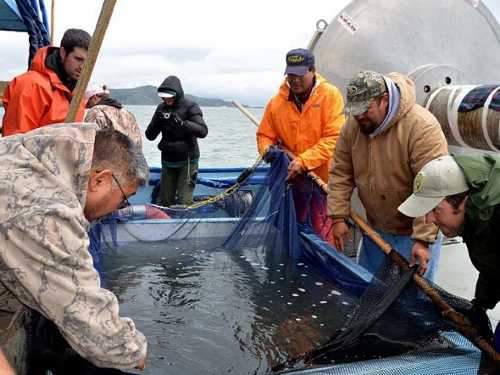
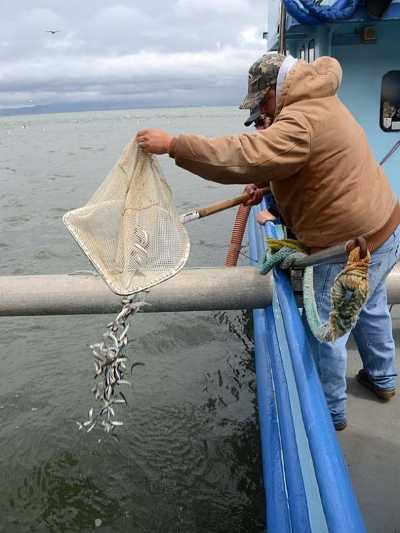
On May 3, for the first time in state history, DFG staff used a boat to move approximately 100,000 young Chinook (called smolts) down the Sacramento River to San Francisco Bay.
Upon arrival, the smolts were released in the Bay, where they will grow to adulthood before returning upriver to spawn.
“We’ve been using trucks to transport smolts to points downstream for years, but we’ve never moved them by barge, and we’ve never moved them this far,” said DFG Environmental Scientist Colin Purdy, who supervised the boat transport to the Bay Area.
“Truck releases are typically much further upstream, and though they do shorten the fish’s journey to the ocean, they still face all kinds of hazards in the river,” Purdy said. “It’s possible we could better the chances of survival for this species just by making a few thoughtful changes in our operating practices. The data we collect over the next few years will tell the story, but we’re hopeful that we’ll see positive results.”
Salmon return to their spawning grounds using their sense of smell.
The process, called imprinting, begins before birth as waters flow over the eggs and continues as they grow and make their way to the ocean.
Each segment of water on their journey has distinctive chemical cues which they can re-trace to their spawning grounds.
Water is circulated through pumps from the Sacramento River into the boat’s holding tank, where the fish are kept.
The hope is that this may improve their ability to find their way back as an adult and predators are unable to access the fish in the holding tank during the journey downstream.
This is the beginning of a multiyear study program aimed at increasing return rates of salmon from the sea to their native rivers.
Over the next few years, scientists will use the data collected from the fish to test and evaluate the idea that overall survival rates and increased adult returns can be better achieved by barging the young salmon downstream.
To form a basis of comparison for this study, two other control groups of 100,000 smolts each were released by trucks in other locations at the same time as the barge release – one at a different location in the Bay, and one into the Sacramento River near Sacramento.
All 300,000 fish in this study were implanted with coded wire tags smaller than a tiny piece of pencil lead, which will ultimately enable scientists to tell which of the three groups the returning fish came from – the barge release, or one of the two truck releases.
The study is being conducted by DFG fisheries biologists with the support of the Commercial Salmon Trollers Advisory Committee, which donated the use of the boat, fuel and crew time to help ensure a successful start to the study. They have committed to helping DFG for the next three years of data collection.
“This has been a major cooperative effort and we really appreciate DFG’s willingness to work with everybody and look at new ways of doing things,” said Zeke Grader, executive director of the Pacific Coast Federation of Fishermen. “DFG is committed to decreasing straying rates among the salmon migrating up the Sacramento River. Barging may be one way to achieve this goal.”
Scientists hope to confirm that – unlike the usual method of transporting the fish by truck – the boat transport will both eliminate in-river hazards such as getting lost or being eaten by predators, and give the smolts a chance to imprint on their native stream on their way to the ocean, improving their chances of successful return.
LOWER LAKE, Calif. – The Konocti Unified School District has a new superintendent.
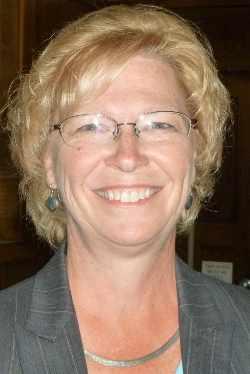
At its regular meeting on Wednesday evening, the Konocti Unified School District Board of Trustees announced that Donna Becnel has been selected to serve as district superintendent effective July 1.
Becnel will succeed Superintendent Dr. William MacDougall, who will retire on June 30.
Board President Anita Gordon said the board was unanimous in the decision to hire Becnel.
Gordon commented that the district is fortunate to have found such an experienced and skilled school administrator to provide leadership to the students and staff of the Konocti Unified School District.
Becnel currently serves as the assistant superintendent for human resources in the Hayward Unified School District.
Before coming to Hayward, she worked in personnel services in the Antioch, San Lorenzo and Castro Valley Unified School districts.
Her first administrative position was in the Mt. Pleasant School District where she served as director of special education and pupil services. Mt. Pleasant is a district about the same size as Konocti located in the San Jose area.
Although her main area of expertise has been in human resources, she has likewise had experience in business services including budget preparation and management as well as experience in curriculum and instructional services.
In the Hayward District, she designed and implemented a program called “Aspiring Administrators” to provide coaching and mentoring support to new certificated and classified management staff.
She has been involved in the communities where she has worked volunteering for community service through Rotary, Chamber of Commerce and the Police Activities League.
She currently serves on the board of directors for a nonprofit that provides counseling services to the local schools and community.
Konocti Unified conducted a nationwide search for the superintendent position and received more than 30 applications.
The applications were screened by a team of educators and the board selected eight candidates to be interviewed.
Each candidate not only had an hour long interview with the school board but also met with a community committee composed of 17 local citizens including parents, community business leaders, teachers, classified staff, parents and school administrators.
After listening to the input from the community committee, the board selected three candidates for a second interview.
Once they identified the top candidate, two board members visited the current district of employment to interview teachers, staff and co-workers, the district reported.