 How to resolve AdBlock issue?
News
California Attorney General Kamala Harris on Tuesday announced that claim forms will be sent to approximately 432,584 California borrowers who lost their homes to foreclosure between Jan. 1, 2008, and Dec. 31, 2011, and may be eligible for a settlement payment under the $25 billion national mortgage foreclosure settlement.
Borrowers receiving the claim forms had mortgages serviced by Ally/GMAC, Bank of America, Citi, JPMorgan Chase and Wells Fargo, the servicers that agreed to the settlement with the federal government and attorneys general of 49 states and the District of Columbia.
The settlement, which was signed by the Court in April 2012, earmarked approximately $1.5 billion in payments for 2 million borrowers nationwide. The actual payment amount will depend upon the total number of borrowers who decide to participate. Payment checks are expected to be mailed in mid-2013.
Last week, the national settlement administrator mailed notification postcards to eligible borrowers across the nation.
In California, packets containing a letter from the California Department of Justice, a claim form and answers to frequently asked questions are being mailed to eligible borrowers starting this week and continuing through October 12.
Eligible California borrowers should complete the claim form and return it as soon as possible in the envelope provided, or file the claim form online at www.nationalmortgagesettlement.com . The deadline for all claims is Jan. 18, 2013.
The one-page claim forms are simple to complete. Borrowers who have questions or need help filing a claim should contact the settlement administrator, toll-free, at 866-430-8358, or send questions by email to
Eligible borrowers do not need to prove financial harm to receive a payment, nor do they give up their rights to pursue a lawsuit against their mortgage servicer or to participate in the Independent Foreclosure Review Process being conducted by federal bank regulators. More information about that program is available at www.independentforeclosurereview.com .
Eligible borrowers may receive payment from this settlement even if they participate in another foreclosure claims process. However, any payment received may reduce payments that a borrower may be eligible to receive in any other foreclosure claim process or legal proceeding.
Borrowers who believe they may qualify for a payment, but did not receive a notice because they have moved, should contact the settlement administrator, toll-free, at 866-430-8358, or send an updated address by email to
Attorney General Harris also is warning all homeowners to be aware of settlement-related scams. Do not provide personal information or pay money to anyone who calls or emails and claims to provide settlement-related assistance. The official claim form does not ask for personal financial information. If you believe someone is conducting a settlement-related scam, please file an online complaint with the Attorney General’s Public Inquiry Unit at http://oag.ca.gov/consumers/general .
The national settlement followed state and federal investigations, which alleged that the five mortgage servicers routinely signed foreclosure-related documents outside the presence of a notary public and without personal knowledge that the facts contained in the documents were correct.
This civil law enforcement action also alleged that the servicers committed widespread errors and abuses in their foreclosure processes.
The settlement resulted in broad reform of the mortgage servicing process, as well as financial relief for borrowers who are still in their homes via direct loan modification relief, including principal reduction.
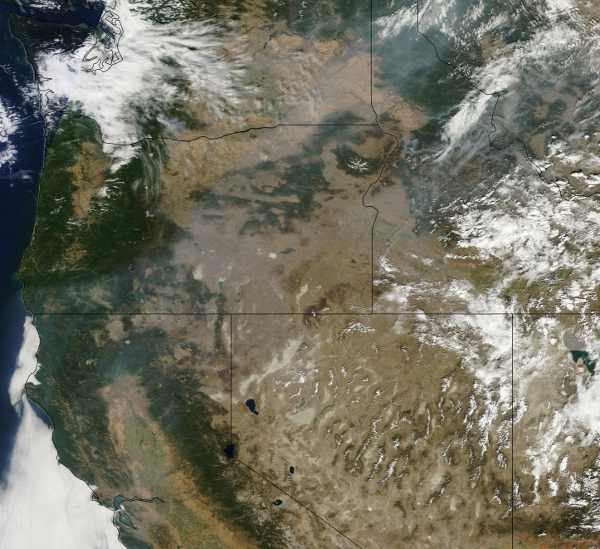
LAKE COUNTY, Calif. – Although there were no new wildland fires in Lake County on Tuesday, concerned residents reported seeing smoke and haze in the air basin.
Their senses weren’t deceiving them: a new intrusion of wildland fire smoke – this time from several states away – was coming into the area.
Lake County Pollution Control Officer Doug Gearhart said the source of the smoke is a major wildland fire in northern Idaho and parts of western Montana.
A NASA/MODIS satellite image posted above shows the smoke making its way down from Idaho, through Washington, Oregon and into Northern California.
The image shows that the smoke appears to be originating from the area of Idaho’s biggest wildland fire, the lightning-caused Mustang Complex in the Salmon-Challis National Forest, burning just over the Montana sate line.
On Tuesday the fire was at 336,744 acres, with 25 percent containment, according to the US Forest Service.
Gearhart the smoke from Idaho has been passing into the air basin for several days.
“It actually affected our air quality on Friday,” he said, noting that while it didn’t cause state health standards to be exceeded, particulate level was raised.
Lakeport Fire Chief Ken Wells, who confirmed to Lake County News that there were no reports of new fires in the county on Tuesday, also cited a pressure system moving over Northern California as a contributing factor to moving the smoke to the county.
Email Elizabeth Larson at
NORTH COAST, Calif. – A 4.5-magnitude earthquake shook the Mendocino and Lake County areas on Tuesday morning.
The quake occurred at 8:15 a.m. two miles north of Talmage, three miles east northeast of Ukiah and 14 miles west of Upper Lake, according to the US Geological Survey. It was recorded at a depth of 6.2 miles.
The US Geological Survey had received 285 shake reports from 26 zip codes by 9:30 a.m.
Reports came from up and down the coast, as well as Kelseyville, Lakeport, Nice, Upper Lake and Witter Springs.
The Mendocino County Sheriff's Office said Tuesday morning that no reports of damage had yet been made.
Citizens were encouraged to report damage to the Mendocino County Office of Emergency Services at 707-467-6497 or by email at
Email Elizabeth Larson at
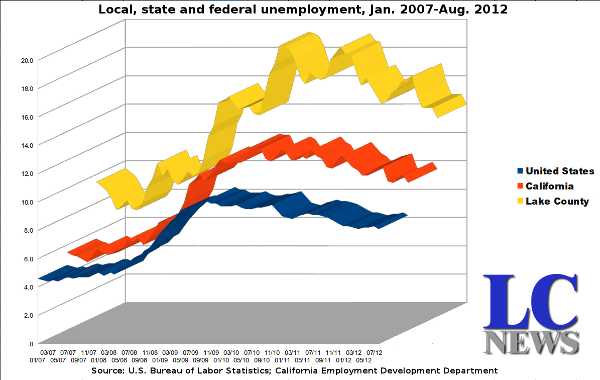
LAKE COUNTY, Calif. – Unemployment numbers reported for August showed slight improvements in Lake County, and across California and the nation.
The California Employment Development Department’s latest report put Lake County’s unemployment rate at 14 percent in August, down from 14.7 percent in July and 15.6 percent in August 2011.
The statewide unemployment rate for August was 10.6 percent, down just slightly from the 10.7 percent rate reported in July and the 11.9 percent rate for August 2011, the agency reported.
Nationwide, the Bureau of Labor Statistics reported that unemployment in August was 8.1 percent, down from 8.3 percent in July and 9.1 percent in August 2011.
Dennis Mullins of the Employment Development Department’s North Coast Region Labor Market Information Division said Lake County’s wage and salary employment increased 430 jobs between July and August. Farm jobs accounted for the bulk of the increase, thanks to the summer harvest of important local products like pears.
For the year over, Lake is down 220 jobs with government accounting for over three-fourths of the cutbacks. Six industry sectors gained or were unchanged over the year and five declined, Mullins said.
He said year-over job growth occurred in trade, transportation and utilities, +10; and private educational & health services, +20.
Industry sectors with no change over the year were farm, manufacturing, information and financial activities, Mullins said.
Industry sectors with decline over the year included mining, logging and construction, -30; professional and business services, -10; leisure and hospitality, -10; other services, -10 ; and government, -170, according to Mullins.
Lake County was ranked No. 45 among California’s 58 counties for its August unemployment rate. Neighboring counties showed the following rates: Colusa County, No. 54, 15.2 percent; Glenn, No. 51, 14.6 percent; Mendocino, No. 16, 9.3 percent; Napa, No. 4, 7.5 percent; Sonoma, No. 8. 8.3 percent; and Yolo, No. 22. 9.7 percent.
Details about California’s job picture
In August California’s nonfarm payroll jobs increased by 12,000 to 14,346,300, for a year-over-year change of 298,700 jobs and a total gain of 504,000 jobs since the recovery began in February 2010, according to data the Employment Development Department derived from two separate state and federal surveys.
The federal survey of households the agency uses, done with a smaller sample than the state survey of employers, showed a decrease in the number of employed people, estimating the number of Californians holding jobs in August was 16,404,000, a decrease of 38,000 from July, but up 203,000 from the employment total in August of last year.
The number of people unemployed in California was 1,935,000 – down by 27,000 over the month, and down by 243,000 compared with August of last year, the report showed.
EDD’s report on payroll employment (wage and salary jobs) in the nonfarm industries of California totaled 14,346,300 in August, a net gain of 12,000 jobs since the July survey. This followed a gain of 17,900 jobs, as revised, in July.
Six categories – construction; manufacturing; information; financial activities; educational and health services; and leisure and hospitality – added jobs over the month, gaining 23,300 jobs, according to the report. Educational and health services posted the largest increase over the month, adding 8,900 jobs.
Five categories – mining and logging; trade, transportation and utilities; professional and business services; other services; and government – reported job declines over the month, down 11,300 jobs. The report showed that government posted the largest decrease over the month, down 7,400 jobs.
The Employment Development Department said nine categories – mining and logging; construction; trade, transportation and utilities; information; financial activities; professional and business services; educational and health services; leisure and hospitality; and other services – posted job gains over the year, adding 329,100 jobs.
Of those categories, professional and business services posted the largest gains on a numerical basis, adding 103,200 jobs, up 4.8 percent. Construction posted the largest gains on a percentage basis, up 6.0 percent, adding 33,000 jobs, according to the jobs report.
Two categories, manufacturing and government, posted job declines over the year, down 30,400 jobs, the Employment Development Department report said. Government posted the largest decline on both a numerical and percentage basis, down by 23,400 jobs, a 1-percent decrease.
The Employment Development Department said there were 501,158 people receiving regular unemployment insurance benefits during the August survey week, compared with 518,605 in July and 543,089 in August of last year.
The agency said new claims for unemployment insurance were 51,467 in August, compared with 52,336 in July and 54,463 in August 2011.
Email Elizabeth Larson at
Gov. Jerry Brown on Monday signed a bill that makes it easier for Californians to vote by allowing same-day voter registration.
Assembly Bill 1436, authored by Assemblyman Mike Feuer (D-Los Angeles), allows same-day voter registration, giving Californians the right to vote with a provisional ballot if the conditional voter registration is deemed effective.
“Voting – the sacred right of every citizen – should be simple and convenient,” said Gov. Brown. “While other states try to restrict voters with new laws that burden the process, California allows voters to register online – and even on Election Day.”
A statement from Feuer’s office said AB 1436 is meant to increase voter turnout by allowing potential voters to register in the days preceding an upcoming election, including Election Day.
“This new law will help assure that all eligible Californians will have the chance to determine who speaks for them in Washington, Sacramento and their home towns,” said Feuer. “By recognizing the importance of increasing voter turnout in our state, we are improving the democratic process in California.”
Currently in California, voter affidavits must be hand-delivered or postmarked to a county elections office at least 15 days before the election. Exceptions are made for people who become U.S. citizens 7-14 days before Election Day. These individuals are allowed to register and vote up to seven days prior to the election.
Currently, 10 states allow some form of Election Day registration, including Connecticut, Idaho, Minnesota and Wisconsin.
The provisions of AB 1436 will go into statute on Jan. 1, 2014, and the law will take effect when Vote Cal, the state’s federally mandated statewide voter database, is fully implemented by the Secretary of State’s office.
Last year, Gov. Brown signed Senate Bill 397 (Yee) allowing Californians to register to vote online.
California Attorney General Kamala Harris announced Monday that two bills that will make it more difficult for human traffickers to hide their assets have been signed into law by Gov. Jerry Brown.
Assembly Bill 2466, by Bob Blumenfield (D-San Fernando Valley), ensures that criminal defendants involved in human trafficking will not dispose of assets that would otherwise be provided as restitution to victims.
Senate Bill 1133, by Mark Leno (D-San Francisco), expands the list of assets that a human trafficker must forfeit and provides a formula for using those resources to help victims of human trafficking. Both laws will take effect on January 1, 2013.
“With these new laws, California prosecutors and law enforcement officials will be able to seize assets of human traffickers, cripple their operations and aid victims,” said Harris. “Human trafficking is big business in California. It is a high profit criminal industry that is expanding rapidly across the globe, including here in California.”
Assembly Bill 2466 (Preservation of Assets for Victims of Human Trafficking), will help to ensure that more victims of human trafficking receive restitution.
Under California law, victims are entitled to mandatory restitution; however there are no laws to help prevent human trafficking defendants from liquidating and hiding their assets before conviction.
Assembly Bill 2466 will allow a court to order the preservation of the assets and property by persons charged with human trafficking.
“We need all hands on deck to confront trafficking,” Blumenfield said. “Trafficking is slavery. Now, the perpetrators of this despicable crime cannot game the system and keep their money when caught and convicted. Justice will come for victims.”
Senate Bill 1133 ensures that those convicted of human trafficking crimes involving minors will not be able to keep the financial benefits reaped from their unlawful activity.
The law expands the scope of property subject to forfeiture and provides a formula to redirect those resources to community groups that aid victims of human trafficking.
“Today we are one step closer to dismantling the economic infrastructure that convicted child sex traffickers rely on to continue to lure young people into the sex trade,” said Sen. Leno. “In addition to taking away the lucrative profits from these horrendous crimes, we are providing much-needed financial support for increased investigations and victim services.”
Attorney General Harris is committed to the fight against this fast-growing crime that deprives persons of basic human rights.
Harris cosponsored the California Human Trafficking Victims Protection Act of 2005, which made human trafficking a felony in California. She also has served on the California Alliance to Combat Trafficking and Slavery Task Force.
Last Friday, Attorney General Harris and Mexico Attorney General Marisela Morales Ibáñez signed an accord to expand prosecutions and secure convictions of criminals who engage in the trafficking of human beings.
The accord will increase coordination of law enforcement resources targeting transnational gangs that engage in the sale and trafficking of human beings across the California-Mexico border.
It also calls for closer integration on human trafficking investigations between the two offices and the sharing of best practices for law enforcement to recognize instances of human trafficking and provide support and services to victims.
Human trafficking is estimated to be a $32 billion industry, the world’s third most profitable criminal enterprise behind drugs and arms trafficking.
Human trafficking involves the recruitment, smuggling, transporting, harboring, buying, or selling of a person for purposes of exploitation, prostitution, domestic servitude, sweatshop labor, migrant work, agricultural labor, peonage, bondage, or involuntary servitude.
While human trafficking often involves the smuggling of human beings across international borders, numerous Americans are trafficked around the United States ever year. Human trafficking strips people, especially women and children, of their freedom and violates our nation’s promise that every person in the United States is guaranteed basic human rights.
For more information on the trafficking of human beings, go to www.oag.ca.gov/human-trafficking .