 How to resolve AdBlock issue?
News
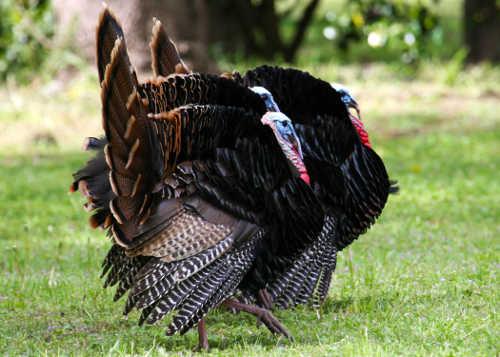
With shorter days and a chilly nip in the air, we know fall has arrived and winter is not too far off.
As the season changes, so do the habits of wildlife. Bears stock up on calories for winter hibernation, birds migrate to warmer climates and wild turkeys seem to come out in droves.
While these wild game birds may seem harmless and approachable, they can cause problems. Many homeowners can’t resist feeding them.
What starts out as innocent fun can become a nuisance if the birds start destroying flower and vegetable gardens, leaving their droppings on patios and decks or roosting on cars where they may scratch the paint.
This time of year, Department of Fish and Game (DFG) typically sees an increase in complaints about nuisance wild turkeys.
DFG recommends the following:
- Never feed wild turkeys.
- If turkeys are causing problems in your yard, remove all sources of food such as bird feeders and/or pet food, and consider motion-detecting sprinklers to discourage visits.
- Know that wild turkeys typically will not enter yards with dogs.
- If confronted by a wild turkey behaving aggressively, slowly back away. Turkeys often strut and gobble at people, but very rarely actually come into contact with them.
- If you find an injured turkey, report it to your nearest DFG regional office.
- Depredation permits can be issued if wild turkeys are causing excessive property damage. For more information on wild turkeys, visit: www.dfg.ca.gov/keepmewild/turkey.html .
Weighing up to 20 pounds, the wild turkey is native to North America.
These majestic birds were once a primary food source for Native Americans and early settlers.
In the early 1900s, deforestation and market hunting brought turkeys to the brink of extinction. But through better wildlife management and improved forestry practices, the wild turkey is a true success story, with an estimated population of 7 million in the wild today.
Males, called toms or gobblers, have long reddish-yellow to grayish-green legs and a black body. When excited, his head turns blue; when ready to fight, it turns red.
Toms fan their tails, strut, and gobble with a beard that protrudes from their chest. Each foot has four toes as well as a spur up its leg.
Earlier this year, the Fish and Game Commission (FGC) expanded wild turkey hunting from 16 to 30 days, marking the fall season from Nov. 10-Dec. 9.
In addition, the FGC also increased the season limit from one to two turkeys.
Hunters may take one turkey (either-sex) per day and two per person.
More information on additional hunt dates can be found here: www.dfg.ca.gov/regulations/upland-summary-12-13.html .
Solar systems with life-bearing planets may be rare if they are dependent on the presence of asteroid belts of just the right mass, according to a study by Rebecca Martin, a NASA Sagan Fellow from the University of Colorado in Boulder, and astronomer Mario Livio of the Space Telescope Science Institute in Baltimore, Md.
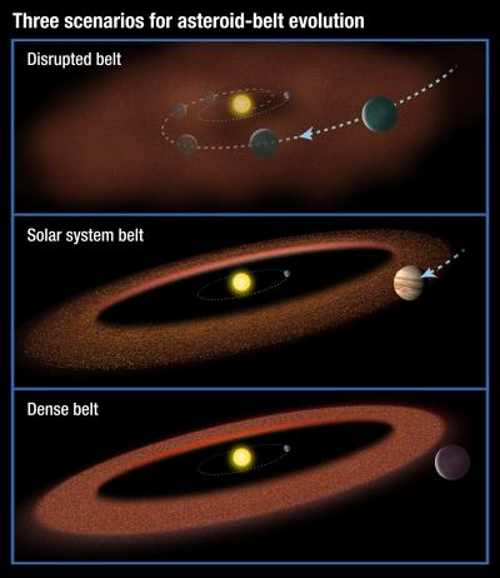
They suggest that the size and location of an asteroid belt, shaped by the evolution of the sun’s protoplanetary disk and by the gravitational influence of a nearby giant Jupiter-like planet, may determine whether complex life will evolve on an Earth-like planet.
This might sound surprising because asteroids are considered a nuisance due to their potential to impact Earth and trigger mass extinctions. But an emerging view proposes that asteroid collisions with planets may provide a boost to the birth and evolution of complex life.
Asteroids may have delivered water and organic compounds to the early Earth. According to the theory of punctuated equilibrium, occasional asteroid impacts might accelerate the rate of biological evolution by disrupting a planet’s environment to the point where species must try new adaptation strategies.
The astronomers based their conclusion on an analysis of theoretical models and archival observations of extrasolar Jupiter-sized planets and debris disks around young stars.
“Our study shows that only a tiny fraction of planetary systems observed to date seem to have giant planets in the right location to produce an asteroid belt of the appropriate size, offering the potential for life on a nearby rocky planet,” said Martin, the study’s lead author. “Our study suggests that our solar system may be rather special.”
The findings will appear today in the Monthly Notices of the Royal Astronomical Society.
Martin and Livio suggest that the location of an asteroid belt relative to a Jupiter-like planet is not an accident.
The asteroid belt in our solar system, located between Mars and Jupiter, is a region of millions of space rocks that sits near the “snow line,” which marks the border of a cold region where volatile material such as water ice are far enough from the sun to remain intact.
At the time when the giant planets in our solar system were forming, the region just beyond the snow line contained a dense mix of ices, rock and metals that provided enough material to build giant planets like Jupiter.
When Jupiter formed just beyond the snow line, its powerful gravity prevented nearby material inside its orbit from coalescing and building planets. Instead, Jupiter’s influence caused the material to collide and break apart. These fragmented rocks settled into an asteroid belt around the sun.
“To have such ideal conditions you need a giant planet like Jupiter that is just outside the asteroid belt [and] that migrated a little bit, but not through the belt,” Livio explained. “If a large planet like Jupiter migrates through the belt, it would scatter the material. If, on the other hand, a large planet did not migrate at all, that, too, is not good because the asteroid belt would be too massive. There would be so much bombardment from asteroids that life may never evolve.”
In fact, during the solar system’s infancy, the asteroid belt probably had enough material to make another Earth, but Jupiter’s presence and its small migration towards the sun caused some of the material to scatter.
Today, the asteroid belt contains less than one percent of its original mass. Using our solar system as a model, Martin and Livio proposed that asteroid belts in other solar systems would always be located approximately at the snow line.
To test their proposal, Martin and Livio created models of protoplanetary disks around young stars and calculated the location of the snow line in those disks based on the mass of the central star.
They then looked at all the existing space-based infrared observations from NASA’s Spitzer Space Telescope of 90 stars having warm dust, which could indicate the presence of an asteroid belt-like structure.
The temperature of the warm dust was consistent with that of the snow line. “The warm dust falls right onto our calculated snow lines, so the observations are consistent with our predictions,” Martin said.
The duo then studied observations of the 520 giant planets found outside our solar system. Only 19 of them reside outside the snow line, suggesting that most of the giant planets that may have formed outside the snow line have migrated too far inward to preserve the kind of slightly-dispersed asteroid belt needed to foster enhanced evolution of life on an Earth-like planet near the belt.
Apparently, less than four percent of the observed systems may actually harbor such a compact asteroid belt.
“Based on our scenario, we should concentrate our efforts to look for complex life in systems that have a giant planet outside of the snow line,” Livio said.
LAKEPORT, Calif. – The jury in the murder trial of a former Maine resident heard from one of the man’s oldest friends about the circumstances that led to the murders of a Maine couple in early 2010.
Thirty-year-old Elijah Bae McKay was on the witness stand for the entire day Friday in the trial of his childhood friend, Robby Alan Beasley.
The 32-year-old Beasley is on trial for the January 2010 murders of Frank and Yvette Maddox of Augusta, Maine.
Beasley is charged with two counts of murder, and special allegations of committing multiple murders in the first or second degree, committing the offenses with the intent to inflict great bodily injury on the victims and using a 9 millimeter firearm to shoot the Maddoxes multiple times along the side of Morgan Valley Road near Lower Lake before dragging their bodies down an embankment.
McKay, Beasley and the Maddoxes all were involved in the lucrative marijuana industry, with the motivation to kill them being that Beasley allegedly believed that the Maddoxes had stolen marijuana from him.
Growing and trafficking marijuana would be a topic of much of McKay’s Friday testimony.
McKay had been on the stand briefly on the first day of testimony on Wednesday. At that time he made a statement during what Judge Andrew Blum said on Friday was a “long-winded narrative” that could have caused prejudice. Specifically, McKay had recalled that Beasley had “threatened to kill people” years ago in high school in Maine.
Defense attorney Stephen Carter filed a mistrial motion over the comment, which Blum again admonished the jury on Friday to disregard. Blum has not yet made a ruling on the mistrial motion.
Under questioning by Senior Deputy District Attorney Art Grothe, McKay recounted a conversation on the porch of his Lower Lake home on the morning of Jan. 20, 2010, two days before Beasley is alleged to have killed the Maddoxes.
Beasley brought up the idea of killing the couple, saying he already had dug holes for their bodies. He suggested pulling out their teeth to prevent them from being identified. McKay testified that he thought that would have been “ridiculous” and that it would be easier to chop off their heads, but that their hands also would need to be chopped off to prevent their fingerprints from being used to identify them.
McKay said he told Beasley that killing the couple was a bad idea due to all of the trouble he would get into. He also suggested that if Beasley killed the Maddoxes, he would never get back the money from the marijuana they allegedly stole from his Clearlake apartment.
McKay testified to telling Beasley that he should instead scare them by shooting off some rounds at their feet and interrogating them, and telling them to go back to Maine and work off the money. “He agreed to do that rather than shoot them,” McKay said.
Beasley planned to use the pretense that his grandmother had died to get the Maddoxes to agree to giving him a ride to the airport. McKay recalled Beasley making himself tear up so he could convince them he was grieving. “I was very surprised that he could make himself cry.”
Two days later, McKay was at his brother’s birthday party in Clearlake in the late afternoon. Beasley called him and said the Maddoxes had agreed to give him a ride to the airport, and he planned to try to scare them. However, he wanted McKay to be ready to come and pick him up, as he didn’t believe he would be able to be in the vehicle with them after threatening them.
Within a few hours, Beasley texted McKay saying he was ready to be picked up. “Change of plans, meet me at the gate,” was what McKay recalled the text said.
When McKay found Beasley with the Maddoxes’ pickup on the side of the road, not far from McKay’s home, an “extremely distressed” Beasley told him, “It didn’t work out as planned.”
McKay asked where the Maddoxes were. Beasley said he had shot them. McKay then asked if he had at least buried them. “He said no, that there were cars driving by and he got scared,” McKay testified.
When McKay told Beasley he was going to drive him back to where the bodies were so he could bury them, Beasley refused and a frustrated McKay gave up trying to convince him. Instead, he took Beasley back to his house.
“I was basically trying to make a bad situation better,” McKay said.
McKay said he stripped Beasley naked, burned all of his clothes, backpack and both of their cell phones on his back lawn. He gave Beasley some clothes, including a leather jacket. The next morning, they moved the couples’ pickup down to the Jerusalem Grade area near Middletown.
Recounting details of roadside confrontation
McKay said Beasley told him that as he was riding with the Maddoxes down Morgan Valley Road he asked them to pull over in a turnout so he could urinate. Frank Maddox got out with him, and while they were out of the pickup Beasley alleged pulled out a 9 millimeter pistol McKay had loaned him.
Beasley then pulled Yvette Maddox from the pickup and began to interrogate them about stealing his marijuana, but neither would admit to it, despite him firing some rounds into the ground at their feet, said McKay.
After they still wouldn’t talk, Beasley shot Frank Maddox in the leg and Yvette Maddox fainted or, as McKay recalled Beasley describing it, “played possum.”
Frank Maddox reportedly told Beasley, “You shot me. You better kill me or I’ll kill you,” McKay testified.
He said Beasley shot Frank Maddox in the head before also shooting Yvette Maddox in the head. Beasley then drug both down the hill and, in the process of doing so, realized both were still alive. So he shot each of them in the head again.
When Beasley saw vehicles driving by, he told McKay that he panicked and left, driving the pickup to a nearby gate. McKay would later tell Beasley that he didn’t appreciate being put at risk by having Beasley kill the couple and dump their bodies near his driveway.
Beasley offered McKay $20,000 to bury the couple, but McKay told him there was “no way in hell” he would put his footprints out there.
McKay also testified that Beasley had offered him $20,000 to kill the Maddoxes during the conversation on his porch two days before the murders.
“I told him no,” McKay said. “If he wanted them dead he'd have to do it himself.”
When the men went to get rid of the Maddoxes’ pickup the day after the murders, McKay said Beasley was having second thoughts because they didn’t admit their guilt.
He said Beasley also had raised suspicions about another couple having stolen the marijuana, suggesting maybe he should kill them, testimony that Carter wanted to keep out. The judge will hear motions on that evidence next week.
As for the 9 millimeter handgun that Beasley borrowed from McKay and is alleged to have used in the murders, he told McKay, “Nobody’s ever going to find it,” McKay said on the stand.
Under Carter’s cross-examination, McKay explained that he had been born in Santa Rosa, and when he was 1 year old his family moved to Maine, where he lived until he was 22 years old.
McKay lived in Gardiner, seven miles outside of Augusta, where he and Beasley grew up together.
Later, he moved back to California, working in the Bay Area, and eventually coming north, spending several years growing marijuana in Mendocino County before coming over to grow in Lake County. He would invite Beasley to come out and work for him.
He said he met the Maddoxes in the fall of 2009 before heading to New York for a fishing trip. Beasley had done well for himself in the previous year and wanted to bring the Maddoxes, who were friends, out so he could help them.
Beasley helped take care of McKay’s growing operation when he was gone on the fishing trip, getting a pound of marijuana, worth about $2,500, in return. The only time McKay said he had contact with Beasley during the trip was when Beasley called to tell him he had chopped the tip off of his finger.
Blum ordered the jury to return at 11 a.m. Wednesday, Nov. 14, when testimony will continue.
Email Elizabeth Larson at
Warmer air temperatures high above the Antarctic led to the second smallest seasonal ozone hole in 20 years, according to NOAA and NASA satellite measurements.
This year, the average size of the ozone hole was 6.9 million square miles. The ozone layer helps shield life on Earth from potentially harmful ultraviolet (UV) radiation that can cause skin cancer and damage plants.
The Antarctic ozone hole forms in September and October, and this year, the hole reached its maximum size for the season on Sept. 22, stretching to 8.2 million square miles, roughly the area of the United States, Canada and Mexico combined.
In comparison, the largest ozone hole recorded to date was in 2000 at 11.5 million square miles.
The Antarctic ozone hole began making a yearly appearance in the early 1980s, caused by chlorine released by manmade chemicals called chlorofluorocarbons or CFCs.
The chlorine can rapidly break apart ozone molecules in certain conditions, and the temperature of the lower stratosphere plays an important role.
“It happened to be a bit warmer this year high in the atmosphere above Antarctica, and that meant we didn’t see quite as much ozone depletion as we saw last year, when it was colder,” said Jim Butler with NOAA’s Earth System Research Laboratory in Boulder, Colo.
Even 25 years after an international agreement was signed to regulate production of ozone-depleting chemicals, the ozone hole still forms each year.
In fact, it could be another decade before scientists can detect early signs of Antarctic ozone layer recovery, according to a paper by NOAA researchers and colleagues published last year.
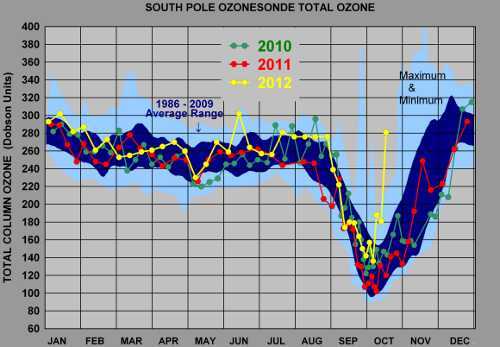
The ozone layer above Antarctica likely will not return to its early 1980s state until about 2060, noted NASA atmospheric scientist Paul Newman.
The length of time needed for this full recovery is due in part to the large quantity and long lifetime of ozone-depleting substances in the atmosphere.
Climate change may also affect the rate of ozone recovery by cooling the stratosphere, which has several competing effects on ozone depletion.
Monitoring the ozone’s state remains important because the ozone layer acts as Earth’s natural shield from DNA-mutating UV radiation.
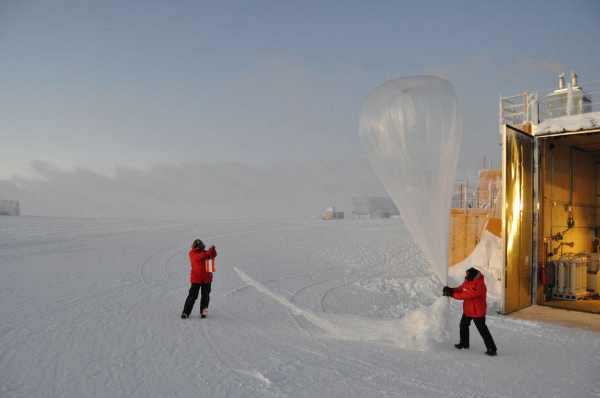
Under the mandate of the Clean Air Act, NOAA and NASA scientists keep a close eye on the ozone layer’s health with satellite data, ground-based measurements and balloon-borne instruments.
A new ozone-monitoring instrument on Suomi-NPP weather satellite, the Ozone Mapping Profiler Suite (OMPS), will be key to that effort. OMPS will extend the satellite record of ozone hole extent, which dates back to the early 1970s, and will provide more detail about ozone levels at various layers in the atmosphere and around the globe.
“OMPS Limb instrument looks sideways, and it can measure ozone as a function of height,” says Pawan Bhartia, NASA atmospheric physicist and OMPS instrument lead.
“This OMPS instrument allows us to more closely see the vertical development of Antarctic ozone depletion in the lower stratosphere where the ozone hole occurs.”
Balloon-borne and ground-based instruments provide ozone data when darkness prevents satellite observations. “The sun doesn’t rise above the South Pole horizon until about Sept. 22, by which time ozone depletion has already begun,” said NOAA atmospheric scientist Irina Petropavlovskikh.
NOAA’s mission is to understand and predict changes in the Earth's environment, from the depths of the ocean to the surface of the sun, and to conserve and manage our coastal and marine resources. Visit them at www.noaa.gov and join them on Facebook, Twitter and other social media channels.
LAKE COUNTY, Calif. – The Lake County community will come together this weekend during the annual Veterans Day celebration to honor those who have served their country.
The public is invited to the event, which will take place beginning at 11 a.m. Sunday, Nov. 11, at Konocti Visa Casino. Doors open at 10 a.m.
The Veterans Day ceremony will include presentations of the County’s annual “Friend of the Veteran” and United Veterans Council’s “Veteran of the Year” awards.
Konocti Vista Casino will provide a complimentary lunch to those who attend.
Konocti Vista Casino is located at 2755 Mission Rancheria Road in Lakeport.
For more information call 707-274-9512.
SANTA ROSA, Calif. – In response to the overwhelming amount of needed support, the American Red Cross continues to provide aid, supplies and comfort to the disaster victims of Hurricane Sandy.
The local Red Cross sent 31 volunteers to the East Coast, where they are helping to feed and shelter the thousands of people displaced by the hurricane. More local volunteers are ready to go and expected to deploy in the next four weeks.
On Thursday night, more than 2,600 people occupied 38 Red Cross shelters across New York, New Jersey, Pennsylvania and West Virginia.
On Nov. 10 and 11, the Red Cross will be teaming up with Goodwill during the donation drive, “From Sonoma With Love.” The fundraiser will take place at Coddingtown Mall from 10 a.m. to 4 p.m.
Red Cross volunteers will be accepting cash donations; Goodwill will be accepting slightly used household items and clothing, and donating to the Red Cross the value of the items.
Other ways to provide financial donations to the Red Cross relief efforts include:
- visit www.redcross.org ;
- call 1-800-RED CROSS (1-800-733-2767);
- call 707-577-7620;
- text the word REDCROSS to 90999 to make a $10 donation;
- mail or hand-deliver to The American Red Cross 5297 Aero Drive, Santa Rosa, CA 95403;
- mail donations to P.O. Box 37243, Washington, DC 20013.