 How to resolve AdBlock issue?
News
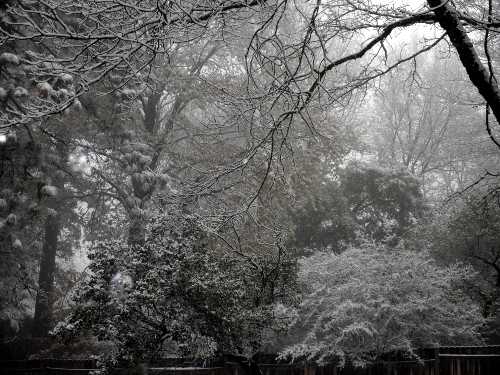
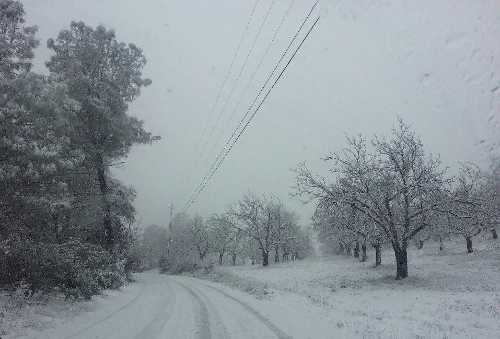
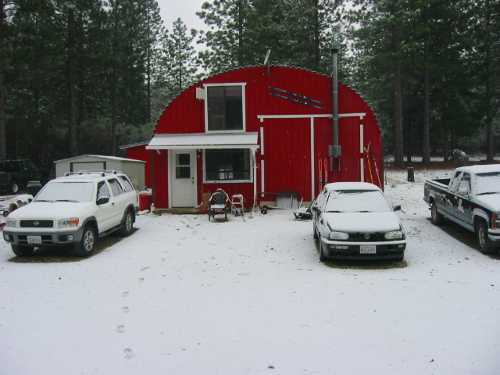
LAKE COUNTY, Calif. – Parts of Lake County experienced a white Christmas preview on Saturday thanks to afternoon snow showers.
Snow was first reported shortly after 1 p.m. on Cobb, where vehicles were reported to be spinning out and blocking the roadway in the area of Bottle Rock and Harrington Flat roads, according to the California Highway Patrol and radio reports.
A postal truck as well as about 10 other vehicles were reported to be stalled out in that area, with a layer of ice under the snow making it difficult to clear the vehicles, radio reports indicated. A fire truck also had trouble getting through the area.
Shortly before 3:30 p.m. the CHP reported a noninjury traffic collision in the Walker Ridge and Indian Valley Reservoir Road area, where a pickup went off the roadway and became stuck in a snowbank. There were concerns the CHP could not respond due to the weather.
In addition to Cobb, Lake County News readers reported snowfall in the Clear Lake Riviera, Clearlake Oaks, Elk Mountain Road near Upper Lake, Morgan Valley near Lower Lake, Kelseyville, Lucerne, Clearlake and Spring Valley. Snow also fell in the High Valley area above Clearlake Oaks.
The National Weather Service on Saturday issued a hazardous weather outlook for parts of Northern California, including southern Lake County.
Several inches of snowfall are expected at higher elevations across the northern part of the state due to a Pacific frontal system, the National Weather Service reported.
Lake County’s seven day forecast anticipates rain and light winds Sunday and Monday, with a chance of rain and snow on Tuesday, when the snow level is expected to fall to 1,600 feet. Forecasters don’t anticipate much, if any, snow accumulation.
Chances of rain are forecast through next Saturday, the National Weather Service said.
Email Elizabeth Larson at
LAKEPORT, Calif. – A group of puppies have joined several adult dogs at the animal shelter and are ready for adoption.
The shelter has had the pups altered and vaccinated and all are ready to go to new homes.
Dogs that are adopted from Lake County Animal Care and Control are either neutered or spayed, microchipped and, if old enough, given a rabies shot and county license before being released to their new owner. License fees do not apply to residents of the cities of Lakeport or Clearlake.
If you're looking for a new companion, visit the shelter. There are many great pets hoping you'll choose them.
The following dogs at the Lake County Animal Care and Control shelter have been cleared for adoption (additional dogs on the animal control Web site not listed are still “on hold”).

Pit bull terrier-Australian Shepherd mix pup
This pit bull terrier-Australian Shepherd mix pup is 10 weeks old.
He has one blue eye and one brown eye, weighs just under 10 pounds, has a short tan coat and has been neutered.
Visit the puppy in kennel No. 4, ID No. 35066.

Terrier mix puppy
This male terrier mix is 14 weeks old.
He has brown eyes, floppy ears and a short black coat, weighs 11 pounds and has been neutered.
Find him in kennel No. 5, ID No. 35109.
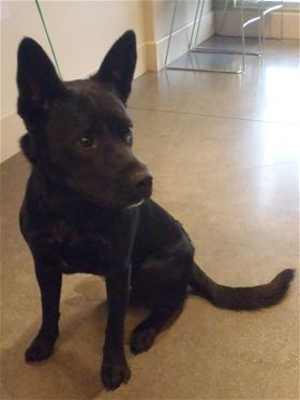
Male German Shepherd mix
This male German Shepherd mix is 1 year old.
He has a short black coat, weighs nearly 50 pounds and has been neutered.
Shelter staff said he is great with other dogs – both male and female.
He’s in kennel No. 6, ID No. 34894.

‘Mia’
“Mia” is a 2-year-old American Staffordshire Terrier mix.
She has a short red coat, weighs 57 pounds and has been spayed.
Find Mia in kennel No. 7, ID No. 34847.
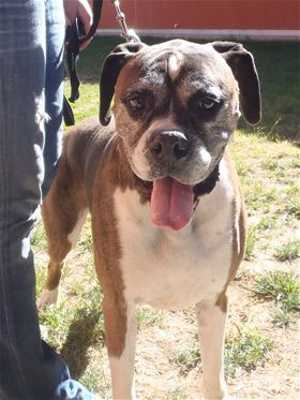
‘Brody’
“Brody” is an older boxer who recently fell on hard times and arrived at the animal shelter after his owner could no longer keep him.
He is 7 years old, has a docked tail and a short brown brindle-colored coat.
Brody is altered and weighs nearly 90 pounds.
You can find him in kennel No. 10, ID No. 34726.

American bulldog mix puppy
This 9-week-old female American Bulldog puppy is part of a big litter that came into the shelter recently.
She is 14 pounds, has a short white and brown spotted coat and has been spayed.
She’s in kennel No. 24a, ID No. 35082.

American bulldog mix puppy
This American Bulldog puppy is 9 weeks old.
Like her littermate she weighs 14 pounds, has a short brown and white spotted coat and has been spayed.
She’s in kennel No. 24b, ID No. 35083.

American bulldog mix puppy
This female American Bulldog puppy is 9 weeks old.
She weighs 14 pounds, has a short brown and white spotted coat and has been spayed.
Find her in kennel No. 24c, ID No. 35084.

American bulldog mix puppy
This male American Bulldog puppy is 9 weeks old.
He weighs 14 pounds, has a short white and brown spotted coat and has been neutered.
He’s in kennel No. 24d, ID No. 35085.

American bulldog mix puppy
This male American Bulldog puppy is 9 weeks old.
He weighs 14 pounds, has a short white and brown spotted coat and has been neutered.
He’s in kennel No. 24e, ID No. 35086.

American bulldog mix puppy
This male American Bulldog puppy is 9 weeks old.
He weighs 14 pounds, has a short white and brown spotted coat and has been neutered.
He’s in kennel No. 24f, ID No. 35087.
Please note: Dogs listed at the shelter's Web page that are said to be “on hold” are not yet cleared for adoption.
To fill out an adoption application online visit http://www.co.lake.ca.us/Government/Directory/Animal_Care_And_Control/Adopt/Dog___Cat_Adoption_Application.htm .
Lake County Animal Care and Control is located at 4949 Helbush in Lakeport, next to the Hill Road Correctional Facility.
Office hours are Monday through Friday, 8 a.m. to 5 p.m., and 1 p.m. to 3 p.m., Saturday. The shelter is open from 10:30 a.m. to 4:30 p.m. Monday through Friday and on Saturday from 1 p.m. to 3 p.m.
Visit the shelter online at http://www.co.lake.ca.us/Government/Directory/Animal_Care_And_Control.htm .
For more information call Lake County Animal Care and Control at 707-263-0278.
Email Elizabeth Larson at
California Emergency Management Agency Secretary Mark Ghilarducci, the governor’s top Homeland Security advisor, urges California’s parents and educators to remain vigilant in the wake of the tragic school shooting in Connecticut on Friday.
“Friday’s shooting at Sandy Hook Elementary School was unimaginable and horrific. As a parent, I can only imagine the pain and grief that the victim’s parents, family members and fellow educators are feeling,” said Ghilarducci.
He added, “This tragic event is a sobering reminder that threats like this, even as infrequent as they are, can happen anywhere. I urge all educators, teachers, parents and community members to pay attention to signs of distress in others and potential risks to the public. Don’t wait. If you think something isn’t right, report it right away.”
Ghilarducci recommends all schools should also review and ensure their emergency plans and security procedures are in place, up to date and understood.
Ghilarducci noted that Friday’s shooting was the second mass shooting in less than a week. Three people were killed at a Portland, Ore., mall after a gunman open fire on innocent shoppers this past Tuesday.
“Remember that the signs of a tragic event may be visible long before it comes to a violent conclusion,” said Secretary Ghilarducci. “If you know someone that is suffering from mental illness, grief, loss or exhibiting unusual behavior see that they receive counseling or treatment from a professional.”
The California Emergency Management Agency has put together a resource Web page for parents, teachers and anyone wanting to know how to get involved in making our schools and workplaces safer:
- Safety in Our Schools - California Emergency Management Agency: http://bit.ly/UoQXE0 ;
- How to Report Suspicious Activity - Department of Homeland Security: http://1.usa.gov/UJEueC ;
- Helping Children Manage Distress After a Shooting - American Psychological Association: http://bit.ly/UJED1M ;
- Gun Violence at School: Safety Tips – www.Kidpower.org (California workshop services) : http://bit.ly/USAjuV .
Additional updates will be posted to www.calema.ca.gov and Cal EMA’s Twitter feed.
A new animation of plant stress shows how drought evolved across the United States from January 2010 through September 2012. Credit: NASA/Goddard Scientific Visualization Studio/USDA-ARS.
In July 2012, farmers in the U.S. Midwest and Plains regions watched crops wilt and die after a stretch of unusually low precipitation and high temperatures.
Before a lack of rain and record-breaking heat signaled a problem, however, scientists observed another indication of drought in data from NASA and NOAA satellites: plant stress.
Healthy vegetation requires a certain amount of water from the soil every day to stay alive, and when soil moisture falls below adequate levels, plants become stressed. Scientists with the U.S. Department of Agriculture’s Agricultural Research Service (USDA-ARS) have developed a way to use satellite data to map that plant stress.
The maps could soon aid in drought forecasts, and prove useful for applications such as crop yield estimates or decisions about crop loss compensation.
“Crop drought monitoring is of high practical value, and any advance notice of drought conditions helps the farmer make practical decisions sooner,” said Steve Running, an ecologist at University of Montana in Missoula.
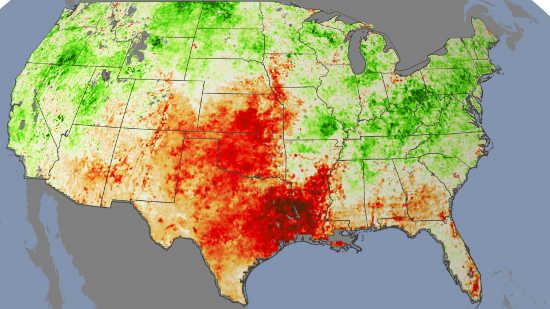
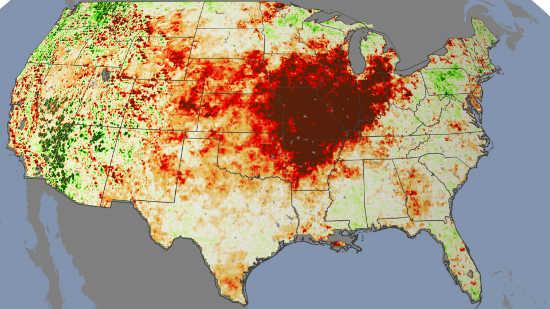
A new animation of plant stress, which can be seen above, shows how drought evolved across the United States from January 2010 through September 2012.
In spring 2010, satellites measured cool leaf temperatures, indicating healthy plants and wetter-than-average conditions (green), over many areas across the country.
By summer 2011, satellites saw the warming of stressed vegetation, indicating significantly lower-than-usual water availability (red) in many areas, most notably in Texas. Crops were either dead or would soon be dead.
Drought in 2012 was the most severe and extensive in at least 25 years, according to the USDA’s Economic Research Service.
By August 60 percent of farms were in areas experiencing drought, and by mid-September USDA had designated more than 2,000 counties as disaster areas.
According to Martha Anderson with USDA-ARS in Beltsville, Md. – who is working with a team to develop the plant stress indicator for drought and presented the research Dec. 5, at the American Geophysical Union meeting in San Francisco – “2012 was record-breaking, this was just a huge event.”
The 2012 event is what experts call a flash drought, meaning that it evolved quickly and unexpectedly. Low soil moisture was further depleted by the heat wave that started in May, and drought abruptly followed.
By about May 5 the core regions of drought began to appear on the plant stress map – earlier than the signs of drought appeared in other indicators, such as rainfall measurements.
“We think there’s some early-warning potential with these plant stress maps, alerting us as the crops start to run out of water,” Anderson said.
Signals of plant stress may often appear first in satellite-derived maps of vegetation temperature before the crops have actually started to wilt and die.
“The earlier we can learn things are turning south, presumably the more time we have to prepare for whatever actions might be taken,” Anderson said.
For example, farmers may decide they need to buy supplemental feed from outside the drought-affected area to support their livestock, or they may need to adjust contract or insurance decisions.
The U.S. Drought Monitor already uses a combination of indices, such as rainfall, to describe drought conditions each week. The monitor currently does not include plant stress, but the potential is being explored.
“Plant stress is one representation of drought impacts, and the drought monitoring community agrees that you can’t do this with just one tool – you need a lot of different tools,” Anderson said.
Plant stress information has the potential to improve the skill of existing forecasts that predict drought out to weeks or months.
Also, because the plant stress information is derived from satellites, it can describe drought conditions in areas where rain gauge and radar networks are sparse – and it can do so at the scale of individual fields.
To produce the maps of plant stress, scientists start with the Moderate Resolution Imaging Spectroradiometer (MODIS) on NASA’s Terra and Aqua satellites. Images are processed to distinguish between land surfaces covered by soil and surfaces covered with vegetation.
Narrowing their focus to vegetated areas, scientists set out to measure moisture availability. Plants cool themselves by sweating water extracted from the soil by their roots.
When access to water is limited, plants lessen their consumption and reduce evapotranspiration from leaf surfaces. As a result, leaves heat up and produce an elevated leaf or canopy temperature, which can be detected by thermal sensors on NOAA’s geostationary weather satellites. Hotter plants imply limited water in the soil.
“This is not a drought forecast. It’s a map of what’s going on right now,” Anderson said. “Is there more or less water than usual?”
What is “usual” or normal, however, can depend on the season or even the year. Scientists currently define normal by calculating and mapping plant stress averaged over periods of 1-3 months, from the start of MODIS data collection in 2000 to present.
The mean of these historic maps is considered normal. Compare a current map with the longer-term “normal” map, and scientists get a picture of the magnitude by which current conditions deviate from normal.
“What was normal back in 1920 is not what’s normal now, so the more years we have under the belt the better we can define normal,” Anderson said. “But this year is so far out of line with respect to previous years, it is unusual regardless of the period of record used as the baseline.”
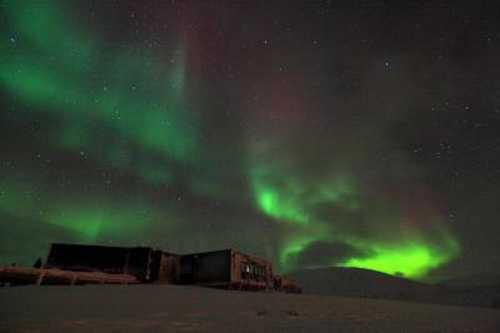
Hoping to expand our understanding of auroras and other fleeting atmospheric events, a team of space-weather researchers designed and built NORUSCA II, a new camera with unprecedented capabilities that can simultaneously image multiple spectral bands, in essence different wavelengths or colors, of light.
The camera was tested at the Kjell Henriksen Observatory (KHO) in Svalbard, Norway, where it produced the first-ever hyperspectral images of auroras – commonly referred to as “the Northern (or Southern) Lights” – and may already have revealed a previously unknown atmospheric phenomenon.
Details on the camera and the results from its first images were published in the Optical Society’s (OSA) open-access journal Optics Express.
Auroras, nature’s celestial fireworks, are created when charged particles from the Sun penetrate Earth’s magnetic field.
These shimmering displays in the night sky reveal important information about the Earth-Sun system and the way our planet responds to powerful solar storms.
Current-generation cameras, however, are simply light buckets – meaning they collect all the light together into one image – and lack the ability to separately capture and analyze multiple slivers of the visible spectrum.
That means if researchers want to study auroras by looking at specific bands or a small portion of the spectrum they would have to use a series of filters to block out the unwanted wavelengths.
The new NORUSCA II hyperspectral camera achieves the same result without any moving parts, using its advanced optics to switch among all of its 41 separate optical bands in a matter of microseconds, orders of magnitude faster than an ordinary camera.
This opens up new possibilities for discovery by combining specific bands of the same ethereal phenomenon into one image, revealing previously hidden details.
“A standard filter wheel camera that typically uses six interference filters will not be able to spin the wheel fast enough compared to the NORUSCA II camera,” said Fred Sigernes of the University Centre in Svalbard (UNIS), Norway. “This makes the new hyperspectral capability particularly useful for spectroscopy, because it can detect specific atmospheric constituents by their unique fingerprint, or wavelengths, in the light they emit.”
These spectral signatures can then reveal subtle changes in atmospheric behavior, such as the ionization of gases during auroras. This form of multispectral imaging also will enable scientists to better classify auroras from background sky emissions and study the way they cluster in the atmosphere.
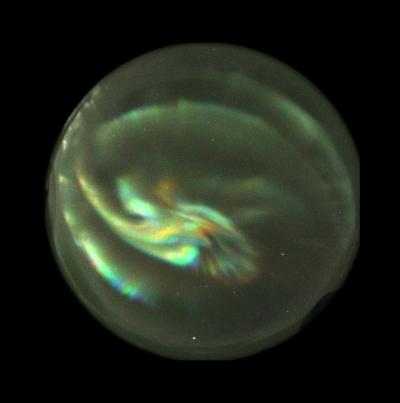
A new phenomenon
On Jan. 24, 2012, during the inaugural research campaign of NORUSCA II, a major solar flare jettisoned a burst of high-energy particles known as a Coronal Mass Ejection (CME). The CME eventually slammed into Earth’s magnetic field, producing magnificent auroras and a chance to fully test the new camera.
The researchers were able to image the aurora in unprecedented clarity through a layer of low altitude clouds, which would have thwarted earlier-generation instruments (see Image 1).
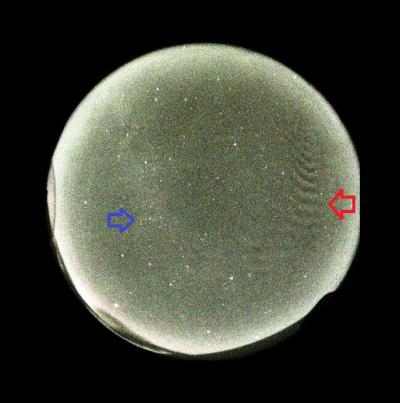
The camera also revealed something unexpected – a very faint wave pattern of unknown origin in the lower atmosphere.
The wave pattern resembles “airglow” – the natural emission of light by Earth’s atmosphere. Airglow can be produced by a variety of known sources, including cosmic rays striking the upper atmosphere and chemical reactions.
Its concurrent appearance with the aurora suggests that it may also be caused by a previously unrecognized source.
“After the January CME, we think we saw an auroral-generated wave interaction with airglow,” said Sigernes. This would be an entirely new phenomenon and if confirmed, would be the first time airglow has been associated with auroras.
“Our new all-sky camera opens up new frontiers of discovery and will help in the detection of auroras and the understanding of how our Sun impacts the atmosphere here on Earth. Additional development and commissioning will also hopefully verify our intriguing first results,” concluded Sigernes.
CLEARLAKE OAKS, Calif. – Lake County offers a rich tapestry of wildlife that’s display all the year round.
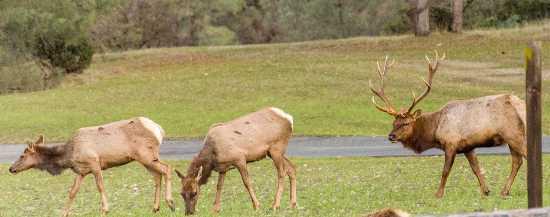
On Thursday evening, Lake County resident James Hershey photographed the Wilson Valley elk herd paying a visit to Cache Creek Vineyards near Clearlake Oaks.
The Bureau of Land Management reports that the Wilson Valley elk are part of one of the few free-roaming tule elk herds in California.
Follow Lake County News on Twitter, @LakeCoNews.