 How to resolve AdBlock issue?
News
LAKEPORT, Calif. – A Kelseyville man was flown to a regional trauma center Wednesday night following a single-vehicle crash on Highway 175.
California Highway Patrol Officer Kory Reynolds said Steven Calogianes, 20, of Kelseyville, sustained injuries that required he be transported by air ambulance.
Also injured in the crash was Calogianes' passenger, David Steele, 20, also of Kelseyville, Reynolds said.
Reynolds said the crash occurred at approximately 11:14 p.m. Wednesday night on a stretch of Highway 175.
Calogianes was driving a 1995 Mitsubishi westbound at an unknown speed when, for unknown reasons, he allowed his vehicle to exit the roadway, where it hit a tree, Reynolds said.
Calogianes was airlifted by REACH to Santa Rosa Memorial Hospital with complaints of pain to his right ankle and stomach, according to Reynolds.
Steele was transported by private vehicle to Sutter Lakeside Hospital for complaint of pain to his right leg, Reynolds said.
Reynolds said Calogianes does not have a valid driver license.
The incident remains under investigation by CHP Officer Ryan Erickson, Reynolds said.
LAKE COUNTY, Calif. – A new alert program to help find missing seniors is going into effect in the new year.
The new “Silver Alert” program was enacted through SB 1047, legislation introduced by state Sen. Elaine Alquist (D-Santa Clara) and Sen. Lou Correa (D-Santa Ana), and sponsored by the California Senior Legislature.
The legislation, approved earlier this year, allows law enforcement to request endangered missing advisories – dubbed “Silver Alerts” – for missing seniors.
The Silver Alert program will be coordinated by the California Highway Patrol, which also operates California’s Amber Alert system, meant to help find missing children, according to Jaime Coffee, a spokesperson for the CHP’s Sacramento Office.
Coffee said the Silver Alert program will use the existing Amber Alert system, with the main difference being that the Emergency Alert System – which breaks in on television and radio broadcasts – won’t be used for Silver Alerts. Changeable message signs on highways also won’t be used.
Local law enforcement agencies would request the alerts for missing persons, age 65 and older, if certain criteria are met, said Coffee.
Those criteria, according to the CHP, include that the person is missing under unexplained or suspicious circumstances or the law enforcement agency believes the person is in danger due to age, health, mental or physical disability, environment or weather conditions; the person is in the company of a potentially dangerous person; or there are other factors indicating that the person may be in peril.
Any information available about the senior also would be shared with the public, said Coffee.
The program could prove especially valuable in Lake County where, according to the U.S. Census Bureau’s American Community Survey data for 2011, just over 18 percent of the population is age 65 or older, above the 13 percent senior population average for the rest of the nation.
Lake County’s law enforcement is gearing up to be ready to use the new alerts if needed.
Lakeport Police Chief Brad Rasmussen called the new alert “a good thing.”
He didn’t have statistics handy on how often his agency gets reports of seniors who have walked away from home or otherwise gone missing, but he felt the new alerts will help with those cases.
Rasmussen’s staff has attended a legislative update to learn about new laws for 2013, including SB 1047, which now is included Government Code 8594.10.
There had been unsuccessful attempts to pass similar Silver Alert legislation – which has been enacted in a number of other states – in California previously.
Alquist had introduced such a bill in 2009, according to a legislative analysis of the bill.
In October 2011, the California Senior Legislature adopted the Silver Alert as its top legislative priority.
The Silver Alert was preceded in 2011 by the “Blue Alert,” which Coffee said is meant to notify citizens when a suspect who has assaulted or killed a law enforcement officer remains at large.
Email Elizabeth Larson at
LAKEPORT, Calif. – Among the animals available for adoption at Lake County Animal Care and Control are several young dogs.
This playful male Labrador Retriever-shepherd mix is 8 months old.
He has a short black coat, brown eyes and floppy ears, has had his shots and been altered.
Currently he weighs nearly 32 pounds and looks like he will be a good-sized dog.
Visitors can see him in kennel No. 12, ID No. 35108.
To fill out an adoption application online visit http://www.co.lake.ca.us/Government/Directory/Animal_Care_And_Control/Adopt/Dog___Cat_Adoption_Application.htm .
Lake County Animal Care and Control is located at 4949 Helbush in Lakeport, next to the Hill Road Correctional Facility.
Office hours are Monday through Friday, 8 a.m. to 5 p.m., and 1 p.m. to 3 p.m., Saturday. The shelter is open from 10:30 a.m. to 4:30 p.m. Monday through Friday and on Saturday from 1 p.m. to 3 p.m.
Visit the shelter online at http://www.co.lake.ca.us/Government/Directory/Animal_Care_And_Control.htm .
For more information call Lake County Animal Care and Control at 707-263-0278.
Email Elizabeth Larson at
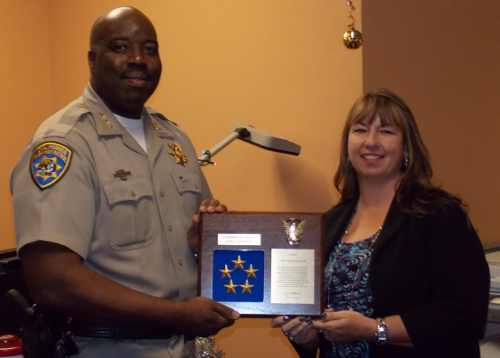
NORTH COAST, Calif. – On Wednesday, California Highway Patrol Assistant Commissioner Warren Stanley presented the CHP Ukiah Area Communications Center with the Commissioner’s Unit Citation award.
This award was presented on behalf of California Highway Patrol Commissioner Joe Farrow.
The commissioner recognized, and commended the Ukiah Communication Center for exceptional and sustained performance from 2009 through the first quarter of 2011, by consistently exceeding the established departmental and National Emergency Number Association 911 call answering standards.
The Ukiah Communications Center, through teamwork and dedication, has excelled in providing emergency services and enhancing the safety of the public.
The center serves areas of the North Coast including Lake County.
LAKE COUNTY, Calif. – With holiday celebrations in full swing, the California Highway Patrol is preparing for increased enforcement throughout the heavy travel period to help ensure safety on the road.
The CHP is reminding travelers to play by the rules behind the wheel: buckle up, adhere to the posted speed limit, avoid distractions behind the wheel and never drive while impaired.
The CHP’s “Drive Sober or Get Pulled Over” holiday enforcement effort begins Friday, Dec. 21, at 6 p.m. and continues through Tuesday, Dec. 25, at 11:59 p.m.
During this Maximum Enforcement Period (MEP), all available officers will be out on the roadways for enhanced enforcement efforts and assisting motorists wherever needed.
“The winter holidays can pose some of the toughest challenges for our officers,” said CHP Commissioner Joe Farrow. “Inclement weather, holiday celebrations, and drivers in a hurry to get to their destination can make for a deadly combination. We want you to enjoy the season and remember that safety is a crucial element.”
The holiday season can be particularly dangerous for drivers. Young adults, males and those driving at night, are among those who have the greatest risk of being involved in a collision with an alcohol-impaired driver or worse yet, losing their lives. Local law enforcement will be out in force, cracking down on impaired driving.
Last year during the Christmas holiday weekend, 14 people were killed in collisions in California; half of the people killed in CHP jurisdiction were not wearing a seat belt.
In addition, the CHP made 980 arrests for driving under the influence during the 78-hour Christmas MEP.
“Now is the time of year when celebrations increase, as well as the chance of encountering an impaired driver,” added Commissioner Farrow. “One way to keep everyone safe, and reduce the odds of spending the holidays in jail, is to designate a non-drinking driver in advance. Your life may depend on it.”
There are three simple ways you can help prevent a tragedy:
- Plan ahead. Designate a sober driver beforehand, or make arrangements for a safe way home. If you drink, do not drive.
- If you are impaired, instead of getting behind the wheel, find another way home. Call a taxi, a sober friend or family member or use public transportation.
- If someone you know is drinking, do not let that person drive. If you see an impaired driver on the road, contact law enforcement. You may save someone’s life.
- Along with the increased enforcement effort, the CHP is asking motorists to help keep the state’s
- roadways safe by calling 911 to report a suspected drunk driver. Callers should be prepared to provide dispatchers a description of the vehicle, its location, and direction of travel.
The CHP will conduct a similar MEP effort over the New Year’s holiday weekend from Friday, Dec. 28, at 6:01 p.m. to 11:59 p.m. on Tuesday, Jan. 1, 2013.
The network of Marine Protected Areas (MPAs) in California’s coastal waters, from the California/Oregon state line to Mexico, is now complete.
Nineteen MPAs became effective Wednesday in the Northern California coastal region between the California/Oregon state line and Alder Creek, near Point Arena in Mendocino County.
“We have completed the nation’s first statewide coastal system of marine protected areas,” said Cat Kuhlman, deputy secretary for oceans and coastal matters at the California Natural Resources Agency. “What this means for the future of California’s oceans and the coming generations that will enjoy them, is thrilling.”
California encompasses approximately 5,285 square miles of coastal state waters. The coastal portion of the statewide network of MPAs now includes 119 MPAs of varying designations, five recreational management areas and 15 special closures, that combined cover approximately 16 percent of all open coast state waters.
Approximately half of California’s new or modified MPAs are multiple use areas, with the remaining in no-take areas. The MPAs were developed to be consistent with California’s landmark Marine Life Protection Act (MLPA), the first statutory mandate of its kind in the nation.
The MLPA required that California’s MPAs be redesigned based on the best available science, with identified goals and objectives, and with the advice and input of stakeholders and experts to create a statewide network.
“The Department of Fish and Game is incredibly proud of the work that we did, along with the Fish and Game Commission and the stakeholders in each region to create these designated areas,” said Department Director Charlton H. Bonham. “Nowhere more so than in Northern California where the MPAs balance the needs of the future with the history of ancestral fishing practices among North Coast tribes.”
The North Coast regulations include a provision for federally recognized tribal members to continue harvesting and gathering fish, kelp and shellfish as they have for countless generations.
The provision will allow non-commercial take to continue where there is a record of ancestral take by a specific tribe, consistent with existing regulations, in MPAs other than State Marine Reserves.
“This is a story of what went right. Thanks to an extraordinary collaboration, the final plan ensures the MLPA goal of sustainable marine ecosystems can be achieved while tribal traditional gathering and fishing continue in marine conservation areas,” said Priscilla Hunter, chairwoman of the InterTribal Sinkyone Wilderness Council. “We thank the Creator, and are very pleased that North Coast residents stood in solidarity with the tribes.”
The North Coast region covers approximately 1,027 square miles of state waters from the California/Oregon state line south to Alder Creek near Point Arena in Mendocino County.
Developed pursuant to the MLPA, the North Coast network that goes into effect today includes 19 MPAs, one State Marine Recreational Management Area, and seven special closures, covering approximately 137 square miles of state waters and 13 percent of the region.
The new MPAs include four of the five pre-existing MPAs on the North Coast. The MPA at Punta Gorda (Punta Gorda State Marine Reserve) was removed from the network.
A complete listing of all North Coast MPAs, including detailed regulations and maps, can be found at www.dfg.ca.gov/mlpa/ncmpas_list.asp .
The Department of Fish and Game’s MPA mobile Web site, located at http://www.dfg.ca.gov/m/MPA , was updated Wednesday to reflect the new MPAs going into effect.
The mobile Web site allows the public to locate any current MPA boundaries and regulations by using an interactive map or searching by name, county or general area. A mobile device’s GPS can also be used to find and track a person’s current location relative to any MPA.
In addition to the mobile Web site, boaters can view MPAs on nautical charts or other background maps by visiting MarineBIOS at www.dfg.ca.gov/marine/gis/viewer.asp , DFG’s interactive online marine and coastal map viewer.
For more information on the North Coast MPAs or the MLPA, please visit www.dfg.ca.gov/mlpa .
California North Coast Marine Protected Areas Map