 How to resolve AdBlock issue?
News
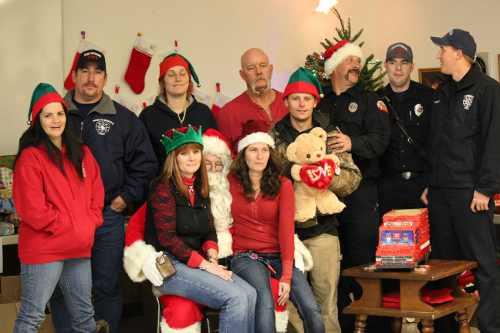
CLEARLAKE OAKS, Calif. – The Clearlake Oaks Volunteer Firefighters Association’s members have been busy this holiday season, sharing gifts and cheer with the community.
The group hosted Santa Claus at the Northshore Fire Protection District’s Clearlake Oaks Fire Station on Friday, Dec. 21, where they handed out gifts to local children.
Then, on Christmas Eve, they came to the aid of a Clearlake family, delivering Christmas gifts to the six children on behalf of Santa Claus.
In addition to its charitable works in the community, the association conducts fundraising for the equipment and training needed to run the Northshore Fire Protection District fire and rescue boat, based in Clearlake Oaks. It’s the only fire and rescue boat of its kind on Clear Lake.
Two district volunteers – Keith Leffler and Ted Christensen – and one captain, Rich Haney, operate the boat.
For community members who would like to support the association and its important work in the county, donations can be mailed to the Clearlake Oaks Volunteer Firefighters Association, 12655 E. Highway 20, Clearlake Oaks, CA 95423.
For more information, contact association President Keith Leffler at 707-350-0383.
Email Elizabeth Larson at

LAKEPORT, Calif. – Two men were arrested this week after a police officer found them taking gasoline from the transportation yard at a local school district.
David Edward Elliston, 30, and Michael Anthony Gama, 30, both of Nice, were arrested early Thursday morning, according to Lakeport Police Chief Brad Rasmussen.
At about 4:20 a.m. Thursday morning Officer Norm Taylor responded to the Lakeport Unified School District in response of a motion detector alarm going off in the transportation yard, Rasmussen said.
Rasmussen said Taylor saw a vehicle in the area and two subjects putting gas in the vehicle out of a gas can.
Taylor contacted Elliston and Gama and determined that they had taken the gasoline from the district and may have been out looking for additional gas to steal. Rasmussen noted there have been other gas thefts in the city recently.
Elliston and Gama both were on probation for theft-related crimes, Rasmussen said.
Both Elliston and Gama were booked for felony receiving stolen property and felony probation violations. Both remained in the Lake County Jail on no-bail holds on Saturday, according to jail records.
Their booking sheets said they are due to appear in court next Monday, Dec. 31.
Email Elizabeth Larson at
The Mayan calendar finally rolled over again this December and the Four Horsemen didn’t appear, no downpour of poisonous frogs or locusts. On the other hand, 2012 was a disastrous year in many other ways.
According to the National Oceanic and Atmospheric Administration (NOAA), this year past 365 days or so was one of the costliest on record in the United States.
While 2011 was also a record year for disasters, when 14 different events cost more than $60 billion in damages; this year exceeded overall costs of disasters.
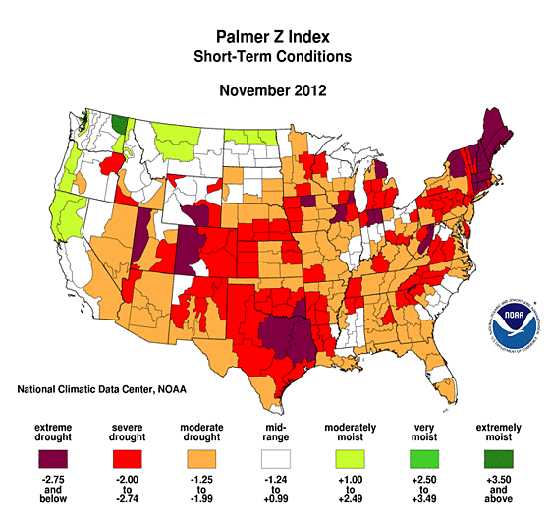
This surge is much in part due to the hurricane and subsequent superstorm Sandy, as well as the wide spread drought.
Hurricane Sandy has already totaled more than $100 billion in damages to New York, New Jersey and Connecticut together. The estimates are expected to increase over the years as recovery continues.
In the last 12 months there have been 11 billion-dollar events, which included seven thunderstorms, two hurricanes (Sandy and Isaac) and many large wildfires.
The widespread drought may end up being the most expensive of all the disasters that occurred this year.
In fact, the majority of states are still experiencing drought conditions. November 2012 was the 20th warmest and eight driest on record.
According to NOAA, almost 17 percent of the United States is still in “extreme” drought conditions.
This raises the question, do you have the basic necessities in order if a natural or human-caused disaster hits your community? Studies say probably not.
Check out this wealth of resources on how you can do just that: http://www.calema.ca.gov/Pages/default.aspx .
Here are the 11 costliest disasters of 2012:
- Southeast/Ohio Valley tornadoes: March 2-3;
- Texas tornadoes: April 2-3;
- Great Plains tornadoes: April 13-14;
- Midwest/Ohio Valley severe weather: April 28-May 1;
- Southern Plains/Midwest/Northeast severe weather: May 25-30;
- Rockies/Southwest severe weather: June 6-12;
- Plains/East/Northeast severe weather (“Derecho”): June 29-July 2;
- Hurricane Isaac: Aug. 26-31;
- Western wildfires: Summer-fall;
- Hurricane Sandy: Oct. 29-31;
- U.S. drought/heatwave: Throughout 2012.
It is important to note that there were a total of 10 hurricanes measured off the Atlantic coast, as well as 19 depressions and 19 significant storms.
According to NOAA, 349 people lost their lives due to natural disasters this year.
On Jan. 1, 2013, the 3.8 percent Medicare surtax, passed by Congress in 2010 to help pay for Obamacare, takes effect.
The 3.8 percent surtax is in addition to any income tax owed and applies to both individuals and trusts and estates.
Let us examine how the 3.8 percent surtax will apply in 2013 to individuals and to those trusts and estates which are required to file income tax returns.
With individual taxpayers the 3.8 percent Medicare surtax applies to the lesser of the taxpayer’s “Net Investment Income” or the excess of the taxpayer’s “Modified Adjusted Gross Income” (MAGI) over the applicable threshold: $125,000 (married filing separately), $250,000 (married filing jointly and qualified widowers), or $200,000 (single filers).
Thus, the amount by which MAGI exceeds the applicable threshold limits how much of the net investment income is subject to the surtax.
With taxable estates or trusts, however, the surtax applies to the lesser of its “Undistributed Net Investment Income” or the excess of an estate’s or trust’s “Adjusted Gross Income” (AGI) above $11,650.
Thus, the amount by which AGI exceeds $11,650 limits how much of the net investment income is subject to the surtax.
Trusts and estates with an AGI above $11,650 also pay the highest tax rates on their excess income (39.6 percent in 2013).
By contrast, individuals do not reach the highest income tax bracket until they earn above $300,000. Accordingly, trustees often distribute out any otherwise taxable trust income to their beneficiaries, who typically are in lower tax brackets.
The surtax applies to bypass trusts, marital trusts, and to third party special needs trust for the benefit of persons with special needs receiving needs based benefits (e.g., SSI and/or Medi-Cal). It does not apply to revocable living trusts, to charitable remainder trusts, or to self-settled (first party) special needs trusts.
For example, consider a third party special needs trust established at the death of a parent for the benefit of a surviving child with special needs.
Because this special needs trust is a third party special needs trust (and not a self settled first party special needs trust) it is required to file its own income tax returns.
Let us say that this special needs trust has $15,000 in adjusted gross income, of which $5,000 is taxable net investment income and the rest is exempt municipal bond interest.
In this case, $3,350 of the $5,000 net investment income would be subject to the 3.8 percent surtax because the trust’s AGI exceeds $11,650 by $3,350 which is the lesser amount (the ceiling). Here the 3.8 percent surtax owed is only $127. The trust’s income tax owed on the same $3,350 is $1,327.
What is Net Investment Income? It is interest, dividends, royalties, rents, unless derived in the ordinary course of a trade or business.
The surtax excludes retirement income from IRA and 401(k) distributions, which are still subject to income tax.
Thus, if a trust or estate is the beneficiary of an IRA or 401(k) plan, then the trust’s receipt of such retirement distributions are excluded from the 3.8 percent Medicare surtax, which is still subject to income tax (a good reason to distribute to the beneficiary).
This may happen when a special needs trust is named as the plan participant’s death beneficiary in order to preserve SSI and Medi-Cal eligibility of a person with special needs.
Where the trustee can either distribute out the trust’s net investment income and/or otherwise invest in non taxable assets the surtax can be reduced.
The trustee’s ability to distribute out net investment income will be affected by the terms of the trust and California law.
Dennis A. Fordham, attorney (LL.M. tax studies), is a State Bar Certified Specialist in Estate Planning, Probate and Trust Law. His office is at 55 First St., Lakeport, California. Dennis can be reached by e-mail at
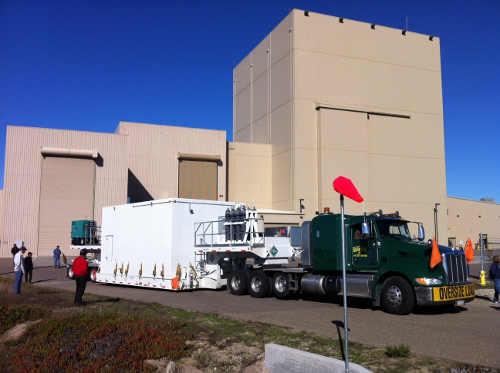
An oversized semi-trailer truck carrying NASA’s Landsat Data Continuity Mission (LDCM) arrived earlier this month at its launch site at Vandenberg Air Force Base in California in preparation for launch.
This NASA and U.S. Geological Survey mission will continue a 40-year record of measuring change on the planet from space.
LDCM is the eighth satellite in the Landsat series, which began in 1972. It will extend and expand global land observations that are critical in many sectors, including energy and water management, forest monitoring, human and environmental health, urban planning, disaster recovery and agriculture.
Following final tests, the LDCM satellite will be attached to an Atlas V rocket and launched into space February 11, 2013. Built and tested by Orbital Science Corp., LDCM left their Gilbert, Ariz. Facility on Dec. 17.
“LDCM builds on and strengthens a key American resource: a decades-long, unbroken Landsat-gathered record of our planet’s natural resources, particularly its food, water and forests,” said Jim Irons, Landsat project scientist at NASA’s Goddard Space Flight Center in Greenbelt, Md.
LDCM carries two instruments, the Operational Land Imager (OLI) built by Ball Aerospace & Technologies Corp. in Boulder, Colo., and the Thermal Infrared Sensor (TIRS) built by NASA Goddard
“Both of these instruments have evolutionary advances that make them the most advanced Landsat instruments to date and are designed to improve performance and reliability to improve observations of the global land surface,” said Ken Schwer, LDCM project manager at NASA Goddard.
OLI will continue observations in the visible, near infrared, and shortwave infrared portions of the electromagnetic spectrum and includes two new spectral bands, one of which is designed to support monitoring of coastal waters and the other to detect previously hard to see cirrus clouds that can otherwise unknowingly impact the signal from the Earth surface in the other spectral bands.
TIRS will collect data in two thermal bands and will thus be able to measure the temperature of the Earth’s surface, a measurement that’s vital to monitoring water consumption, especially in the arid western United States.
NASA and the U.S. Department of the Interior through the U.S. Geological Survey (USGS) jointly manage the Landsat program.
After launch and the initial check out phase, USGS will take operational control of the satellite, will collect, archive, and distribute the data from OLI and TIRS, and will rename the satellite as Landsat 8. The LDCM data will be freely and openly available through the USGS data system.
NASA’s Launch Services Program at Kennedy is responsible for launch management. United Launch Alliance is the provider of the Atlas V launch service.
For more information, visit http://www.nasa.gov/Landsat .
Ellen Gray works for NASA’s Goddard Space Flight Center in Greenbelt, Md.
Federal unemployment benefit extensions set to end; hundreds of Lake County residents to be impacted
LAKE COUNTY, Calif. – Hundreds of thousands of Californians – including several hundred Lake County residents – are set to lose federal unemployment benefit extensions within days unless the president and Congress take action.
California Employment Development Department confirmed to Lake County News that the federal benefits are set to come to an abrupt halt by the end of this week for some 346,000 Californians, with no action yet taken by President Barack Obama or Congress on this aspect of the “fiscal cliff.”
Approximately 755 Lake County residents will be affected by the ending of the federal benefit extensions, the Employment Development Department reported.
Those benefits for the federal Emergency Unemployment Compensation program are not the same as the regular state unemployment insurance payments, which will continue and are not affected by the federal stalemate, the agency said.
The most recent numbers available, for this past October, showed that 1,556 Lake County residents were certified for state unemployment benefits, which will not be interrupted.
Earlier this month, the Employment Development Department sent letters notifying the recipients of the federal benefit extensions about the end to the program, which won’t continue payments even if recipients still have an existing balance due them. Those letters also advised of alternative assistance programs.
In July 2008, as the impacts of the recession were beginning to be felt, the first tier of the federal unemployment benefit extensions became available for Californians, the Employment Development Department reported.
State and federal benefits combined could, at one point, provide up to 99 weeks of benefits. The Employment Development Department said that was reduced to 73 weeks this past September.
The state said $40 billion in federal benefit extensions have been paid to out-of-work Californians in the four and a half years since the federal program started.
The Employment Development Department said more than 928,000 unemployed Californians have exhausted all available benefits on the state and federal levels.
The Employment Development Department urged those affected to monitor its Web site, www.edd.ca.gov , or its Twitter account, www.twitter.com/CA_EDD , for updates.
Email Elizabeth Larson at