 How to resolve AdBlock issue?
News

UPPER LAKE, Calif. – Officials on Monday continued their efforts to locate a young Northshore woman who went missing last week.
The search remains under way for 23-year-old Kimberly Marie Hazelwood of Nice.
Lt. Steve Brooks of the Lake County Sheriff’s Office said Lake County Search and Rescue was performing a search in the Upper Lake area on Monday, with assistance from K-Corps, Willits Fire Swift Water Rescue Team and California Department of Fish and Game.
Brooks said a California Highway Patrol helicopter also was to assist with the search Monday afternoon.
Hazelwood, who has been undergoing cancer treatment, was last seen on the night of Dec. 23 when she left a home in the 10000 block of Rancheria Road near Upper Lake, according to an initial sheriff’s office report issued last week. She was reported missing after 9 p.m. that night.
A short time before deputies were dispatched to the Rancheria Road residence, fire officials responded to a report of a person who was in Middle Creek near the 9100 block of Bridge Arbor Road, about two miles south of where Hazelwood was last seen. Northshore Fire Chief Jay Beristianos said they were unable to locate anyone.
Hazelwood is 5 feet 3 inches tall, weighs 160 pounds, has brown eyes and long brown hair.
Anyone with information on her whereabouts is asked to call the Lake County Sheriff’s Office at 707-263-2690, or her family at 707-245-2772, 707-900-1401 or 707-900-1946.
John Jensen contributed to this report.
Email Elizabeth Larson at

LAKE COUNTY, Calif. – A Cal Fire veteran has been tapped as the new chief of the agency’s Sonoma-Lake-Napa Unit.
Eric Hoffman, 51, who just finished his 30th firefighting season with Cal Fire, will start the new year in the unit chief’s position after serving since 2009 as chief of the unit’s west division, which covers Sonoma County.
If Hoffman’s name is familiar to Lake County readers, that’s because he spent time in the county this past summer as incident commander on the Wye and Walker fires, and the Scotts fire.
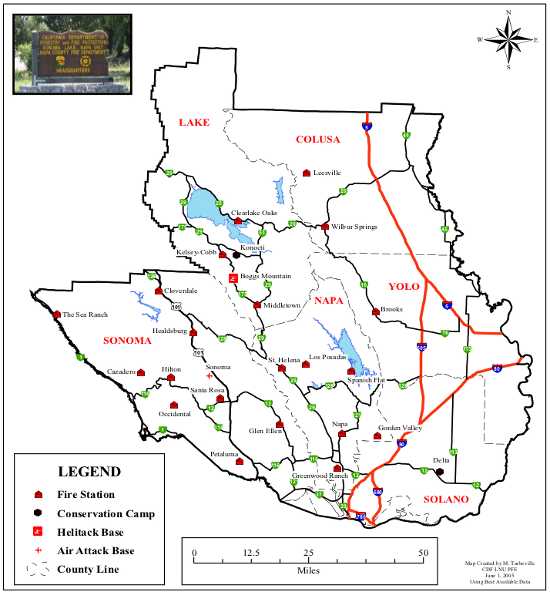
In his new role as unit chief, he will oversee four divisions – the north, which covers Lake County; the south, covering Napa County; the east, which includes Solano, Yolo and Colusa counties; and the west, the biggest division of the four, which covers Sonoma County, he explained.
The unit covers a total of six counties and, geographically, is the largest State Responsibility Area in California, Hoffman said.
The Sonoma-Lake-Napa Unit covers 10,000 square miles – or just over 2.1 million acres – and includes 20 state stations, 31 engines, 11 crews, five bulldozers, a helitack base at Boggs Mountain and an air attack base in Sonoma County, and 250 personnel, according to Hoffman.
“It’s huge,” Hoffman said.
The unit’s staffing increases in the summertime firefighting season, when Hoffman said personnel numbers top 400.
Yet, as big as it is, it runs well.
“The good news is, I’m not inheriting anything broken,” said Hoffman,
Since he started with Cal Fire in 1983, Hoffman has seen numerous changes in firefighting and how Cal Fire itself works.
One of the big changes has to do with training, he said.
When he began firefighting in his early 20s, Hoffman said it sounded like fun work. Back then, a young firefighter would get a week’s worth of training before they were assigned to an engine and setting out on the fire lines.
Firefighters today undergo far more intensive training, with Hoffman explaining that their level of professionalism has increased.
A firefighter now must have a minimum of 180 hours of training before they’re placed on an engine, said Hoffman, adding that most firefighters starting work now have “a pile of certificates” that he said is bigger than those he amassed.
Firefighters now are coming into the agency trained, educated and ready – they are certified in hazmat and as emergency medical technicians, and they’ve completed a six-month academy to receive a firefighter level one certificate.
“We give them the wildland experience,” said Hoffman.
In his time with Cal Fire, the other big change Hoffman has seen is in the area of technology and how it has affected firefighting.
Hoffman said firefighters used to draw topographical maps on fire scenes with grease pencils. Now they rely on high speed Internet for both mapping and weather data.
“The technology behind the scenes is incredible,” he said.
On some big Southern California fires they’ve used military and NASA drones to help map the fires. More commonly, they use helicopters with a GPS mapping program and infrared capability to fine tune perimeters.
Hoffman, acting as incident commander on the Wye and Scotts fires this summer, said those incidents illustrated how the California fire service works.
The cooperation between state and local agencies was seamless, he said.
Cal Fire had been short on resources at the time, but was able to get local government strike teams through its relationship with the California Emergency Management Agency, he said.
“Although there was a lot of fire, it worked pretty well,” he said.
With the Scotts and Wye fires within Lake County’s boundaries, as well as the nearby 16 and Sites fires in Colusa County, and the Mill Fire in the Mendocino National Forest, “Lake County just seemed to be at the eye of the storm this summer,” Hoffman said.
Altogether, all of those fires inside and outside of Lake County’s boundaries burned approximately 64,183 acres.
The Walker and Wye fires – managed as the Wye Fire incident – hit in the second week of August, spreading rapidly to thousands of acres, burning at least one residence as well as outbuildings before being fully contained at 7,934 acres.
The damage could have been worse, but Hoffman said Cal Fire was able to focus its efforts on hitting the fire from the air and keeping it out of New Long Valley.
Hoffman said a cause still hasn’t been determined for the Wye incident.
Less than a month later, the Scotts Fire hit west of Scotts Valley Road, burning a total of 4,618 acres. “The Scotts Fire was really challenging, just because it stayed there above Scotts Valley Road and kinda hung there,” he said.
The cause of the Scotts Fire also hasn’t been determined, Hoffman said.
A factor in the summer’s fires were the dry conditions. Hoffman said there were record levels of dryness in fuels – or vegetation – as well as a dry spring. “And we’re not in a prolonged drought.”
The first 20 days of the fire season was normal, and overall it wasn’t the fire season with the most acres burned. But Hoffman said firefighters were busy for a prolonged period of time, with 50 days of resource drawdown. That equaled many exhausted firefighters.
Beyond busy fire seasons, Hoffman will be occupied with longterm planning for the unit and its future leadership.
One of his areas of concentration will be on establishing the next generation of first level company officers for the unit.
There are a lot of people to hire. In the coming year, he said they will need to hire between five and seven battalion chiefs and a new division chief to succeed him.
“It’s a constant effort for success and planning,” Hoffman said.
Email Elizabeth Larson at
LAKE COUNTY, Calif. – Hearings have been set for February in a case alleging that the California Department of Fish and Game is carrying out fish stocking programs around the North Coast, including Lake County, without the required permits.
In the suit, Del Norte County resident and outdoorsman Felice Pace and Missoula, Mont.-based Wilderness Watch challenge the Department of Fish and Game’s fish stocking practices in Lake, Del Norte and Humboldt counties.
The suit – which specifically names Department of Fish and Game Director Charlton H. Bonham and Stafford Lehr, Fish and Game’s fisheries division branch chief – was first filed in federal court in November, with an amended complaint filed Dec. 23, according to court records.
The state deputy attorney generals assigned to represent Bonham, Lehr and the Department of Fish and Game appeared in court on Dec. 21 in a hearing on the case.
A case management conference has been set for Feb. 8 in San Francisco, based on the most recent case filings.
The suit alleges that the Department of Fish and Game discharged, and continues to discharge, “fish by airplanes and canisters borne by packstock” into waters without first obtaining the required permits under the National Pollutant Discharge Elimination System of the Clean Water Act.
Court documents do not specifically state which water bodies in the three counties are affected.
“Plaintiffs seek declaratory relief that these discharges will continue to be illegal, and an injunction prohibiting such discharges unless and until Fish and Game possesses required permits,” the suit states.
Pace and Wilderness Watch also are seeking reasonable attorneys’ fees, costs, and other expenses under the Clean Water Act.
According to the suit, the plaintiffs notified the Department of Fish and Game in June of the alleged Clean Water Act violations.
“Fish stocking in these waters harms Mr. Pace by, among other things, altering the integrity of waters he enjoys, introducing fish that were historically not present, elevating fish populations to unnatural levels, and adversely affecting native wildlife,” court documents state.
Wilderness Watch has 1,050 members, some of whom reside in the affected counties, according to the suit.
The group’s members are harmed, the suit alleges, because of the fish stocking program “altering the integrity of waters they enjoy, introducing fish that were historically not present, elevating fish populations to unnatural levels, and adversely affecting native wildlife.”
Concerns about fish stocking cited in the suit including alteration of physical and biological integrity of lakes.
“Stocked fish alter nutrient cycling in lakes. Stocked fish alter algal production in lakes. Stocked fish consume tadpoles and other life stages of amphibians in lakes. Stocked fish may spread disease to amphibians,” the suit states. “Stocked fish attract snakes that then prey on amphibians. Stocked fish consume macroinvertebrates in lakes.”
In addition, “Stocked fish consume large-bodied zooplankton in lakes,” court documents state. “Diminished populations of large-bodied zooplankton affects the presence of phytoplankton in lakes. Stocked fish prey on or compete with populations of native fish. Collectively, these impacts result in major changes to lake food webs. The water used to release fish can harbor non-native species of aquatic plans, invertebrates, and fish that is introduced into the lake being stocked.”
Also on Dec. 21, the Attorney General’s Office, on behalf of Bonham, Lehr and the Department of Fish and Game, notified the court that several other similar actions about the fish stocking program – filed in Sacramento County Superior Court and in federal court – were under way.
Those cases involve the Center for Biological Diversity, Californians for Alternatives to Toxics – for which Wilderness Watch is a petitioner – and the California Association for Recreational Fishing.
The cases challenged the propriety of the Department of Fish and Game’s fish hatchery and stocking program as well as an environmental impact report prepared for the program.
The state court trial actions were decided in July and September, and in a September statement, the agency said that as a result of the ruling its stocking and hatchery programs had survived. However, appeals have since been filed in the cases.
“The complaint in this action alleges that a Clean Water Act permit is required for that activity,” the state’s Dec. 21 filing said.
It goes on to point out that Pace and Wilderness Watch have alleged that the department’s fish stocking program has adverse environmental impacts.
“To the extent that is at issue in this action, the Court should be mindful of the state court judgments on that issue. This may counsel this Court deferring any determination on that issue until those state court actions run their course,” the filing stated.
Email Elizabeth Larson at
LAKE COUNTY, Calif. – Several adult cats and a kitten are waiting at the county’s animal shelter for adoption.
The cats, ranging in age from 10 weeks to 7 years, are ready to start out the new year in loving, forever homes.
In addition to spaying or neutering, cats that are adopted from Lake County Animal Care and Control are microchipped before being released to their new owner. License fees do not apply to residents of the cities of Lakeport or Clearlake.
If you're looking for a new companion, visit the shelter. There are many great pets there, hoping you'll choose them.
The following cats at the Lake County Animal Care and Control shelter have been cleared for adoption (other cats pictured on the animal control Web site that are not listed here are still “on hold”).
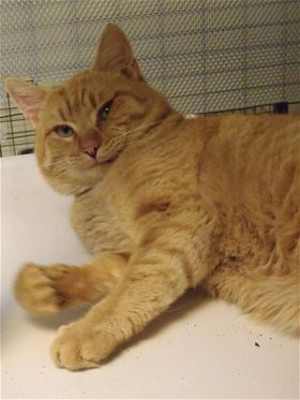
Male orange tabby
This male orange tabby is 6 years old.
He has green eyes, a short orange coat and weighs 10 pounds. He has been neutered.
Find him in cat room kennel No. 9, ID No. 35111.

Male brown tabby
This male brown tabby is of undetermined age.
He has green eyes and a short coat. Shelter staff didn’t report if he had been altered.
He’s in cat room kennel No. 42, ID No. 35146.

Brown female tabby kitten
This little brown tabby is 10 weeks old.
She has green eyes, a short brown striped coat, weighs 2 pounds and has been spayed.
Find her in cat room kennel No. 46c, ID No. 35102.

Domestic short hair mix
This male domestic short hair mix is of undetermined age.
He has seal point coloring and blue eyes. Staff did not report if he was altered or not.
He’s in cat room kennel No. 63, ID No. 35131.

Female domestic short hair mix
This female domestic short hair mix is 2 years old.
She has green eyes and a short gray tabby coat, and weighs 9 pounds. She has been spayed.
She’s in cat room kennel No. 88, ID No. 34940.
Adoptable cats also can be seen at http://www.co.lake.ca.us/Government/Directory/Animal_Care_And_Control/Adopt/Cats_and_Kittens.htm or at www.petfinder.com .
Please note: Cats listed at the shelter's Web page that are said to be “on hold” are not yet cleared for adoption.
To fill out an adoption application online visit http://www.co.lake.ca.us/Government/Directory/Animal_Care_And_Control/Adopt/Dog___Cat_Adoption_Application.htm .
Lake County Animal Care and Control is located at 4949 Helbush in Lakeport, next to the Hill Road Correctional Facility.
Office hours are Monday through Friday, 8 a.m. to 5 p.m., and 1 p.m. to 3 p.m., Saturday. The shelter is open from 10:30 a.m. to 4:30 p.m. Monday through Friday and on Saturday from 1 p.m. to 3 p.m.
Visit the shelter online at http://www.co.lake.ca.us/Government/Directory/Animal_Care_And_Control.htm .
For more information call Lake County Animal Care and Control at 707-263-0278.
Email Elizabeth Larson at
LAKE COUNTY, Calif. – The new year is expected to arrive with frosty temperatures, according to the National Weather Service.
The forecast for the coming week includes patchy nighttime and early morning frosts, with light winds and highs in the mid 50s.
Monday is forecast to have winds up to 15 miles per hour with mostly sunny conditions and daytime highs up to 56 degrees, with lows down to 26 degrees, according to the forecast.
Similar frost and temperature conditions are expected on New Year’s Day and night, as well as on Wednesday. Temperatures are forecast to be in the 30s on Wednesday night.
On Thursday, the forecast calls for mostly cloudy conditions with a chance of rain during the day and evening. Daytime highs will range up to 53, with nighttime lows down to 32 degrees.
Cloud conditions and chances of rain also are predicted from Friday through next Sunday, with daytime temperatures in the mid 50s and nighttime lows down to 32 degrees.
Email Elizabeth Larson at
New state-by-state report: Employer health insurance premiums increased 62 percent from 2003 to 2011
Average premiums for employer-sponsored family health insurance plans rose 62 percent between 2003 and 2011, from $9,249 to $15,022 per year, according to a new Commonwealth Fund report.
The report, which tracks state trends in employer health insurance coverage, finds that health insurance costs rose far faster than incomes in all states.
Workers are also paying more out-of-pocket as employee payments for their share of health insurance premiums rose by 74 percent on average and deductibles more than doubled, up 117 percent between 2003 and 2011.
The report, State Trends in Premiums and Deductibles, 2003-2011: Eroding Protection and Rising Costs Underscore Need for Action, finds that total health insurance premiums now amount to 20 percent or more of annual median family incomes in 35 states, affecting 80 percent of the U.S. working-age population.
States in the South and South-Central U.S. had the highest costs relative to household income – in West Virginia, New Mexico, South Carolina, and Texas, average total health insurance premiums amounted to more than 25 percent of median incomes.
“Wherever you live in the United States, health insurance is expensive, and for many middle- as well as low-income families it is becoming ever less affordable,” said Commonwealth Fund senior vice president Cathy Schoen, lead author of the report. “Workers are paying more for less financial protection when they get sick. The steady increase in health care costs over the past decade underscores the urgent need to build on the groundwork laid by the Affordable Care Act to slow the growth in private insurance costs.”
In 2011, average annual premiums for family plans ranged from about $12,400 to $13,500 in the lowest-cost states (Arkansas, Alabama, Iowa, Tennessee, Idaho, Mississippi, Utah, and North Dakota), to more than $15,000 a year in 21 states.
Premiums averaged from $16,000 to nearly $17,000 in Delaware, Alaska, Connecticut, Vermont, New York, the District of Columbia, New Hampshire, and Massachusetts, which have the highest average family premiums.
Paying more for less
Premiums rose far faster than incomes across the country from 2003 to 2011. While average family premiums jumped 62 percent during that time, median family income rose just about 11 percent.
The increase in premiums ranged from 42 percent in the lowest-growth state, Tennessee, to 76 percent in the highest-growth state, New York. Twenty-seven states had increases of 60 percent or more.
The report finds that deductibles and employees’ premium shares grew, leaving employees with more out-of-pocket expenses and less protective health insurance benefits.
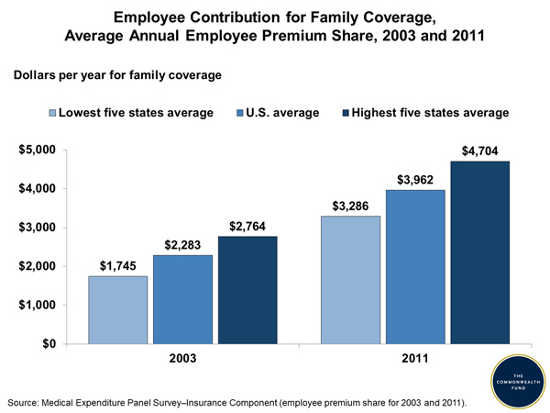
The average annual amount an employee paid toward a family health insurance plan rose from $2,283 in 2003 to $3,962 in 2011 – a 74 percent increase.
Looking state-by-state, employee contributions ranged from about $3,300 in Indiana, Hawaii, West Virginia, Ohio, and Wisconsin, to more than $4,600 in Arizona, South Carolina, New Mexico, Colorado, and Mississippi.
Deductibles more than doubled from 2003 to 2011, increasing an average of 117 percent per person during the eight years the report studied.
In 2011, 78 percent of workers faced deductibles, up from 52 percent in 2003. In 2011 average deductibles exceeded $1,000 in 35 states, compared to none in 2003. Deductibles have been rising for employees working for large as well as small firms.
However, workers in small firms with fewer than 50 employees typically face higher deductibles than those working for larger firms.
Deductibles in small firms were highest in North Carolina, Texas, and Vermont, exceeding $2,200 per person.
Future trends: Affordable Care Act provides platform for further action
If historical trends continue, family premiums will reach $24,740 by 2020, an increase of 65 percent from 2011.
The analysis also shows that slowing the rate even modestly would make a significant difference for families and businesses.
For example, reducing the annual growth rate by one percentage point would lead to $2,029 in savings for families by 2020. Slowing annual cost growth by 1.5 percent would yield savings of $2,986 per family.
The report’s authors note that the Affordable Care Act lays the groundwork for lowering cost growth and improving and expanding insurance coverage. The law’s provisions put pressure on private insurance plans to lower their overhead and focus on the underlying costs of health care, setting standards for how much of each premium dollar must go to health care, as opposed to administrative costs, with insurers who don’t meet the new standard paying rebates to policyholders.
Other reforms provide private insurers with a platform for further cost-reduction efforts. The authors conclude, however, that more will need to be done to confront the forces driving up the cost of care in private insurance markets.
“The Affordable Care Act has put the United States on a path toward a high performing health care system, where everyone has access to high-quality, affordable, and secure health care,” said Commonwealth Fund president Karen Davis. “As we implement the law’s reforms, it will be crucial to stabilize cost growth by holding care systems and private insurers accountable for better outcomes and lower costs.”