How to resolve AdBlock issue?
News
The California Fish and Game Commission will consider a petition to give threatened or endangered species status to the West Coast great white shark population at its meeting early next month.
The commission meeting will be held Wednesday, Feb. 6, and Thursday, Feb. 7, in the Natural Resources Building, First Floor Auditorium, 1416 Ninth St., Sacramento.
At that time, the commission may take action on whether or not to accept the petition and declare the Northeast Pacific population of great white shark, Carcharodon carcharias, as a candidate for future threatened or endangered species status under the California Endangered Species Act.
If the petition is accepted, the commission will start a one-year status review before a decision on listing is made, state officials reported.
In preparation for the meeting, the California Department of Fish and Wildlife released a staff evaluation of the listing petition, which is available at http://dfg.ca.gov/news/pubnotice/ or can be seen below.
In completing the petition evaluation, CDFW determined there is sufficient scientific information to indicate that the petition action may be warranted, and recommended the petition be accepted and considered by the California Fish and Game Commission.
Last August, Oceana, the Center for Biological Diversity and SharkStewards filed a scientific petition with the National Marine Fisheries Service in Washington, D.C., seeking to protect the West Coast population of great white sharks under the Endangered Species Act, filing shortly thereafter to seek protection for the apex predator under California’s Endangered Species Act.
The groups cited as impetus for the petitions findings that showed the unique West Coast white shark populations to be “alarmingly low” and on the brink of extinction.
A chief danger to the sharks that the groups cited was the use of gillnets, which it was estimated account for more than 80 percent of captures of young white sharks in nursery areas, where the juvenile sharks are taken as bycatch during commercial fishing.
Other challenges for young white sharks include mercury levels – the groups said the sharks have been found to have mercury levels that are the second-highest worldwide – and the highest levels observed globally of contaminants PCB and DDT in liver tissue.
The West Coast great white sharks, according to the petition, are genetically distinct and isolated from all other great white sharks around the globe.
The Northeast Pacific great white shark population extends from Mexico north to the Bering Sea and west to Hawaii, with the petition explaining that they are found primarily from Mexico to Oregon, both inshore and offshore areas, and from the continental shelf west to a common foraging area between the West Coast of North America and Hawaii known as the Shared Offshore Foraging Area, or SOFA.
The SOFA is described in the petition as a “vast area of deep open water habitat” shared by great white sharks from both central California and Guadalupe Island, Mexico. During the sharks' offshore migration adults from the Northeast Pacific shark population spend from six to 16 months feeding in the area.
The petition estimated that there are 339 adult and sub-adults in the great white shark's Northeast Pacific population.
Great white sharks’ survival outlook is made more challenging because, as the documents point out, they are low in abundance, late to mature and have few offspring.
The state's analysis found the petition’s great white shark population estimate to be based “on debatable assumptions such as a closed population at one of the aggregation sites,” and goes on to point out that there is no population trend information available for the Northeast Pacific shark group.
California gave great white sharks special protected status in 1994, with new laws instituted at that time that prohibited the sharks from being taken except by special permit granted by the state. Commercial take also was prohibited except for state permitted scientific and educational purposes.
The laws, however, allow for incidental take of the sharks by roundhaul or gill nets, and any sharks landed live may be sold for scientific or live display purposes, although a state permit is required, the petition analysis documents explain.
Check the commission Web site, www.fgc.ca.gov , for more information.
Email Elizabeth Larson at
CLEARLAKE, Calif. – The Clearlake Planning Commission will meet this week to hold a public hearing on a variance request and to discuss a proposed ordinance regarding the regulation of medical marijuana cultivation in the city limits.
The meeting will begin at 6 p.m. Tuesday, Jan. 15, in the council chambers at Clearlake City Hall, 14050 Olympic Drive.
Gurdarshan Singh has requested the variance and notice of exemption for the Shell gas station at 14091 Lakeshore Drive.
Singh is asking for a maximum building area of 3,000 square feet to be increased to allow for an accessory dwelling unit.
The parcel currently has a 2,538 square foot convenience store and a 1,074 square foot gas station canopy. City staff is recommending approval.
The commission on Tuesday also will hold an initial discussion regarding a proposed ordinance that would prohibit or limit commercial medical marijuana cultivation in the city.
The draft ordinance, a copy of which can be seen below, proposes cultivation bans on vacant parcels and within 600 feet of public or private schools, and requires that grows be screened with plants not to exceed 6 feet in height.
The ordinance would require collectives and cooperatives to maintain evidence at grow sites that they are organized according to the California Attorney General’s guidelines.
In addition, it would limit parcels of one acre or less to a total of six plants, with 12 plants allowed on larger parcels. No cultivation would be allowed within mobile home parks unless management has designated a specific garden area. Cultivation would be banned on apartment complex properties.
The amount of marijuana that could be processed on a parcel would be limited to the amount of marijuana that the ordinance allows to be grown there, according to the draft document.
Marijuana grows that violate the rules set out in the draft ordinance would be declared public nuisances. Violations would be punishable as a misdemeanor by a fine of no more than $100 on the first offense, $300 on the second, and $500 or up to six months in county jail – or both – for the third offense, the draft document states.
Email Elizabeth Larson at
January 2013 - Clearlake Draft Medical Marijuana Cultivation Ordinance by LakeCoNews
LAKE COUNTY, Calif. – Lake Transit Authority has received a state funding allocation to assist it with purchasing new buses for its fleet.
The California Transportation Commission last week allocated the agency $718,000 to purchase five diesel-powered buses.
The commission distributed a total of $64 million to 43 projects that will reduce traffic congestion and repair highways, local streets, and bridges.
“We are putting transportation dollars to work supporting jobs and making improvements that will benefit Californians now and for decades to come,” said Caltrans Director Malcolm Dougherty.
The allocations include $42 million from Proposition 1B, a transportation bond approved by voters in 2006, the commission reported.
In total, approximately $14.7 billion in Proposition 1B funds have been distributed statewide, according to the commission. The remaining allocations of $22 million came from assorted transportation accounts funded by state and federal dollars.
Mark Wall, Lake Transit Authority general manager, said they plan to purchase five cleaner burning diesel buses – which he said run more efficiently than gas-powered buses – using the state allocation, which they applied for six years ago.
He said the goal is to combine the $718,000 with $1.3 million in Proposition 1D funds that Lake Transit previously received to purchase heavy duty buses, which he said will hold up better, provide a better ride for passengers and require less maintenance.
The heavy duty buses are what would be seen in larger cities. The buses currently used in the county are considered medium duty, with a seven-year, 200,000 mile lifespan, compared to the 12 years and 400,000 miles possible with heavy duty vehicles, which is important because the buses run a lot of miles in Lake County, he said.
Wall said Lake Transit is part of a consortium being run by the Central Contra Costa Transit Authority, which is working on behalf of about 12 transit agencies to get bids on the buses.
Once the bid has been awarded, Wall said Lake Transit can ask the winning contractor to test some of their buses.
The biggest buses Lake Transit currently has are about 30 feet long. Wall said they would like to go up a size, to 35 feet, in order to have more room for passengers.
That's important, because Wall said Lake Transit's ridership has continued to expand.
“Ridership is looking very good,” he said. “It is continuing to grow.”
Lake Transit also is planning to expand its evening service hours, Wall said.
He said it will take about a year and a half to two years to get the new buses in service. In the meantime, they may buy some new medium duty buses to help meet the immediate ridership needs.
Lake Transit's fleet currently has 23 buses. With the addition of the new, heavy duty vehicles, Wall said they should be stocked up on buses.
He said Lake Transit will be doing a new transit development plan this year, and that will set the direction for how they grow and if they need to add any more vehicles in the future.
Other projects around the North Coast that received funds from the commission last week included $20,000 for the construction of sidewalks and bike lanes on School Road between Fisher Road and Salmon Avenue in McKinleyville in Humboldt County.
Email Elizabeth Larson at
LAKE COUNTY, Calif. – Four young cats are awaiting the chance to meet new owners at the county’s animal shelter this week.
The cats cleared for adoption range in age from 12 weeks to 2 years. All are spayed or neutered.
In addition to spaying or neutering, cats that are adopted from Lake County Animal Care and Control are microchipped before being released to their new owner. License fees do not apply to residents of the cities of Lakeport or Clearlake.
If you're looking for a new companion, visit the shelter. There are many great pets there, hoping you'll choose them.
The following cats at the Lake County Animal Care and Control shelter have been cleared for adoption (other cats pictured on the animal control Web site that are not listed here are still “on hold”).

Female domestic long hair mix
This female domestic long hair mix is 12 weeks old.
She has green eyes, a black coat and weighs 3 pounds. She has been spayed.
Find her in cat room kennel No. 14a, ID No. 35204.
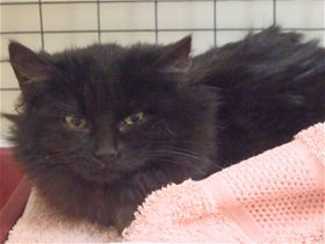
Male domestic long hair mix
This male domestic long hair mix is 12 weeks old.
He has green eyes, a black coat and weighs 3 pounds. He has been neutered.
He’s in cat room kennel No. 14b, ID No. 35205.
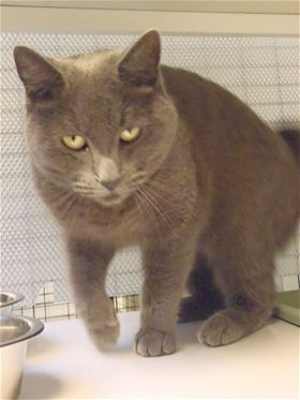
Domestic short hair mix
This female domestic short hair mix is 2 years old.
She has gold eyes, if of medium size and has been spayed.
She’s in cat room kennel No. 29, ID No. 35259.
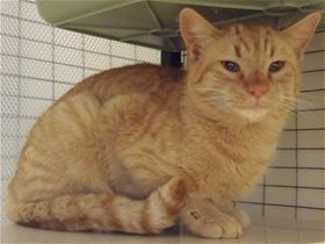
Male orange tabby
This male orange tabby is 1 year old.
He has gold eyes, weighs 9 pounds and has been neutered.
You can find him in cat room kennel No. 81, ID No. 35198.
Adoptable cats also can be seen at http://www.co.lake.ca.us/Government/Directory/Animal_Care_And_Control/Adopt/Cats_and_Kittens.htm or at www.petfinder.com .
Please note: Cats listed at the shelter's Web page that are said to be “on hold” are not yet cleared for adoption.
To fill out an adoption application online visit http://www.co.lake.ca.us/Government/Directory/Animal_Care_And_Control/Adopt/Dog___Cat_Adoption_Application.htm .
Lake County Animal Care and Control is located at 4949 Helbush in Lakeport, next to the Hill Road Correctional Facility.
Office hours are Monday through Friday, 8 a.m. to 5 p.m., and 1 p.m. to 3 p.m., Saturday. The shelter is open from 10:30 a.m. to 4:30 p.m. Monday through Friday and on Saturday from 1 p.m. to 3 p.m.
Visit the shelter online at http://www.co.lake.ca.us/Government/Directory/Animal_Care_And_Control.htm .
For more information call Lake County Animal Care and Control at 707-263-0278.
Email Elizabeth Larson at
LAKE COUNTY, Calif. – As a flu epidemic crosses the nation, state and local health officials said California so far is not seeing an unusual spike in the seasonal illness, but they nonetheless urged people to be vaccinated as a precaution before the season peaks.
The Centers for Disease Control and Prevention said Friday that 47 states have reported widespread geographic influenza activity, up from 41 the previous week.
The CDC estimates that an average of 25,000 people die annually from flu across the United States, with the elderly, children and other special populations proving to be especially vulnerable.
The California Department of Public Health's surveillance indicators are showing a steady increase in influenza activity in California.
Dr. Ron Chapman, director of the California Department of Public Health and state health officer, said that while California is seeing an increase in flu activity, it's not an unexpected one.
“California is seeing an accelerated increase in flu activity over the past few weeks,” said Dr. Chapman. “You can help prevent further spread of the flu by getting a flu shot.”
Chapman's office reported that while influenza activity varies from year to year and is unpredictable, California generally sees an increase in cases in late December or early January and it often peaks in February or March.
“So far it's been very quiet,” said Dr. Karen Tait, Lake County's public health office.
Tait said she has not heard any reports of case spikes from local hospitals. Lake County News also did not receive responses back from local hospitals on Friday regarding the numbers of cases.
Tait said her office also hasn't gotten any notice of “reportable cases,” which are limited to flu deaths to people under age 65.
“In terms of even just informal reports, we’re not getting a lot of activity so far,” she said. “We don’t know if that means we’re still on an upswing and it hasn’t gotten here yet.”
However, she points out that the annual flu spikes are normal. “People forget what the normal seasonal flu does.”
“The best defense against the flu is getting vaccinated. This year’s vaccine is an excellent match against this year’s influenza strains,” Dr. Chapman said. “There is no shortage of vaccine in California and it is not too late to get vaccinated. Our flu season may not peak for several more weeks, so I encourage everyone to get vaccinated to protect not only themselves, but those with whom they come into contact.”
Tait agreed. While in many places across the country flu vaccine is running out, Tait said her office has plenty.
The CDC reported that 90 percent of all of the flu strains circulating are included in the vaccine. More than 130 million doses that were produced by the vaccine manufacturers this year already have been given.
Since scheduled clinics are past, Tait said people can call the Public Health Department to check on times for when to come in for shots.
She said it's best to call ahead of time. “It’s gotten quite busy all of a sudden,” she said, a fact she attributed to increased media attention about the flu.
“After a few years of fairly flu seasons, people weren’t all that eager to be vaccinated this year,” she said.
It may be more “hit and miss” supply-wise for local doctors and other care providers. Tait urged people to call their providers right away to check on availability.
Not available is the flu mist nasal spray which have expired, and usually expires fairly quickly in the flu season, Tait said.
Regarding why flu is worse some years than others, Tait explained that flu strains “do evolve and change,” and sometimes those changes are minor and sometimes major.
If a strain is similar to one that was widespread 20 years ago, older people might find they are relatively protected, she said.
Tait said Lake County always has been fortunate because in its rural environment there are not a lot of venues for people to crowd together and thus spread the flu more.
Dr. Chapman noted that in addition to getting vaccinated, it’s important to practice good hand washing and other good health habits.
Flu symptoms include fever, cough, sore throat, runny or stuffy nose, muscle or body aches, headaches and fatigue.
People who are ill should take actions to stop the spread of germs such as limiting contact with others; covering one's nose and mouth when coughing or sneezing; washing hands thoroughly with soap and water or using an alcohol-based rub; and avoiding touching one's eyes, nose and mouth, Chapman’s office said.
State health care officials said special care should be shown to high risk groups, including the elderly, pregnant women, infants or those with other health conditions that make them particularly vulnerable. When they show flu symptoms a physician should be contacted immediately.
To find out more about flu vaccines, call Lake County Public Health, 707-263-1090.
Email Elizabeth Larson at

KELSEYVILLE, Calif. – The fourth-annual Kelseyville Olive Festival will be held from 11 a.m. to 5 p.m. Sunday, April 21, at the Chacewater Winery & Olive Mill located at 5625 Gaddy Lane in Kelseyville.
The event will showcase local products and their importance to the health of our community, while benefiting local nonprofit organizations.
The festival will feature vendors offering olive-related and other local products, samples, food, soaps, and more, as well as providing educational materials about olives and our local industry. Vendor and sponsorship opportunities are available.
There is no cost to attend the festival; wine and beer tasting with a commemorative glass will be available for a $15 fee with proceeds benefiting Lake Family Resource Center.
Several related contests will be held up to and during the festival, including a poster contest, amateur recipe contest, olive pit spitting contest, and people’s choice olive oil contest.

Event proceeds from the silent auction will benefit the California Women for Agriculture’s Lake County Chapter and their AgVenture Program, the raffle benefits the Kelseyville Education Foundation, and the tasting sales benefit the Lake Family Resource Center. The Lake County Arts Council will also benefit from the event for their part in the poster contest.
For more information about the Kelseyville Olive Festival, contact Livia Kurtz, Rosa d’Oro Vineyards, at 707-279-0483 or visit www.kelseyvilleolivefestival.com .
The Kelseyville Olive Festival is presented by Rosa d’Oro Vineyards and Chacewater Winery & Olive Mill. Both companies are located in Kelseyville and produce wine and olive oil.
The Chacewater Winery & Olive Mill is located at 5625 Gaddy Lane in Kelseyville, across from the Kelseyville Post Office.
For more information about Rosa d’Oro Vineyards, visit www.rosadorowine.com or call 707-279-0483. For information about Chacewater Winery & Olive Mill, visit www.chacewaterwine.com or call 707-279-2995.