 How to resolve AdBlock issue?
News
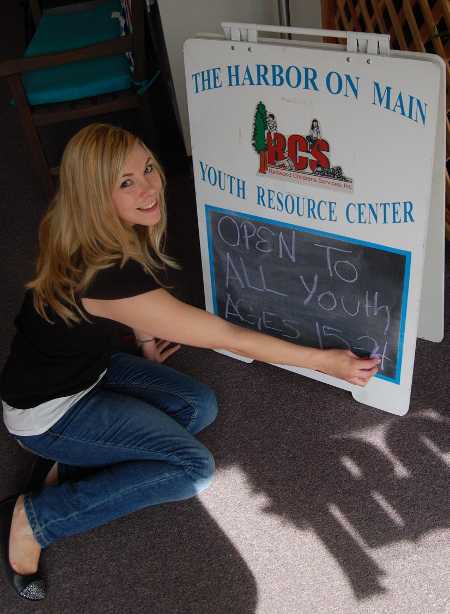
LOWER LAKE, Calif. – It was not the best way for Jolene Chappel to develop an understanding of the panic of being a teenager suddenly left to fend for one’s self by abandoning parents.
But, because Chappel, herself, while in high school in Clearlake was left on her own and rendered homeless, she is wise beyond her 23 years on the issues facing these young people.
“When I was 15 my family moved away,” explained Chappel, the youth resource director of The Harbor on Main, a storefront service for youth on Lower Lake’s Main Street.
She said her sister took her family to Chico and her mother – who would later return to Lake County – also left the area at that time, leaving Chappel behind.
“I had other family in the area, but I had to really figure things out,” she said. “I was living with different friends. I would go home to a friend’s home, but I never had a stable feeling like, ‘This is my home.’ It was more like, ‘This is my home and this is my home and this is where I’m sleeping tonight.’”
So, to the process of providing her aged 14-to-24 clients guidance and steering them toward hope and a more secure existence, Chappel brings a graduation from the school of hard knocks, as well as the degree in psychology she was awarded 14 months ago at Sonoma State.
“My motivation to do this job was growing up in Lake County with very little support,” said Chappel, who is a little more than a year into her position. “I wanted to be adult support for other young people who are in the situation I was in and I understand what it takes to do this.”
The staff at The Harbor on Main consists of one other full-time specialist and one part-time.
As the other full-timer, Danielle Casey, serves as youth development specialist, assisting mainly with helping clients develop resumes and continuing education up to and including earning a GED certificate at Yuba College and the Konocti Unified School District.
On a part-time basis, Nura Brown serves as peer support specialist assists clients with “whatever they’re going through and whenever they need somebody to talk to,” Chappel explained. “She also goes out to local community colleges, the high schools and adult education classes and performs outreach.”
It is a small staff for a significant caseload.
Chappel estimates that 200 clients were served in the first year at the center – one third from foster homes.
Another third comes from referrals by parents, teachers, and agencies such as Lake County Behavioral Health, Social Services, Child Welfare Services and Probation. The final third are walk-ins who learn about the program mostly from their peers.
All of the youth served by The Harbor on Main are economically challenged.
The Harbor on Main is a relatively new program, at least in name.
According to Chappel, the program was launched in 2008 with funding from the Mental Health Services Act, Proposition 63, and was headquartered at the old firehouse. It’s a program of Redwood Children’s Services.
“We completely revamped the program last April and changed the name from Lake Center for Support to the present name,” she said. “Before then, they really didn’t have a lot of stuff going on in this program.”
Essentially, the services that come under the program’s umbrella include:
- Peer support and counseling with young people, such as Chappel, who have had similar experiences;
- Individual case management, including aid in finding low-income housing;
- Goal setting;
- Behavior modification;
- Continuing education leading to a GED;
- Employment, job and military, which consists of walking clients through the application process and developing references; and
- Planned parenthood.
“What I hear a lot from the clients who come in is ‘job,’” said Chappel. “Our program consists of (answers to) ‘Where do I go? What do I wear to work?’ and mock interviews. Then we actually go out and canvass the community and talk to business owners to make them aware of the importance of hiring young people.
“We will try to get our clients into apprenticeship,” she added regarding a newly launched program. “But we just finished our outreach plan, so we really don’t have results yet.”
A grant from United Way’s Youth Advancement program provides the youth $40 a month for attending 12-week learning sessions.
Clients who complete The Harbor on Main’s six-week program receive a $25 savings account from a supportive credit union.
Another piece of the program, maternity, also was recently adopted.
“We see a lot of young parents and we received a grant for a maternity group home here in the county called ‘The Nest.’ It opened a couple of weeks ago,” Chappel said. “We had our first pregnant couple move in and they will be going through a (15-month) process where we help them find a job and get their GEDs.”
Every service provided at The Harbor on Main is being tracked by quarterly reports, but with the program being new, there is relatively little quantitative data.
Many, if not most clients, Chappel asserted, “are really confused about what path to take. They’ll say, ‘If I commit (to a job or the military), does that mean I’m committed for the rest of my life?’ and ‘How am I going to pay for this?’
“We work through those things and then plan it out step by step, which changes their thinking from ‘I have to do a million things,’ to ‘Oh, I can do this part today.’ We just try to keep them on track,” she said. “If a youth comes in and is not ready to look for a job . . . I say ‘Well, what are you ready to do?’”
After describing the plethora of The Harbor on Main services, Chappel led the reporter in a walk-through of the facility, which includes computers for Internet training, a library, a conference room, a closetful of interview and everyday clothes, Planned Parenthood aids, hygiene products, video games and Friday night movies.
“So we have to be a combination of take care of yourself but also help us ... the whole nine yards,” Chappel said proudly of a place that fits her calling.
“I always wanted to help people,” she said.
Chappel said The Harbor on Main is seeking members to sit on its youth board, ages 15 to 24, which makes decisions about the center’s policies, and what activities and services they provide.
For more information about the center and its services contact The Harbor on Main, 16170 Main St., Suite F, Lower Lake, CA 95457, telephone 707-994-5486.
Email John Lindblom at
What do you get when you join a group of five adventurous women from Santa Monica with a group of equally adventurous women from Northern California for a birding trip to Costa Rica?
Lots of fun. And, as the Costa Rican’s say: “Pura Vida!”
Add to this group, a patient, somewhat serious birding guide with an ironic sense of humor and a good-natured driver, and you have a recipe for a fantastic journey in one of the most beautiful countries in the world.
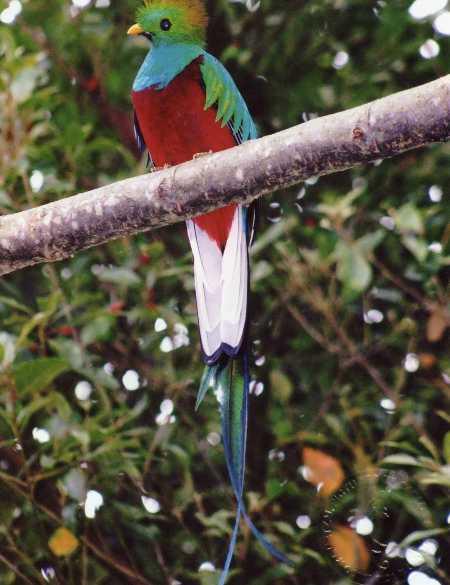
Costa Rica has an incredible number of colorful exotic birds and interesting animals, including the indescribable resplendent quetzal.
The people are fantastic too: tourism is so important in Costa Rica that they do everything they can to make your visit easy and enjoyable.
Although it is a good idea to have some Colones, most places takes dollars and credit cards are also easy to use, and if you don’t speak Spanish, no problem, everyone who needs to speaks English.
Organized by Lake County resident, Bella Kluyt, a 76-year-old Dutch/Indonesian ball of energy and Ecole Travel of Costa Rica, we were met at the airport near San Jose, Costa Rica by Andres and Ricardo to start our trip.
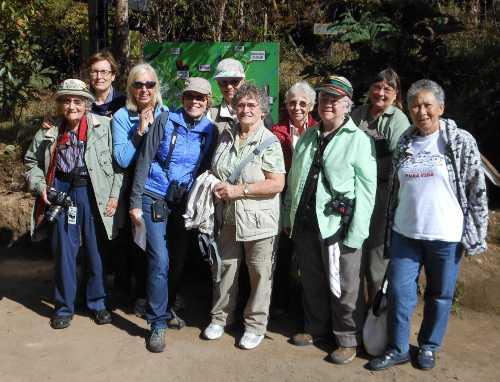
“Bella Birding,” read the sign held by Andres, our birding guide, and we were soon boarding Ricardo’s small tourismo bus and heading to the Cerro Lodge near Tarcoles close to the Pacific. It didn’t take long for Andres to figure out he had a group of interesting, chatty, crazy women on his hands!
There was Nel, the 73-year-old Dutch blonde beauty with a sense of humor that never stopped; Paula, also Dutch, who teaches computer usage to elders in her town of Santa Monica; and perhaps the coolest of all, Nancy Cattel, a 92-year-old practicing attorney – a world traveler who was on the trip with her daughter Jody. Nancy carried around a 10 pound camera too, and took fabulous images of every bird we saw.
Birding wasn’t exactly Jody’s thing – the youngster of the group, just 61; her idea of a good time besides running and mountain climbing is launching herself over 5 foot jumps on her 18 hand high Hanoverian horse.
So, one can see how birding, which requires long and tedious moments of standing in one spot staring up at the trees, could be a little tame for Jody, but, like the other ladies who were not exactly keen birders she was a great sport and soon got into the spirit of it all.
Carol, also of Santa Monica, was an unassuming little slip of a thing, but guess who was among the ladies who went zip lining? You got it! Carol!
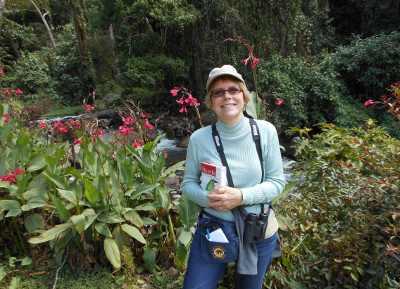
Then there were the Lake County girls, including Janet, Michelle, Susanne, Bella and me who were considered the “real birders” of the group, with poor Susanne getting stuck with the job of keeping our bird list.
Of course with 10 women, all 60 or over, there was a lot of clamoring for bathrooms. Andres figured that out right away and carefully planned our journey making sure we had appropriate bano stops all along the way.
A handsome 30-year-old Costa Rican with a degree in ecological tourism, Andres was not only an expert at identifying birds for us, but also explained both the cultural and natural history of the country.
Poor Andres had his hands full with this group of ladies. One of our members put it this way: “It’s like herding cats!” He would often have to say: “Ladies, ladies, please, I will explain to you, what we are doing, But could you please listen.” Ha ha! We did manage to get a smile out of him once in awhile and we soon caught on to his ironic humor.
Our first two nights were at the Cerro Lodge near Tarcoles. The lodges in Costa Rica have bird feeders to attract the more “common” birds like macaws, toucans, oropendolas and a variety of tanagers that fly into the feeding platforms strewn with different types of fruits.
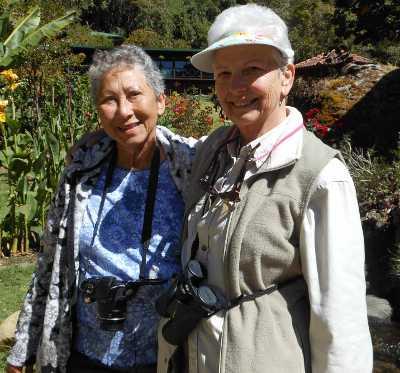
On our first afternoon walk in the vicinity of Cerro Lodge we saw the tropical kingbird, scarlet macaw, Montezuma Oropendola, rufous-naped wren, melodious blackbird, squirrel cuckoo, Inca dove, striped-headed sparrow, short-tailed hawk, gray hawk, cinnamon hummingbird, to name just a few, and that was just on the road near our lodge!
Dinner was typical Costa Rican faire – beans and rice, trout or chicken, fantastic salad and other vegetables.
The next day it was on to the Tarcoles River for an astounding trip where again, we saw numerous birds along with lots of crocodiles. Andres was the best birding guide imaginable.
We could never have seen, let alone identified, the birds that he pointed out to us. On the Tarcoles we saw: bare throated tiger heron, white ibis, wood stork, roseate spoonbill, magnificent frigate bird, ringed, green, and amazon kingfishers, mangrove swallow, boat-billed heron, prothonotary warbler, and on and on.
The nine-day trip consisted of staying two nights each at different eco-lodges. We basically made a circle, flying into San Jose, then driving west to Tarcoles, near the Pacific Ocean; then north to Mt. Arenal, where we stayed at the Arenal Observatory Lodge, then east to Sarapiqui, then south again to the Savegre River area to get our best chance at seeing the resplendent quetzal.
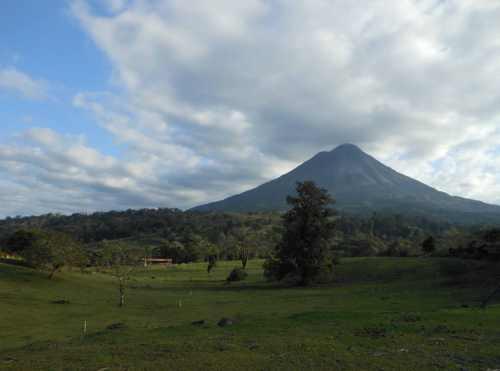
All of the areas were beautiful and the lodgings were excellent. Two were “rustic,” but still very nice and two were more “high end” and modern. All were built to blend with the unique habitat of the areas and all catered to birders.
The Arenal Observatory Lodge, where we stayed after El Cerro in Tarcoles, was perhaps the most modern. The original buildings were for the scientific observation of the active Arenal volcano, but eventually the hotel was constructed and it has become a tourist mecca.
The lodge boasts beautiful rooms, nice bar and restaurant, numerous trails, a lovely pool, a huge deck for viewing the volcano, birds and other wildlife (like the white-nosed coatimundi) and numerous trails, one leading to a gorgeous waterfall. You can also go on trail rides here. I could have spent a week at this place!
All of the lodges have restaurants on site. At Arenal, you could order from a menu, but the other places were similar to bed and breakfasts where all diners enjoy the same kitchen fare produced by the hosts.
Costa Rica doesn’t seem to have a distinct cuisine, like Mexico or France, but the food was good. Lots of what they call trout, which looked and tasted to me more like salmon. It was delicious as were the salads. Beans and rice were served at every meal, breakfast and dinner. Water at all of the lodges was potable, right from the tap, and no one in our group became ill.
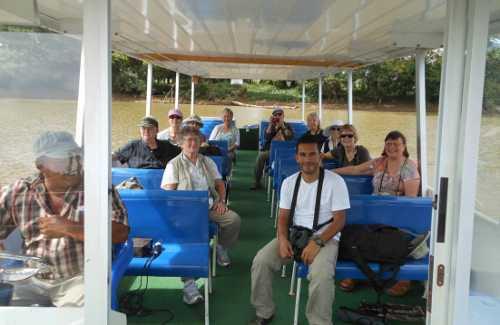
While at Arenal we drove north and enjoyed another boat tour, this time on the Rio Frio in the Cano Negro Wildlife Refuge. We had lunch on the boat and it was on this trip that we saw both the great and common potoo. Apparently catching a site of the great potoo is quite unusual, so we were happy about that.
We also saw (and heard) many howler monkeys, and the Capuchin monkey, long-nosed bats roosting on a tree, iguanas, crocodiles, caymans and the Jesus Christ Lizard (so named because it can “walk on water,” for short distances.)
After Arenal we traveled east to Sarapiqui to stay at the El Gavilan Lodge, another “rustic,” inn. There we saw the spectacled owl and also visited the famous La Selva Biological Station where researchers from all over the world come to study tropical rain forests.
At La Selva we saw different song birds, the black-cheeked woodpecker, social flycatcher, chesnut-headed oropendola, great curassow, a three-toed sloth sleeping in a tree, and a family of peccary (pigs) trotting through the reserve.
Also while at the El Gavilan, most of the Santa Monica gang, including Carol, Jody, Nel and 92-year-old Nancy, opted for zip-lining. Jody was the youngest who went on this adventure, which requires a bit of stamina, with seven or eight platforms where you switch zip-lines and also some hiking to get to them.
I was too chicken, instead opting to walk the local trails and roads with Andres and the Lake County girls in search of the green macaw – which we never did get a good view of, although we did see them flying.
We also randomly bumped into the famous international bird guide, Victor Emanuel, who had his group on the same road where we were looking for the macaw.
It was a funny coincidence because we had just been teasing Andres about Victor Emanuel and how we were going to have to be “more like him” in order to meet our 200 target list of bird species. We were joking of course, we didn’t want to get up at 3 a.m. and bird for eight hours straight. We did meet our target of 200; in fact we got 220!
Our final stop was to the breath-taking Savegre River area in San Gerardo de Dota. We traveled south to arrive there. Although we covered a lot of territory, the bus rides were not too arduous, the longest being the trip to Savegre (six hours).
We got up pretty early on some mornings, heading out by 6 a.m. in some cases. Staying two nights at each place was an absolute must however. All of the places we stayed were either in, or near, one of Costa Rica’s many national parks.
Trogon Lodge was our final destination near the Savegre River, known for having the cleanest water in the world. En route we stopped at the Hotel De Montana Paraiso Quetzal where for $25 we enjoyed lunch and a guided walk through the forest to find the elusive resplendent quetzal.
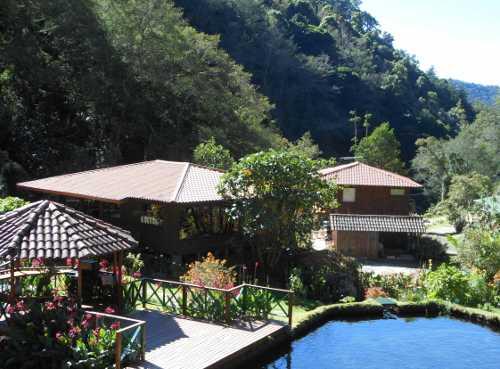
The Serrano family operates the restaurant and resort, with some sons sharing duty in the hotel and restaurant, while others trek the forests, find the quetzal, then stealthily lead visitors to view this gorgeous bird.
Everything is designed to minimize disturbance to the birds and the Serranos leave part of their family lands completely untouched to provide human-free habitat. The family has studied the quetzals for years and is committed to their preservation. It was really fun quietly stalking the bird and exciting when we finally saw him.
After the quetzal adventure, we traveled down into the Savegre Gorge where our lodge was located. The Trogon Lodge is another eco-lodge that is very well-designed and fits into the habitat beautifully. It is next to the Savegre River, with its pure water carefully diverted to a few beautiful ponds where trout are raised for the lodge’s diners.
Guides take people to see the quetzal from here as well; although we didn’t spot it again we added to our list the sulphur-winged parakeet, emerald toucanet, slaty flower-piercer, scintillate hummingbird, collared restart, and more, of course.
The Trogon Lodge marked the end of our wonderful Costa Rican journey. I would certainly go back and spend more time.
We were lucky to have this trip especially designed for us by Bella and Ecole Travel. With only 10 people on the trip, it was very personalized and easy to go on walks and eat at restaurants.
It was great fun, especially to be with such a nice group of amiable and interesting women. We really were able to enjoy “Pura Vida” in Costa Rica!
Roberta Lyons is a journalist and active volunteer in a number of organizations in Lake County, Calif. She lives in Lower Lake, Calif.
Have you taken a great trip that you’d like to share with Lake County readers? Email
LAKE COUNTY, Calif. – Each year, millions of Americans take the chance to celebrate their connection to a beloved emerald isle and its people across the sea.
March is Irish-American Heritage Month, with the month’s pinnacle event coming on Sunday, March 17 – St. Patrick’s Day.
It’s a time when Americans’ affection for the Irish – which is reciprocated – is put on display.
Ireland is a small island nation with a mighty presence.
Ireland is nearly 33,000 square miles in size. For perspective, that’s roughly the size of the state of Indiana, and about 24 times the size of Lake County, which covers 1,329 square miles.
The patron saint of Ireland, St. Patrick introduced Christianity to Ireland in the fifth century. March 17 is the day he died, around 460 AD.
Patrick, born to wealth in Britain in the fifth century, was taken hostage by Irish raiders when he was 16. According to a history of his life, he would spend the next six years in Ireland, eventually converting to Christianity.
He later escaped and returned to Britain. However, he experienced a vision of an angel telling him to return to Ireland to work as a missionary, which he did after 15 years of religious training and ordination as a priest.
Patrick drew on Irish cultural symbols to help teach the faith. The shamrock was used to explain the trinity, he created the Celtic cross by placing the venerated sun symbol over the Christian cross and applied Christian principles to Irish celebrations.
In Lake County, Irish was the second most frequently reported ancestry, with German No. 1, according to American Community Survey statistics for 2011, the most recent year available.
Approximately 7,291 Lake County residents – out of a total population of 64,323 – claimed Irish as their primary ancestry, the survey records showed.
The US Census Bureau reported that, nationwide, German and Irish also are the No. 1 and No. 2 most commonly reported ancestries, respectively.
Across the nation, in 2011 34.5 million people reported Irish ancestry, more than seven times the 4.68 million people living in Ireland. Also in 2011, 150,990 Irish-born individuals became naturalized US citizens.
Those of Irish ancestry are likely helping keep the value of Irish imports high. The US Census Bureau's Foreign Trade Division said 2011 imports of Irish goods totaled $39.4 billion, with alcoholic beverages – except wine and related products – at $532.1 million.
For the traditional St. Patrick's Day dinner, in 2011 $2.8 billion in corned beef and $28.6 billion in cabbage were imported, according to the US Census Bureau.
For those interested in finding out more about their Irish ancestors, there are a number of Web sites that can help.
Sites such as www.ireland.com can help get history hunters started, with the Irish-government sponsored www.irishgenealogy.ie a place where officials records can be found.
The National Archives Web site also has access to a variety of immigration records; start at www.archives.gov/research/immigration/ .
For those who know their ancestors’ names and are looking for ship records, the National Archives’ Irish ship passenger data offers a wealth of fascinating information. Find it at http://aad.archives.gov/aad/fielded-search.jsp?dt=180&;cat=SB302&tf=F&bc=sb,sl .
Email Elizabeth Larson at
LAKE COUNTY, Calif. – There are many adoptable dogs in local shelters needing a bit of luck this St. Patrick’s Day in order to get new and loving homes.
If you’re looking for a type of dog, there’s a good chance you can find it among the many friendly pooches available among the local shelters and rescue groups.
This week adoptable dogs from Lake County Animal Care and Control, Clearlake Animal Control and the SPCA of Clear Lake are featured.
In addition to the animals featured here, all adoptable animals in Lake County can be seen here: http://bit.ly/Z6xHMb .
CLEARLAKE ANIMAL CONTROL

‘Dalton’
“Dalton” is an 8-week-old husky-shepherd mix puppy.
Dalton is a happy and plump little boy, with a big goofy grin.
He is very affectionate and will follow you everywhere you go, so will make a great companion.
If interested in Dalton or any of the other dogs from Clearlake Animal Control, please contact Officer Frankie Blavet at 707-994-8201, Extension 118, or visit the kennels at 6820 Old Highway 53 from 1 p.m. to 2 p.m. Monday through Friday.
Visit Clearlake Animal Control on Facebook at https://www.facebook.com/CityOfClearlakeAnimalControl .
SPCA OF CLEAR LAKE

‘Molly’
“Molly” is a 2-year-old Doberman mix.
She has a sweet personality, knows her basic commands and walks great on a leash.
Molly loves to play with other dogs but would not be suited for a home with chickens.
She is spayed, microchipped and current on all her vaccinations.

‘Roscoe’
“Roscoe” is a beautiful boxer/sharpei mix.
He loves to play fetch and run around with people.
He is learning his basic commands and is doing well on leash.
Roscoe is neutered, microchipped and current on all vaccinations.

‘Zeus’
“Zeus” is a gorgeous mastiff/boxer mix.
This big boy is a gentle giant. He is great on leash and he has a huge heart.
Zeus would be a great addition to your family.
Zeus is neutered, microchipped and current on all vaccinations.
For more information about these dogs contact SPCA of Clear Lake at 707-279-1400.
LAKE COUNTY ANIMAL CARE AND CONTROL
Dogs that are adopted from Lake County Animal Care and Control are either neutered or spayed, microchipped and, if old enough, given a rabies shot and county license before being released to their new owner. License fees do not apply to residents of the cities of Lakeport or Clearlake.
If you're looking for a new companion, visit the shelter. There are many great pets hoping you'll choose them.
The following dogs at the Lake County Animal Care and Control shelter have been cleared for adoption (additional dogs on the animal control Web site not listed are still “on hold”).

Chihuahua mix
This female Chihuahua mix is 2 years old.
She weighs 8 pounds, has a short tan coat and blue eyes, and has been spayed.
She’s in kennel No. 3, ID No. 35742.

Dachshund-terrier mix
This male dachshund-terrier mix is 10 years old.
He has a short red coat, weighs nearly 12 pounds and has been neutered.
Visit with him in kennel No. 8, ID No. 35644.

Male retriever mix
This male retriever mix is 4 years old.
He has a short yellow coat and brown eyes, weighs 46 pounds and has been neutered.
Find him in kennel No. 16, ID No. 35734.

Hound-Doberman Pinscher mix
This male hound-Doberman Pinscher mix is 1 year old.
He has a short gold coat and brown eyes, and has been altered.
He’s in kennel No. 17, ID No. 35733.

Male border collie mix pup
This male border collie mix puppy is 10 weeks old.
He has blue eyes, a short brown and white coat, weighs 10 pounds and has been neutered.
He’s in kennel No. 18a, ID No. 35704.

Female border collie mix pup
This female border collie mix puppy is 10 weeks old.
She has blue eyes, a short brown and white coat, and weighs 9 pounds.
Find her in kennel No. 18c, ID No. 35706.

Female border collie mix pup
This female border collie mix puppy is 10 weeks old.
She has blue eyes, a short brown and white coat, and weighs 9 pounds.
Find her in kennel No. 18d, ID No. 35707.

Male border collie mix pup
This male border collie mix puppy is 10 weeks old.
He has blue eyes, a short black and white coat, weighs 9 pounds and has been neutered.
He’s in kennel No. 18e, ID No. 35708.

Labrador Retriever-hound
This male Labrador Retriever-hound mix is 4 months old.
He has a short red coat, weighs nearly 28 pounds, has brown eyes and has been neutered.
Find him in kennel No. 21, ID No. 35776.
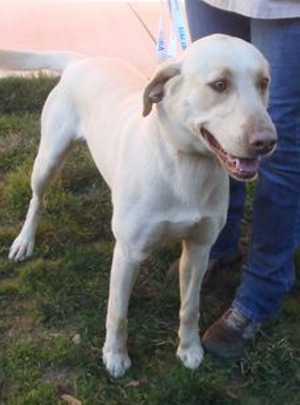
Labrador Retriever mix
This male Labrador Retriever mix is 2 years old.
He has a short yellow coat, weighs nearly 64 pounds and has been neutered.
Find him in kennel No. 29, ID No. 35691.

‘Chino’
“Chino” is a 4-year-old male cocker spaniel mix.
He has a long buff-colored coat and brown eyes, weighs 16 pounds and has been altered.
He’s in kennel No. 34, ID No. 35740.
Please note: Dogs listed at the county shelter's Web page that are said to be “on hold” are not yet cleared for adoption.
To fill out an adoption application online visit http://www.co.lake.ca.us/Government/Directory/Animal_Care_And_Control/Adopt/Dog___Cat_Adoption_Application.htm .
Lake County Animal Care and Control is located at 4949 Helbush in Lakeport, next to the Hill Road Correctional Facility.
Office hours are Monday through Friday, 8 a.m. to 5 p.m., and 1 p.m. to 3 p.m., Saturday. The shelter is open from 10:30 a.m. to 4:30 p.m. Monday through Friday and on Saturday from 1 p.m. to 3 p.m.
Visit the shelter online at http://www.co.lake.ca.us/Government/Directory/Animal_Care_And_Control.htm .
For more information call Lake County Animal Care and Control at 707-263-0278.
Email Elizabeth Larson at

An analysis of a rock sample recently collected by NASA’s Curiosity rover shows ancient Mars could have supported living microbes.
“A fundamental question for this mission is whether Mars could have supported a habitable environment,” said Michael Meyer, lead scientist for NASA’s Mars Exploration Program at the agency’s headquarters in Washington. “From what we know now, the answer is yes.”
Last month, Curiosity drilled into a sedimentary rock near an ancient stream bed in Gale Crater. In the powder from the drill sample, scientists have identified sulfur, nitrogen, hydrogen, oxygen, phosphorus and carbon – some of the key chemical ingredients for life.
“Clay minerals make up at least 20 percent of the composition of this sample,” said David Blake, principal investigator for the CheMin instrument at NASA’s Ames Research Center in Moffett Field, Calif.
These clay minerals are a product of the reaction of relatively fresh water with igneous minerals, such as olivine, also present in the sediment.
The reaction could have taken place within the sedimentary deposit, during transport of the sediment, or in the source region of the sediment. The presence of calcium sulfate along with the clay suggests the soil is neutral or mildly alkaline.
Scientists were surprised to find a mixture of oxidized, less-oxidized, and even non-oxidized chemicals, providing an energy gradient of the sort many microbes on Earth exploit to live. This partial oxidation was first hinted at when the drill cuttings were revealed to be gray rather than red. (Red, like rust, is a sign of oxidation.)
“The range of chemical ingredients we have identified in the sample is impressive, and it suggests pairings such as sulfates and sulfides that indicate a possible chemical energy source for micro-organisms,” said Paul Mahaffy, principal investigator of the SAM suite of instruments at NASA’s Goddard Space Flight Center in Greenbelt, Md.
Clues to this habitable environment come from data returned by the rover’s Sample Analysis at Mars (SAM) and Chemistry and Mineralogy (CheMin) instruments.
The data indicate the Yellowknife Bay area the rover is exploring was the end of an ancient river system or an intermittently wet lake bed that could have provided chemical energy and other favorable conditions for microbes.

The rock is made up of a fine-grained mudstone containing clay minerals, sulfate minerals and other chemicals. This ancient wet environment, unlike some others on Mars, was not harshly oxidizing, acidic or extremely salty.
An additional drilled sample will be used to help confirm these results for several of the trace gases analyzed by the SAM instrument.
“We have characterized a very ancient, but strangely new ‘gray Mars’ where conditions once were favorable for life,” said John Grotzinger, Mars Science Laboratory project scientist at the California Institute of Technology in Pasadena, Calif. “Curiosity is on a mission of discovery and exploration, and as a team we feel there are many more exciting discoveries ahead of us in the months and years to come.”
Scientists plan to work with Curiosity in the “Yellowknife Bay” area for many more weeks before beginning a long drive to Gale Crater’s central mound, Mount Sharp.
Investigating the stack of layers exposed on Mount Sharp, where clay minerals and sulfate minerals have been identified from orbit, may add information about the duration and diversity of habitable conditions.
For updates, stay tuned to Science@NASA.
You can follow the mission on Facebook and Twitter at: http://www.facebook.com/marscuriosity and http://www.twitter.com/marscuriosity
Dr. Tony Phillips works for the National Aeronautics and Space Administration.

LAKE COUNTY, Calif. – Law enforcement officials around the region are searching for a Napa County man believed to be responsible for numerous bank robberies in Lake and other counties over the past two months.
On Friday the Lake County Sheriff’s Office identified the suspect in two Middletown bank robberies as 23-year-old Joshua James Metoxen of Napa.
Metoxen, a 2007 graduate of Vintage High School where he was a football standout, is believed to have robbed the Middletown Westamerica Bank on Feb. 27 and the Tri Counties Bank on March 7, according to Lt. Steve Brooks.
Brooks said a $750,000 arrest warrant has been issued for Metoxen.
According to Napa Valley Crime Stoppers, Metoxen was arrested last August for charges including a felony probation violation and possession of a controlled substance.
Lake County Sheriff’s officials had previously stated that they believed the Middletown suspect was responsible for several North Bay bank robberies.
The Lake County Sheriff’s Office did not respond to a Lake County News inquiry on Friday regarding the connections between those robberies and the two that occurred in Middletown.
Lt. Jamie Scardina of the Marin County Sheriff’s Office told Lake County News on Friday that the agency believed a suspect who robbed a Mill Valley Westamerica Bank on Wednesday was similar in appearance to the Middletown suspect – who was not identified as Metoxen until later in the day.

The Mill Valley suspect – described as a white male adult in his late 20s, with a large build and facial hair under his bottom lip – walked up to a teller and handed over a note demanding money, according to the report.
The bank teller handed over an undisclosed amount of money and the suspect – who did not exhibit a weapon – fled with an undisclosed amount of cash, Marin officials reported.
The suspect was wearing sunglasses, a black sweatshirt, tan shorts and a red and black 49ers hat, was last seen getting into a mid 2000s tan Honda traveling southbound on Redwood Highway, officials said.
During the Lake County robberies, the suspect also appeared to have a similar modus operandi, handing over a note demanding money, with no weapon seen.
Scardina said the Mill Valley suspect also resembled the suspect who robbed a Chase Bank in Santa Rosa Feb. 1, two US Banks in Santa Rosa and Rohnert Park on Feb. 14, and another US Bank in Novato Feb. 19.
In a statement issued Feb. 14 the Santa Rosa Police Department said its investigators also believed the Santa Rosa and Rohnert Park robberies were committed by the same individual, who used a note to demand cash but didn’t show a firearm.

Three of the banks – the US Banks in Rohnert Park and Novato, and the Chase Bank in Santa Rosa – also were located in grocery stores, officials reported.
U.S. Bank is offering up to a $25,000 reward for information leading to the arrest and conviction of any individuals responsible for committing any bank robberies at any U.S. Bank branch.
Lake County officials said a multiagency manhunt is under way for Metoxen, who is considered armed and extremely dangerous and should not be approached.
Anyone with information concerning his whereabouts is encouraged to call 911.
Email Elizabeth Larson at