 How to resolve AdBlock issue?
News
LUCERNE, Calif. – A state agency tasked with advocating for low rates for utility customers has released its proposal for Lucerne water rates, who are facing another potentially large rate hike over the coming three years.
However, the California Public Utilities Commission’s Division of Ratepayer Advocates proposal comes in not very far below the proposal California Water Service Co. submitted last summer to the commission.
“They’ve been more more aggressive in the past,” said Lake County District 3 Supervisor Denise Rushing of the DRA’s proposal.
Rushing, who along with the county of Lake is an intervenor in the latest general rate case, added, “It doesn’t look like there is much fight in them.”
Another party to the case is The Utility Reform Network, whose telecommunications director, Regina Costa, attended the April 12 hearing the CPUC held at the Lucerne Alpine Senior Center.
Costa said TURN is looking at the DRA’s proposal and researching additional areas where cuts can be made to benefit customers.
“Lucerne is the poster child for having high rates and a lot of people with low incomes,” said Costa.
Cal Water is seeking a revenue increase in 2014 of 57 percent or $818,041 for Lucerne, according to DRA documents. The DRA said it is recommending an increase of 46.1 percent, or $673,753.
According to the DRA’s breakdown, they are proposing total operating revenues of $2,134,000, or 6 percent less than the $2,254,000 sought by Cal Water.
Proposed operation and maintenance costs are $778,400, compared to $813,000 sought by Cal Water, with DRA also proposing to give the company $272,300 for general office expenses. Cal Water had requested $326,300.
Ting Yuen, a DRA staffer, had appeared at the April 12 hearing, telling the group of more than 200 Lucerne residents that the DRA was proposing rates that would amount to less than half of what Cal Water as seeking for plant upgrades.
Regarding plant additions, DRA is proposing approximately $579,628 from 2013 to 2016, as compared to the $850,172 Cal Water requested.
Upgrades to the new plant are important because, according to Cal Water, it’s very challenging and expensive to treat water from Clear Lake.
Yoke Chan, a senior utilities engineer with the DRA, said that one of the key areas of reduction was related to Cal Water’s request for $150,000 to implement a disinfection process at its new plant. She said the DRA recommended instead $20,000 for a pilot test program.
As for administrative and general expenses, Cal Water had asked for $307,100 and DRA is suggesting giving the company a larger amount – $318,200 – due to an incorrect Cal Water calculation for nonspecific expenses, Chan explained.
For Cal Water’s entire Redwood Valley District – which serves Guerneville, Duncan Mills, Santa Rosa, Lucerne and Dillon Beach – the DRA said it is disallowing 20 new employees Cal Water asked to add, as well as 35 requested vehicles and related transportation costs.
It’s also removed costs included in the pension component for the Supplemental Executive Retirement Plan and removed an expense included by Cal Water in its administrative and general salaries for stock awards granted to executive officers.
Company officials told Lake County News that they are proposing to raise assistance from the low income rate assistance fund and a rate support fund to help Lucerne customers. The LIRA would go from $12 to $14 per month.
Costa pointed out that more than a third of Lucerne households are eligible for the low-income rate, yet the town has some of the highest rates in the entire company. “That low income rate doesn’t help them very much.”
Cal Water also had asked to offer a “balanced payment plan” to customers, which the DRA suggests the CPUC should only approve if it’s offered to all Cal Water customers.
Despite Lucerne’s high rates, Cal Water reported that its rate of return on the system was -8.8 percent in 2010, 4.5 percent in 2011 and 1.17 percent in 2012.
Rushing, in her review of the proposal, said there are important issues not being dealt with in the document. “Nobody seems to be pushing hard on the affordability issues, which is really key here.”
She suggested there also is a morality issue, when people who only make $800 a month are expected to pay $300 a month for water. Similarly situated county water systems don’t cost that much for customers, she said.
Rushing has faulted state officials for allowing Cal Water to require customers to pay $8 million for its new plant, which had three redesigns and should only have cost a third that amount.
That would be a huge amount for the entire county of Lake to have to pay, much less Lucerne alone, Rushing said.
Costa agreed, saying the town shouldn’t have to pay so much for the plant, and suggesting that someone at the CPUC was “asleep at the switch” when it was approved.
The town, which has about 1,200 connections, has a rising vacancy rate and has been in a downward economic spiral, Rushing said.
“They are serving a community that can’t afford their product, and their answer is to raise rates,” Rushing said of Cal Water. “I don’t know the sense in that.”
Said Costa, “The rates in Lucerne are ridiculously high,” which she added is true in a few places in Cal Water’s service area, including Antelope Valley and Tomales.
There also is the matter of inequality in rates. Communities like Los Altos, where Rushing estimated the median income is 10 times that of Lucerne, monthly water rates are about $25 a month. The population of Los Altos was estimated at 28,976 in 2012.
Company officials reported that water rates, unlike power rates, are set up on a cost of service basis, with each district paying different rates accordingly. They also acknowledge that, in the case of Lucerne, the costs are paid by a smaller customer base.
Cal Water has estimated an average customer in Lucerne pays about $62.85 for 500 cubic feet of water, but the County Administrative Office and Cal Water disagree on that amount, with the county asserting that an average bill is around $158 a month.
Currently, because of reduced water sales, Cal Water customers in Lucerne are paying a surcharge to raise the company’s rate of return, because less water is being used than the company anticipated in its last general rate case.
That level of sales is determined based on a five-year historic average, according to company officials. If sales are below the predicted level, a water revenue adjustment mechanism goes into effect. If water usage were to suddenly go up above predicted levels, customers would get a credit.
Costa suggested that the company’s sales forecasts were messed up, but regardless it is allowed to recover the money lost due to the bad estimates. Meanwhile, she said customers already are paying rates they can’t afford.
“It’s a broken system,” she said, adding that the CPUC realizes it and is trying to fix it.
Costa and Rushing said there is a CPUC proceeding relating to making rates more fair across the board, and Lucerne is part of that statewide proceeding. TURN also submitted testimony in that case, Costa said.
For those who attended the April 12 hearing, Costa said it was a worthwhile exercise. “The testimony at the public participation hearing was very, very important,” and can be used by the DRA and TURN in the fight to reduce rates .
The ratemaking process soon will move to meetings of the involved parties, including Cal Water, DRA and the county.
“We will have a settlement meeting with the company in May,” said Chan.
Costa said no dates had been set yet for the hearing.
During the settlement talks, the parties will consider Cal Water’s rebuttals to the DRA proposal, and if no settlement can be reached, the matter will go to a judge, Chan said.
At that point, only intervenors can make comments. Chan said they will be invited to the settlement meeting.
Rushing expects to take part in those settlement hearings along with other county officials,.
Costa said Lucerne’s situation has resonated with TURN, and they’re going to try to get a better rate proposal for the town.
Lucerne’s high rates and economic challenges “are going to be front and center in these talks, as far as we’re concerned,” Costa said.
Email Elizabeth Larson at
LAKE COUNTY, Calif. – After a dry spring, the county is starting to see small wildland fires, and fire officials say it’s time to prepare in order to keep residents and homes safe.
On Tuesday, a fire estimated at about six acres burned in Morgan Valley new Lower Lake, another small fire was reported alongside the road near Middletown that day and on Wednesday afternoon, as high winds blew through Lake County, a fire near Lakeport burned about an acre of land and a pump house, followed later by a fire that destroyed a home in Kelseyville.
Around the region, large wildland fires broke out this week, scorching thousands of acres.
Lakeport Fire Chief Ken Wells said the recent winds and high temperatures have created concerns for fire officials.
The wind, he explained, dries out the grass fast. The area’s grass already is dry after a spring with a dearth of rain.
“Now is the time to work on your defensible space,” said Wells.
While being prepared for fire always is advisable, in Lake County it’s particularly important to be ready for the fast-approaching fire season.
In 2012, thousands of acres were burned between the Scotts Fire and Wye Fire, as Lake County News has reported.
Wells urged area residents to get weeds, grass and other vegetation cleared around homes.
He said to do weedeating before 10 a.m., and advised that weedeating – which usually involves plastic line – is safer than lawnmowers, which use metal blades. Such blades, when they hit rocks, can create sparks that ignite grass.
Wells said Middletown firefighters on Tuesday recorded humidity as low as 8 percent. In Lakeport on Wednesday it was 15 percent.
“Fires burn when the humidity is down that low,” he said.
Due to the early increase in fire activity this year and the lack of rainfall, Cal Fire reported that it is anticipating the potential for a higher fire threat this summer.
So far this year, Cal Fire has responded to close to 700 fires, more than 200 over the average for this time of year.
Due to the low rainfall levels across the state from January to April, this year is likely to go down as one of the driest ever, the agency reported.
“While we are busy transitioning into fire season, this is the time we want residents to begin preparing their homes for fire season by creating 100 feet of Defensible Space,” said Chief Ken Pimlott, Cal Fire’s director.
Cal Fire advises residents to maintain 100 feet of defensible space around homes and structures, and to remove all dead plants, grass, and weeds from within 30 feet of your home.
Defensible space helps protect not only homes but, in the case of firefighters, it help protect them while they defend a home against fire.
Trees should be trimmed 6 feet from the ground, and all leaves, pine needles and debris should be removed from roofs. Cal Fire also advises families to create evacuation plans.
Cal Fire’s Ready Set Go Web site, http://www.readyforwildfire.org/ , offers guidance for homeowners on how to prepare for fire season, including creating an action plan, how to use the right equipment for vegetation removal, fire safe landscaping and more.
More information also is available at Cal Fire’s main Web site, www.fire.ca.gov .
Email Elizabeth Larson at
LAKE COUNTY, Calif. – With more people choosing a motorcycle as their mode of transportation, the California Highway Patrol, Office of Traffic Safety and Department of Motor Vehicles are embarking on a month-long endeavor to encourage all motorists to safely share the road.
This month’s traffic safety campaign follows a significant increase in the number of people killed in motorcycle-involved collisions in California.
“Law enforcement and traffic safety organizations throughout the nation are working to reverse this unfortunate trend,” said CHP Commissioner Joe Farrow of the increase in the number of people killed and injured in motorcycle-related collisions. “This month, and every month, motorists are reminded to safely share the road with motorcycles, and to be extra vigilant to help keep motorcyclists safe.”
According to the Department of Motor Vehicles, there are more than 1.3 million licensed riders in the state; and with California’s nearly year-round ideal climate, you will almost always encounter a motorcyclist while on the highway.
Because they are one of the smallest vehicles on the road, motorcycles are often hidden in a car’s or truck’s blind spot. Every driver needs to diligently look for them before changing lanes or merging with traffic. Motorcyclists are reminded to follow the rules of the road and make sure they are visible to motorists. Everyone on the highway is reminded to eliminate distractions.
According to preliminary figures from the CHP’s Statewide Integrated Traffic Records System, more than 400 people were killed and nearly 12,000 people were injured in motorcycle-involved collisions in 2011, representing a nearly 20 percent increase in the death rate in California from the previous year.
Preliminary estimates from the Governor’s Highway Safety Association indicate a slight decline in motorcycle fatalities in California for the first nine months of 2012.
“After two years of dramatic declines, motorcycle deaths are heading up again,” said OTS Director Christopher J. Murphy. “A training course can make a big difference for rider safety. In addition, much can be accomplished when both riders and motorists share the road safely and watch out for each other.”
The CHP administers California's official safety training program for motorcyclists through the California Motorcyclist Safety Program (CMSP). As of March 2012, more than 800,000 motorcycle riders have received training at one of the CMSP's 134 training sites since the program began in July 1987.
The Motorcycle Safety Foundation (MSF), a national non-profit organization, is charged with overseeing the day-to-day operations for the CMSP. The MSF not only emphasizes the importance of training and licensing for all motorcyclists, but stresses a rider’s critical need for proper safety gear.
“Not only should motorcyclists wear protective gear, all of the time, including a helmet manufactured to the standards set by the U.S. Department of Transportation; they should ride unimpaired by alcohol or drugs,” said MSF Vice President Robert Gladden. “If you follow these simple steps, lives can be saved.”
The CHP, DMV and OTS offer the following tips for drivers to help keep motorcyclists safe on our roadways:
- Remember, a motorcycle is a vehicle with all of the rights and privileges of any other motor vehicle. The person under that helmet could be a mother, brother, doctor, or friend.
- Perform a regular visual check for motorcycles by checking mirrors and blind spots before entering or exiting a lane of traffic, at intersections, and pulling out of driveways and parking lots. Always look twice before pulling out.
- Always signal your intentions before changing lanes or merging with traffic.
- Don’t be fooled by a flashing turn signal on a motorcycle – motorcycle signals are often not self-canceling. Wait to be sure the motorcycle is going to turn before you proceed.
- Allow more following distance - three or four seconds - when behind a motorcycle to give the motorcyclist time to maneuver around obstacles in the roadway or stop in an emergency.
Motorcyclists can increase their safety by:
- Wearing a DOT-compliant helmet.
- Never riding while impaired.
- Using turn signals for every turn or lane change, even if the rider thinks no one will see it.
- Signaling intentions by combining hand signals and turn signals to draw more attention to themselves.
- Assuming drivers can’t see them. Wearing brightly colored protective gear and using reflective tape and stickers to make sure they are seen.
- Positioning themselves in the lane where they will be most visible to other drivers.
- Not accelerating too quickly, since drivers turning ahead might not notice until too late.
The CHP, DMV and OTS join with the National Highway Traffic Safety Administration in sharing the following message: Help share in the responsibility of keeping all road users safe, and do your part by safely “sharing the road.”
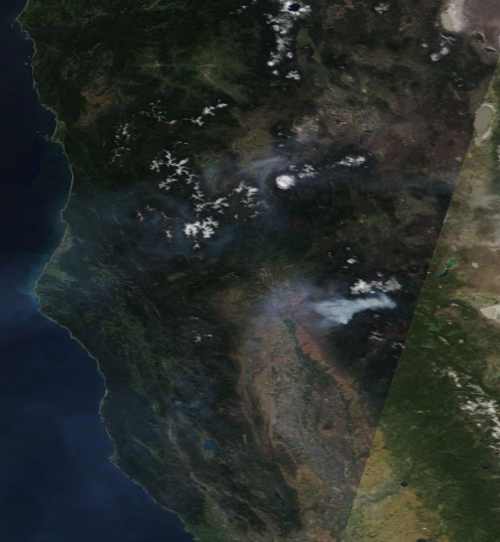
NORTHERN CALIFORNIA – While wildland fires around Northern California continued to grow in size on Thursday thanks to hot, dry conditions, state, local and federal firefighters gained ground on the blazes.
Chief among the fires in Northern California is the 7,000-acre Panther Fire, located north of Butte Meadows in the Ishi Wilderness Area in Tehama County, according to Cal Fire.
Cal Fire said Thursday evening the fire – the reported size of which had increased by about 5,000 acres since the morning report – was 10 percent contained. There was no immediate threat reported to homes or infrastructure.
The Panther Fire, which began on Wednesday morning in timber and timber slash, was being fanned by dry, windy conditions, and had a moderate to rapid rate of spread in the steep terrain where it was burning, located in the Mill Creek and Deer Creek drainages.
On Thursday evening, Cal Fire said 27 engines, 497 firefighters, eight dozers and five water tenders were assigned to the incident.
Lake County Air Quality Management District reported on Thursday that it was the Panther Fire that was responsible for the smoky haze hanging over parts of Lake County.
Near Elk Creek in Glenn County, firefighters gained ground on the 306 Fire, which began on Wednesday and by Thursday night had reached 217 acres and 50-percent containment, according to Cal Fire. It was burning on steep terrain near Road 306 on Gravelly Ridge.
Resources assigned included 255 firefighters, 11 engines, 12 fire crews, one dozer and two water tenders, Cal Fire said.
In the Knights Valley area of Sonoma County, northwest of Calistoga, the Yellow Fire – which also began on Wednesday – had burned 125 acres by Thursday evening but was 80 percent contained, Cal Fire said.
The fire is burning in steep terrain and heavy fuels off of Highway 128 and Yellow Jacket Ranch Road, the agency reported.
Approximately 145 fire personnel, 10 engines, six fire crews, one helicopter and one dozer were working the Yellow Fire on Thursday evening, with Cal Fire noting that heavy mop up and fire suppression damage repair activities are under way.
Fire officials said that smoke may be visible within the fire perimeter for several days, and urged anyone driving through the incident area to use caution because of fire equipment at work.
Email Elizabeth Larson at
LAKE COUNTY, Calif. – With wildland fires burning in neighboring counties and other parts of Northern California, Lake County residents are seeing hazy skies overhead.
Fires have begun burning over the last few days in Sonoma, Napa and Glenn counties, but the Lake County Air Quality Management District reported Thursday that one fire in particular – the Panther Fire, burning in Tehama County – is resulting in smoke, haze and degraded air quality for Lake County.
Cal Fire said Thursday morning that the Panther fire had burned 2,000 acres and was 10-percent contained, with no estimate given yet on when the fire is expected to reach full containment. The fire is burning in steep terrain and being driven by gusty down-canyon winds.
Lake County Pollution Control Officer Doug Gearhart reported that weather forecasts indicate mixed
conditions that may cause intermittent smoke impacts for the Lake County air basin over the next four to five days. Calm conditions overnight are likely to result in smoke settling in the basin.
He said air quality conditions on Wednesday were good much of the day, with several hours of noticeable smoke intrusion in the evening and overnight.
Ozone and particulate levels are elevated, but have not exceeded state health-based air quality standards. Localized areas may experience higher ozone and particulate levels depending on the weather conditions, Gearhart said.
The prediction for the weekend is for “moderate “ to “unhealthy for sensitive individuals” air quality in Lake County. Gearhart said all areas of Lake County may be significantly impacted should meteorological conditions worsen. Smoke impacts are most likely to occur during the overnight hours.
Smokey conditions can cause irritation of the eyes, nose and air passages. These conditions can be hazardous for sensitive individuals including young children, the elderly, and individuals with heart conditions, and those with chronic lung disease such as asthma, bronchitis and other respiratory conditions, Gearhart said.
He urged people to remember to take precautions and plan ahead as smoke conditions can change quickly.
The “moderate” to “unhealthy for sensitive individuals” air quality alert results from fine particulate in the smoke and ground level ozone. These are generated when combustion products in the smoke combine with the high temperatures, sunlight and humidity, Gearhart said. Other chemical reactions reduce visibility by forming secondary particulates.
Poor air quality, haze and particulate from the ongoing wildfires are expected to continue throughout Lake County over the weekend, depending on weather conditions and containment of the Panther Fire, Gearhart said.
NORTHERN CALIFORNIA – Firefighters are busy in Glenn County fighting a fire that began on Wednesday night as high winds moved through the region.
The 306 Fire had reached 110 acres and was 5 percent contained on Thursday morning, according to Cal Fire, whose Tehama-Glenn Unit is overseeing the incident.
Cal Fire said the incident began around 7 p.m. Wednesday on Road 306 on Gravelly Ridge near the community of Elk Creek.
The fire was said to have a moderate rate of spread, and was burning in steep and inaccessible terrain, making access for equipment difficult.
Approximately 147 firefighters – among them, 118 Cal Fire personnel – along with nine engines, seven fire crews, two dozers and three water tenders were working the fire on Thursday morning, according to Cal Fire.
Email Elizabeth Larson at