 How to resolve AdBlock issue?
News
LAKE COUNTY, Calif. – It’s Mother’s Day, and there is a wide variety of dogs around Lake County that need new human moms.
Big loyal dogs, puppies, small terriers, hounds and many other dogs of various shapes, sizes and temperaments are ready to join your home.
This week adoptable dogs from Lake County Animal Care and Control, Clearlake Animal Control and the SPCA of Clear Lake are featured. A number of breed mixes are available.
In addition to the animals featured here, all adoptable animals in Lake County can be seen here: http://bit.ly/Z6xHMb .
CLEARLAKE ANIMAL CONTROL
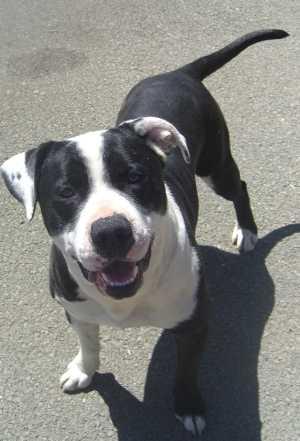
'Bruiser'
"Bruiser" is a gentle giant.
This beautiful pit bull/mastiff mix loves to play ball and give kisses.
Shelter staff says he is very loyal and loving. Bruiser is so loyal that he would be best for a home without other dogs, so he can get all the one on one attention he craves.
He is neutered and up-to-date on all his vaccinations.
Call 707-994-8251, Extension 115 for more details.
If interested in Bruiser, please contact Officer Frankie Blavet at 707-994-8201, Extension 118, or visit the kennels at 6820 Old Highway 53 from 1 p.m. to 2 p.m. Monday through Friday.
Visit Clearlake Animal Control on Facebook at https://www.facebook.com/CityOfClearlakeAnimalControl .
SPCA OF CLEAR LAKE
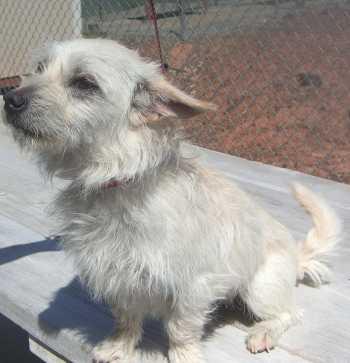
‘Comet’
"Comet" is a Cairn/wirehair terrier mix.
He is neutered, microchipped and current on all his vaccinations.
He is a very friendly and energetic guy who loves to play.
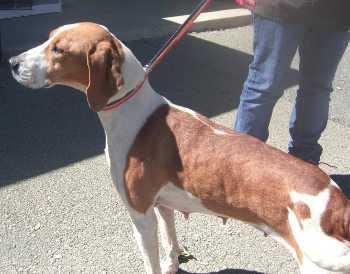
‘Ginger’
"Gingera' is a gorgeous and sweet hound.
She is spayed, microchipped and current on all vaccinations.
She is a sweet girl in need of a loving home.

‘Sweet Pea’
"Sweet Pea" is a beautiful boxer.
She is spayed, microchipped and current on all vaccinations.
Sweet Pea is an affectionate girl. She loves walks and being by your side.
For more information, contact the SPCA of Clear Lake, 707-279-1400.
LAKE COUNTY ANIMAL CARE AND CONTROL
Dogs that are adopted from Lake County Animal Care and Control are either neutered or spayed, microchipped and, if old enough, given a rabies shot and county license before being released to their new owner. License fees do not apply to residents of the cities of Lakeport or Clearlake.
If you're looking for a new companion, visit the shelter. There are many great pets hoping you'll choose them.
The following dogs at the Lake County Animal Care and Control shelter have been cleared for adoption (additional dogs on the animal control Web site not listed are still “on hold”).

Female pit bull terrier mix
This female pit bull terrier mix is 7 months old.
She weighs nearly 26 pounds, has been spayed, and has a short brown and white coat.
She is currently in foster, ID No. 35880.

Chihuahua-wirehaired terrier
This male Chihuahua-wirehaired terrier is 7 months old.
He weighs nearly 10 pounds, has a long tan coat and has been altered.
He’s currently in foster, ID No. 36211.

Female pit bull terrier mix
This female pit bull terrier mix is 7 years old.
She weighs 51 pounds, and has a short gray and white coat. Shelter staff did not report if she had been spayed.
She’s in kennel No. 6, ID No. 36265.
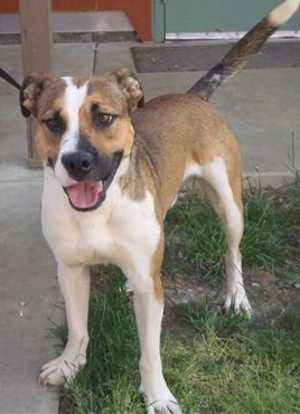
Pit bull terrier-hound mix
This male pit bull terrier-hound mix is 2 years old.
He weighs 45 pounds, has a short tricolor coat and has been neutered.
He’s in kennel No. 11, ID No. 36261.
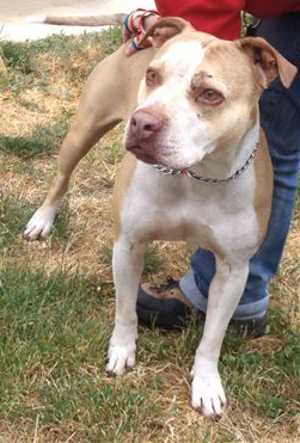
Female pit bull terrier mix
This female pit bull terrier mix is 3 years old.
She has a short tan and white coat and weighs 52 pounds. It was not reported if she had been spayed.
Find her in kennel No. 15, ID No. ID: 36313.

Male Chihuahua mix
This male Chihuahua mix is 7 years old.
He weighs 10 pounds, has a short tan coat and has been neutered.
Find him in kennel No. 18, ID No. 36150.

Lhasa Apso mix
This male Lhasa Apso mix is 3 years old.
He weighs nearly 13 pounds, has a long white coat and has been neutered.
Find him in kennel No. 19, ID No. 36315.

Pit bull terrier-hound mix
This female pit bull terrier-hound mix is 15 weeks old.
She weighs 18 pounds, has a short tan and white coat, and has been spayed.
She’s in kennel No. 22a, ID No. 36133.

Pit bull terrier-hound mix
This female pit bull terrier-hound mix is 15 weeks old.
She weighs 18 pounds, has a short tan and white coat, and has been spayed.
She’s in kennel No. 22c, ID No. 36135.
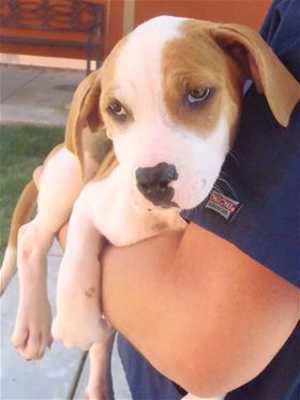
Pit bull terrier-hound mix
This female pit bull terrier-hound mix is 15 weeks old.
She weighs 18 pounds, has a short tan and white coat, and has been spayed.
She’s in kennel No. 22d, ID No. 36136.

Pit bull terrier-hound mix
This male pit bull terrier-hound mix is 15 weeks old.
He weighs 18 pounds, has a short tan and white coat, and has been spayed.
He’s in kennel No. 23a, ID No. 36137.

Pit bull terrier-hound mix
This male pit bull terrier-hound mix is 15 weeks old.
He weighs 18 pounds, has a short tan and white coat, and has been spayed.
He’s in kennel No. 23c, ID No. 36139.

Pit bull terrier-hound mix
This male pit bull terrier-hound mix is 15 weeks old.
He weighs 18 pounds, has a short tan and white coat, and has been spayed.
He’s in kennel No. 23d, ID No. 36140.
Please note: Dogs listed at the county shelter's Web page that are said to be “on hold” are not yet cleared for adoption.
To fill out an adoption application online visit http://www.co.lake.ca.us/Government/Directory/Animal_Care_And_Control/Adopt/Dog___Cat_Adoption_Application.htm .
Lake County Animal Care and Control is located at 4949 Helbush in Lakeport, next to the Hill Road Correctional Facility.
Office hours are Monday through Friday, 8 a.m. to 5 p.m., and 1 p.m. to 3 p.m., Saturday. The shelter is open from 10:30 a.m. to 4:30 p.m. Monday through Friday and on Saturday from 1 p.m. to 3 p.m.
Visit the shelter online at http://www.co.lake.ca.us/Government/Directory/Animal_Care_And_Control.htm .
For more information call Lake County Animal Care and Control at 707-263-0278.
Email Elizabeth Larson at
LAKE COUNTY, Calif. – Welcome to Lake County Skies, a monthly column that highlights what’s visible in the night skies of Lake County.
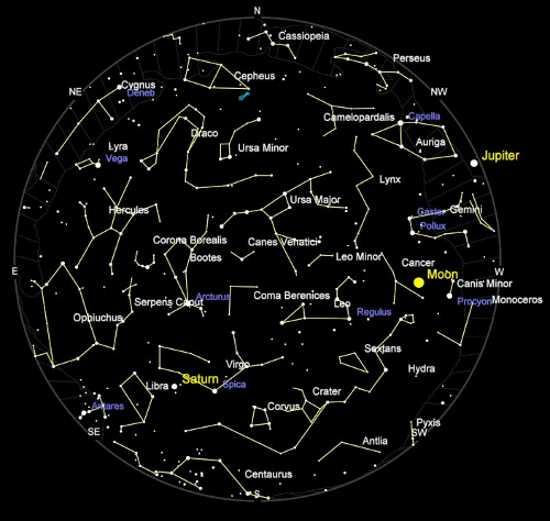
With some of the country’s darkest, clearest skies, Lake County is ideal for star gazing. A chart of the May night skies is displayed below.
The May night skies are dominated by the constellation Bootes.
Bootes looks like a kite, but owing to the flow of human history, he is not a kite – he is a herdsman/hunter.
Bootes was first named in Homer’s Odyssey in the 8th century BC, long before the kite was introduced in Europe by Marco Polo in the late 13th century AD. Had the ancients known about the kite, one can only imagine what this constellation would have been named!

Bootes has the brightest star in the Northern Hemisphere, Arcturus. Arcturus lies at the base of Bootes. It’s a giant orange star, many times larger than our Sun. Images of Bootes and the difference in size between our Sun and Arcturus are shown below.
Directly to the north and west of Bootes is Ursa Major, the Big Bear. This constellation has a distinct pattern of stars we call “The Big Dipper.
The Big Dipper has been recognized by cultures all over the world by various names: The Plough in England, The Saucepan in Holland, the Salmon Net in Finland, and Goncol’s Cart in Hungary,
Look at the second star from the end of handle of the dipper, Mizar. If you have really good eyesight, you will see it is really two stars close together – the second star is named Alcor.
If you have a telescope you will see that Mizar has a companion star very close to it. The following image shows the Big Dipper and Alcor and Mizar through a telescope.
Our star chart shows the planet Saturn rising in the east. The bright star Spica is to the west of Saturn. As we mentioned in our April article, a star twinkles, a planet does not.

Saturn is one of the most beautiful planets in the solar system. It is the sixth planet from the sun, second in size only to Jupiter.
Saturn is what we call a “gas giant.” It has no solid land mass like our Earth. Instead, it is a giant ball of gas – mostly hydrogen and helium. If we had a large enough body of water, Saturn would float!
What makes Saturn unique is its ring system. Through even a small telescope Saturn’s rings are beautiful to behold. The rings are believed to be composed of tiny rock particles.
Two images of Saturn are shown below. The one to the left is typical of what can be seen through a large observatory telescope. The one to the right is typical of a medium (8” or more) amateur astronomer’s telescope.
Lake County’s Taylor Observatory ( www.taylorobservatory.org ) is open to the public on the third Saturday of each month, affording an excellent opportunity to view Saturn.
John Zimmerman is a resident of Lake County and has been an amateur astronomer for over 50 years. For more information about Astronomy and local resources, visit his Web site at www.lakecountyskies.com .

Sunset is a special time of day. Low-hanging clouds glow vivid red and orange as the background sky turns cobalt blue. The first stars pop out in the heavenly dome overhead, eliciting wishes from backyard sky watchers.
The sunset of May 26th will be extra special. On that date, Venus, Jupiter and Mercury will gather in the fading twilight to form a bright triangle only three degrees wide.
Triple conjunctions of planets are fairly rare. The last time it happened was in May 2011, and it won't happen again until October 2015.
This triple is especially good because it involves the three brightest planets in May's night sky: No. 1, Venus; No. 2, Jupiter; and No. 3, Mercury. The triangle will be visible even in places with heavy urban light pollution.
The best time to look is about 30 to 60 minutes after sunset. The three planets will be hugging the horizon, so a clear view of the western sky is essential.
Let Venus be your guide. It pops out of the fading twilight long before the others. As soon as you locate Venus, look in that direction using binoculars.
If your binoculars are typical, all three planets will fit in the eyepiece simultaneously. As the twilight continues to fade, set the optics aside; eventually the triangle will become visible to the naked eye.
You don't have to wait until May 26 to enjoy the show, however. The planets start gathering weeks earlier.
Dates of special interest include May 11 through May 13, when the crescent Moon, Venus, and Jupiter form a long diagonal line jutting upward from the sunset; May 23, when Jupiter and Venus converge to less than 5 degrees apart, close enough for simultaneous binocular viewing; and May 24, when Mercury passes Venus less than 2 degrees away, giving shape to the triangle that reaches maximum compactness two nights later on May 26.
The triangle begins to disperse on May 27, but even then the show is not over. On May 28, Venus passes Jupiter at a distance of 1 degree, forming a truly spectacular pair.
From beginning to end, the three naked-eye planets will be close enough to fit inside the field of ordinary binoculars from May 23 until early June. May 26 is just the best among many very good nights.
Step outside, face west and observe the planets. It's a beautiful way to end the day.
Dr. Tony Phillips works for the National Aeronautics and Space Administration.
LAKE COUNTY, Calif. – The life cycle of a butterfly – egg to caterpillar to chrysalis and finally winged flight – is a common yet amazing example of life transformation from nature’s book.
There are many comparisons about that transformation that can be made to our human experience.
One comparison is the value of nurturing a young child; enabling it to take flight and reach its full potential in life. Every month of the year, we are reminded of various issues that impact the nurture of young children.
For instance, April was designated as Child Abuse Prevention Month, and May as Depression Awareness.
Service providers working across the service spectrum are involved in raising awareness of these impacts, as well as providing on-going family support services that assist children in Lake County to reach their full potential.
Recently St. Helena Hospital Clear Lake was awarded a Community Transformation Grant from the Centers for Disease Control.
This collaborative project to better population health and reduce chronic disease is bringing together public health, hospitals, clinics, behavioral health services, schools, tribal health, child welfare, family support, Lake Family Resource Center, First 5, People Services, NCO Community Action Agency and others to act as the Health Policy Cabinet for the project, entitled Climb to the Peak of Health.
The project is named to represent Mt. Konocti and the breathtaking beauty that awaits at the summit, thereby making each step to the top worthwhile.
Among the objectives of the Community Transformation Grant project is to create awareness of the important role that emotional health plays in chronic disease. Research shows that experiences during early childhood influence brain development and are pivotal for shaping future health and well-being.
Similar to humans, the butterfly starts life as a very small egg. The mother butterfly must lay her tiny eggs on just the right kind of leaves or the caterpillar will not eat the leaves and thus have no food to keep growing. Humans also need good nourishment through every stage of life to keep growing.
This not only means parents providing healthful food for children, but also developing safe emotional attachment, providing supportive guidance through the various stages of development, and showing children how to develop positive relationships with others.
What happens during a child’s formative years has lifelong implications. We are living in a time when one out of every five children is exposed to domestic violence in our country and about five children die each day due to child abuse. Home may be “where the heart is,” but for many, home is heart-breaking.
Relationships in the household between parents and children optimally provide the safety of a cocoon. A strong family provides a protective shield for children and a solid foundation that children can depend on. Life has ups and downs and difficult times, but children benefit from seeing their parents cope and bounce back. This is an important way they learn coping skills.
Children also benefit from extended family and friends who provide support when needed. A nurturing home life has a lasting influence on a child’s development. Like the butterfly, it enables children to leave the cocoon and launch into a healthy adult life in which they are able to fly on their own.
However, growing up in a home where safety and well-being is at risk, often takes a toll on the direction of one’s life, one’s health and collectively on the community.
Research from the Adverse Childhood Experiences Study (ACE) shows that a traumatic childhood takes a significant toll on health. Those suffering substantial childhood trauma have double the risk for early death compared with adults who had not endured adverse childhood experiences.
Types of trauma (known as ACE factors) include child abuse (sexual, physical, and emotional), neglect (physical and emotional), chaotic, dysfunctional households in which the mother is treated violently, or a household member is an alcoholic or drug user, or is imprisoned, or is diagnosed with a mental illness, or parents are separated or divorced and the child feels abandoned by one or both parents.
Each type of trauma is given a score of one, with 10 the maximum score. A person who was emotionally abused, physically neglected and grew up with an alcoholic father who spent time in prison, would receive a score of four.
Researchers note that someone with six or more of these factors may die 20 years prematurely because a strong link between these adverse childhood experiences and adult onset of chronic illness was found.
Those with ACE scores of four or more had significantly higher rates of heart disease and diabetes, as well as a 390 percent increased likelihood of pulmonary lung disease; 240 percent increased likelihood of hepatitis; 460 percent increased likelihood for depression; and 1,220 percent for suicide. Those with an ACE score of six had a 4,600 percent increase in the likelihood of becoming an IV drug user.
Adverse childhood experiences are common; 64 percent of those in the original ACE study conducted at Kaiser Permanente in San Diego had experienced one or more categories of the ACE factors.
In a small pilot study done in Lake County that percentage was higher – about 82 percent had one or more factors.
Research linking ACE factors to premature death is in early stages, but researchers note that even if cutting life expectancy by 20 years is not an exact statistic, the study definitely bears out that exposure to early trauma is an important public health issue.
Researchers from different disciplines have found that trauma alters the function and development of children’s brains and nervous systems and that a person’s experiences can turn on genes that manufacture chemical stressors that affect the brain.
That’s what’s happening in the brains of traumatized children who become hyper-vigilant, edgy, impulsive, and have hot tempers – and it's happening everywhere, including to our own children in Lake County.
They develop behaviors that get them into trouble and can lead to getting involved in risky behaviors such as smoking, drinking too much alcohol, eating too much, working too much, and more - all negatively affecting their health.
The cycle repeats and continues through multiple generations, shaping families and in turn impacting the communities we live in.
A healthy community is one in which emotional well-being at all ages is valued and opportunities that offer hope and healing are available for those struggling with unhealed emotions.
Why emotional health is important
There is a strong connection between the body and the mind – and the health of each aspect of your “self” is very important.
From an early age, we realize this when we feel nervous about something or experience “butterflies in our stomach” or sweaty palms.
These are examples of how thoughts affect the body.
– Stress is not something “out there” that happens to you (daily hassles, change, the environment, loss, work or lack of work, finances, relationships, inner conflict, etc.) it’s our internal responses (moods, physical reactions, etc.) to situations as we perceive them. The goal is not a stress-free life, but to keep stress within manageable limits so it doesn’t turn into “distress” (excessive stress that is destructive to physical, mental, and emotional health).
– Our attitude, internal self-talk, support systems, health practices, coping methods, ability to relax, ability to communicate, and the way we see ourselves all factor into how we manage stress.
– Researchers find increased risk for heart attacks in people with increased levels of worry, especially over financial and health concerns.
– There is a higher risk for heart disease in people who carry anger and in people who are depressed, according to researchers.
– People who are anxious, unhappy, or depressed are more likely to develop high blood pressure.
– Sleeplessness and lack of sleep contributes to high blood pressure and being overweight.
– People with strong support systems – such as friends, family, a pastor, physician, or counselor, along with community ties – cope better with stress.
– Physical activity protects physical and emotional health, relieves stress, and makes you feel good. Take a walk every day if you can.
– People who have peaceful minds and actively practice achieving inner peace are more content and happy with the lives.
– Using community resources to address issues of emotional well-being can afford opportunity for hope and healing.
For information on community resources contact Lake Family Resource Center, 707-279-0563.
The world is changing. As greenhouse gases accumulate in the atmosphere, global temperatures are on the rise. Sea levels inch upward as polar ice retreats. Crops are growing in new places.
The world is changing. The question is, can life change with it?
A batch of genetically engineered plants orbiting Earth on board the ISS may have something to say about this.
“Our environment on Earth is changing, so we need to know how plants respond to novelty,” said molecular biologist Anna-Lisa Paul of the University of Florida. “Spaceflight is outside the evolutionary experience of any terrestrial organism. Learning how plants respond to this unique environment can also tell us how plants respond to new challenges on Earth.”
Paul and colleague Rob Ferl are principal investigators of an experiment on the ISS called TAGES, the Transgenic Arabidopsis Gene Expression System.
For the past two years, they have been using the ABRS experimental growth chamber on board the space station to grow a garden of Arabidopsis thaliana, also known as “thale cress.” Cameras captured growth rates, root patterns, and a strange green glow.
“We genetically modified the plant to glow when it is under stress,” explained Paul. “This can tell us a lot about how Arabidopsis adapts to the microgravity environment.”
Learning how plants adapt to new situations is crucial to climate change research. In terms of global biomass, plants outweigh mammals by a factor of 1,000.
They are a dominant part of the biosphere, playing a key role in the carbon cycle. Scientists and farmers have been experimenting with plants for centuries, yet at a fundamental, genetic level, much remains unknown.
This is why Paul and Ferl have been putting Arabidopsis through its paces, exposing the plant to extremes of pressure, temperature, and drought. Most of their work has been done on Earth – but some extremes can only be found in space.
“Removing gravity from the equation reveals unique aspects of cell growth and development that we cannot discover in any other way,” said Ferl. “The International Space Station is a great place to do this.”
In a recent issue of the journal Plant Biology, they presented some of TAGES’ first results.
“We have seen some things that surprised us,” reported Paul.
Paul and Ferl inserted a glowing “reporter gene” into the DNA of Arabidopsis that would be triggered by the plant hormone auxin.
Auxin is important to how plants move and respond to their environment. By watching parts of Arabidopsis light up, they tracked the action of the hormone at the cellular level without actually dissecting the plants.
“We expected to find [auxin signals] in the gravity-sensing cells at the tip of the roots. Instead it showed up in the hypocotyls, the stem-like region between the roots and leaves,” she said.
An even bigger surprise was “skewing,” a pattern of root movement that, on Earth, helps plants navigate sticks and stones in soil as they search for water and nutrients.
Paul recalled being with Rob Ferl and watching some of the first images of Arabidopsis come down from the ISS. “Are those roots skewing?” they asked. The pattern was definitely there.
“It was pretty exciting,” she said. “This is something we thought only happened in gravity.”
Paul and Ferl also observed how Arabidopsis used light as a gravity-substitute for telling “up” from “down.” With lamps shining overhead, roots grew clearly away from leaves, just like on Earth.
“Arabidopsis has proven remarkably adaptable to the space environment,” noted Ferl.
The details are not yet fully understood, but, thanks to TAGES, data at the cellular and genetic level are now available for study.
“The more we learn,” said Paul, “the better partners we can be for life in a changing world.”
Dr. Tony Phillips works for the National Aeronautics and Space Administration.
CLEARLAKE OAKS, Calif. – A man reported missing from Spring Valley Thursday night has been found safe.
The 63-year-old developmentally disabled man, whose name was not released, was found at about 11:30 a.m. Friday, according to a report from Lt. Steve Brooks of the Lake County Sheriff’s Office.
Brooks said that at 9 p.m. Thursday Lake County Sheriff’s Office patrol deputies responded to an address in the 17000 block of Cache Creek Road in Spring Valley on the report of a missing person.
The missing man was reported to have walked away from his residence. Brooks said an immediate search of the area was conducted and deputies were unable to locate the subject.
Lake County Search and Rescue was notified and immediately responded to the location and started a systematic search of the area, according to Brooks. The search continued through the night with negative results and additional resources were requested to assist.
An aircraft with forward looking infrared capabilities was requested for aerial support early in the search, but was unavailable due to weather conditions, Brooks said.
Lake County Search and Rescue and K-Corp were assisted by Mendocino County Search and Rescue, Sonoma County Search and Rescue, Sonoma County Sheriff’s Helicopter (Henry 1), Solano County Search and Rescue and Marin County Search and Rescue, according to Brooks.
The sheriff’s office thanked the assisting agencies that responded with their personnel and assets to assist with the search, bringing the incident to successful conclusion with the man’s discovery on Friday morning.