 How to resolve AdBlock issue?
News
LAKE COUNTY, Calif. – This month we have hot August stars to complement the hot classic cars associated with hot august nights.
August was originally named Sextilis by the Romans when their calendar had only 10 months, and Sextilis was the sixth month.
In 700 BC two additional months were added making this the eighth month. In 8 BC it was renamed August in honor of Augustus Caesar.
As you wait for the skies to darken after sunset, look toward the west after the sun has set for a very bright object. That is the planet Venus, the second planet from the sun.
Venus is nearly the size of Earth. But it differs from Earth due to an atmosphere that is 97 percent carbon dioxide as compared to .04 percent for Earth.
The high levels of carbon dioxide in Venus' atmosphere creates a greenhouse effect, trapping heat which gives Venus a surface temperature higher than that of Mercury, the closest planet from the Sun.
Venus is a disappointing object through a telescope. Its atmosphere prevents viewing the planet’s surface.
Venus does, however, exhibit phases just as does our moon. Radar enhanced images of Venus from NASA probes provide a more detailed view of the planet’s atmosphere.
On Aug. 9 the moon will appear close to Venus.
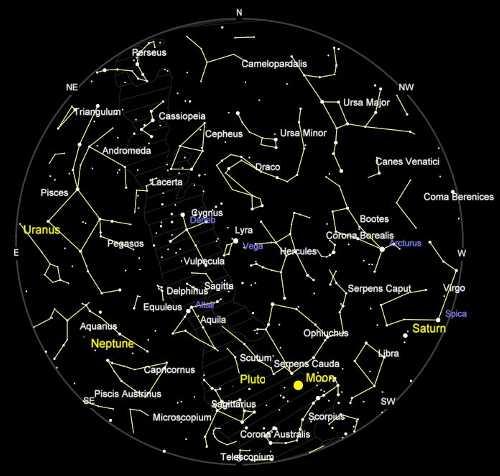
After observing Venus, the sky should be dark enough to locate the Summer Triangle. This is a pattern of three bright stars, Vega, Deneb and Altair. They are located directly overhead. Use our star chart to identify them.
Vega is the fifth brightest star in the sky, Altair the 12th and Deneb the 19th. All three are relatively young stars which means they burn hotter than older stars, like our Sun. And so it is appropriate that these young, hot stars shine brightly overhead during hot August nights!
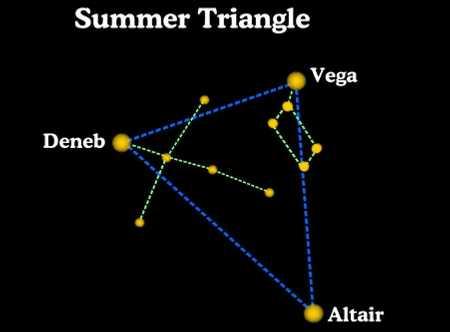
Vega is located in the constellation Lyra the Harp. As our star chart shows, it lies directly overhead. Lyra represents the harp that Orpheus played. In Greek Mythology, Orpheus was a great musician and poet.
Lyra contains two remarkable objects visible through a small telescope. The first is the Ring Nebula. This is a faint object that looks like a tiny smoke ring.
The second object in Lyra is the “Double Double.” No, that’s not a typo. That is the name of a double star, which, under high power, reveals that each double star is itself a double.
August is notable for the Perseids Meteor Shower. This year it peaks after midnight on Aug. 11-12. The Moon will not interfere with viewing this year.
While meteors are sometimes called falling stars, nothing could be further from the truth. Most meteors are small dust particles that enter the Earth’s atmosphere and burn up. They originate when the Earth passes through the debris left by a comet.
Get a comfortable lawn chair, set up in a dark location, and watch toward the northeast beginning around midnight.
If you plan on staying up until sunrise, you will be rewarded by seeing Jupiter and Mars rising in the East, followed by Mercury.
John Zimmerman is a resident of Lake County and has been an amateur astronomer for more than 50 years. For more information about astronomy and local resources, visit his Web site at www.lakecountyskies.com .

CLEARLAKE, Calif. – The body of a man reported missing on Saturday afternoon was found later in the day in water near where he was last seen.
Yongli Zhang’s body was discovered by Northshore Dive Team members at 8:15 p.m. Saturday, according to Sgt. Tim Hobbs of the Clearlake Police Department.
The 72-year-old – who did not speak English and had been showing the early signs of dementia – had last been seen at around 12:30 p.m. Saturday, police said.
At that time, he left a residence in the 15200 block of Harbor Lane in Clearlake in an unknown direction, according to Hobbs.
Hobbs said Clearlake Police, Cal Fire, Lake County Fire, the Lake County Sheriff’s Office, California State Parks and the Northshore Dive Team responded to assist in the ground and air search.
Zhang’s body eventually was found in water under a residence in the same block of Harbor Lane where he was last seen, according to Hobbs. The homes in that area line Cache Creek.
The circumstances surrounding Zhang’s death were not considered suspicious, with Hobbs reporting that it appeared to be an accidental drowning.
Email Elizabeth Larson at
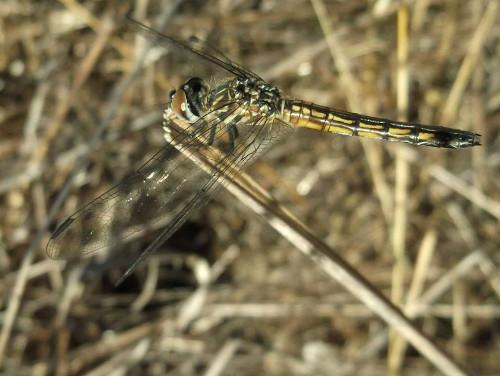
You see them all over the region this time of year, wherever there’s a slow-moving or still body of water nearby, flitting around on specialized wings sometimes in excess of 30 miles per hours.
They’re sometimes called “water witches” or “fairies spinning needles,” but most of us just call them dragonflies and damselflies.
One of the most common dragonflies you’ll see this time of year is the Flame Skimmer.
Their bodies are up to 3 inches long, and are fiery red-orange in color (including their eyes and the veins in their wings).
Males are generally brighter in color than the females. Kathy Biggs, an expert in California Odonates (dragonflies and damselflies), says that you’ll most likely find the males nearer the water, and the females further inland.
To catch a photo of a male Flame, Biggs suggests, just hold a stick down near the water’s edge. Perching-sticks attract males, who may come and sit for a while to survey their territory.
“Even if he flits away immediately, be patient; there’s a 50% chance he’ll come back,” said Biggs.
Some species of Odonates can live up to six years, but the majority of their lifetime is spent underwater as voracious nymphs called naiads.
The alien-looking wingless naiads will eat just about anything, including fish and tadpoles that are bigger than they are.
When mature, the naiad will climb up onto the stem of a nearby plant, shed its skin (called exuvia) and emerge as a pale dragonfly or damselfly. Their color intensifies as they grown older.

Adult dragonflies are generally much larger in size than damselflies, and when they land they hold their wings out away from their bodies. Damselflies fold their wings neatly against their backs.
You may also see pairs of dragonflies or pairs of damselflies in a tied-together formation called “in wheel”; this is the configuration they use when mating.
After mating, the females will generally head toward water to lay their eggs, and the males patrol in a “hover-glide” fashion to keep other marauding males away from them.
The female Flame Skimmer actually “splashes” her eggs into the water so they bounce up and adhere to nearby water plants. This keeps hungry fish from gobbling up her eggs before they have a chance to develop.
One of the most prominent features of the dragonfly is its set of huge multifaceted eyes. The eyes, which can vary in color, have as many as 30,000 separate lenses.
Most dragonflies have broad-spectrum color vision and can even see into the ultraviolet range. Damselflies, like the Vivid Dancer, one of the species most regularly seen in our area, likewise have excellent color vision.
The male Vivids are a glorious neon-blue with black bands and stripes on their bodies. The females are usually dusky tan or even chalk-white.
To snap some photos of the Vivids, Kathy Biggs suggests looking for them as they bask on sunlit trails near the water and on wooden bridges.
“For some reason, they just seem to love places like that,” said Biggs.
When you first approach a Vivid, it may clap its wings together as a warning for you to get away from its territory, but don’t worry. Damselflies and dragonflies don’t have stingers.
In California there are about 113 different species of Odonates, and what’s extra special for those of us who live in the counties encompassing the Berryessa Snow Mountain region is the fact that almost half of those species live right here.
According to Biggs they are easiest to find on sunny days when there is little wind, and it’s best to approach them slowly and directly (rather than quickly and at an angle). So get out there and photograph some of these “water witches” while the summer months last.
Tuleyome thanks the Xerces Society ( www.xercessociety.com ) and Odonate expert Kathy Biggs for their assistance with this article. You can find Biggs’ guides to identifying local dragonflies and damselflies on the web at www.sonic.net/dragonfly . Tuleyome Tales is a monthly publication of Tuleyome, a conservation organization with offices in Woodland and Napa, Calif. Visit www.tuleyome.org . Mary K. Hanson is a local amateur naturalist and photographer.
In astronomy, there's nothing quite like a bright meteor streaking across the glittering canopy of a moonless night sky.
The unexpected flash of light adds a dash of magic to an ordinary walk under the stars.
New research by NASA has just identified the most magical nights of all.
"We have found that one meteor shower produces more fireballs than any other," explained Bill Cooke of NASA's Meteoroid Environment Office. "It's the Perseid meteor shower, which peaks on Aug. 12 and 13."
Using a network of meteor cameras distributed across the southern USA, Cooke's team has been tracking fireball activity since 2008, and they have built up a database of hundreds of events to analyze. The data point to the Perseids as the “fireball champion” of annual meteor showers.
A fireball is a very bright meteor, at least as bright as the planets Jupiter or Venus. They can be seen on any given night as random meteoroids strike Earth's upper atmosphere.
One fireball every few hours is not unusual. Fireballs become more numerous, however, when Earth is passing through the debris stream of a comet. That’s what will happen this August.
The Perseid meteor shower comes from Comet Swift-Tuttle. Every year in early- to mid-August, Earth passes through a cloud of dust sputtered off the comet as it approaches the sun.
Perseid meteoroids hitting our atmosphere at 132,000 miles per hour produce an annual light show that is a favorite of many backyard sky watchers.
Cooke thinks the Perseids are rich in fireballs because of the size of the parent comet.
"Comet Swift-Tuttle has a huge nucleus – about 26 kilometers in diameter," said Cooke. "Most other comets are much smaller, with nuclei only a few kilometers across. As a result, Comet Swift-Tuttle produces a large number of meteoroids, many of which are large enough to produce fireballs."
Since 2008, the Perseids have produced more fireballs than any other annual meteor shower. The Geminids are a close second, but they are not as bright as the Perseids.
"The average peak magnitude for a Perseid observed by our cameras is -2.7; for the Geminids, it is -2," explained Cooke. "So on average, Geminid fireballs are about a magnitude fainter than those in the Perseids."
Cooke recommends looking on the nights of Aug. 12 and 13 between the hours of 10:30 p.m. to 4:30 a.m. local time. Before midnight the meteor rate will start out low, then increase as the night wears on, peaking before sunrise when the constellation Perseus is high in the sky.
For every fireball that streaks out of Perseus, there will be dozens more ordinary meteors.
"Get away from city lights," advised Cooke. "While fireballs can be seen from urban areas, the much greater number of faint Perseids is visible only from the countryside."
In total, the Perseid meteor rate from dark-sky sites could top 100 per hour.
That’s a lot of magic. Enjoy the show.
Dr. Tony Phillips works for the National Aeronautics and Space Administration.
LAKE COUNTY, Calif. – Looking for a companion to enjoy the outdoors with you this summer?
Consider adopting a four-legged friend from one of the local animal rescue organizations.
Dogs featured this week are from Lake County Animal Care and Control and the SPCA of Clear Lake are featured this week.
In addition to the animals featured here, all adoptable animals in Lake County can be seen here: http://bit.ly/Z6xHMb .
SPCA OF CLEAR LAKE
All dogs have been spayed or neutered, are microchipped and current on all their vaccinations and started on heartworm preventative. For more information on the dogs listed below, contact the SPCA of Clear Lake, 707-279-1400.
In addition to this week’s featured dogs, SPCA has several litters of puppies available for adoption.

'Mohawk'
“Mohawk” is a Cairn terrier mix with a bit of a funny hairdo, thus the name.
He is a fun and friendly little guy, and he loves people and animals alike.
He has a great smile and a sparkling personality.

'Bentley'
“Bentley” is a cattle dog mix.
He is house trained, has gentle manners, loves to take walks and is great on the leash.

'Sweet Pea'
Sweet Pea is a gorgeous and affectionate boxer.
She has been at the SPCA for several months and is looking for a loving forever home.
She is spayed, current on all vaccinations, microchipped and is on heartworm preventative.
LAKE COUNTY ANIMAL CARE AND CONTROL
Dogs that are adopted from Lake County Animal Care and Control are either neutered or spayed, microchipped and, if old enough, given a rabies shot and county license before being released to their new owner. License fees do not apply to residents of the cities of Lakeport or Clearlake.
If you're looking for a new companion, visit the shelter. There are many great pets hoping you'll choose them.
The following dogs at the Lake County Animal Care and Control shelter have been cleared for adoption (additional dogs on the animal control Web site not listed are still “on hold”).

Pit bull terrier mix
This male pit bull terrier mix is 3 years old.
He has a short blue coat and has been neutered.
Shelter staff said he's an outstanding, calm and charming dog that was attacked by another dog before entering the shelter.
He has no food aggression. A cat-free home would be best for him.
He’s in kennel No. 10, ID No. 36931.

Female Chihuahua mix
This female Chihuahua mix is 3 and a half years old.
She has a short black and white coat, weighs almost 11 pounds and has been spayed.
She's in kennel No. 18, ID No. 35315.

Male terrier mix
This male terrier mix is 3 years old.
He has a medium-length tan and white coat, and has not yet been neutered.
He's in kennel No. 29, ID No. 37185.
To fill out an adoption application online visit http://www.co.lake.ca.us/Government/Directory/Animal_Care_And_Control/Adopt/Dog___Cat_Adoption_Application.htm .
Lake County Animal Care and Control is located at 4949 Helbush in Lakeport, next to the Hill Road Correctional Facility.
Office hours are Monday through Friday, 8 a.m. to 5 p.m., and 1 p.m. to 3 p.m., Saturday. The shelter is open from 10:30 a.m. to 4:30 p.m. Monday through Friday and on Saturday from 1 p.m. to 3 p.m.
Visit the shelter online at http://www.co.lake.ca.us/Government/Directory/Animal_Care_And_Control.htm .
For more information call Lake County Animal Care and Control at 707-263-0278.
Email Elizabeth Larson at

CLEARLAKE, Calif. – Striking Lake Transit Authority bus drivers and union representatives held what amounted to a pep rally on Friday, highlighted by a call to replace the transit line's operator.
Teamsters Local 665 called for the replacement of Washington-based Paratransit Services as service provider, alleging that it is not fulfilling service requirements that the union said are spelled out in a 2007 operator's agreement with Lake Transit Authority.
If “the service required under the operator's agreement with the LTA has not been fulfilled during this past week then this operator should be penalized and financially sanctioned … or perhaps replaced,” the union said in a written statement.
However, Lake Transit General Manager Mark Wall said Friday that the performance clause that the union was citing doesn't exist.
“They have not requested a copy of the contract,” he said. “I don’t think they've read the contract.”
The rally, held in front of Clearlake City Hall, was attended by about 20 or so striking employees and Teamsters Local 665, and presided over by Ralph Miranda, the union's president and North Bay director, and Mark Gleason, secretary-treasurer and principal officer of Local 665.
Union members began an indefinite walkout on Monday after rejecting Paratransit Services' latest offer of a 2.2-percent raise. The union is seeking a 2.4-percent increase.
The call for replacement of Lake Transit was put forth in a written statement distributed to the striking drivers and read aloud by Miranda at the Friday event.
Both Miranda and Gleason, as well as most of the drivers, also were critical of Lake Transit and Wall, accusing the agency and Wall of siding with Paratransit Services in the ongoing strike by the Teamsters.
“They (LTA) were staying out of it and letting collective bargaining take its course,” said Gleason. “But in the last couple of days Mark was definitely leaning in Paratransit's favor.”
Gleason's reference was to Wall's allegation earlier this week that Teamster representatives and striking employees were violating the Homeland Security Act.
“I don't know if he (Wall) is speaking for the entire (LTA) board, but I'm very disappointed that he's siding with Paratransit authorities in saying that we should recognize their terms,” said Gleason. “We're just not going to do that. He should be doing more to helps us resolve this dispute than finger-pointing.”
Wall, reached by a phone call to his office, denied siding with Paratransit Services.
“If they want to make that case, fine,” he said. “But I remain neutral. The LTA remains neutral.”
He added, “The only concern I have is the long-term well-being of the transit system,” noting he's been with the system since it started 17 years ago.
The contract spells out that the transit agency can't be held responsible for events beyond its control, including natural disasters and labor strikes, Wall said.
“There's nothing I can do other than make sure that the contractor is following the law,” said Wall, adding that he believes Paratransit Services is doing just that.
Wall said he's also concerned about safety of passengers.
Paratransit Services said Friday that union members are creating safety issues by obstructing buses and staff vehicles from exiting or entering the transit facility off Highway 53.
Miranda said this week that Teamsters are participating in “ambulatory picketing,” which entails following buses on their routes and picketing them at stops.

The center of the dispute
The dispute between Paratransit Services and Local 665 centers on a temporary suspension of yearly “step” increases transit employees agreed to make to help the help the county's sagging economy. Now the employees feel that the increases should be resumed.
“It's not about the money, which amounts to only 25 cents an hour,” said Sandy Frarish, a former transit supervisor for eight years in Yolo County who been worked in Lake County the last two years. “But we gave up the step increases and now they won't give them back to us. With more longevity you get a little step increase every year and you become a better person for the company, but (Paratransit) doesn't see it that way. It's totally unfair that they won't negotiate.”
However, in a Friday statement, Paratransit Services maintained that it never promised to reinstate the step increases.
The Friday union statement presented by Miranda and Gleason spelled the issues out in harsher terms. It accuses Paratransit Services of not meeting the performance standards it agreed to in 2007.
“Yet this operator continues to bill and accept funding from LTA, the state of California and the federal government, by claiming each day that 'phantom' bus service is providing a benefit to the citizens of Lake County,” the statement reads.
But, the union statement points out, Lake Transit buses are not running and the striking drivers are not going to drive the buses without a sincere offer from management.
There was an unsubstantiated report that one woman bus driver stopped her vehicle and exited it in the midst of a run in sympathy with the strike.
The union on Friday called for intervention by the county's elected officials.
For his part, Wall said he doesn't see the Teamsters moving to end the strike.
Wall said he has asked Paratransit Services for a plan by early next week that will give a timeline for restoration of several routes that have been scaled back or stopped temporarily during the strike.
Once the document is ready, Wall intends to present it to the community, adding he will expect Paratransit Services to stand by the plan.
Elizabeth Larson contributed to this report.
Email John Lindblom at