 How to resolve AdBlock issue?
News
NORTHERN CALIFORNIA – The investigation is continuing into a Monday night plane crash in Colusa County that claimed the life of the pilot.
The crash was first reported shortly after 7 p.m. Monday in the foothills east of Williams, when a witness saw the plane flying low over the hills and then saw a black smoke plume, as Lake County News has reported.
The fixed-wing, single-engine plane went down under unknown circumstances and burned about one mile north of mile marker 11.88 on Highway 20 in Colusa County, according to the Federal Aviation Administration.
The pilot, the only person on board, was killed in the crash, according to an initial report from the FAA.
Colusa County officials did not report on the identity of the pilot on Tuesday. FAA records showed the plane was registered to a Willows man.
The FAA told Lake County News that the plane that crashed was an experimental RV6A.
According to the Web site for Van's Aircraft RV-4, which developed the RV6A, the plane is a popular two-seat kit aircraft first introduced in 1986.
The plane that crashed was amateur-built and manufactured in 2001, according to the FAA's aircraft registration database.
The FAA confirmed that it is investigating the cause of the crash, along with the National Transportation Safety Board.
Email Elizabeth Larson at
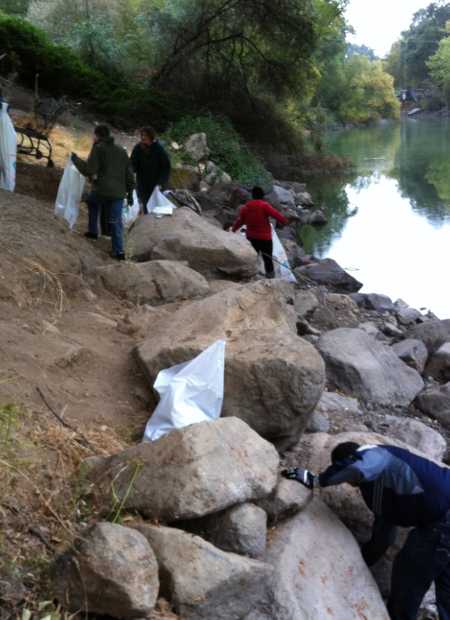
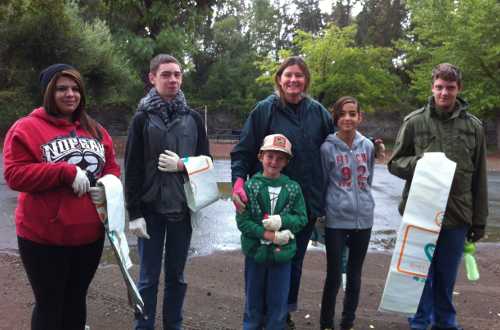
LAKE COUNTY, Calif. – Despite this past Saturday's wet conditions, several dozen volunteers were out to help clean up local waterways.
The local watershed cleanup was part of the 29th annual Coastal Cleanup Day, which focuses as much on inland waterways as it does beaches and the coast.
The California Coastal Commission said there were 850 cleanup sites this year in 53 of the state's 58 counties.
With 70 percent of cleanup sites reporting, the commission said there were 51,543 volunteers who picked up 471,218 pounds of trash and an additional 30,530 pounds of recyclable materials, for a total of 501,748 pounds or 251 tons.
On Saturday there were 33 volunteers, as well as Americorps members, who showed up to help clean up in the Clearlake area, according to Carolyn Ruttan, invasive species program coordinator for Lake County Water Resources.
There were two staging points – one at Lake County Fire Protection District in Clearlake and the second at the Bachelor Valley Grange. Ruttan said on Monday that she hadn't yet gotten a report or tally from the Northshore cleanup area.
Notable items pulled from Clearlake-area waterways and creeks were 14 tires, a car fender and five shopping carts, said Ruttan.
Altogether, the nearly three dozen volunteers removed 1,680 pounds of trash and recyclables from the Clearlake area, Ruttan said.
Lake County's watershed cleanup, and other inland efforts like it, play an important role in the Coastal Commission's overall efforts to keep coastlines clean.
Based on data from past cleanups, the commission said 60 to 80 percent of the debris on beaches and shorelines originates in land-based sources, traveling through storm drains, creeks or rivers to the beaches and ocean.
In Lake County, the largest body of water – Clear Lake – is connected to the Bay-Delta and, ultimately, the coast through Cache Creek.
The Cache Creek area was a focus for the Saturday cleanup, said Ruttan, explaining that volunteers removed a large amount of trash from underneath the Highway 53 bridge that passes over Cache Creek.
The area has been a homeless camp. “It was the biggest trash heap you can imagine,” said Ruttan.
After the cleanup, she said it was a “night and day” difference.
While cleaning up, volunteers met with a homeless man living there, and left him with garbage bags to help dispose of his trash, she said.
A number of local students and teacher Lisa Rogers from Lower Lake Elementary took part in the cleanup, and Ruttan said along the way she was able to give them a biology lesson about cyanobacteria, which can turn the water green.
Lisa Wilson, whose parents own the Shady Acres Campground on Cache Creek Way, allowed volunteers to access the bridge from the campground's property, as Ruttan said it's too dangerous to access it from the highway.
Ruttan said the campground also made bathroom and other facilities available to volunteers.
Wilson said the campground has led two previous Cache Creek cleanups, one a month ago and one this past winter.
In addition to Cache Creek, Ruttan said cleanup also took place on Austin Beach and along Burns Valley Creek.
This year the Coastal Commission said coastal volunteers were on the lookout for debris from a new source – items that may have been washed into the Pacific due to the March 2011 tsunami in Japan.
Volunteers at many sites carried a data card, designed by the Coastal Commission with help from the NOAA Marine Debris Program, to track potential tsunami debris, the commission said.
“We’ve been on the lookout for any debris that may have come from the tsunami, but at least to date, most of the debris on our beaches is still coming from the usual sources,” explained Eben Schwartz, marine debris program manager for the California Coastal Commission. “Coastal Cleanup Day teaches us that what we see along our coast as a result of the Japan tsunami is just a small drop in the bucket compared to what we clean up each year.”
As of the end of August, the Coastal Commission had run more than 40 cleanups over an eight-month period for the purpose of tracking potential tsunami debris.
During those cleanups, volunteers have found barely a dozen items that were considered “suspected” tsunami debris. By contrast, volunteers on California Coastal Cleanup Day typically find upwards of 850,000 debris items in only three hours, the commission said.
In addition to tracking down tsunami debris, volunteers picked up a number of “unusual” items during this year’s cleanup. Most unusual item picked up on the coast was a stereo speaker with a live octopus inside, the commission said. The speaker was opened and the octopus returned to the ocean.
In inland California, the commission said a baby stroller with a demon head attached to it was ruled the oddest item.
Those who were unable to make it to the beach for Coastal Cleanup Day can still participate in COASTWEEKS, a three-week celebration of our coastal resources that takes place across the United States. The Coastal Commission has a calendar of COASTWEEKS events on its Web site.
To get involved with COASTWEEKS, or to find out how you can become a coastal steward throughout the year, please contact the commission at 800-COAST-4U or visit at www.coast4u.org .
Email Elizabeth Larson at
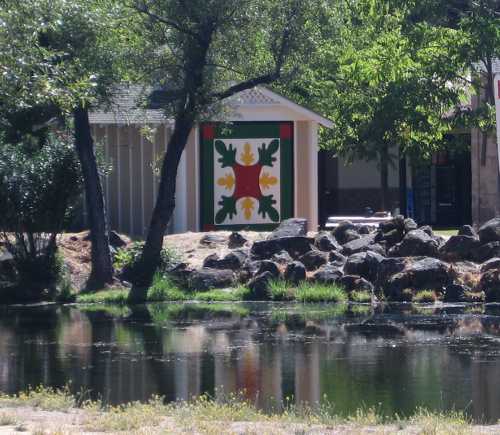
HIDDEN VALLEY LAKE, Calif. – The 48th quilt block on the Lake County Quilt Trail is located near the Stone House Historical Museum at 18174 Hidden Valley Road, Hidden Valley Lake.
The Stone House was determined in the 1950s by the California Centennial Commission to be the
oldest building in Lake County.
The house was originally built over the winter of 1853-54 to serve as headquarters for the Rancho Guenoc and Rancho Collayomi, the only Spanish land grants in Lake County.
For more Stone House history visit www.lakecountystonehouse.com/timeline .
The quilt block design “Oak Leaf Variation” was chosen to honor a 200 year old oak tree which succumbed in the 1970s.
The quilt block can be viewed from Hidden Valley Road where most of the 7,000 residents of Hidden Valley pass by regularly.
It is located inside the Hidden Valley Lake gates, but visitors are invited the second Saturday of every month.
To view the quilt block you may call Georgeann at 707-987-7370 or Jean at 707-987-3568 for entrance
through the Hartmann Road gate.
The GPS location of “Oak Leaf Variation” is Latitude-38.48, Longitude -122.34.
The Lake County Quilt Trail is an agricultural and tourism project designed to promote community pride.
The 8-foot by 8-foot quilt block was drawn and painted by the Lake County Quilt Trail team, a group of dedicated quilters, graphic artists, painters, writers, carpenters and a videographer.
For more information about the Lake County Quilt Trail visit www.lakecountyquilttrail.com or see the group's Facebook page at https://www.facebook.com/pages/Lake-County-Quilt-Trail/187014251326163 .
NORTHERN CALIFORNIA – Officials on Monday night were at the scene of a fatal plane crash in Colusa County.
The plane was reported to have gone down about 7 p.m. Monday in the foothills west of Williams, about 12 miles east of the Lake County line.
A witness reported seeing the airplane – described as a small, two-seater – flying low into the hills, and then a plume of black smoke, according to radio reports.
Ground ambulances responded from Williams and Colusa, being directed by dispatch to the area of Highway 20 and Highway 16.
The plane was reported to be on fire, with the grass around it also catching fire and moving uphill, based on radio reports.
A witness told officials that they couldn't see movement in the plane, according to dispatch.
Authorities responded with ATVs to help reach the scene.
Colusa County Sheriff's officials and federal aviation representatives were reported to be on scene Monday night investigating the incident.
Additional details were not immediately available.
Email Elizabeth Larson at
LAKE COUNTY, Calif. – A Lakeport man died Sunday evening from injuries he suffered in a motorcycle crash near Cobb.
Louis Jennings, 51, went off Bottle Rock Road and sustained major injuries, dying at a local hospital a short time later, according to the California Highway Patrol's Clear Lake Area office.
At 5:40 p.m. Sunday Jennings was riding a 2006 Yamaha motorcycle on Bottle Rock Road west of Spring Hill Road, accompanied by two other motorcycles, the CHP said.
For reasons still under investigation, Jennings – who was traveling at approximately 30 miles per hour – allowed his motorcycle to travel off the north shoulder of Bottle Rock Road, where he lost control of the motorcycle and went over the embankment, the CHP said.
The CHP report noted that Jennings was thrown from the motorcycle and sustained major injuries.
Following the crash, Jennings was transported to St. Helena Hospital Clear Lake, where the CHP said he was pronounced deceased.
The CHP said Jennings was wearing a helmet at the time of the crash, and alcohol does not appear to have been a factor.
CHP Officer Matt Norton is investigating the crash, according to the Sunday night report.
Email Elizabeth Larson at
NORTHERN CALIFORNIA – Caltrans, the California Highway Patrol and the Office of Traffic Safety are calling on all Californians for their help in the ongoing effort to make highway work zones safer.
According to published reports, since Sept. 16 four incidents – all of which were preventable – resulted in injuries to 15 persons:
– On Sept. 16, a head-on collision between a passenger vehicle and a Caltrans truck on Highway 20 in Mendocino County sent both drivers and their passengers to the hospital with major injuries. The Caltrans workers had stopped to remove a dead deer from the roadway.
– On Sept. 16, a contractor on flagging duty near Highway 191 in Butte County was struck by a vehicle and sustained major injuries. Authorities say the driver swerved to avoid another vehicle which had slowed down in front of them.
– On Sept. 17, a CHP officer on Interstate 80 in Auburn positioned his cruiser into the path of a vehicle approaching a work zone at an estimated 65 miles per hour. His intervention successfully blunted the vehicle’s approach, saving the life of a Caltrans worker who was removing debris from the roadway. The officer was knocked unconscious from the impact.
– On Sept. 18, a big rig drove into a work zone on Highway 60 in Diamond Bar, injuring the driver, two Caltrans workers, and six members of a crew of court-ordered community service workers who were picking up roadside litter.
“Every day, highway workers put their lives in danger just by going to work,” said Caltrans Director Malcolm Dougherty. “These incidents are a sobering reminder that we all must do everything we can to keep our highways safe. Motorists must slow down, watch out for highway workers and safely move over a lane when passing work crews.”
Californians can help keep highways safe by slowing down in work zones and complying with the Move Over law, which took effect in 2007 and was amended in 2009 to add Caltrans vehicles displaying flashing amber warning lights to the list of vehicles for which motorists must move over if safe to do so, or slow down.
Caltrans and the CHP work together in construction zones to monitor driver safety, and enforce the speed limit and the Move Over Law.
When feasible, Caltrans allows an extra buffer lane between workers and vehicles in specific construction zones, so that workers previously separated only by orange cones have more space between themselves and oncoming vehicles.
“By moving over and slowing down, motorists can do their part to ensure the public, highway workers, and emergency personnel stay safe,” said CHP Commissioner Joe Farrow. “The CHP will continue to work with Caltrans to ensure motorists are complying with the Move Over, Slow Down law.”
California has made significant strides in work zone safety since 1999 when Caltrans launched its "Slow for the Cone Zone" safety campaign.
Since the inception of Slow for the Cone Zone, California’s work zone fatality rate has declined 56 percent compared to a drop of 32 percent nationally.
“Every day on every highway throughout the state, highway workers, emergency personnel, tow truck operators, and law enforcement risk their lives to make travel safer and more efficient,” said Chris Cochran, assistant director, Marketing and Public Affairs, California Office of Traffic Safety. “We can all help just by following the simple rule when we see flashing lights on the side of the road – Move Over, Slow Down.”
Highway construction and maintenance work is one of the most dangerous occupations in the United States. Since the 1927, 180 Caltrans employees have died while on the job.