 How to resolve AdBlock issue?
News
LAKE COUNTY, Calif. – Habitat for Humanity Lake County has received a $100,000 grant from the US Department of Agriculture Rural Development to repair and rehabilitate more homes.
USDA Rural Development State Director Glenda Humiston announced that Habitat for Humanity Lake County and four other organizations across California had received funds through the USDA Rural Development's Housing Preservation Grant program.
The five organizations will use the money to repair and improve homes for low income rural residents, the agency said.
“Helping improve housing conditions is an important part of our mission at USDA Rural Development,” said Humiston. “Working together with these five groups, some of the neediest in our rural communities will have the opportunity to make critical repairs to their homes, and safe, reliable housing is key component to healthy rural communities.”
Grants may be used to make general repairs, such as installing or improving plumbing, or providing or to make homes more energy efficient, according to the USDA.
Funds also may be used to enhance access to people with disabilities, officials said.
For example, Habitat for Humanity Lake County used a previous Housing Preservation Grant to help James, a wheelchair-bound Vietnam veteran in Lucerne, widen his doorway and install a wheelchair lift at his home.
With these accessibility repairs, James was able to leave his home without assistance for the first time in many years.
Habitat for Humanity Lake County will use the $100,000 grant to help rehabilitate and repair another 21 homes in Lake County, according to Humiston's office.
Self-Help Enterprises in Visalia will use the $100,000 it received to help 75 homeowners throughout Fresno, Kings, Madera, Merced and Tulare counties with a variety of weatherization repairs, officials said.
The county of Fresno will use its $50,000 award to help three homeowners with roof repairs and handicap accessibility, the USDA reported.
Humiston's office reported that Great Northern Corp. in Weed will use its $70,602 grant to assist nine homeowners in Siskiyou County correct health and safety hazards as well as make weatherization upgrades.
Self-Help Home Improvement Project in Redding will help rehabilitate 25 homeowners in Shasta and Tehama counties with support from two other weatherization and home repair programs, officials said.
In total, 133 low-income homeowners in California will be able to make important repairs to their homes. USDA Rural Development said its investments are being leveraged with $455,721 from other sources.
Housing Preservation Grants are provided to intermediaries such as local governments, public agencies, federally-recognized Indian tribes, and nonprofit, faith-based and community organizations.
These organizations then distribute the grants to homeowners and owners of multifamily rental properties or cooperative dwellings who rent to low- and very-low-income residents. Funds are not directly provided to eligible homeowners by USDA.
Nationally, 45 organizations received funding from the program. The largest grants totaled $100,000.
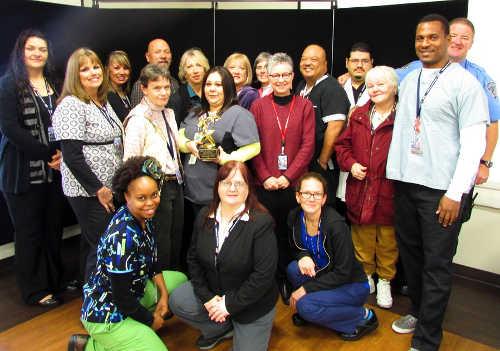
CLEARLAKE, Calif. – The Clearlake Veterans Affairs Clinic recently was honored with the Stars of Lake County's “Organization of the Year – Nonprofit” award.
The award was presented during the 16th annual awards celebration in Lakeport on Nov. 16.
Clearlake VA Clinic, nominated by one of its veteran patients, was recognized for the tireless work it performs on behalf of others and for their involvement in the community, according to Lake County Chamber of Commerce Chief Executive Officer Melissa Fulton.
The clinic, which opened in November 2010, serves more than 1,800 veterans in Lake County annually.
Staff members are involved in community outreach events such as Veterans Day celebrations, open houses and VetConnect, and they also participate in Lake County emergency response.
The Clearlake VA Clinic recently received a $5,000 transportation grant from Pacific Gas and Electric Co. through Red Cross’ Service to Armed Forces initiative to assist qualifying veterans in traveling to the clinic for their medical appointments.
“I’m very proud of my staff and their achievement – we have an outstanding crew and it’s a pleasure to work with them,” said Clearlake VA Clinic Medical Director Kirk Andrus, MD, who attended the Nov. 16 ceremony along with Clearlake’s Director of Mental Health Teresa Timmons, MD, and Administrative Officer Wendy Carter.
“I’m astonished and pleased that the community and our veterans recognized us for this award,” said Carter. “This validates us, that we’re on the right track and that we care about our patients. We have an awesome staff.”
“It is a great honor to receive this award,” said Nurse Manager Carol Brown. “We are here to serve the Veterans of Lake County, and this award reflects our dedication and service to our nation’s heroes.”
The Clearlake VA Clinic is located at 15145 Lakeshore Drive and is open Monday through Friday, 8 a.m. to 4:30 p.m., serving enrolled veterans of Lake County.
The clinic offers a wide array of services from primary medical care, outpatient mental health, podiatry, women’s care and basic dermatology, to social work, nutritional counseling, marriage and family therapy, and much more.
Member Services is at the clinic every other Thursday. Member Services can help with billing issues, getting or updating a Veteran ID card, enrolling in VA healthcare, and with annual required financial updates.
For an appointment call 707-995-7200.
To learn more, please visit http://www.sanfrancisco.va.gov/locations/clearlake.asp .
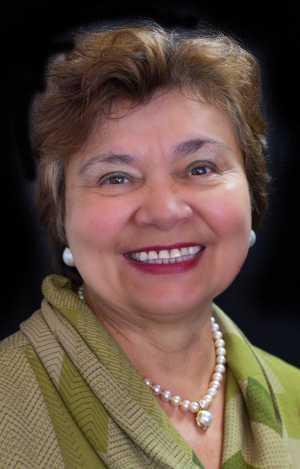
LAKE COUNTY, Calif. – Longtime Clearlake resident Maria Almia De Los Santos last month received the Global 100 Award as one of the top 100 Most Influential Filipina Women in the World.
The Filipina Women's Network, which sponsors these awards, recognizes women who have risen to the most influential and/or highest positions in corporations and nonprofit/government institutions in North America, South America, Africa, Asia, Australia, Antarctica and Europe.
De Los Santos is being recognized in the Founder and Pioneer category for her work in co-founding Hospice Services of Lake County in 1979 with other community visionaries.
De Los Santos spearheaded the fundraising efforts and offered the fledgling organization a rent free space for its first office.
The founder and pioneer award honors Filipina women in their capacities as the chief executive, president, executive director or founder of a company, community organization, nonprofit or business venture that they helped start, build or significantly grow.
This award category is for the trailblazers who have marshaled resources and applied innovative practices, processes and/or technologies in a new and groundbreaking way to address a significant business or organizational opportunity.
Hospice Services of Lake County originated as an all-volunteer nonprofit organization until 1989 when Medicare accreditation was finally achieved through the hard work and persistence of many of the original founders including De Los Santos.
Being accredited for Medicare allows people with Medicare insurance coverage to receive the hospice care benefit free of charge.
De Los Santos has worked continually for Hospice Services of Lake County since its inception and in March of 2003 she joined the organization's staff as a spiritual caregiver who provides spiritual support to hospice patients and their families.
In terms of a decedent’s own creditors, does it matter whether assets are distributed to decedent’s beneficiaries through a probate estate or by non-probate transfers?
Yes, it does, especially regarding persons other than the decedent’s surviving spouse who are not personally liable for the decedent’s debts.
Assets that are part of a decedent's probate estate are subject to creditor claims within the probate, essentially a clearinghouse for creditor claims; distributions to beneficiaries come last.
Non-probate assets – such as trusts, retirement accounts or designated beneficiary accounts or estates with a gross value under $150,000 – escape the probate clearinghouse.
In a court-supervised probate, the decedent's personal representative invites all “reasonably ascertainable creditors” to submit their claims within the first four months of probate prior to beneficiary distributions.
This even includes creditors whose claims are not yet legally established and enforceable.
While revocable living trusts are answerable to creditors for the debts of a settlor, both while the settlor is alive and he or she dies, nevertheless assets held in trust may be less susceptible to the reach of many of the decedent’s creditors.
Unlike probates, Trusts are administered for the sake of the trust beneficiaries, i.e., the deceased settlor's loved ones, according to the terms of the trust.
Unlike probates, a trustee is neither required to publish notice in a newspaper (announcing the trust administration), nor to solicit creditor claims from potential creditors whose claims are not yet legally enforceable.
Like probates, however, a trustee must contact known and reasonably ascertainable creditors of the decedent and solicit claims.
After all actual creditors are either paid, settled, and/or an adequate reserve is kept for the same, the trustee may then distribute trust assets to the trust beneficiaries.
This is true even though potential creditor claims are still being established inside the decedent's probate; which may have even been commenced by the creditors themselves in order to perfect their creditor claim against the estate prior to submission of a perfected claim to the trustee.
Oftentimes, it is only when the creditor claim is perfected inside probate and submitted to the trustee outside probate that the trustee is obliged to recognize such debts of the deceased settlor in the course of settling the trust.
If the claim arrives late after the trust assets have been distributed then the creditors must pursue the beneficiaries, who are liable to the creditors only to the extent of any assets received.
This may place the creditor at a significant disadvantage in the collection process – especially where many beneficiaries have received assets across the nation -- and may favor negotiated settlements with the beneficiaries.
Next, life insurance, retirement accounts, and joint tenancies are non-probate assets with creditor protection advantages.
Life insurance proceeds are exempt from the claims of a deceased insured’s creditors to the extent reasonably needed by the surviving beneficiary for the support of the beneficiary and/or his/her spouse and dependents.
Retirement accounts are usually exempt from the participant’s own creditors while alive and remain so after his or her death.
Lastly, assets held in joint tenancy pass to the surviving joint tenants without creating any new liability for the debts of the deceased joint tenant except those already secured against the joint tenancy property itself.
It may, therefore, seem that the law favors persons who plan to avoid paying their debts after they die through non-probate assets.
Not so. Transfers of non-probate assets – that were acquired by the decedent on the eve death – to surviving beneficiaries can be undone where the creditors prove that such planning was creditor avoidance.
Nevertheless, within limits, non-probate assets provide clear creditor protection advantages over probate.
Dennis A. Fordham, attorney (LL.M. tax studies), is a State Bar Certified Specialist in Estate Planning, Probate and Trust Law. His office is at 870 S. Main St., Lakeport, California. Fordham can be reached by e-mail at
Astronomers have long been puzzled by a certain meteor shower.
Every year in mid-December the sky fills with flashes of light shooting out of the constellation Gemini. The Geminids are fast, bright, and reliable. They never fail to show up and many observers count them as the finest meteors of the year.
But where do they come from? That is the puzzle.
Meteor showers are supposed to come from comets, yet there is no comet that matches the orbit of the Geminid debris stream. Instead, the orbit of the Geminids is occupied by a thing called “3200 Phaethon.”
Discovered in 1983 by NASA's IRAS satellite, Phaethon looks remarkably like a rocky asteroid. It swoops by the sun every 1.4 years, much like a comet would, but it never sprouts a dusty tail to replenish the Geminids.
That is, until now.
A group of astronomers led by Dave Jewitt of UCLA have been using NASA’s STEREO probes to take a closer look at 3200 Phaethon when it passes by the sun.
The twin spacecraft were designed to monitor solar activity, so they get a good view of sungrazing comets and asteroids.
In 2010 one of the STEREO probes recorded a doubling of Phaethon's brightness as it approached the sun, as if sunlight were shining through a cloud of dust around the asteroid. The observers began to suspect 3200 Phaethon was something new.
“A rock comet,” said Jewitt.
A rock comet is, essentially, an asteroid that comes very close to the sun--so close that solar heating scorches dusty debris right off its rocky surface. This could form a sort of gravelly tail.
Indeed, in further STEREO observations from 2009 and 2012, Jewitt along with colleagues Jing Li of UCLA and Jessica Agarwal of the Max Planck Institute have spotted a small tail sticking out behind the “rock.”
“The tail gives incontrovertible evidence that Phaethon ejects dust,” said Jewitt.
Jewitt's team believes that the dust is launched by thermal fracturing of the asteroid’s crust. A related process called “desiccation fracturing” – like mud cracks in a dry lake bed – may play a role too.
Seeing 3200 Phaethon sprout a tail, even a small one, gives researchers confidence that Phaethon is indeed the source of the Geminids – but a mystery remains: How can such a stubby protuberance produce such a grand meteor shower?
Adding up all of the light STEREO saw in Phaethon’s tail, Jewitt and colleagues estimate a combined mass of some 30 thousand kilograms.
That might sound like a lot of meteoroids but, in fact, it is orders of magnitude too small to sustain the massive Geminid debris stream.
Perhaps Phaethon experienced a “big event” in the recent past. “The analogy I think of is a log in a campfire,” said Jewitt. “The log burns, makes a few embers, but occasionally will spit out a shower of sparks.”
Continued monitoring by NASA's STEREO probes might one day catch the rock comet spitting out a shower of dust and debris, solving the mystery once and for all.
Until then, it's a puzzle to savor under the stars. This year's Geminid meteor shower peaks on the nights of Dec. 13-14 with dozens of “rock comet meteors” every hour. Bundle up and enjoy the show.
Dr. Tony Phillips works for the National Aeronautics and Space Administration.
LAKE COUNTY, Calif. – The latest report from the California Employment Development Department reported that unemployment was down across the state, but up slightly nationwide and here in Lake County.
Lake County's unemployment in October was 11.5 percent, the report showed, up from 11.1 percent in September but an improvement compared to the 13.7 percent rate recorded in October 2012.
The U.S. unemployment rate increased to 7.3 percent in October, up from 7.2 percent in September but down from 7.9 percent recorded the previous October, according to the US Bureau of Labor Statistics.
California’s unemployment rate was 8.7 percent in September and October, down from 8.9 percent in August and 10.1 percent in October 2012, the report showed.
Nonfarm jobs in California totaled 14,713,600 in October, an increase of 39,800 jobs over the month, according to the report.
The number of people unemployed in California was 1,612,000 – down by 18,000 over the month, and down by 250,000 compared with October of last year, the Employment Development Department reported.
While Lake County's unemployment increased in this latest report, the rate for October remains the second-lowest – with September being the lowest – since October 2008.
During that time, Lake County unemployment peaked at 19 percent in January 2010, state data showed.
Job growth in Lake County between September and October occurred in sectors including information, 6.7 percent; government, 1.5 percent; and educational and health services, 0.4 percent, the report noted. Decreases occurred in industries including goods producing, -26.9 percent; farm, -17 percent; and leisure and hospitality, 5.7 percent.
Once again, Marin maintained its No. 1 ranking for lowest unemployment, with 4.8 percent, while Imperial continued to rank No. 58 for its 25.2-percent rate, according to the state.
Lake County's October unemployment rate earned it a ranking of No. 48 out of the state's 58 counties.
Lake's neighboring counties ranked as follows in October, according to the Employment Development Department: Colusa, No. 56, 12.6 percent, Glenn, No. 39, 10 percent; Mendocino, No. 13, 7.1 percent; Napa, No. 3, 5.3 percent; Sonoma, No. 6, 6.1 percent; and Yolo, No. 24, 8.3 percent.
The Employment Development Department also reported that there were 405,761 people receiving regular Unemployment Insurance benefits during the October survey week, compared with 362,532 in September and 453,448 last year.
At the same time, new claims for unemployment insurance were 72,737 in October, compared with 37,333 in September and 55,543 in October of last year, the state reported.
Email Elizabeth Larson at