How to resolve AdBlock issue?
News

NORTH COAST, Calif. – California's governor will be among the thousands expected to attend the Wednesday funeral of a Mendocino County Sheriff's deputy who was killed in the line of duty last week.
Deputy Ricky Del Fiorentino, 48, will be honored in the Wednesday services, which begin at 10 a.m. Wednesday in the Cotton Auditorium, 500 North Harold Street in Fort Bragg.
Del Fiorentino was shot March 19 by an Oregon man wanted in connection to a homicide, carjacking and armed robbery, as Lake County News has reported.
Gov. Jerry Brown's office confirmed on Tuesday that he will attend Del Fiorentino's funeral service.
Last week, Brown had ordered the State Capitol's flags to fly at half-staff in the slain deputy's honor.
The commemoration of Del Fiorentino's life will begin with a procession that will start in Ukiah, leaving at 6:45 a.m., according to the Mendocino County Sheriff's Office.
Caltrans will help provide traffic control at various locations from Ukiah to Fort Bragg.
The agency said up to 1,000 law enforcement vehicles are anticipated to participate.
The procession will leave Ukiah and travel north on US Highway 101 to Willits, west on Highway 20 to Highway 1, then briefly south along Highway 1 to Pearl Drive before turning north to arrive at the Georgia Pacific Mill site in Fort Bragg at about 9 a.m.
Caltrans is coordinating with the California Highway Patrol, the Mendocino County Sheriff's Department and other local law enforcement agencies to provide traffic control at major intersections including US Highway 101/Route 20 in Willits, and Route 1/20 and Route 1/Simpson Lane in Fort Bragg.
Motorists are advised to avoid these locations if possible, or to anticipate possible 45-minute delays.
Mendocino Sheriff's Capt. Greg Van Patten said attendance at the funeral is expected to exceed the seating capacity of the Cotton Auditorium.
Overflow seating has been established adjacent to the Cotton Auditorium at the Fort Bragg Middle School Gymnasium and a large enclosed outdoor tent beside the Gymnasium.
It is expected that there will be a live steaming video feed transmitted from inside the Cotton Auditorium to the Gymnasium and tent for viewing purposes.
The live steaming video feed will be broadcast on cable channels 3 and 65 in the Ukiah Valley area and on the Internet at the www.mendocinoaccess.org Web site.
Those who are unable to attend the memorial service are encouraged to watch the cable broadcast if at all possible as opposed to the Internet broadcast to prevent any disruption in the Internet broadcast due to oversaturation, Van Patten said.
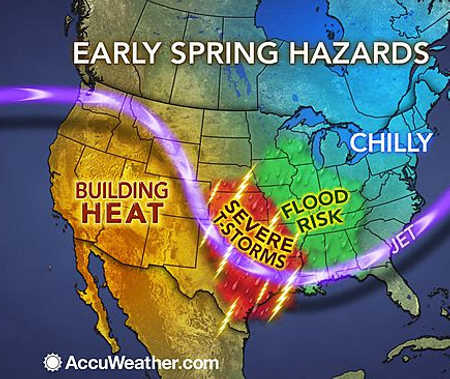
ACCUWEATHER GLOBAL WEATHER CENTER – AccuWeather.com reports persistent cold air during the first part of the spring is likely to cause severe weather to get off to a sluggish start in a heavily populated part of the nation. However, a marked turnaround is expected later in the spring for 2014.
On average, severe weather gradually ramps up moving forward through the spring. This year, the transition may occur later and may be more dramatic.
A spike in damaging thunderstorms, including some capable of producing tornadoes, is expected during May and June.
Early season temperature extremes
According to AccuWeather Long Range Weather Expert Paul Pastelok, “We expect a southward dip in steering-level winds to occur much of the time over a large part of the Midwest to the Eastern states during March and the first part of April.”
This dip of strong winds high in the atmosphere, known as a jet stream trough, will generally keep warm, moist air at bay from near the Mississippi River to the Atlantic coast.
Last year, a similar setup occurred in much of the same area during the spring and led to a much lower-than-average severe weather season for the nation as a whole.
Thunderstorms are fueled by rising warm, moist air. As a general rule, the lower the temperature near the ground, the lower the risk for tornadoes and violent thunderstorms.
“This year, the ground is colder, the Great Lakes have an extensive amount of ice and the Gulf of Mexico waters are starting off colder than average,” Pastelok said. “All of these can have a negative impact on temperatures in the lower atmosphere.”
Over much of the Southeast, Midwest and Northeast, the tornado risk will be lower than average early on due to the colder-than-average environment expected.
According to Severe Weather Expert Dan Kottlowski, “As a positive note, we may not see the frequency and violence of severe thunderstorms and tornadoes that typically occur during March and much of April, because of the lingering chill impacting a significant part of the nation.”
However, Kottlowski urged caution when comparing overall numbers of tornado and other severe weather incidents to other seasons.
“This is not to say there cannot be a couple of outbreaks of severe weather during the first part of the spring in portions of the Midwest, the South and even the Northeast,” Kottlowski said. “People should not let their guard down.”
Even during a minor severe weather event, all it takes is one tornado hitting a populated area to bring the potential for great loss of life and destruction.
Strong storm systems can exploit temperature extremes. These storms can allow building warm, moist air to surge in just long enough to trigger an outbreak of severe weather in an otherwise, predominantly cool weather pattern.
There is one area where severe weather may get off to an early, typical start with the possibility of frequent severe weather events during March and April.
In portions of Texas, Oklahoma, western Arkansas and western Louisiana, Kottlowski and Pastelok both expect warmth to build quickly relative to the balance of the Central and Eastern states.
The AccuWeather long-range team has concerns for flooding over part of the Tennessee and Ohio valleys with this setup, however. Weakening thunderstorms could unload heavy rain as they move farther east and unwind in the semi-permanent cooler air.
Dramatic pattern change later in spring
Pastelok and Kottlowski expect the pattern from the Mississippi Valley to the East to change significantly during May and June and correspondingly expect a spike in severe weather incidents to progress northward and eastward.
“We expect a normal to perhaps an above-average amount of severe thunderstorms over the Central states during May and June,” Kottlowski said.
Indications are that the jet stream will pull to the north during May and June and hence will allow warm, moist air to flow northward more regularly over the Midwest.
“While warmth combined with drier air may keep a lid on severe weather for a time in the East during May, the air should be thoroughly warm and moist over much of the Midwest and South Central states,” Pastelok said.
Areas from the Dakotas and Minnesota to Wisconsin, Michigan, the Appalachians and Atlantic coast should experience surge of severe weather during June and July.
A significant number of severe weather events are likely to continue to occur over the balance of the Midwest and South Central states and expand to along the Rockies as spring draws to a close and summer begins.
Justin Roberti works for www.accuweather.com .
California Attorney General Kamala D. Harris and four other state attorneys general on Tuesday signed a letter of intent with the National Banking and Securities Commission of Mexico to establish a binational working group on money laundering enforcement.
The delegation of U.S. state attorneys general is in Mexico to strengthen working relationships with governments of both countries and enhance efforts to combat transnational crime.
“The laundering of money fuels transnational criminal organizations and threatens California's economy and our public safety,” Harris said. “This binational agreement will create the cooperation and communication needed to disrupt the financing of transnational crime. I want to thank my colleagues and the Mexican government for their steadfast commitment to addressing this serious issue.”
Last week, Attorney General Harris issued a report, Gangs Beyond Borders: California and the Fight Against Transnational Organized Crime, that identified California as a key portal for the transfer of illicit money.
According to the report, transnational criminal organizations transfer billions of dollars out of the U.S. through California. As much as $40 billion in illicit funds were laundered in the state in 2012.
The binational agreement will develop an anti-money laundering working group with the following purposes:
- Establish the scope of coordination between Mexico and U.S. state attorneys general on money laundering enforcement issues.
- Develop a plan for mutual technical assistance and training on combating money laundering.
- Share best practices on money laundering enforcement techniques and other enforcement issues of mutual concern, including the impact of money laundering on the border region of the U.S. and Mexico.
The delegation of U.S. state attorneys general, including California Attorney General Kamala D. Harris, Colorado Attorney General John Suthers, Florida Attorney General Pam Bondi, Nevada Attorney General Catherine Cortez Masto, and New Mexico Attorney General Gary King signed the letter of intent with Jaime Gonzalez Aguadé, President of the National Banking and Securities Commission of Mexico.
On Monday, the U.S. delegation of state attorneys general met with Mexican state attorneys general to discuss various issues related to transnational crime, including high-tech crime, human trafficking, and the use and adoption of technology.
The delegation met with Mexican state attorneys general from Baja California, Chihuahua, Campeche, Distrito Federal, Jalisco, Sonora and Zacatecas.
On Monday, the delegation also met with Mexican Attorney General Jesus Murillo Karam to strengthen cooperation in the fight against transnational crime in the areas of drug, human, and weapons trafficking, money laundering, cybercrime and use of technology in law enforcement.
Attorney General Harris’ report last week was the first comprehensive report analyzing the current state of transnational criminal organizations in California and the threats they pose to the state’s public safety and economy, including the problem of money laundering.
The report is available here: https://oag.ca.gov/transnational-organized-crime .
NORTHERN CALIFORNIA – Clear Lake High School was among 65 high schools from across the state taking part in the California Academic Decathlon this past weekend.
Altogether, 565 students competed in the 35th annual event, held in Sacramento.
El Camino Real Charter High School and Granada Hills Charter School, both located in the Los Angeles Unified School District, won first and second places the state competition, respectively.
El Camino's team scored 57,747.3 points out of 65,400 possible, while Granada Hills' score was 57,214.1.
Both of El Camino and Granada Hills' nine-member teams will represent California at the 33rd national Academic Decathlon, to be held in Honolulu April 24 and 25.
California has won 11 consecutive US Academic Decathlon titles and 15 titles in the last 18 years, according to state competition officials. Over the 32 years of the national competition, California has placed first or second every year but one.
Marshall High School of the Los Angeles Unified School District won the large school title with 56,963 points, Campolindo High/Contra Costa received the medium school title with 49,205.6 points and University High/Fresno received the small school title with 48,345.3 points.
State competition officials said all three of those division-winning high schools will be eligible to compete in the US Academic Decathlon.
Each team includes nine members from three categories: Honors, 3.75 grade point average and above; Scholastic, 3.0 to 3.74 GPA; and Varsity, 2.99 to GPA and below.
Clear Lake High School represented Lake County at the annual state competition, participating in Division III.
The school, making its first appearance on behalf of the county in more than a decade, scored 31,623.50, earning it a ranking of No. 63 overall.
Asia Jones was Clear Lake High's top scorer, contributing 6763.8 points to the team's total, according to the final standings.
Philip Leighton, performing in the Varsity level, tied for a gold medal in the interview category, scoring 980 points.
Clear Lake High Junior Savannah Rasmussen told Lake County News that the state competition offered the team a “great and fun experience.”
“It was really about more than just the testing; our team bonded together and we met some really great people from around California,” she said.
Rasmussen said she hoped that, now that the team knows what the competition is all about, it can return next year.
In other results from schools around the region, Casa Grande High School from Sonoma County placed No. 16 in Division I with 48040.3 points, St. Helena High School from Napa County scored 41786.5 in Division III and placed No. 47, River City/Davis Senior High School in Yolo County scored 31647.4 points in Division III and placed No. 62 and Glenn County's Orland High School, competing in Division III, placed No. 65 with 28746.9 points.
Casa Grande's individual student medals in the Division I category include Honors student Carol Tang's nine-way tie for third place in art, Honors student Shin Mei Chan took second place in interview and third place in speech, Honors student Joy Gu took second place in speech, Varsity student James Moore medaled in social science and Varsity student Cassidy Visco died for first in speech.
St. Helena High students also put in a strong showing.
Brandon Cole placed second in Division III's overall student winners for the Varsity category, with 6,213 points. Another Varsity student, Brianna Haug, was in a two-way tie for third place in art and also tied for third in the interview category.
In economics, Scholastic student Joseph Coon of St. Helena High School tied with three other students for third place in Division III; in essay Varsity student Spencer Pearson won first place; and Honors student Cori Calabi won a gold medal for speech.
Honors student Ankita Singh of River City/Davis Senior High School was in a three-way tie for first in the Division 3 science category.
Email Elizabeth Larson at
LAKE COUNTY, Calif. – A Clearlake man has entered a guilty plea to voluntary manslaughter for the fatal stabbing of another man last May.
Darrell Vernon Sidwell, 58, entered the plea this week, according to his attorney, Stephen Carter.
“I am extremely pleased with this disposition because my client no longer faces the possibility of life in prison, instead, he will be out of prison in four years,” said Carter of the Law Offices of Carter & Carter in Lower Lake.
Sidwell was arrested in May 2013 for the stabbing of 43-year-old Brad Beaudion of Clearlake, as Lake County News has reported.
On the evening of May 9, 2013, Clearlake Police officers were dispatched to Beaudion's Park Street residence, where they found him outside with a stab wound to the stomach, according to the original police report on the case.
Beaudion was able to identify the person who stabbed him as “Darrell” before he was unable to speak further. Police said he was transported to St. Helena Hospital Clear Lake and died later that night.
Based on the investigation, police concluded that the two men had argued earlier in the evening over a boat located near Sidwell’s residence and led to a physical confrontation, during which Sidwell stabbed Beaudion with a knife.
As a result of the plea, Sidwell will be sentenced to six years in prison rather than facing the potential of life in prison for the killing, Carter said. With his custody credits, he will be out of prison in four years.
Carter said the defense toxicologist located illegal drugs and prescription drugs in the victim’s blood and a significant amount of alcohol in Sidwell's blood.
“In order to prove this was a premeditated murder, the prosecutor would have to prove that my client had the ability to form the specific intent to kill the victim,” Carter said. “Under the law, extreme intoxication can negate the ability to form a specific intent to kill.”
Carter said the additional charges of murder and assault, a special allegation for use of a deadly weapon and a second special allegation alleging great bodily injury were all dismissed.
Email Elizabeth Larson at
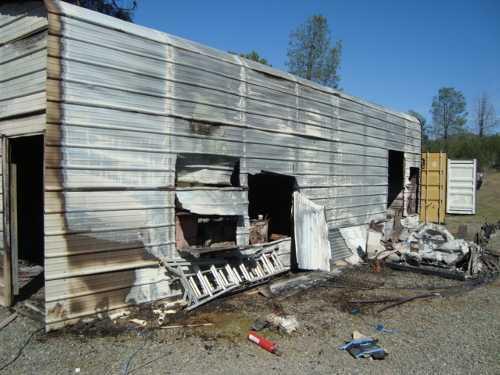
LOWER LAKE, Calif. – The investigation into a structure fire last week in Lower Lake led authorities to discover a marijuana honey oil lab.
No arrests have so far been made in the case, according to a report from Lt. Steve Brooks.
At 11:40 a.m. Thursday, March 20, Lake County Fire and Cal Fire were dispatched to a parcel of property located in the 20000 block of Morgan Valley Road in Lower Lake for a structure fire, Brooks said.
Upon arrival, fire personnel notified Central Dispatch of a possible marijuana honey oil lab with outstanding suspects who were seen leaving the area. Brooks said law enforcement officers from California State Parks were in the area and responded to assist fire personnel.
Members of the Sheriff’s Narcotics Task Force responded to the scene and confirmed a large-scale butane honey oil lab – also referred to as a BHO lab – was being used, Brooks said.
Marijuana honey oil is a product extracted from marijuana using butane gas, which is highly volatile and explosive. Brooks said the tetrahydrocannabinol (THC) content in honey oil is approximately 80 percent, compared to 25 percent THC content in high grade marijuana.
The property was secured by narcotics detectives and a search warrant was obtained for the property. Brooks said the fire appeared to originate from an area near on outbuilding, where a PVC tube used for the extraction process exploded.
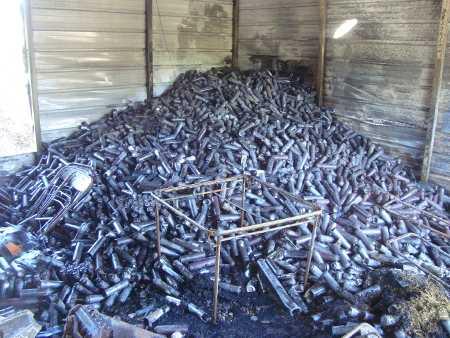
During a search of the property detectives located several thousand burned butane canisters along with nearly 2,000 full canisters which did not catch fire, he said.
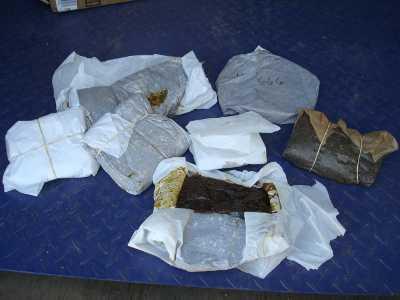
Approximately 237 pounds of processed marijuana shake was located in plastic bags outside the burned structure. Inside a metal storage container on the property, detectives located approximately 8.1 pounds of finished butane honey oil, which has a street market value of $8,000 per pound, according to Brooks.
When broken up and packaged for personal use, the street value is as much as $22,650 per pound when sold at $50 per gram, Brooks said.
Commercial production of butane honey oil is a trend in marijuana cultivation operations, as there is no waste of the marijuana. This process utilizes the marijuana trimmings or shake, which most cultivators claim to be a waste product, according to Brooks' report.
This investigation is ongoing and anyone with information pertinent to this case is asked to contact the Lake County Sheriff’s Office at 707-263-2690.