How to resolve AdBlock issue?
News
California Congressmen Mike Thompson (D-St. Helena), Jared Huffman (D-San Rafael), Sam Farr (D-Carmel), and Doug LaMalfa (R-Richvale) applauded the U.S. Sentencing Commission for taking action to increase public safety and stop the environmental destruction caused by trespass marijuana grows on our public and private lands.
The U.S. Sentencing Commission announced last Thursday that it adopted increased penalties for high-level offenders cultivating marijuana on trespassed private or public lands, as Huffman, Thompson, Farr, and LaMalfa, along with California’s U.S. Senators Dianne Feinstein and Barbara Boxer, requested in a November letter to the Commission.
These amended Sentencing Commission guidelines will be submitted to Congress and reviewed for a six-month period. They will officially take effect Nov. 1.
“Illegal marijuana grow sites that threaten lives, destroy public lands and devastate wildlife have become far too common,” said Congressman Thompson. “These new sentencing guidelines will serve as a strong deterrent against these illegal grow sites, and they will help make sure criminals who wreck our public and private lands are held fully responsible for the harm they cause.”
“From the use of highly-toxic and illegal pesticides and rodenticides, to the violence perpetuated by drug trafficking organizations, trespass marijuana cultivation makes our public and private lands unsafe for all of us. California is in the midst of a devastating drought, and many of these grow operations illegally divert streams and tap groundwater with untold impacts on downstream water users and wildlife,” said Congressman Huffman.
“As we move toward more rational marijuana policies it’s critical that we address the immediate threat to our environment and public safety posed by trespass growing operations,” added Huffman. “Where it is lawful to grow marijuana, it must be done lawfully and responsibly, and I’m glad that the Sentencing Commission has taken strong action to help keep our communities and public lands safe.”
“As our nation moves forward with more sensible laws to address marijuana use, we have to develop better policies to deal with the bad actors,” said Congressman Farr. “I am glad that the Sentencing Commission is changing their guidelines to address trespass marijuana grows. With these new guidelines in place, we can make public and private lands safer while protecting the environment for everyone to enjoy.”
“While illegal marijuana cultivation has made many of our public and private lands unsafe, it also does untold damage to our forests and waterways. When these operations illegally divert streams, contaminate water supplies and leave refuse behind, property owners and local governments are stuck with thousands of dollars in clean-up costs,” said Congressman LaMalfa. “The Sentencing Commission’s recognition of these impacts will go a long way toward ensuring that those who disregard our nation’s laws are held responsible.”
Thompson, Huffman, Farr, and LaMalfa previously introduced the PLANT Act, a bipartisan bill which would direct the Sentencing Commission to establish new penalties for these environmentally destructive practices.
Sen. Feinstein and Sen. Boxer introduced a companion bill in the Senate.

NORTHERN CALIFORNIA – The Humboldt County Sheriff's Office is seeking information on a Eureka woman reported missing last week.
Jacqueline Joanne Sullivan, 39, was reported missing by her mother at 3 p.m. Tuesday, April 8, according to a report from the Humboldt County Sheriff's Office.
Officials said Sullivan's mother told the investigating deputy that she last communicated with her daughter on Feb. 20. During that conversation, the mother said Sullivan sounded confused.
Sullivan's mother has been attempting to contact her daughter ever since with no success. Officials said the mother is concerned there are medical issues and Sullivan needs treatment.
It is unknown where Sullivan is and her cell phone voice mail is full. Her mother has checked with all her friends and other family members and no one has any idea what has happened to her or where she went, according to the report.
The sheriff's office said Sullivan's last known residence was Eureka, but that apartment was cleaned out.
Jacqueline Sullivan is a white female, 5 feet 6 inches tall, weighing 150 pounds. She has brown eyes, wears glasses and has brown shoulder-length hair.
She drives a gray 2002 Toyota Tacoma with a shell, California Plate 7M50504, officials said.
Anyone with information regarding this case is encouraged to call the Humboldt County Sheriff's Office at 707-445-7251 or the agency's crime tip line at 707-268-2539.
You may be in the midst of a chaotic moment, a health crisis, or even worse and the three numbers that come to mind to call in the emergency are 9-1-1.
The people answering the phones are highly trained professionals who may calmly give direction on what to do, or perhaps give life-saving instructions.
The California Highway Patrol (CHP) honors the brave men and women you do not see who are behind the scenes.
National Public Safety Telecommunicators week is April 13-19, 2014, and a chance to give thanks to the men and women on the other end of a 9-1-1 call.
“I am very proud of our dedicated professionals and the services they provide the public every single day,” said CHP Commissioner Joe Farrow. “In addition to assisting the public, they help our officers out in the field by providing valuable resources, so that officers can get the job done out there on the front lines.”
The CHP has 25 communications dispatch centers statewide that employ nearly 900 public safety dispatchers.
Last year these employees were responsible for handling approximately 8.9 million calls for service. Calling 9-1-1 can be intimidating.
The following tips help callers during an emergency.
- No matter what happens – stay calm.
- Be prepared to provide your name, phone number, address or location, and a detailed description of the incident or vehicle being reported.
- Let the dispatcher guide the conversation.
- Wait for the dispatcher to ask questions, and then answer clearly and calmly.
- Listen carefully and follow all directions provided by the dispatcher.
- Be prepared to provide a physical description if the emergency involves a criminal suspect.
Cellular telephones may not tell the call-taker where you are. Use a landline to report an emergency whenever possible.
Remember, 9-1-1 is for life-threatening emergencies. Misuse of the emergency 9-1-1 system will result in a delay for callers with real emergencies and is punishable by a fine of not more than $1,000.
“We honor all public safety communications professionals by recognizing their contributions and the positive impact they have on thousands of lives every day,” added Commissioner Farrow.
The mission of the California Highway Patrol is to provide the highest level of safety, service and security to the people of California.
LAKEPORT, Calif. – The new Lake County Poet Laureate will be selected at a special event planned for Saturday, April 19.
The reading and selection will take place beginning at 2 p.m. at the Lake County Arts Council's Main Street Gallery, 325 N. Main St. in Lakeport.
There will be a round robin reading by former Lake County Poets Laureates James Blue Wolf, Carolyn Wing Greenlee, Mary McMillan, Russell Gonzaga and Elaine Watt.
The finalists for 2014-16 Lake County Poet Laureate, who include John Hoey and Casey Carney, will then do readings of their work.
The new poet laureate will be announced at the end of the reading.
Refreshments will be served.
LAKE COUNTY, Calif. – Three cats are ready and waiting for new homes at Lake County Animal Care and Control this week.
The cats, two males and a female, range in age from 8 months to 5 years.
In addition to spaying or neutering, cats that are adopted from Lake County Animal Care and Control are microchipped before being released to their new owner. License fees do not apply to residents of the cities of Lakeport or Clearlake.
If you're looking for a new companion, visit the shelter. There are many great pets there, hoping you'll choose them.
In addition to the animals featured here, all adoptable animals in Lake County can be seen here: http://bit.ly/Z6xHMb .
The following cats at the Lake County Animal Care and Control shelter have been cleared for adoption (other cats pictured on the animal control Web site that are not listed here are still “on hold”).

'Atlas'
“Atlas” is a 5-year-old male Siamese mix.
He has a short coat with seal point markings and blue eyes, and has been neutered.
He's in cat room kennel No. 38, ID No. 39285.

Male tuxedo cat
This male tuxedo cat is 5 years old.
He has a short coat and green eyes, and has been neutered.
Find him in cat room kennel No. 80, ID No. 39342.
'Winnie'
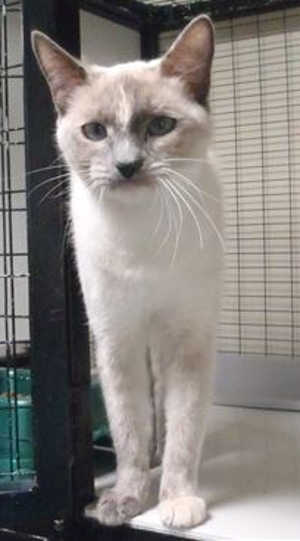
“Winnie” is an 8-month-old Siamese mix.
She has blue eyes, a short light-colored coat, weighs 6 pounds and has been spayed.
She's in cat room kennel No. 88, ID No. 39396.
Adoptable cats also can be seen at http://www.co.lake.ca.us/Government/Directory/Animal_Care_And_Control/Adopt/Cats_and_Kittens.htm or at www.petfinder.com .
Please note: Cats listed at the shelter's Web page that are said to be “on hold” are not yet cleared for adoption.
To fill out an adoption application online visit http://www.co.lake.ca.us/Government/Directory/Animal_Care_And_Control/Adopt/Dog___Cat_Adoption_Application.htm .
Lake County Animal Care and Control is located at 4949 Helbush in Lakeport, next to the Hill Road Correctional Facility.
Office hours are Monday through Friday, 8 a.m. to 5 p.m., and 1 p.m. to 3 p.m., Saturday. The shelter is open from 10:30 a.m. to 4:30 p.m. Monday through Friday and on Saturday from 1 p.m. to 3 p.m.
Visit the shelter online at http://www.co.lake.ca.us/Government/Directory/Animal_Care_And_Control.htm .
For more information call Lake County Animal Care and Control at 707-263-0278.
Email Elizabeth Larson at
LOWER LAKE, Calif. – Anderson Marsh State Historic Park, located on Highway 53 between Lower Lake and Clearlake, is comprised of more than 1,000 acres of wetlands, oak woodlands and grasslands.
Anderson Marsh is set on the largest lake situated wholly in California, and the oldest lake in North America – Clear Lake.
There are more than 30 documented American Indian archaeological sites here, some of which are more than 10,000 years old.
Anderson Marsh has a rich history of European settlement as well. The Grigsbys settled here in the 1850s and the Andersons in the 1880s.
A walk in the park at Anderson Marsh is never the same twice.
You have a choice of trails to explore, along with the McVicar Wildlife Sanctuary. The Marsh Trail allows you an all-encompassing vista of the park's landscape. Its 1.6 miles long trail lopes through the park's predominant habitat – freshwater marsh, with 19 percent tule prairie and 42 percent sedge-rush prairie. A walk here garners a view of Bald Eagles in the winter months.
This jewel of a park protects an ecologically valuable tule marsh, which plays a significant role in the lives of birds, fish and mammals that make use of it for breeding, nesting and living in or amongst the tules.
The tules here at Anderson Marsh are some of the remaining (about 8 percent) of Clear Lake's once immense expanse of tule reed habitat.
Tule reeds provide necessary habitat during the lifecycles of fish such as catfish, blue gill and crappie.
Tule reeds were carefully managed by Anderson Marsh's original inhabitants, the Pomo Indians. Then, the reeds were put to a variety of uses including tule huts, mats, baskets, clothing and even tule reed boats. American Indians were mindful of leaving enough of the plant to ensure plenty for future use.
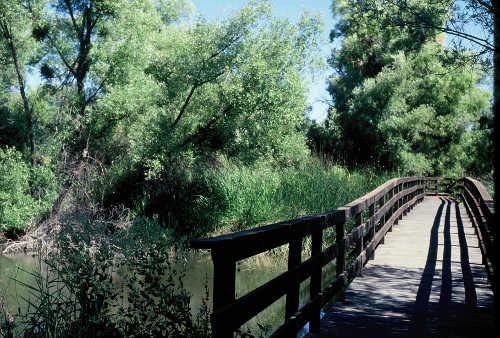
The 1.2-mile Cache Creek Trail encompasses a riparian environment with a valley oak forest and cottonwood-willow woodland, and makes up 4.5 percent of the park.
There is an 800-foot-long bridge and boardwalk constructed, in part, by the Telephone Pioneers of America to take you along Cache Creek to the edge of Clear Lake.
Here, where the soil meets water, is where a wealth of plant and animal life live out their day to day dramas. This habitat is attractive to great blue herons, wood ducks, various hawks, warblers, American Robins and several types of hummingbirds.
It prospers in a rich insect-life which feeds the assorted fish and bird species. Migratory birds find their way here to pause on their long journeys, and a host of other wildlife may be seen here such as black-tail deer, raccoons, pond turtles and more.
Anderson Flats Trail meanders through a grassland environment, and is 0.8 miles long.
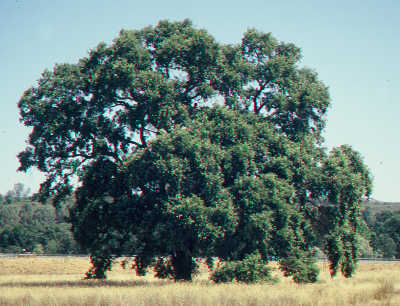
Set prominently amongst the grasses is a huge, ancient valley oak, known as the “kite tree” since it is frequented by black-shouldered kites. These avian acrobats beat their wings to hover – hence the name “kite” – then snatch up their prey with talons to enjoy a tasty treat of mice, insects, birds or small mammals.
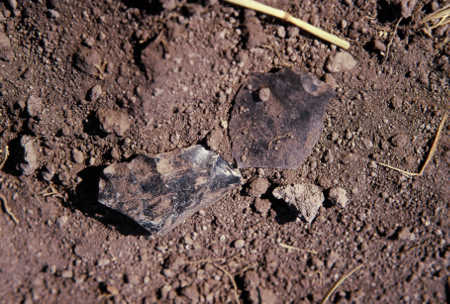
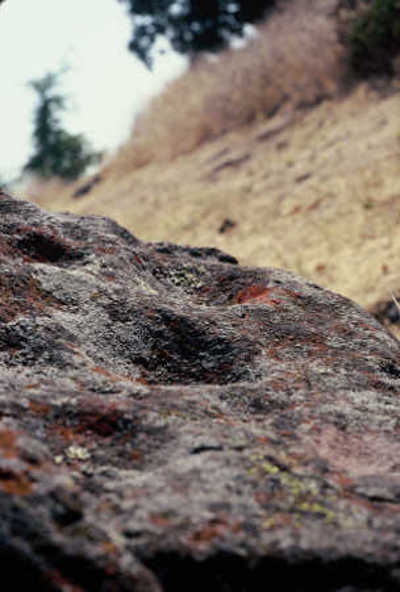
Evidence of the park's past can be seen twinkling in the sunshine – a piece of glass-like obsidian. These once-valued volcanic remnants were mightily important in the Pomo Indian culture. The rock was painstakingly fashioned into arrowheads, fishhooks, scrapers and tools of all description.
Signs in the park warn against taking anything, including obsidian from the premises.
To gaze upon this stone can take you back in time when everyone in the community here had a job and a purpose: a hunter, food gatherer, basket weaver, a shaman or fisherman. Everyone relied on one another and knew that part intimately.
The 1.5-miles-long Ridge Trail rambles through an oak woodland ecosystem, and comprises about 7 percent of the park.
You can discover lots of blue oaks, manzanita and other shrubs, along with their inhabitants: great horned owl, Cooper's Hawks, various woodpeckers, California ground squirrel, Western gray squirrel, porcupine and other critters.
There is always a surprise in store when hiking the Ridge Trail. Western Redbud practically glows its distinctive magenta coloration on the trail in the springtime.
Redbud played a part in Pomo basket weaving, when the bark from the plant's slim branches were incorporated to provide a brown color or, when peeled, presented white colored strips for the ancient artisans. Pomo baskets can be found not only in our local museums, but the Smithsonian houses special Pomo basketry as well. Descendants of the first people here still pass on the exquisite art of basket weaving today.
We have local archaeologist Dr. John Parker to thank for our precious park. Parker worked diligently for years in the state and federal levels to help preserve the land that is now Anderson Marsh from becoming a residential area for 1,000 new homes.
He worked to promote the rich cultural awareness of Lake County history, bringing in the Native American community who pointed out plant materials used for basket making, food and medicine. Parker highlighted the importance of Clear Lake's ecosystem to aquatic life.
The local Redbud Audubon Society made a list of birds and other wildlife in the area, some of which were on the national rare and endangered lists. Groups such as the Cultural Heritage Council, Audubon and many, many concerned citizens fought to preserve the land.
In 1977 Anderson Marsh officially was classified as an archaeological district and was listed on the National Register of Historic Places. In 1982 the State of California acquired the ranch property and preserved a significant, rich cultural area of California.
Anderson Marsh State Historic Park's Interpretive Association, AMIA, celebrates its 30th anniversary, along with the sesquicentennial anniversary of California's State Parks on May 31.
For more information about AMIA's 30th anniversary events, visit www.andersonmarsh.org or www.facebook.com/AMIA.org .
Kathleen Scavone, M.A., is an educator, potter, writer and author of “Anderson Marsh State Historic Park: A Walking History, Prehistory, Flora, and Fauna Tour of a California State Park” and “Native Americans of Lake County.” She also writes for NASA and JPL as one of their “Solar System Ambassadors.” She was selected “Lake County Teacher of the Year, 1998-99” by the Lake County Office of Education, and chosen as one of 10 state finalists the same year by the California Department of Education.