How to resolve AdBlock issue?
News

CLEARLAKE, Calif. – The eighth annual "Andy Day" at Andrew Johnson Memorial Skatepark on April 12 in Clearlake saw skateboarders and BMX bikers celebrating the young man responsible for bringing them together.
The event was filled with daredevil tricks, monstrous music and fond memories of a lost friend and role model.
Johnson, who was an avid skateboarder and BMX rider, was killed in a vehicle collision in 2006 while traveling with friends to a skateboard/BMX facility in Eureka.
Prior to his death, he built a bridge between skateboarders and BMX bikers at the Clearlake Skate Park that instilled camaraderie among area youth.
In 2008, Johnson’s memory was immortalized after the skateboarding/BMX biking community united in efforts to have the skate park in Clearlake named in his honor.
Councilman Joey Luiz said the skate park effort launched his career into local politics. He recognized the efforts of Michele Bush and her son Ricky, who also were at the forefront of repairing, reopening and dedicating the park.
Luiz recalled and lauded contributions and commitment that resulted in $15,000 in repairs to skate park ramps.
"We appreciate Andy Day at City Hall and we appreciate this skate park for our city's youth and what everyone did to get it reopened. Andy would be very proud," Luiz said. "We will not tolerate those gates to be closed again. Happy Andy Day!"
Athletes of all ages took their wheels to the ramps.
Josh Sharp, 11, of Clearlake Oaks, said his brother-in-law was friends with Johnson. "I know Andy will always be here," he said, with his helmet firmly in place en route to his favorite ramp.
Vice Mayor Gina Fortino Dickson strapped a helmet as well, borrowed a bike and hit the ramps, too, literally.
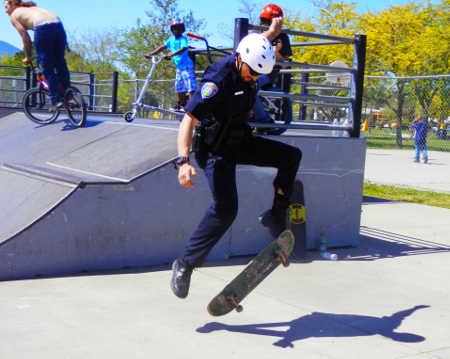
With a bit of encouragement from Mayor Denise Loustalot and a cheering section of enthusiastic youth, Officer Travis Parsons put on safety gear and showed the crowd he is a just skater at heart.
"Today marks eight years when Andy Johnson's life was taken in a car accident along with three other youths. Andy's ability to ride, friendships and ability to bring people together is amazing," Michele Bush said. "(It) was another epic Andy Day and we will continue to honor Andrew Daniel Johnson. You are loved and missed."
Email Denise Rockenstein at

Assemblymember Mariko Yamada (D-Davis) Assembly Bill 1434 to help low-income Californians with their water bills will be heard in Utilities and Commerce on Monday, April 21, 2014 at 3 p.m. at the State Capitol, Room 437.
Since 2012, California established that safe, clean and affordable water is every human being’s right. While AB 685 (Eng) requires the California Public Utilities Commission (CPUC) to consider low-income rate relief programs, it is not required by statute to implement these programs.
Moreover, they have no authority over utilities that qualify as public agencies which are the vast majority of water service providers in the state.
“This is a bill of livelihood that seeks to help about three quarters of Californians in rural areas, where the majority of smaller utility companies could not or choose not to provide them with assistance.” Yamada stated. The right to water is a necessity and we must ensure its affordability.”
AB 1434 would direct the California Department of Community Services and Development (CSD) in conjunction with the Board of Equalization (BOE) to develop and implement a statewide Low-Income Water Rate Assistance Program for low-income ratepayers.
Low-income Californians need a statewide program to receive their assistance in order to overcome the problems individual water service providers have in operating a low-income assistance program.
AB 1434 creates a functional collaboration for CSD and the BOE to create these programs and manage the fund that will help millions of Californians with their water bills.
For more information about supporting AB 1434 in the hearing, please contact Arturo Salaices,

UPPER LAKE, Calif. – The service of two search warrants earlier this week resulted in two arrests and the seizure of marijuana, firearms and cash.
Ob Klyd Lowrie, 28, of Nice and 22-year-old Connor William Rieves of Upper Lake were arrested following the search warrant services, according to Lt. Steve Brooks of the Lake County Sheriff's Office.
On Tuesday, narcotics detectives secured a search warrant for a residence located in the 1400 block of E. State Highway 20 in Upper Lake, serving the warrant at 2:20 p.m. that day, Brooks said.
Brooks said detectives located two greenhouses on the property, one of which was a large hoop-style green house. The large hoop-style green house contained 52 marijuana plants and the other contained 51 marijuana plants.
Lowrie told detectives that the marijuana plants belonged to him and Rieves. He admitted to growing about the same amount of marijuana last year where he yielded approximately 70 pounds of processed marijuana, Brooks said.
Brooks reported that Lowrie also told detectives that he sold the marijuana to a cannabis club in the Bay Area for $2,000 a pound. When asked how much money he made last year, Lowrie was unable to provide a straight answer.
Rieves told detectives that his brother worked at a marijuana store front, where he also sold the marijuana, Brooks said. He said he just sold a pound to the store front for $900. Rieves told detectives he made about $10,000.00 in cash from his marijuana sales last year and also obtained a vehicle.
After being questioned by the detectives, Rieves changed his story and said he made about $20,000 last year and was given a place to live, Brooks said.

Narcotics detectives eradicated 103 marijuana plants from the two greenhouses. Brooks said that during a search of the residence detectives located 38.3 pounds of processed marijuana in the living room which they seized.
Both Lowrie and Rieves were arrested for the possession of marijuana for sale, cultivating marijuana and conspiracy to commit a crime. Brooks said they were transported to the Lake County Hill Road Correctional Facility and booked.
Based on information they received while interviewing Lowrie and Rieves, detectives obtained a second search warrant for a residence located in the 2700 block of Lakeview Drive in Nice, the residence where Lowrie said he was living. Narcotics detectives served the warrant at the residence on the same day, Brooks said.
Detectives located two sheds on the property which contained marijuana plants. One of the sheds contained 522 marijuana plants and the other contained 23 marijuana plants. All of the plants were eradicated, Brooks said.
During a search of the residence, detectives located a gun safe which they were able to access. Inside the safe detectives located $30,697 which Brooks said was seized pending asset forfeiture proceedings.
In one of the bedrooms detectives located a .38-caliber handgun sitting next to two bags containing concentrated cannabis, which were seized as evidence, Brooks said. Inside a tool box on the bedroom floor, detectives located a scale and packaging materials. They also located four rifles in another bedroom, which were seized also seized.
The Sheriff’s Narcotics Task Force can be reached through its anonymous tip line at 707-263-3663.
Rain and snow from February and March storms have allowed the California Department of Water Resources (DWR) to increase water contract allocations for State Water Project (SWP) deliveries from zero to 5 percent.
Precipitation from these recent storms also eliminates the current need for rock barriers to be constructed in the Delta to prevent saltwater intrusion.
Additional flexibility in salinity control requirements is being sought as an alternative to the Delta rock barriers that is less harmful for fish, wildlife, and other Delta water users.
The Department of Fish and Wildlife (DFW) announced that it will fast-track actions to manage and reduce the drought’s impact on fish.
“During February and March, state and federal water agencies worked together to capture storm runoff and increase our water supplies. As a result, the late spring storms have translated into much needed water supplies for communities, farmers and environmental habitat,” said DWR Director Mark Cowin. “As this drought continues, we need all Californians to remain vigilant and use every drop of water wisely.”
The most up-to-date runoff and snow pack data show that February and March storms have increased reservoir storage modestly.
While this storm runoff is not nearly enough to take California out of the current extreme drought, this minimal increase in water supply will allow the SWP and the federal Central Valley Project (CVP) to limit saltwater intrusion into the inner Delta without immediately installing rock barriers in Delta channels, which have adverse impacts on fish and wildlife and worsen water quality for some agricultural users in the Delta.
DWR will closely monitor key water quality and storage capacity data to determine whether barriers are needed later in the year to protect the quality of vital water supplies for Contra Costa, Alameda and Santa Clara counties, as well as other water users who rely on drinking water supplies from the Delta.
DWR is requesting the State Water Resources Control Board to relocate a salinity control point from the Emmaton location slightly up the Delta to Three Mile Slough. This change would continue to ensure adequate salinity controls within the Delta and enables more flexible use of reservoir supplies for purposes other than outflow to the Pacific Ocean.
“Thanks to early, bold action by the state and federal water agencies and recent water conservation by residents across the state, we are able to increase water allocations and avoid installing rock barriers at this time in the Delta,” said California Natural Resources Secretary John Laird. “Reducing the impact to iconic fish species that rely on the Delta continues to be central to our management efforts. Every Californian can help during this drought by doing their part to reduce their water usage in their homes and businesses.”
The recently released Drought Operations Plan calls for DWR to reassess the need for barriers in the fall and early winter, if dry conditions persist. DWR will continue to closely monitor water quality and storage capacity data in case barriers are needed later in the year to protect vital water supplies.
Measures to protect various species of salmon, trout, smelt, and other fish that breed in or travel through the Sacramento and San Joaquin rivers and the Delta will continue be vital part of managing water during the drought. Robust and real-time monitoring systems to track the impact of the drought and related water management decisions is particularly important.
“Drought causes real and lasting impacts on California’s fish and wildlife. Important steps can be taken now to help,” said Chuck Bonham, Director of the California Department of Fish and Wildlife. “For example, we will move immediately to more closely monitor evolving drought impacts on protected fish. After fast tracking this additional monitoring, habitat and fish passage projects in the Upper Sacramento River system for the benefit of winter run, spring run, and fall run Chinook can be pursued later in the year.”
Allocations
As the current drought persisted into its third year, on January 31, DWR announced its first zero water allocation (water delivery estimate) ever for all State Water Project contractors.
The SWP supplies water to 29 public agencies serving more than 25 million Californians and irrigates nearly a million acres of irrigated farmland.
Collectively, the 29 SWP “contractors” requested just over 4 million acre-feet of water to be delivered this calendar year. The increase to a five percent allocation will make a little more than 200,000 acre-feet available. An acre-foot is enough water to supply a family of four for approximately a year.
The only previous zero allocation in the 54-year history of the SWP was for agriculture in 1991, but cities and others that year received 30 percent of requested amounts. Allocations are no longer made separately for agriculture.
At this year’s “zero” allocation, only “carryover” water stored by local agencies, water transferred from willing sellers to buyers and supplies for drinking, sanitation and fire protection were guaranteed to be delivered.
Although nearly all areas served by the SWP also use other sources of water such as groundwater and water stored locally, a zero percent allocation translated to major harm to agricultural operations in the Central Valley.
Salinity barriers
As discussed in the Drought Operations Plan, the temporary rock barriers would have blocked Sacramento River water from branching into Sutter and Steamboat sloughs near Courtland and prevented San Joaquin River water from flowing into False River near Oakley.
The Sutter and Steamboat barriers would have kept more fresh water in the main channel of the Sacramento River to more forcefully repel salt water coming from the San Francisco Bay, while the False River barrier would have controlled tidal salinity in the central Delta.
However, these barriers would have also worsened water quality conditions for some agricultural water users in the northern Delta, adversely affecting Delta fisheries and impacting boating and recreation in the Delta.
DWR has concluded that it can avoid these impacts with the captured runoff from recent storms, at least in the short term, while reducing the amount of water needed from upstream reservoirs to control salinity in the Delta.
During the drought of 1976-77, Delta barriers were constructed that allowed operators to preserve water in reservoirs they otherwise would have had to release to maintain salinity standards in Delta channels.
Instead of installing barriers this year, DWR will seek a modification of the State Water Board’s western Delta salinity requirements that will reduce the amount of water necessary for compliance, while maintaining adequate water quality in the interior Delta.
DWR will provide the State Water Board with data to show that the requested modification will not harm municipal and agricultural users of water in the Delta.
Steps to manage drought impacts on fish and wildlife
Working with the National Marine Fisheries Service and U.S. Fish and Wildlife Service, the California Department of Fish and Wildlife will “fast track” the development and implementation of a monitoring effort in the Sacramento River to, among other things, monitor and manage fish spawning, rearing, and stranding conditions, with a specific focus on closely watching temperature conditions and winter run Chinook.
The department will also start immediately, in coordination with federal fish and wildlife agencies, to implement monitoring actions detailed in the Drought Operations Plan for Delta and long-fin smelt, green sturgeon, and salmon and steelhead.
The Drought Operations Plan, as well as the California Water Action Plan, identified specific improvements to the biological and species’ monitoring needs in the Delta to utilize better technology for scientific monitoring such as new modeling, modern tracking systems, and improved marking of fish.
This work will be done in collaboration with the U.S. Bureau of Reclamation and California Department of Water Resources, and will build on ongoing collaborative efforts with conservation organizations, scientific experts, and public water agencies.
Later this year, the Department plans to work with the National Marine Fisheries Service and U.S. Fish and Wildlife Service to complete restoration and fish passage projects for the benefit of several runs of salmon in the Upper Sacramento River and its tributaries.
Additional drought impacts, reservoir capacities
In addition to economic ripples caused by farmland fallowing and the loss of agricultural jobs, California is bracing for the impacts of a severe, drought-fueled wildfire season and some communities are taking emergency action to supply drinking water to homes.
Water content in the Sierra snowpack that normally provides about a third of the water for California cities and farms was at only 32 percent of its historical average in early April and with the spring melt underway now is down to 21 percent of its historical average for the date.
Even with most of the stormy season behind us, the state’s key reservoirs remain well below normal levels.
Lake Oroville in Butte County, the SWP’s principal reservoir, is at 52 percent of its 3.5 million acre-foot capacity (66 percent of its historical average for the date).
Shasta Lake north of Redding, California’s and the federal Central Valley Project’s (CVP) largest reservoir, is at 53 percent of its 4.5 million acre-foot capacity and 63 percent of its historical average for this time of year.
San Luis Reservoir, a critical south-of-Delta pool for both the SWP and CVP, is at 46 percent of its 2 million acre-foot capacity (52 percent of normal for the date).
The final SWP allocation for calendar year 2013 was 35 percent of requested water amounts. In 2012, the final allocation was 65 percent. It was 80 percent in 2011, up dramatically from an initial allocation of 25 percent. The final allocation was 50 percent in 2010, 40 percent in 2009, 35 percent in 2008, and 60 percent in 2007.
The last 100 percent allocation – difficult to achieve even in wet years because of Delta pumping restrictions to protect threatened and endangered fish – was in 2006.
The final allocation in 1991 is still the record low, not only for agriculture at zero but for others at 30 percent of requested amounts.
In the recent Frank Aragona Trust case, 142 T.C. No. 9 (2014), the US Tax Court reached a taxpayer favorable decision, one that benefits trusts that materially participate in real estate business activities.
For years, the IRS has steadfastly refused to allow trusts to deduct net operating losses related to real estate activities against other ordinary income unrelated to the real estate; based on the so-called “passive activity loss” limitations.
Now, it may be possible for such trusts to deduct the losses associated with the real estate against other profitable activities to reduce income taxes.
In Frank Aragona Trust, the trust owned rental real-estate properties and was involved in other real-estate business activities such as holding real estate and developing real estate that are considered per se passive activities unless the Trust qualified for the “material participating exception.”
At issue was whether the activities of the individual trustees would be treated as materially participating in real-property trades or businesses.
That is, could the trustee(s)’ own involvement in the operation of real-property trades or businesses on a regular, continuous, and substantial basis count as material participation.
The material participation exception applies when more than one-half of the personal services performed in trades or businesses by the taxpayer are performed in real-property trades or businesses where the taxpayer materially participates and performs more than 750 hours of services during the year in real-property trades or businesses in which the taxpayer materially participates.
The Tax Court held that, “[a] trust is capable of performing personal services within the meaning [because …] services performed by individual trustees on behalf of the trust may be considered personal services performed by the trust.”
The Tax Court rejected the IRS’s argument that a trust is incapable of providing personal services, reasoning that, “[I]f the trustees are individuals, and they work on a trade or business as part of their trustee duties, their work can be considered ‘work performed by an individual in connection with a trade or business.’”
Also, the Tax Court rejected the IRS’s argument the work of certain trustees as employees of an LLC that managed most of the Trust’s rental real estate properties – which was wholly owned by the Trust – should not count because such work was performed as employees and not as trustees.
The Tax Court counted the work of the trustees which they performed as employees of the Trust’s wholly owned LLC because, “trustees are not relieved of their duties of loyalty to beneficiaries by conducting activities through a corporation wholly owned by the trust.”
However, the Tax Court did, “not decide whether the activities of the trust’s nontrustee employees should be disregarded.”
Given that the IRS expressly disregards the work of non trustee employees towards the material participation test, what is certain is that trusts can count the work of their trustees (even if performed as employees of a corporation wholly owned by the same trust).
Work performed by trustees as employees of a corporation that is unrelated to the trust might not count.
The Frank Aragona Trust decision is good news for those ongoing trusts that actively manage real properties as a business and have income tax losses in such activities. It may now be possible for such losses to be deducted against other activities.
While the case resolves some uncertainties it does not resolve all uncertainties, most importantly whether to include the activities of trust employees who are not themselves trustees towards satisfaction of the material participation requirement.
Dennis A. Fordham, attorney (LL.M. tax studies), is a State Bar Certified Specialist in Estate Planning, Probate and Trust Law. His office is at 870 S. Main St., Lakeport, California. Fordham can be reached by e-mail at

Using NASA's Kepler Space Telescope, astronomers have discovered the first Earth-size planet orbiting in the “habitable zone” of another star.
The planet, named “Kepler-186f” orbits an M dwarf, or red dwarf, a class of stars that makes up 70 percent of the stars in the Milky Way galaxy.
The discovery of Kepler-186f confirms that planets the size of Earth exist in the habitable zone of stars other than our sun.
The “habitable zone” is defined as the range of distances from a star where liquid water might pool on the surface of an orbiting planet.
While planets have previously been found in the habitable zone, the previous finds are all at least 40 percent larger in size than Earth and understanding their makeup is challenging. Kepler-186f is more reminiscent of Earth.
Kepler-186f orbits its parent M dwarf star once every 130-days and receives one-third the energy that Earth gets from the sun, placing it nearer the outer edge of the habitable zone. On the surface of Kepler-186f, the brightness of its star at high noon is only as bright as our sun appears to us about an hour before sunset.
“M dwarfs are the most numerous stars,” said Elisa Quintana, research scientist at the SETI Institute at NASA's Ames Research Center in Moffett Field, Calif., and lead author of the paper published today in the journal Science. “The first signs of other life in the galaxy may well come from planets orbiting an M dwarf.”
However, “being in the habitable zone does not mean we know this planet is habitable,” cautions Thomas Barclay, a research scientist at the Bay Area Environmental Research Institute at Ames, and co-author of the paper. “The temperature on the planet is strongly dependent on what kind of atmosphere the planet has. Kepler-186f can be thought of as an Earth-cousin rather than an Earth-twin. It has many properties that resemble Earth.”
Kepler-186f resides in the Kepler-186 system, about 500 light-years from Earth in the constellation Cygnus. The system is also home to four companion planets: Kepler-186b, Kepler-186c, Kepler-186d, and Kepler-186e, whiz around their sun every four, seven, 13, and 22 days, respectively, making them too hot for life as we know it. These four inner planets all measure less than 1.5 times the size of Earth.
Although the size of Kepler-186f is known, its mass and composition are not. Previous research, however, suggests that a planet the size of Kepler-186f is likely to be rocky.
“The discovery of Kepler-186f is a significant step toward finding worlds like our planet Earth,” said Paul Hertz, NASA's Astrophysics Division director at the agency's headquarters in Washington.
The next steps in the search for distant life include looking for true Earth-twins – Earth-size planets orbiting within the habitable zone of a sun-like star – and measuring the their chemical compositions.
The Kepler Space Telescope, which simultaneously and continuously measured the brightness of more than 150,000 stars, is NASA's first mission capable of detecting Earth-size planets around stars like our sun.
Looking ahead, Hertz said, “future NASA missions, like the Transiting Exoplanet Survey Satellite and the James Webb Space Telescope, will discover the nearest rocky exoplanets and determine their composition and atmospheric conditions, continuing humankind's quest to find truly Earth-like worlds.”
Dr. Tony Phillips works for the National Aeronautics and Space Administration.