 How to resolve AdBlock issue?
News
NORTHERN CALIFORNIA – New wildland fires were reported around Northern California on Friday as an incident in neighboring Yolo County nears full containment.
The Monticello Fire, the region's largest wildland fire so far this summer at 6,488 acres, was reported 98-percent contained on Friday night.
The fire is burning on the southeast shore of Lake Berryessa near the Monticello Dam in Yolo County.
Cal Fire said firefighters will continue to build containment line and extinguish smoldering areas of the fire while working on fire suppression repair.
In Shasta County, firefighters have been battling the Bully Fire since the middle of Friday afternoon.
The fire, located near Igo, had burned 2,500 acres and was 10-percent contained by Friday night, with mandatory evacuations ordered and an evacuation center set up in Redding, according to Cal Fire.
A road closure is in effect from Platina Road to Rainbow Lake Road and Plantina Road and Highway 36, Cal Fire reported.
Cal Fire said approximately 283 personnel, 23 fire engines, six fire crews, six dozers and seven water tenders are assigned to the incident.
Shortly before 10 p.m. Friday, another wildfire began in Contra Costa County.
The Marsh Fire is located east of Clayton. Cal Fire said evacuations were in progress in the fire area.
Late Friday Cal Fire said the Marsh Fire had burned 100 acres and was 50-percent contained.
Email Elizabeth Larson at
As wildfires in California continue, Congressman John Garamendi (D-CA-03), former Deputy Secretary of the Department of Interior, on Friday joined 85 of his colleagues in signing a discharge petition that would force consideration of H.R. 3992, the bipartisan Wildfire Disaster Funding Act of 2014.
When a majority of members of the House of Representatives sign onto a discharge petition, the bill automatically comes to the House Floor for a vote.
“This commonsense bipartisan legislation would enable us to better protect our communities and land from the dangerous spread of wildfires,” said Garamendi. “The historic drought in the West has turned California into a tinderbox. While these are both natural disasters, they are both within our control to effectively manage.”
The Wildfire Disaster Funding Act, a bipartisan bill authored by Congressman Mike Simpson (R-ID-02) and Congressman Kurt Schrader (D-OR-05), makes commonsense changes to treat the budget for federal wildfires like those for similar major disasters, such as floods and hurricanes.
It ensures that money intended for forest management activities is used as it was originally intended.
For example, it would ensure resources go to needed ongoing services like general forest management and hazardous fuel reductions that would help to prevent catastrophic fires.
When firefighting costs balloon beyond appropriated levels, the bill would require the use of contingency money rather than dipping into forest management money.
The Monticello Fire near Lake Berryessa has burned nearly 6,500 acres in Northern California and has required 1,533 firefighters, 121 engines, 46 fire crews, three helicopters, 18 bulldozers and 25 water tenders.
Under current law, the extraordinary expense of the Monticello Fire will result in a reduction in money available for forest management.
This will result in reduced funds for forest hazard reduction, thus creating a greater probability for more fires in the future.
The Wildfire Disaster Funding Act of 2014 would help prepare for future wildfires in order to make them less severe, which saves lives and saves money, Garamendi's office reported.
In June of last year, a full moon made headlines.
The news media called it a “supermoon” because it was 14-percent bigger and 30-percent brighter than other full moons of 2013.
Around the world, people went outside to marvel at its luminosity.
If you thought one supermoon was bright, how about three?
The full moons of summer 2014 – July 12, Aug. 10 and Sept. 9 – will all be supermoons.
The scientific term for the phenomenon is “perigee moon.”
Full moons vary in size because of the oval shape of the moon's orbit.
The moon follows an elliptical path around Earth with one side (”perigee”) about 50,000 kilometers closer than the other (“apogee”).
Full moons that occur on the perigee side of the moon's orbit seem extra big and bright.
This coincidence happens three times in 2014.
On July 12 and Sept 9 the moon becomes full on the same day as perigee.
On Aug. 10 it becomes full during the same hour as perigee – arguably making it an extra-super moon.
It might seem that such a sequence must be rare.
Not so, said Geoff Chester of the US Naval Observatory.
“Generally speaking, full moons occur near perigee every 13 months and 18 days, so it's not all that unusual,” he said. “In fact, just last year there were three perigee Moons in a row, but only one was widely reported.”
In practice, it's not always easy to tell the difference between a supermoon and an ordinary full moon.
A 30-percent difference in brightness can easily be masked by clouds and haze. Also, there are no rulers floating in the sky to measure lunar diameters.
Hanging high overhead with no reference points to provide a sense of scale, one full moon looks about the same size as any other.
Chester expects most reports of giant moons this summer to be … illusory.
“The ‘Moon Illusion’ is probably what will make people remember this coming set of full moons, more than the actual view of the moon itself,” he said.
The illusion occurs when the moon is near the horizon.
For reasons not fully understood by astronomers or psychologists, low-hanging moons look unnaturally large when they beam through trees, buildings and other foreground objects.
When the moon illusion amplifies a perigee moon, the swollen orb rising in the east at sunset can seem super indeed.
“I guarantee that some folks will think it's the biggest moon they've ever seen if they catch it rising over a distant horizon, because the media will have told them to pay attention to this particular one,” said Chester.
“There's a part of me that wishes that this 'supermoon' moniker would just dry up and blow away, like the 'blood-moon' that accompanied the most recent lunar eclipse, because it tends to promulgate a lot of misinformation,” admitted Chester. “However, if it gets people out and looking at the night sky and maybe hooks them into astronomy, then it's a good thing.”
Indeed it is.
Mark your calendar – July 12, Aug. 10 and Sept. 9 – and enjoy the super-moonlight.
See the ScienceCast here: http://youtu.be/D1KKpeW231Y .
Dr. Tony Phillips works for the National Aeronautics and Space Administration.
Is a residuary clause necessary in a will or trust?
Yes, both a will and a trust should always contain a residuary clause in addition to any specific bequest clauses.
The bulk of a decedent’s estate, if not all of it, typically passes according to the terms of the decedent’s testamentary residuary clause.
Let us examine what is a residuary clause, why it is necessary, and what undesired consequences might occur without a residuary clause.
Simply put, a residuary clause says who gets any assets, or the sale proceeds, not specifically gifted elsewhere within the will or trust.
Thus, a residuary clause is a catch all provision that allows a testator (of a will) or a settlor (of a trust) to ensure that all his or her assets pass as he or she wishes.
Assets that are not specifically gifted elsewhere in the will or trust fall into the catch-all residuary estate. Who receives these residuary assets is controlled by the residuary clause.
For example, a very simple residuary clause might essentially read, “I leave all my other assets, not specifically gifted elsewhere [in my will (or trust)] equally to my two children by right of representation.”
A residuary clause, however, can be more elaborate and provide for a variety of unforeseen contingencies.
For example, the residuary clause might provide that the first $100,000 of the residue estate goes to the grandchildren in further trust, that next $10,000 goes to certain charities, and that all of the remainder of the estate goes to certain other persons based on various percentages, with alternative beneficiaries named.
Why is a residuary clause essential? Even if a will or trust specifically gifts each and every asset owned by the testator (of a will) or settlor (of a trust) at the time when he or she executed the will or trust that often becomes increasingly insufficient as time passes.
A residuary clause is necessary to address the following issues: (1) who inherits any assets not specifically gifted in the will or trust; (2) what if a beneficiary who is to receive a specific gift does not survive to inherit, or refuses to accept the gift (disclaims), and there is no other alternative beneficiary, who inherits that gift; and (3) what if a non probate asset (such as life insurance or retirement plans) reverts to the decedent’s probate estate (perhaps due to a failure with the designation of death beneficiary form)?
In such cases, without a residuary clause, any later acquired assets, any specific gifts which fail, and any extra assets that fall into the probate estate will all pass under the laws of intestacy.
Who inherits under intestacy depends on which relatives survive the decedent and the character of each one of the decedent’s assets (i.e., is the asset community property or separate property).
For example, if a decedent dies survived by a spouse and two children, and the decedent’s will does not have a residuary clause, then, with respect to any assets that are part of the decedent’s probate estate, the spouse inherits 100 percent of any community property assets plus one-third of the separate property, and the children inherit the remaining two-thirds of the decedent’s separate property.
Other nonprobate assets, such as retirement accounts, if they exist, should still pass according to designated death beneficiary forms to the surviving designated death beneficiaries.
Not having a residuary clause is virtually unheard of in an attorney drafted will or trust. When it does occur, failing to provide a residuary clause is most likely to be found in a layperson’s handwritten (holographic) will. A well-drafted attorney will or trust should provide you greater peace of mind.
Dennis A. Fordham, attorney (LL.M. tax studies), is a State Bar Certified Specialist in Estate Planning, Probate and Trust Law. His office is at 870 S. Main St., Lakeport, California. Fordham can be reached by e-mail at
NORTHERN CALIFORNIA – The Glenn County Sheriff's Office is continuing its efforts to identify skeletal human remains found in the Sacramento River last month.
Kayakers found the remains – consisting of the fibia and tibia of a right leg, with an intact Brahma brand boot on the foot – on June 21 south of Hamilton City, as Lake County News has reported.
Glenn County Sheriff Larry Jones said examinations of the remains were conducted on June 25 by forensic pathologist Dr. Thomas K. Resk, M.D. and members of the Chico State Human Identification Laboratory.
Jones said efforts also are being made to track the factory numbers found stamped and attached to the boot in order to discover what store or geographical area the boot may have sold. That process is still ongoing.
On Monday, the area where the skeletal remains were located was searched by cadaver dogs and their handlers, as provided by the Butte County Sheriff’s Office Search and Rescue Team, Jones said. A Glenn County Sheriff’s patrol boat provided transport and support to the two search members and their K9 partners.
Three hours of methodical searching was conducted approximately 2.5 miles south of the Irvine Finch Park, Jones said.
Det. Kelly Knight reported one dog showed interest in a particular area of the river along the west bank, upstream from where the remains were located. The depth at that location is such that it was necessary to conduct an underwater search.
Det. Knight, who also is a member of the Sheriff’s Dive Team, along with two other members of the team, conducted an underwater search of that particular area on Thursday, supported by the Glenn County Sheriff’s river patrol boats and operators. Jones said the underwater search yielded no results.
With the Human I.D. Laboratory completing its work, the skeletal remains have now been transferred to the State Department of Justice Crime Lab, arriving there on Friday, Jones said.
He said the state crime lab will extract and process DNA from the remains, then match the DNA against known samples in DNA databases. The I.D. Laboratory report from the University is yet not completed, he added.
No further information has been forthcoming regarding this case and thus far the information gained has not matched any known missing person cases for the area, Jones said.
The Glenn County Sheriff’s Office continues to investigate, and anyone with information – no matter how remote – is asked to contact Det. Kelly Knight at 530-934-6721.
Callers who wish to remain anonymous may call the Sheriff’s Secret Witness line at 530-934-6627.
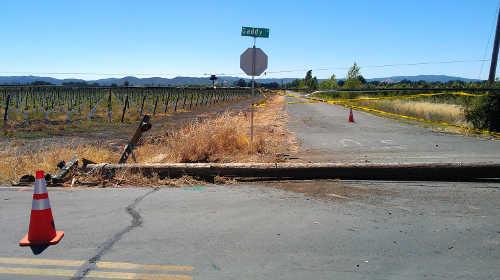
KELSEYVILLE, Calif. – A single-vehicle crash involving a power pole early Friday afternoon sent one person to a regional trauma center with major injuries and resulted in a road closure and power outage.
The crash, involving what initial reports indicated was an SUV, occurred just after 12:30 p.m. in the 4000 block of Gaddy Lane at Loasa Road, according to the California Highway Patrol.
The vehicle was reported to be on its side and in the ditch on the west side of the road, with the pole severed, reports indicated.
A person in the vehicle suffered major injuries, and was transported to a landing zone at Kelseyville High School, where an air ambulance picked the crash victim up and flew them out of county.
Additional details on the crash and the patient were not immediately available early Friday evening.
The roadway was closed temporarily, the CHP reported.
A Pacific Gas and Electric crew remained on scene early Friday evening, working to restore power to about 35 customers whose electricity was knocked out as a result of the crash, according to PG&E spokeswoman Brittany McKannay.
McKannay said the outage started at approximately 1:15 p.m. and it's expected that power will be fully restored Friday evening.
“They always try to restore customers while they’re doing the work if we can,” McKannay said.
Email Elizabeth Larson at