 How to resolve AdBlock issue?
News
LAKE COUNTY, Calif. – A Clearlake woman died early Saturday morning in a single-vehicle crash on Highway 20 near Nice.
The 46-year-old woman's name has not yet been released by the California Highway Patrol pending notification of next of kin.
The CHP said the crash occurred at approximately 3:38 a.m. Saturday on Highway 20 east of Bartlett Springs Road.
The woman was driving a 1993 Oldsmobile Bravada westbound on Highway 20 at an unknown speed when, for unknown reasons, she allowed the vehicle to turn south from her lane of travel, the CHP said.
The Oldsmobile left the roadway, entered a ditch and hit the embankment of the ditch/culvert, according to the CHP report.
The CHP said the woman was not wearing her seatbelt and sustained major injuries.
She was pronounced dead at the scene, the CHP said.
CHP Officer Glen Thomas is investigating the crash, according to the report.
Email Elizabeth Larson at
UPPER LAKE, Calif. – Federal and local officials participated in an operation this week in Upper Lake that resulted in the eradication of hundreds of marijuana plants.
The daylong operation was carried out at the Vann Ranch, located off Elk Mountain Road, beginning early Tuesday morning.
The ranch is owned by Jose Fernandez, 57, known locally as “Hippy Joe.”
Drug Enforcement Administration spokeswoman Casey Rettig told Lake County News that the DEA served a federal search warrant.
She said the DEA was assisted by the Internal Revenue Service; the Bureau of Alcohol, Tobacco, Firearms and Explosives; US Forest Service; California Department of Fish and Wildlife; and the Lake County Sheriff's Office.
Rettig said no arrests were made.
“The search warrant is under court seal. The investigation is ongoing,” she said.
Lt. Steve Brooks of the Lake County Sheriff's Office confirmed to Lake County News that the agency assisted the operation, but didn't initiate it.
As of Friday afternoon, Brooks hadn't received a final report of how many plants had been eradicated.
He said he had received estimates of between 500 and 1,000 plants cut down during the search warrant services.
In a Friday interview with Lake County News, Fernandezsaid there were 11 gardens, each with about 48 plants, on his 1,500-acre ranch. That totals approximately 528 plants.
“I'm just really frustrated,” Fernandez said.
Over the years, Fernandez has become known for contributing to the community, including paying to repaint the Odd Fellows Hall in downtown Upper Lake, holding fundraisers at his ranch – including the May “Fire in the Barn” event – and raising money for the town clock and computers for local schools.
Upper Lake Union Elementary Principal/Superintendent Valerie Gardner acknowledged Fernandez's donation of 15 iPads to the district in a July letter: http://bit.ly/1uAONro .
He said he believes he's being targeted by Sheriff Frank Rivero, who Fernandez has publicly opposed.
Fernandez supported the failed recall effort against Rivero last year and campaigned against him in the run up to the spring primary election, in which voters ousted the one-term sheriff.
He said he has contracts with medical marijuana patients, including disabled veterans, to cover the gardens.
Fernandez, who said he is a disabled veteran, also grows marijuana for his own medical use. He said he prefers it to prescription drugs to deal with grand mal seizures he suffers as a result of a head injury and post traumatic stress disorder from his time in the military.
The operation at his ranch began at around 6 a.m. Tuesday, after Fernandez had left to feed cattle.
He said the agents arrived to find his girlfriend and their 13-month-old daughter. His girlfriend was put in handcuffs – and left that way for hours – and water was cut off to their house, with a residence on the property and his new barn being red-tagged.
The agents cut down every garden, which he maintained were all legal based on medical marijuana recommendations, Fernandez said.
Law enforcement officials left at around 5 p.m. that day, before Fernandez returned home.
In September 2012, Fernandez also was the focus of a raid that resulted in his arrest, the arrests of several other individuals, the eradication of more than 1,100 marijuana plants, the discovery of a hash conversion lab, and the seizure of cash and several pieces of equipment, including a bulldozer, tractor, utility vehicle, dump bed trailer and commercial grade electric generator, as Lake County News has reported.
The lab, some of the plants and equipment reportedly did not belong to Fernandez.
In that case, the Lake County Sheriff’s Narcotics Task Force served the warrants with the assistance of the DEA and a number of federal, state and local agencies.
Fernandez was arrested during that raid for felony conspiracy, possession of marijuana for sale and marijuana cultivation.
He said none of his equipment has ever been returned.
However, District Attorney Don Anderson said Fernandez hasn't yet filed a claim for his property, which should have been done within 30 days of the seizure. Anderson said his office is waiting to see what the DEA will do before pursuing asset forfeiture proceedings.
Anderson said the criminal case against Fernandez resulting from the September 2012 search warrant service hasn't moved forward, but is still pending.
“It hasn't been dropped, it's just under review,” Anderson said, explaining that his office is waiting for additional information from the DEA and the sheriff's office.
Cases involving local and federal agencies can take more time, Anderson said.
In this latest case, federal and local officials have not indicated if further action will be taken against Fernandez.
Email Elizabeth Larson at
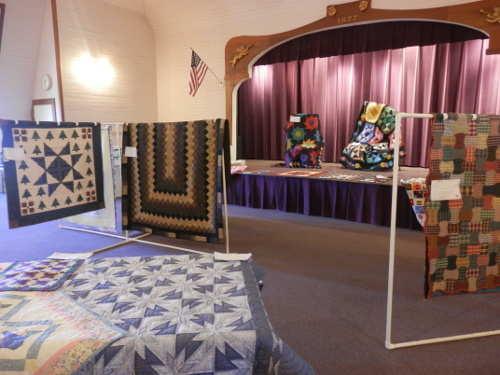
LOWER LAKE, Calif. – The 21st annual Quilt and Textile Arts Exhibition closes Saturday after a four-week run in Weaver Auditorium at the historic Lower Lake Schoolhouse Museum.
The exhibit features artists of the Ladies of the Lake Quilt Guild, Konocti Quilters and textiles by Sheila O'Hara, an internationally recognized weaver, and her students.
“We had a very generous response from some lovely quilters in the county,” Jane Alameda, who coordinated the quilt portion of the show, said, “and the textile exhibit is extraordinary. They really outdid themselves.”
Alameda said more than two dozen quilters are participating in the exhibit.
Displays feature a variety of colors, techniques and patterns and themes from pastel nursery to vibrant holiday.
“We also have an antique quilt in this year's show, with ties to the Middletown area going back to the 1800s,” Alameda said.
Alameda said the quilt was contributed by Marie Strait, of the San Francisco Bay Area, who is descended from early Lake County settlers.
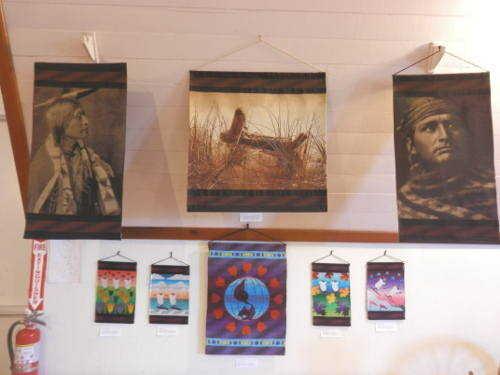
Textile art on display include decorative as well as practical woven pieces by O'Hara and her students: Janis Eckert, Pam Perry, Suzanne Britz, Ellen Hardenburger, Sylvia Anderson, Hana Musgrove, Lorna Rochman-McEntire, Goldie Pitre, Shellie Taylor and Rosalee Littrell.
Table cloths with matching napkins, cozy blankets and fluffy pillows, hats, scarves, creative tapestries and table runners woven with lavender stems fill the exhibit.
Hand-knitted and hand-crocheted items made from hand-spun yarn are also on display.
O'Hara said she wanted to bring awareness to global warming in her tapestry “Birds of a Feather,” which is featured among the textile exhibit.
She said design began with the idea of “global warming” caused by love rather than through bad chemistry.
“I circled our planet Earth with hearts in tune with Mother Nature and the phases of the moon,” O'Hara said. “When I was trying to decide what continents to add to the earth, I remembered a drawing I had come across around 1990 of the eagle the condor.”
O'Hara said the configuration and orientation of the continents is from the indigenous people of South America.

“I had never looked at the continents upside down and in the shapes of birds before,” she said. “The idea is that the North American continent – the eagle – that has guided the Americans with the guided strategizing mind principles, will be united with the compassionate heart principles of South America – the condor, bring all the people of the Americas together in harmony.”
She added, “It would be nice if we could flock together in peace.”
The exhibit has been viewable during regular museum hours, 11 a.m. to 4 p.m. Wednesday through Saturday since Aug. 2.
The event included an artists' reception earlier this month, during which members Sheep Thrills Spinning Guild provided spinning demonstrations.
The exhibit, hosted by the Lower Lake Historic Schoolhouse Preservation Committee, closes at the museum this Saturday.
However, some pieces have been relocated for competition in the Lake County Fair where they will be on display through the close of the fair on Sunday.
Additionally, Ladies of the Lake Quilt Guild is preparing for its 13th annual “Falling Leaves Quilt Show,” to be held Oct. 4 and 5 at the Lake County Fairgrounds in Lakeport.
Visit www.LLQG.org for more information about the annual quilt show.
Email Denise Rockenstein at
California agencies combating the spread of invasive quagga and zebra mussels remind boaters to remain alert over the three-day Labor Day weekend.
People who launch vessels at any body of water are subject to watercraft inspections and are encouraged to clean, drain and dry their motorized and nonmotorized boats, including personal watercraft, and any equipment that comes into contact with the water before and after recreating at a waterway.
“Californians have a unique opportunity to enjoy numerous natural resources,” said California Department of Fish and Wildlife (CDFW) Director Charlton H. Bonham. “Doing your part to clean, drain and dry before heading out to recreate will help keep them free of quagga and zebra mussels, as well as other invasive species.”
Quagga and zebra mussels, non-native freshwater mussels native to Eurasia, multiply quickly and encrust watercraft and infrastructure, and compete for food with native and sport fish species.
These mussels can be spread from one body of water to another by nearly anything that has been in an infested waterbody, or via standing water from an infested waterbody entrapped in boat engines, bilges, live-wells and buckets.
To ensure that watercraft are clean, drained and dry, many local agencies are conducting boat inspections.
CDFW has posted a list of these inspections on its Web site ( www.dfg.ca.gov/invasives/quaggamussel ) along with additional information about the invasive mussels and what people can do to help prevent their spread in California.
Boaters should call ahead to check for restrictions prior to visiting their destination.
To prevent spreading invasive mussels and to breeze through an inspection, boaters can take a few simple steps before arriving at a water body.
These include inspecting all exposed surfaces, removing all plants and organisms, draining all water, including water contained in lower outboard units, live-wells and bait buckets, and allowing the watercraft to thoroughly dry.
Between launches watercraft should be kept dry for at least five days in warm weather and up to 30 days in cool weather. These measures are essential to safeguard California waterways.
CDFW has developed a brief video demonstrating the ease of implementing the clean, drain and dry prevention method, which can be viewed above.
In addition, a detailed guide to cleaning vessels of invasive mussels is available on the California State Parks Division of Boating and Waterways (DBW) Web site at http://dbw.parks.ca.gov/BoaterInfo/QuaggaLoc.aspx .
Travelers are also advised to be prepared for inspections at California Department of Food and Agriculture Border Protection Stations. Inspections, which can also be conducted by CDFW and the Department of Parks and Recreation, include a check of boats and personal watercraft, as well as trailers and all onboard items. Contaminated vessels and equipment are subject to quarantine or impoundment.
Quagga mussels were first detected in the Colorado River system in January 2007 and were later found in San Diego and Riverside counties. They are now known to be in 29 waters in California, all in Southern California.
Zebra mussels were discovered in San Justo Reservoir in San Benito County in January 2008.
Both species can attach to and damage virtually any submerged surface. They can:
– Ruin a boat engine by blocking the cooling system and causing it to overheat;
– Jam a boat’s steering equipment, putting occupants and others at risk;
– Require frequent scraping and repainting of boat hulls;
– Colonize all underwater substrates such as boat ramps, docks, lines and other underwater surfaces, causing them to require constant cleaning;
– Cost the owners of these items a lot of money.
A multi-agency effort that includes CDFW, DBW, the Department of Water Resources, and the Department of Food and Agriculture has been leading an outreach campaign to alert the public to the quagga and zebra mussel threats.
A toll-free hotline at 1-866-440-9530 is available for those seeking information on quagga or zebra mussels.
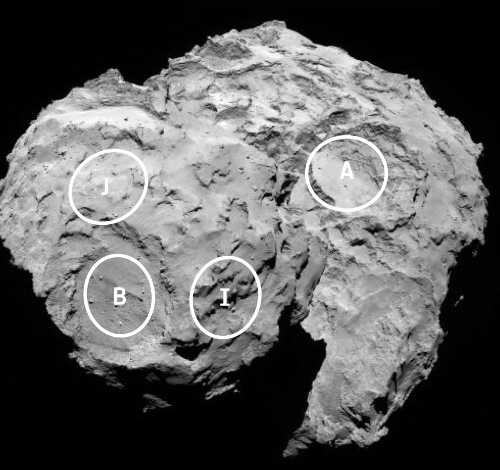
The European Space Agency's Rosetta mission has chosen five candidate landing sites on comet 67P/Churyumov-Gerasimenko for its Philae lander.
Philae's descent to the comet's nucleus, scheduled for this November, will be the first such landing ever attempted.
“This is the first time landing sites on a comet have been considered,” said Stephan Ulamec, Philae Lander Manager at the German Aerospace Center, Cologne, Germany. “The candidate sites that we want to follow up for further analysis are thought to be technically feasible on the basis of a preliminary analysis of flight dynamics and other key issues – for example, they all provide at least six hours of daylight per comet rotation and offer some flat terrain. Of course, every site has the potential for unique scientific discoveries.”
For each possible zone, important questions must be asked: Will the lander be able to maintain regular communications with Rosetta? How common are surface hazards such as large boulders, deep crevasses or steep slopes? Is there sufficient illumination for scientific operations and enough sunlight to recharge the lander’s batteries beyond its initial 64-hour lifetime without causing overheating?
The potential landing sites were assigned a letter from an original pre-selection of 10 possible sites, which does not signify any ranking. Three sites (B, I and J) are located on the smaller of the two lobes of the comet and two sites (A and C) are located on the larger lobe.
“The process of selecting a landing site is extremely complex and dynamic; as we get closer to the comet, we will see more and more details, which will influence the final decision on where and when we can land,” said Fred Jansen, Rosetta's mission manager from the European Space Agency's Science and Technology Centre in Noordwijk, The Netherlands. “We had to complete our preliminary analysis on candidate sites very quickly after arriving at the comet, and now we have just a few more weeks to determine the primary site. The clock is ticking and we now have to meet the challenge to pick the best possible landing site.”
The next step in preparation for landing operations is a comprehensive analysis of each of the candidate sites, to determine possible orbital and operational strategies that could be used for Rosetta to deliver the lander to any of them.
At the same time, Rosetta will move to within 31 miles (50 kilometers) of the comet, allowing a more detailed study of the proposed landing sites. By September 14, the five candidate sites will have been assessed and ranked, leading to the selection of a primary landing site.
A fully detailed strategy for the landing operations at the selected site will be developed, along with a backup.
The landing of Philae is expected to take place in mid-November when the comet is about 280 million miles (450 million kilometers) from the sun.
This will be before activity on the comet reaches levels that might jeopardize the safe and accurate deployment of Philae to the comet’s surface, and before surface material is modified by this cometary activity.
Rosetta is an international mission spearheaded by the European Space Agency with support and instruments provided by NASA.
For more information on the U.S. instruments aboard Rosetta, visit: http://rosetta.jpl.nasa.gov . The ESA's Rosetta home page is at http://www.esa.int/rosetta .
Dr. Tony Phillips works for the National Aeronautics and Space Administration.
HIDDEN VALLEY LAKE, Calif. – A young Hidden Valley Lake man who officials said was injured in a bicycle crash last weekend has died.
Lt. Steve Brooks of the Lake County Sheriff's Office confirmed that 21-year-old Daniel Renninger died earlier this week.
Brooks said the cause of Renninger's death is pending investigation.
The California Highway Patrol said Renninger is believed to have been injured in a bicycle crash that occurred on Deer Hill Road in Hidden Valley Lake at around 1:45 a.m. last Saturday, as Lake County News has reported.
He was flown to Vacaville Kaiser Hospital for treatment of major head trauma, which had caused him to become unresponsive and go into convulsions, the CHP said.
While Renninger died in Solano County, the jurisdiction over the case was transferred to the Lake County Sheriff's Office, the Solano County Coroner's Office told Lake County News on Thursday.
CHP Officer Kory Reynolds told Lake County News that the incident believed to have injured Renninger is still under investigation.
The CHP asks that any witnesses to the incident call the Clear Lake Area CHP office at 707-279-0103.
Email Elizabeth Larson at