 How to resolve AdBlock issue?
News
LAKE COUNTY, Calif. – Grab your lawn chairs, preferably ones that allow you to recline.
The Leonid meteor shower begins late in the evening of Monday, Nov. 17, and continues into the morning of Tuesday, Nov. 18.
The best place to watch is from a dark location. Try to look at a broad expanse of night sky, since the meteors will appear to come from many different directions.
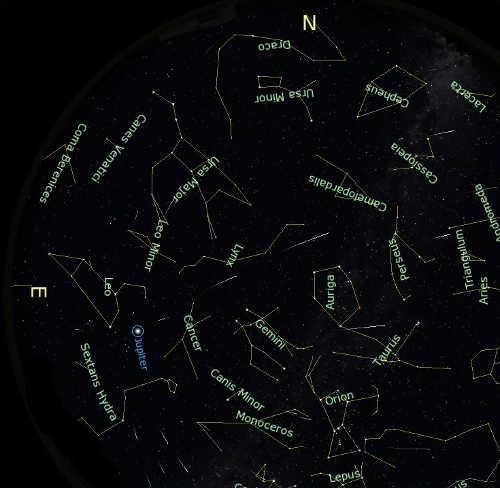
The origin of the Leonids is from the constellation Leo the Lion. Leo rises after midnight, and by 3 a.m. is visible in the eastern morning sky.
There should be an average of 10 to 15 meteors per hour.
The Leonids shower is caused by the earth passing through the dust and debris left by comet Tempel-Tuttle.
While you are looking for meteors in the wee hours of the morning, the planet Jupiter will become visible in the east near Leo around 2 a.m. It’s the brightest object in the night sky next to the moon.
If staying up late to see a meteor shower just isn’t your thing, there is more to see in November in the evening.
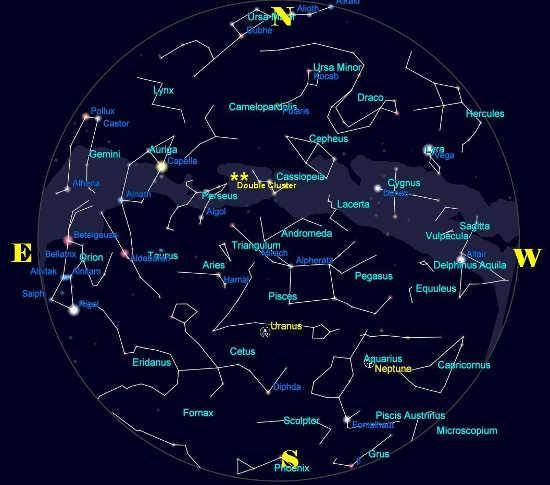
Perseus is a beautiful constellation visible in the northern part of the sky.
Perseus was a hero in Greek mythology who beheaded the monster Medusa and saved the beautiful princess Andromeda.
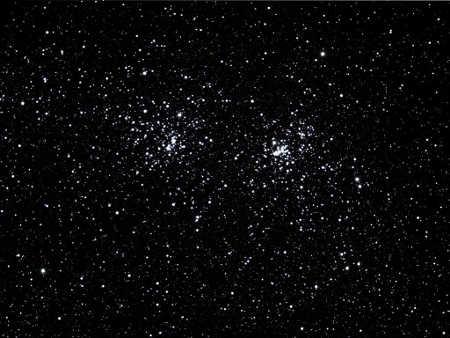
Perseus has one of the night sky’s most glorious objects, the Double Cluster. Our star chart shows the location of this object.
The Double Cluster is two star clusters visible at low power in a telescope.
Both clusters are approaching the earth at a speed of 24 miles per second.
But fear not! At a distance of 7,500 light years, it would take millions of years before the clusters enveloped the Earth.
John Zimmerman is a resident of Lake County, Calif., and has been an amateur astronomer for more than 50 years. For more information about astronomy and local resources, visit his Web site at www.lakecountyskies.com .
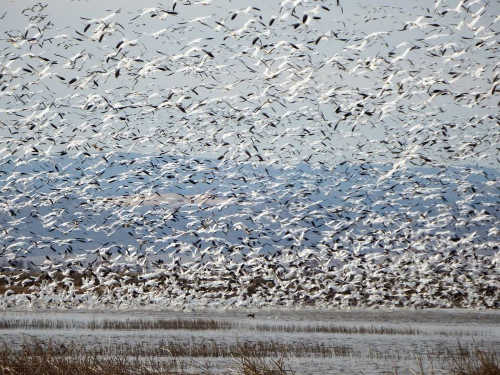
NORTHERN CALIFORNIA – The Central Valley, from Red Bluff through Bakersfield, is part of the 4,000-mile Pacific Flyway, the route taken by migrating birds from Alaska to Patagonia (at the southern end of South America).
This time of year our local region gets visited by a huge influx of Aleutian Geese, snow geese, white fronted geese, and bufflehead and northern pintails ducks, to name just a few, so this is the best time to grab your cameras and head out to your local wetlands areas.
The Pacific Flyway contains 60 percent of the habitat critical to wintering waterfowl in the region – and our area is ranked No. 2 on the list of the 25 most important and threatened waterfowl habitats in the entire continent.
So, being able to see these magnificent birds is a real treat and everyone should take advantage of the opportunity to see them.
Other migratory birds seen around this time of year include the American Wigeon, cinnamon teal ducks, canvasback ducks, and the American Coot.
Keep in mind, too, that the Berryessa Snow Mountain region is home to the second largest wintering population of bald eagles in the country.
Snow geese (Chen caerulescens) are sometimes also referred to as “blue geese” because there are two color morphs: the all-white version, and a blue-gray version.
It is the white morph that is most common in this region. They’re easily identifiable: an all-white body and wings with black wing tips. They also have rosy feet and legs, and pink bills with black tomia (the cutting edges of the bill).
Snow geese fly, eat and nest in large gatherings, and their numbers are on the rise (increasing about 5 percent each year according to some studies). They like to forage on fall grain – including wheat and rice – when they can find it.
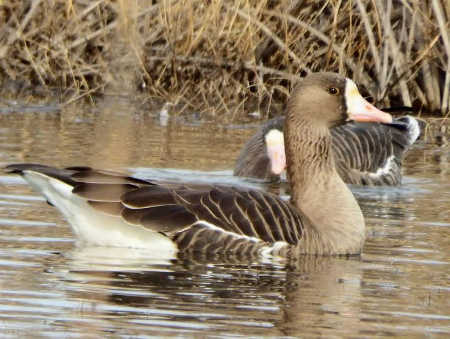
The white-fronted goose (Anser albifrons) is another species of goose that winters here in our area in large numbers.
Unlike the white snow goose, the white-fronted goose is grayish brown with a speckled chest and a patch of light (usually white) feathers that borders the base of its bills.
They have bright orange legs and feet, and their bills are orange as well. White-fronted geese populations are affected greatly by weather conditions in their Arctic nesting areas.
If it stays cold for too long, or there’s a sudden spring snow storm, the hatcheries can suffer great losses. Still, in 2010 their populations numbered between 600,000 and 700,000 individuals. These geese prefer a diet of grains, seeds, grasses and berries.
Buffleheads (Bucephala albeola) are small sea ducks with golden-yellow eyes. Females are gray are a white patch behind the eye, but the males are especially striking: black and white overall with a shiny iridescent purple and green head and large white blotch behind the eyes. When they puff out their head feathers, their “buffalo”-like heads take on a very distinct oddly bulbous shape.
Oddly enough, too, buffleheads evolved over time into their smaller size so they could fit into their favorite nesting cavities: the nesting holes made by northern flickers.
In ecological circles this ability to benefit from a host without affecting the host is called a “metabiotic” relationship. Buffleheads are “diving” ducks, and usually forage on whatever insects, aquatic plants and fish eggs they can find.
The pintail (Anas acuta) is a species of duck with a very large range (including Europe, Asia and the United States). These ducks are larger than the buffleheads, but like the male buffleheads the male pintails are very handsome.
Their chocolate-colored heads have a bright white strip running down them from the back of the head to the chest, and the male’s central tail feathers are especially elongated (giving rise to its name “pintail”).
The male pintails also whistle – which is almost flute-like – while the drab-colored females have a harsh quack. Both males and females have gray legs and feet, and their bills are blue-gray. Like all dabbling ducks, pintails feed on plants and invertebrates in the water.
You can see many of these birds at your local wetland/wildlife preserves including the Cache Creek Nature Preserve, the Yolo Bypass Wildlife Area, the Sacramento National Wildlife Preserve and the Cosumnes River Preserve.
Bring your binoculars, spotting scopes and cameras and take lots of photos while the migration season lasts.
Tuleyome Tales is a monthly publication of Tuleyome, a nonprofit conservation organization based in Woodland and Napa, Calif. For more information about Tuleyome go to www.tuleyome.org . Mary K. Hanson is an amateur naturalist and photographer and author of The Chubby Woman’s Walkabout blog.
CLEARLAKE, Calif. – Organizers already are at work, preparing for Clearlake's annual Christmas celebration.
The event, featuring the city's popular parade, begins at 6 p.m. Saturday, Dec. 6.
The parade leads from Redbud Park to Austin Park on Lakeshore Drive.
This year's theme is “Jingle Bells” and participants of all ages are being sought.
Trophies will be awarded to the top three entries.
Participants are prohibited from throwing candy and other treats into the crowd; however, walkers may hand items to spectators. Those taking part also must adhere to other safety precautions.
The parade will culminate with the annual tree lighting ceremony at Austin Park, where Santa and Mrs. Claus will be waiting to take pictures with all the children.
Photos will be available for purchase will all proceeds supporting area foster care programs.
Entry forms are available at Clearlake City Hall and Four Corners Building Supply.
There is no cost to participate.
For more information, contact Vicki Leonard at 707-994-5922.
Email Denise Rockenstein at
With Daylight Savings Time set to end on Sunday, Cal Fire is once again encouraging Californians to check that smoke alarms are in working order.
Daylight Savings Time this year ends at 2 a.m. Sunday. Cal Fire typically issues the smoke alarm reminders in the spring and fall, when the time changes occur.
Nearly two-thirds of home fire deaths result from fires in homes with no working smoke alarms.
To help reduce your chances of becoming a victim, Cal Fire is reminding all Californians to make sure they have working smoke alarms in their homes.
A little attention to these devices goes a long way to increasing your chance of surviving a devastating fire, the agency said.
“When a fire strikes, a working smoke alarm gives you that valuable warning that could save your life,” advises State Fire Marshal Tonya Hoover.
Smoke alarm safety tips:
– Place properly installed and maintained smoke alarms both inside and outside of sleeping areas and on every level of your home.
– Interconnected smoke alarms are best, because if one sounds, they all sound.
– Get smoke alarms that can sound fast to all types of fires. Cal Fire recommends that every residence and place where people sleep be equipped with ionization and photoelectric smoke alarms or dual sensor smoke alarms, which contain both ionization and photoelectric smoke sensors.
– Inspect, test and clean smoke alarms and change alkaline batteries at least once every year, or when the alarm signals (“chirps”) the end of the battery life. You can use a date you already know, like your birthday or when you change your clocks as a reminder.
– Follow manufacturer’s instructions if you have a 10-year smoke alarm which uses a long-life lithium battery.
– Never paint over a smoke alarm.
– Replace your smoke alarm at least every 10 years.
– Practice exit drills so everyone understands what to do when they hear a smoke alarm.
Keep your smoke alarm working. Cal Fire urged residents to never remove the batteries from their smoke alarms.
For more information on smoke alarms, visit www.fire.ca.gov .
Leaving an inheritance outright to a minor raises various concerns.
Let us consider some important concerns and possible solutions.
A frequent concern is that anything left to a minor may be taken away and used by a self-serving parent.
For example, consider a couple who names their now single daughter’s children as alternative death beneficiaries should the daughter not be alive to inherit.
The daughter’s parents are concerned that their ex-son in law, whom they distrust with good reason, will do his best to get control over any inheritances that pass to his children (from the grandparents).
How can this be prevented?
The best way to prevent this is to provide that the grandchildren’s inheritances will be held in further trust, or else, if the amount is relatively modest, be held at a bank in a custodial account, under the control of a trustworthy relative, friend, or private fiduciary as trustee or custodian, as relevant.
In the example, this would protect the inheritance against the grandchildren’s predatory father.
Another concern is that anything left to a minor will be wasted or abused by the minor as soon as he or she get their hands on it.
Leaving the assets in trust with express goals and uses allows the trust to purposefully further worthwhile goals.
For example, the trust may allow the trustee to pay for the child’s college tuition, room and board and perhaps a stipend so long as the beneficiary maintains at least a “B” average and carries a full course load.
The trust encourages the beneficiary to pursue college but prevents him or her from becoming lazy and uninterested in his or her own responsibilities.
Further concerns are “when”, “how” and even “if” the minor receive outright inheritance distributions.
Should inheritances be distributed in stages or all at once upon attaining a certain age? At what age should distributions occur?
There is no single answer. Some trusts distribute everything once the beneficiary attains a certain age (say, 21 or 25), others distribute in stages (e.g., a third at age 21, half at age 25, and the rest at age 30), and still other trusts hold everything in trust for the beneficiary’s lifetime.
Trusts that hold assets up to the beneficiary’s entire lifetime are usually discretionary trusts created to protect the assets from creditors.
Discretionary trusts give the trustee absolute discretion over if, when and how assets should be used for the beneficiary’s benefit.
Special needs trusts, for example, are completely discretionary trusts. The trustee may, but does not have to, use the assets to pay for the comforts of life that are not provided for by welfare benefits (SSI and Medi-Cal) while preserving eligibility for such needs based benefits.
Other discretionary trusts serve simply to protect the assets against the beneficiary’s own creditors. If the beneficiary cannot demand distribution of the assets then neither can his or her own creditors (limited special exceptions, including one for the unpaid child support owed by the beneficiary).
Such discretionary trusts allow the trustee to make purchases and payments on behalf of the beneficiary without directly depositing money into the beneficiary's own account, where creditors can get at it.
Lastly, what if minors depend on their parent’s or guardian’s estate being kept intact – instead of sold and divided – how can they be protected when their parent dies?
A so-called “family pot trust” allows the trustee to keep the parents’ estate undivided in order to provide any dependent children with a home.
Once the last dependent has reached a milestone (usually age 21 or 25) then the trust assets are sold, and typically divided equally amongst the adult children.
Dennis A. Fordham, attorney (LL.M. tax studies), is a State Bar Certified Specialist in Estate Planning, Probate and Trust Law. His office is at 870 S. Main St., Lakeport, California. Fordham can be reached by e-mail at

As the European Space Agency prepares to drop a lander on Comet 67P/Churyumov-Gerasimenko on Nov. 12th, the comet is showing signs of increased activity.
Images of the comet nucleus, taken by Rosetta earlier in the summer, showed that the distinct jets of dust and gas emanating from the comet were originated from the neck region, which connects the comet's two lobes. Images obtained by OSIRIS (Rosetta's Optical, Spectroscopic, and Infrared Remote Imaging System) now show jets of dust along almost the entire length of the comet.
Rosetta and comet 67P are still more than 280 million miles (450 million kilometers) from the sun.
Based on a rich history of ground-based observations, scientists have been expecting the comet's activity to pick up noticeably once it comes within 186 million miles (300 million kilometers).
On Nov. 12, the Rosetta spacecraft will release its Philae lander at 3:03 a.m. EST / 1:03 a.m. PST (Earth Receive Time).
Touchdown of Philae on Site J is expected about seven hours later, at around 11 a.m. EST / 8 a.m. PST.
Rosetta is the first mission to attempt a soft landing on a comet.
While 67P's overall activity is clearly increasing, the mission's designated landing site, "J," located on the head of the comet, still seems to be rather quiet.
However, there is some indication that new active areas are waking up about half a mile (one kilometer) from J. These will allow the lander's instruments to study the comet's activity from an even closer distance.
Launched in March 2004, Rosetta was reactivated in January 2014 after a record 957 days in hibernation.
Composed of an orbiter and lander, Rosetta's objectives since arriving at comet 67P/Churyumov-Gerasimenko earlier this month have been to study the celestial object up close in unprecedented detail, prepare for landing a probe on the comet's nucleus in November and, following the landing, track the comet's changes as it sweeps past the sun.
Rosetta is a European Space Agency mission with contributions from its member states and NASA. Rosetta's Philae lander is provided by a consortium led by the German Aerospace Center, Cologne; Max Planck Institute for Solar System Research, Gottingen; National Center of Space Studies of France, Paris; and the Italian Space Agency, Rome. NASA's Jet Propulsion Laboratory in Pasadena, California, a division of the California Institute of Technology, manages the U.S. participation in the Rosetta mission for NASA's Science Mission Directorate in Washington.
Dr. Tony Phillips works for the National Aeronautics and Space Administration.