 How to resolve AdBlock issue?
News
LAKE COUNTY, Calif. – Lake County Animal Care and Control has a dozen dogs of varying sizes and breeds needing new homes this week.
Dogs available for adoption are mixes of cattle dog, Chihuahua, Doberman, English Bulldog, pit bull, Rhodesian Ridgeback, Shar Pei and shepherd.
Dogs that are adopted from Lake County Animal Care and Control are either neutered or spayed, microchipped and, if old enough, given a rabies shot and county license before being released to their new owner. License fees do not apply to residents of the cities of Lakeport or Clearlake.
If you're looking for a new companion, visit the shelter. There are many great pets hoping you'll choose them.
In addition to the animals featured here, all adoptable animals in Lake County can be seen here: http://bit.ly/Z6xHMb .
The following dogs at the Lake County Animal Care and Control shelter have been cleared for adoption (additional dogs on the animal control Web site not listed are still “on hold”).

Chihuahua mix
This male Chihuahua mix is 6 years old.
He weighs 5.4 pounds and will be neutered when he is adopted.
He's in kennel No. 4, ID No. 1751.

Pit bull terrier mix
This handsome male pit bull terrier mix has a short tan and white coat.
He is about 2 years old and weighs 70 pounds. He was found in the Kelseyville area as a stray.
Shelter staff said he loves people and can't wait to be in a new home.
He's in kennel No. 6, ID No. 1664.
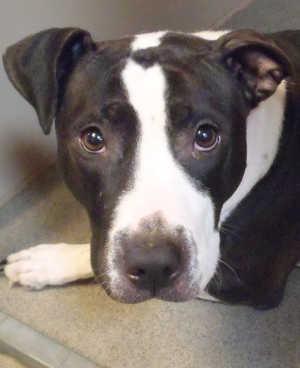
'Baby'
“Baby” is a female pit bull terrier mix.
She has a short black and white coat.
She's in kennel No. 7, ID No. 1763.

'Copper'
“Copper” is a young male pit bull terrier mix.
He has a short red and white coat, and already has been neutered, so he has a low adoption fee.
Copper is in kennel No. 8, ID No. 1738.
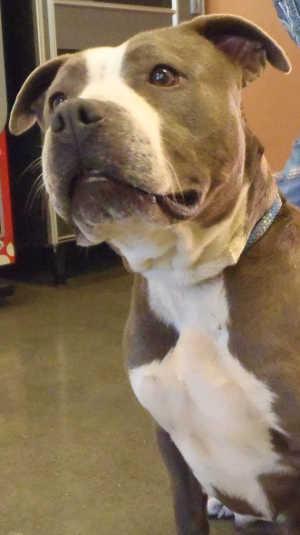
Pit bull terrier mix
This female pit bull terrier mix has a pretty face and a short gray and white coat.
She's 2 years old and weighs 53 pounds.
Found as a stay, she is friendly loves to play with other dogs, male or female. Shelter staff doesn't recommend her for a home with cats, but she has no food guarding issues.
She's in kennel No. 9, ID No. 1663.
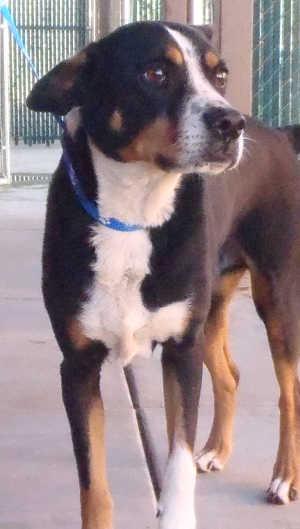
'Snoopy'
“Snoopy” is a 10-year-old male shepherd mix looking for a mellow home.
He weighs nearly 50 pounds and has a short tricolor coat.
He has a low adoption fee as he is already neutered.
Snoopy loves people, and he gets along with low energy dogs because in the past he was attacked by another dog.
If you have dogs and are interested in Snoopy, shelter staff requests that an application to be filled out and bring your dogs for a meet and greet
He's in kennel No. 12, ID No. 1650.

Shar Pei-pit bull mix
This 6-month-old male Shar Pei-pit bull mix has a short, dark-colored coat.
Shelter staff said he's very intelligent and energetic.
He gets along with both male and female dogs, and loves to play. He's not recommended for a home with cats and could use some training.
He's in kennel No. 17, ID No. 1684.
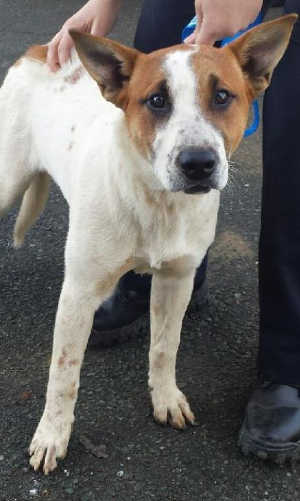
Cattle dog mix
This young male cattle dog mix has a short white coat with reddish-brown markings.
He is in kennel No. 26a, ID No. 1722.
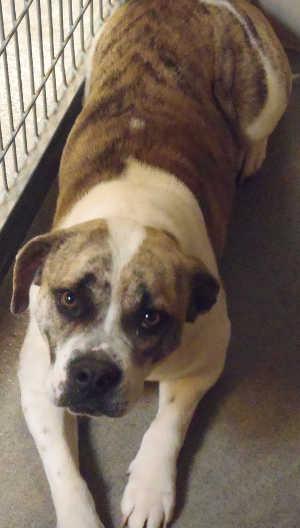
English Bulldog mix
This female English Bulldog mix has white and brown brindle markings on a short coat.
She's in kennel No. 31, ID No. 1734.
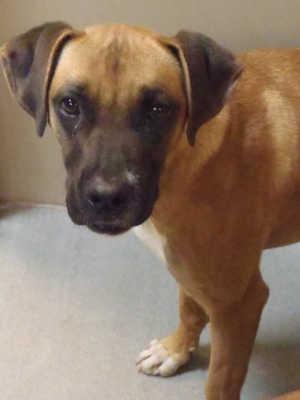
Rhodesian Ridgeback mix
This female Rhodesian Ridgeback mix has a short brown coat and black markings.
She's in kennel No. 32a, ID No. 1757.
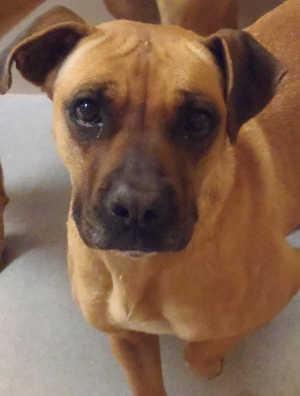
Rhodesian Ridgeback mix
This male Rhodesian Ridgeback mix has a short brown coat and black markings.
He's in kennel No. 32b, ID No. 1762.
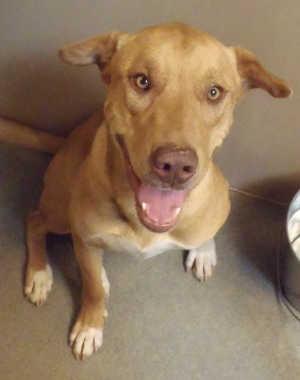
'Mel'
“Mel” is a male Doberman Pinscher-Shar Pei mix.
He has a short brown and white coat.
He's in kennel No. 33a, ID No. 1718.
To fill out an adoption application online visit http://www.co.lake.ca.us/Government/Directory/Animal_Care_And_Control/Adopt/Dog___Cat_Adoption_Application.htm .
Lake County Animal Care and Control is located at 4949 Helbush in Lakeport, next to the Hill Road Correctional Facility.
Office hours are Monday through Friday, 11 a.m. to 5 p.m., and 11 a.m. to 3 p.m., Saturday. The shelter is open from 11 a.m. to 4 p.m. Monday through Friday and on Saturday from 11 a.m. to 3 p.m.
Visit the shelter online at http://www.co.lake.ca.us/Government/Directory/Animal_Care_And_Control.htm .
For more information call Lake County Animal Care and Control at 707-263-0278.
Email Elizabeth Larson at
NORTHERN CALIFORNIA – A woman whose body was found in the surf on a beach near Jenner on Feb. 7 has been identified.
The Sonoma County Sheriff Coroner’s Office said the woman has been identified as Janelle Patrice McGovern, 30, of Santa Rosa. Her family was located and informed of her death.
The agency last week had asked for the community's help in identifying McGovern, whose body had been found in an area known as Driftwood Beach on the north side of the mouth of the Russian River, as Lake County News has reported.
The Sonoma County Sheriff’s Office Violent Crimes Investigations Unit will conduct the preliminary investigation into the circumstances surrounding McGovern's death.
The Sonoma County Coroner Office is conducting a parallel investigation to determine the cause and manner of her death.
There is no information indicating that McGovern had been the victim of foul play or that the circumstances surrounding her death were suspicious, officials said.
Droughts in the U.S. Southwest and Central Plains during the last half of this century could be drier and longer than drought conditions seen in those regions in the last 1,000 years, according to a new NASA study.
The study, published Thursday in the journal Science Advances, is based on projections from several climate models, including one sponsored by NASA.
The research found continued increases in human-produced greenhouse gas emissions drives up the risk of severe droughts in these regions.
“Natural droughts like the 1930s Dust Bowl and the current drought in the Southwest have historically lasted maybe a decade or a little less,” said Ben Cook, climate scientist at NASA's Goddard Institute for Space Studies and the Lamont-Doherty Earth Observatory at Columbia University in New York City, and lead author of the study. “What these results are saying is we're going to get a drought similar to those events, but it is probably going to last at least 30 to 35 years.”
According to Cook, the current likelihood of a megadrought, a drought lasting more than three decades, is 12 percent.
If greenhouse gas emissions stop increasing in the mid-21st century, Cook and his colleagues project the likelihood of megadrought to reach more than 60 percent.
However, if greenhouse gas emissions continue to increase along current trajectories throughout the 21st century, there is an 80 percent likelihood of a decades-long megadrought in the Southwest and Central Plains between the years 2050 and 2099.
The scientists analyzed a drought severity index and two soil moisture data sets from 17 climate models that were run for both emissions scenarios.
The high emissions scenario projects the equivalent of an atmospheric carbon dioxide concentration of 1,370 parts per million (ppm) by 2100, while the moderate emissions scenario projects the equivalent of 650 ppm by 2100. Currently, the atmosphere contains 400 ppm of CO2.
In the Southwest, climate change would likely cause reduced rainfall and increased temperatures that will evaporate more water from the soil. In the Central Plains, drying would largely be caused by the same temperature-driven increase in evaporation.
The Fifth Assessment Report, issued by the United Nations Intergovernmental Panel on Climate Change (IPCC) in 2013, synthesized the available scientific studies and reported that increases in evaporation over arid lands are likely throughout the 21st century. But the IPCC report had low confidence in projected changes to soil moisture, one of the main indicators of drought.
Until this study, much of the previous research included analysis of only one drought indicator and results from fewer climate models, Cook said, making this a more robust drought projection than any previously published.
“What I think really stands out in the paper is the consistency between different metrics of soil moisture and the findings across all the different climate models,” said Kevin Anchukaitis, a climate scientist at the Woods Hole Oceanographic Institution in Woods Hole, Massachusetts, who was not involved in the study. “It is rare to see all signs pointing so unwaveringly toward the same result, in this case a highly elevated risk of future megadroughts in the United States.”
This study also is the first to compare future drought projections directly to drought records from the last 1,000 years.
“We can't really understand the full variability and the full dynamics of drought over western North America by focusing only on the last century or so,” Cook said. “We have to go to the paleoclimate record, looking at these much longer timescales, when much more extreme and extensive drought events happened, to really come up with an appreciation for the full potential drought dynamics in the system.”
Modern measurements of drought indicators go back about 150 years. Cook and his colleagues used a well-established tree-ring database to study older droughts.
Centuries-old trees allow a look back into the distant past. Tree species like oak and bristle cone pines grow more in wet years, leaving wider rings, and vice versa for drought years.
By comparing the modern drought measurements to tree rings in the 20th century for a baseline, the tree rings can be used to establish moisture conditions over the past 1,000 years.
The scientists were interested in megadroughts that took place between 1100 and 1300 in North America. These medieval-period droughts, on a year-to-year basis, were no worse than droughts seen in the recent past. But they lasted, in some cases, 30 to 50 years.
When these past megadroughts are compared side-by-side with computer model projections of the 21st century, both the moderate and business-as-usual emissions scenarios are drier, and the risk of droughts lasting 30 years or longer increases significantly.
Connecting the past, present and future in this way shows that 21st century droughts in the region are likely to be even worse than those seen in medieval times, according to Anchukaitis.
“Those droughts had profound ramifications for societies living in North America at the time. These findings require us to think about how we would adapt if even more severe droughts lasting over a decade were to occur in our future,” Anchukaitis said.
NASA monitors Earth's vital signs from land, air and space with a fleet of satellites and ambitious airborne and ground-based observation campaigns.
NASA develops new ways to observe and study Earth's interconnected natural systems with long-term data records and computer analysis tools to better see how our planet is changing.
The agency shares this unique knowledge with the global community and works with institutions in the United States and around the world that contribute to understanding and protecting our home planet.
For more information about NASA's Earth science activities, visit www.nasa.gov/earthrightnow .

MIDDLETOWN, Calif. – Authorities are searching an area near Middletown for a local man whose family reported him missing Saturday afternoon.
Mark Albee, 58, of Hidden Valley Lake was last seen by family at around 8:30 a.m. Saturday, according to his daughter, Michelle Smith.
Sheriff Brian Martin said the sheriff's office received a report at about 1:30 p.m. from Albee's wife, who had gotten a “concerning message” from Albee.
“So there's some concern for his state of mind,” Martin said.
Martin said Albee's pickup was found in an area near a shallow creek on the Coyote Grade on Highway 29.
That area, Martin said, is now the focus of a search operation.
Smith described her father's pickup as a burgundy 1997 to 2000 model Ford Ranger crew cab with a matching burgundy camper shell. She said his pickup had already been returned to his home by authorities by Saturday evening.
Lake County Search and Rescue and sheriff's personnel are on scene, with Martin reporting that a helicopter has been called in from Napa County to assist with the search effort.
He said the search will continue through the night – or until Albee is found.
The California Highway Patrol reported that officials wanted traffic to slow down in the search area, located south of Hofacker Lane near mile post marker 12.87.
Smith said cones had been set out but no traffic control is in effect.
Albee has health issues and has been depressed. His daughter said he's never left home like this before.
Smith described her father as being around 5 feet 8 inches tall, weighing 130 to 150 pounds, with short brown, graying hair and a short gray beard. He has a tattoo of a lever on his right hand.
Anyone with information should call Lake County Central Dispatch at 707-263-2690.
Email Elizabeth Larson at
KELSEYVILLE, Calif. – The annual Lake County Polar Plunge for Special Olympics Northern California will take place on Saturday, Feb. 21.
The event will once again be held at Lakeside County Park, 1985 Park Drive in Kelseyville.
Registration is from 10:45 to 11:45 a.m., with the costume contest at 11:45 a.m. and the plunge at noon.
The post-plunge party will take place at 12:30 p.m. at the Kelseyville Lions Club, 4335 Sylar Lane.
The plunge is a unique opportunity for individuals, organizations and businesses to support Lake County's Special Olympics athletes by jumping into icy, cold Clear Lake.
Plungers must raise a minimum of $125 in donations to participate.
If you don't want to plunge but want to help, you can register as a “chicken” and be excused from plunging.
Participants can register and set up their own personal or team Web page ate www.polarplungenorcalnv.com/kelseyville .
You can set up your own Web page and email family, friends and coworkers to support your plunge.
A $125 donation earns you a Polar Plunge hooded sweatshirt and free admittance to the post-plunge party. There are more incentive prizes at the $300, $600 and $2,500 levels. People registered as chickens at the same levels also are eligible to receive the prizes.
Special Olympics provides free year-round sports training and competition opportunities for children and adults with intellectual disabilities.
By participating in Special Olympics, athletes gain self-confidence and self-esteem that carries over into their everyday lives, giving them the opportunity to be contributing members of the local community.
All money raised will support Lake County athletes.
This is Lake County Special Olympics' only sources of funding; they receive no government dollars.
For more information about the Polar Plunge, contact Steve or Peggy Buchholz at 707-279-4280 or
Donations may be sent to Lake County Special Olympics, P.O. Box 94, Lakeport, CA 95453.
General information about the Polar Plunge can be found at http://www.polarplungenorcalnv.com/faqs/ .
If you'd like to support a local team, information about teams is available at http://kelseyville.kintera.org/faf/search/searchTeam.asp?ievent=1124181&lis=1&kntae1124181=836693ED440642B6876EFD2627A0C8A4 .
NORTHERN CALIFORNIA – Assemblyman Bill Dodd (D-Napa) has been appointed chair of the Assembly Select Committee on Wine by Assembly Speaker Toni G. Atkins.
The Select Committee on Wine is a bipartisan committee that examines the diverse issues affecting California’s wine industry.
“I want to thank Speaker Atkins for appointing me to chair this important committee,” Assemblyman Dodd said, “The wine industry is a crucial economic driver for our region and the state as a whole. As chair, I will ensure the committee looks at the challenges facing our wine industry and works to identify pragmatic solutions.”
California makes 90 percent of all the wine produced in the United States.
The California wine industry has an economic impact of more than $61 billion to the state and creates upwards of 330,000 jobs.
The wine industry also is an essential part of California tourism, bringing in upwards of 20 million tourists annually.
Wine produced in the Fourth Assembly District, which includes all or portions of Yolo, Napa, Sonoma, Lake, Solano and Colusa counties, represents a significant percentage of all the wine produced in the United States, and billions of dollars in economic activity.
Wineries in this district are a particularly integral part of local tourism, accounting for more than half of all tourists spending on wine throughout all of California.
“Assemblymember Dodd’s appointment to chair the Assembly Select Committee on Wine reflects the increasing importance of the wine industry to the state’s economy, as well as the leadership role that the North Coast region plays within the industry,” said Debra Sommerfield, president of the Lake County Winegrape Commission, a marketing order established in 1991 to promote the region’s premium winegrapes and assist winegrape growers through marketing, research, and educational programs.
“In Lake County alone, the wine industry directly employs more than 925 people in a range of positions including vineyard workers, winemakers, hospitality professionals, accounting and compliance administrators, and sales and marketing professionals. In addition, the industry supports an additional 1,000 local jobs in other industries,” Sommerfield said.
The appointment places Dodd in a position to lead of one of the most important committees impacting the economic stability of the Fourth Assembly District.
“As the committee chair, I’m eager to work with both sides of the aisle in hopes that we can keep this industry flourishing.” said Dodd. “The committee will review crucial issues, such as the impact of the ongoing drought on winegrape growers, innovation in environmental sustainability, and competitiveness in a global marketplace.”
Dodd was elected to the Assembly in November and served in local government for 14 years.
He has significant experience in advancing policies that preserve agriculture and open space, and has served in leadership roles promoting California wines internationally.