How to resolve AdBlock issue?
News
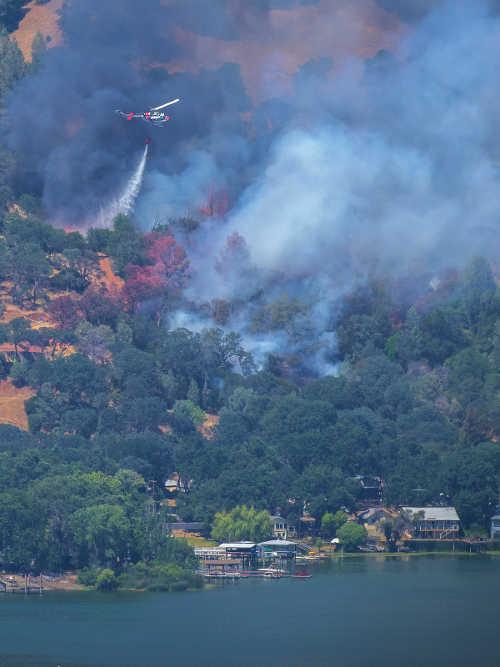
CLEARLAKE OAKS, Calif. – Firefighters are closing in on fully containing a wildland fire that began on Thursday near Clearlake Oaks.
The Harvey Fire was reported just after 3 p.m. Thursday off Harvey Boulevard, as Lake County News has reported.
Fire Capt. Joe Fletcher of Cal Fire told Lake County News on Friday afternoon that the fire burned a total of seven acres.
The official containment number shortly before 5 p.m. Friday was 95 percent, according to Fletcher.
Fletcher said two Cal Fire engines and two inmate crews remained on scene Friday afternoon, continuing to conduct mop up.
Email Elizabeth Larson at
LAKE COUNTY, Calif. – Another step in the process of unifying Upper Lake's school districts was checked off the list on Wednesday night.
The Lake County Board of Education, sitting jointly in its capacity as the Lake County Committee on School District Organization, held two hearings Wednesday on the proposal to unify Upper Lake Union Elementary School District and Upper Lake Union High School District, effective in the 2016-17 school year.
Both district boards voted unanimously earlier this month to approve unification resolutions – Upper Lake Elementary on June 3, Upper Lake High on June 10 – following a series of joint meetings that were part of a process that Upper Lake High Principal Superintendent Patrick Iaccino said began more than a year and a half ago.
The district boards had an initial joint meeting in August, and during additional joint meetings earlier this year evaluated 10 state-mandated criteria and reviewed a feasibility report, as Lake County News has reported.
With the unification resolutions passed on to county Superintendent of Schools Brock Falkenberg, the Lake County Office of Education formally began its work.
The meetings Wednesday took place at Lucerne Elementary School and Upper Lake High School.
Altogether, both meetings took about an hour and included little public comment. The videos of both meetings are posted here.
At both meetings, Falkenberg explained the process and the criteria, and took comments from board members, school officials and parents.
Falkenberg praised both districts for their transparency and focus on children, and said they did their due diligence in analyzing the whole unification question.
It's that groundwork, he noted during the meetings, which is assisting with expediting his office's work.
Falkenberg explained that the first step in the process – the initiation of the unification proposal – was completed, with the two boards forwarding to him their unification resolutions.
He said he had 30 days to determine if those resolutions were sufficient and signed appropriately, a process he completed in seven days. On June 17, he notified the Lake County Board of Education that the resolutions were sufficient.
Effective June 17, Falkenberg said the county board has 60 days to conduct the public hearing process, which is what it did on Wednesday night.
On June 18 Falkenberg mailed to the Lake Local Agency Formation Commission notice of the proposed resolution. On that same date, the county board determined that the unification wasn't a project under the California Environmental Quality Act, Falkenberg said.
Now, the county board will have 120 days to put together a study on the effects of unification. However, Falkenberg estimates that process will take only 56 days, thanks to the thorough work the two districts already have done in gathering the necessary information.
He reviewed the criteria that must be considered, including nine specific topics: enrollment, community identity, equitable division of property and facilities, that the unification won't promote racial discrimination or segregation, no additional costs to the state or taxpayers will result, that unification will be the basis of sound educational performance, insignificant facilities costs will result, it is not done to enhance or affect property values, and that it promotes sound fiscal management.
The 10th criteria – which Falkenberg described as “open-ended” – allows officials to look at other issues they feel are important. In this case, he suggested his agency may review bonded indebtedness.
The county board, again acting in its dual role as the board and the district reorganization committee, is set to meet on Aug. 19, at which time it is expected to take action on the proposal.
Falkenberg said that body needs to forward its recommendation to the State Board of Education by Sept. 1 in order to get on the state's agenda for its November meeting.
Falkenberg said his goal is to complete the process of recruiting and placing a new board by December. Keeping timelines short, he noted at the meetings, was intended so that the new board could be set up for success by being able to get to work as soon as possible.
One of the decisions for the State Board of Education, Falkenberg said, is whether to waive an election process involving district voters.
Falkenberg said that while the districts already have done a written report on the feasibility of unification, the county board needs to engage in the same work.
However, he noted, “We're not going to reinvent the wheel,” and will use the existing report as a basis for the review process. He and his staff also will review the technical aspects of the process before he hands the report on to the county board.
County Board President Patricia Hicks called the process so far “wonderful,” commending the districts for working diligently to collect the information, particularly the fiscal data, on which she said so much hinges.
‘Not a simple process’
During the Lucerne meeting, Iaccino told the county board, “It's been a long process,” and thanked both of the Upper Lake school board for their efforts.
“It wasn't an easy process, simply because it's a political process,” which he said can be emotionally charged at times. However, he noted that they have had tremendous support from parents in both districts.
“As simple as it sounds, the unification of those two districts, it's not a simple process,” he said.
If the county board supports unification, Iaccino said that – beginning July 1 – district officials will have a year to put everything in motion. “There's a lot of work that still needs to be done in order to make that happen.”
He said he and Valerie Gardner, the principal/superintendent for the Upper Lake Union Elementary District, had a lot of discussion with Lucerne Elementary Superintendent Mike Brown about unification.
In the end, however, Lucerne opted to stay on its own, and Iaccino said they respected Lucerne's decision not to take part.
At its meeting June 10, the Lucerne Elementary Board voted to accept a “Thompson” resolution – named for then-state Sen. Mike Thompson, now a Congressman – allowing them to opt out of the unification, according to district documents.
Nevertheless, Iaccino said that if Lucerne wants to look at unifying at some point in the future, Upper Lake officials wouldn't say no, as Lucerne's students go to Upper Lake High.
Upper Lake Middle School Principal Diane Johnson said that, when thinking back to the time when school districts began to form in the 1850s, “School districts were really about that local control. Local people wanted to be able to have a say.”
She said unification should save fiscally and allow the pooling of resources, but added, “For us, that's not the main reason.”
The key reason, said Johnson: “It's really about student success.”
Unification will allow “big picture” considerations and decisions by district officials and one board. “It's the overall structure of it that would bring it closer together,” and make programs smoother, she said.
Hicks noted that it is “absolutely critical” that Lucerne students come to Upper Lake High at the same level as the students from Upper Lake's schools, and she encouraged the districts to work together to ensure a smooth transition from eighth grade to high school.
Upper Lake Elementary Board member Ron Raetz said at the Lucerne hearing he was pleased about how smoothly the process moved, with little friction or protest.
John Tomkins, a former Upper Lake High Board member, also at the Lucerne hearing, said he also thought the process worked well, but he was concerned that Lucerne didn’t join the unification, as he believed it was a matter of student success.
During both the Lucerne and Upper Lake hearings, Falkenberg read a letter from Upper Lake resident Walt Christensen, a former Upper Lake Elementary Board member who has appeared at previous meetings to speak against unification.
Christensen said in his letter that during his 10-year tenure on that board, unification had been brought up, evaluated and rejected a number of times.
“It had been determined that this did not show any positive benefit for the elementary school,” he said, with cost increases unknown.
“I find it totally irresponsible for two boards to vote on a multimillion dollar expenditure without knowing the total cost,” he wrote, raising issues of increased costs and loss of funds for the Lake County Office of Education.
Regarding that loss to the county office, Hicks acknowledged that the agency receives $100,000 per district.
She said that loss previously was discussed by the county board. “We accepted the fact and decided that if it was benefit to the children, that any loss that we might feel should not be considered at all.”
At the Upper Lake meeting, Gardner said she was grateful to both Upper Lake school boards for taking a serious look at unification.
This is the third year in the district for Gardner, who came to Upper Lake after spending 24 years in a unified district, serving in a variety of capacities – from teacher to site administrator.
Within weeks of arriving in Upper Lake, Gardner said she was asked about unification. And over the course of her first year in the district, “I saw the difficulties of not being unified.”
She said having a common vision and a common board, in her opinion, was “going to be the best for our students.”
During public comment, Claudine Pedroncelli, an Upper Lake High Board member, said she was happy that the unification process was moving forward.
“We have a very unique situation here, and I think that the community has really been behind this unification for many years. And it's finally here and now, and I'm more than delighted about it,” Pedroncelli said.
Upper Lake High Board President Keith Austin thanked the county board for involvement in the process so far. “Your desire to be informed and to make a great decision has been encouraging to both boards.”
Regarding Lucerne’s decision not to participate, Austin pointed to the second state criteria that speaks directly to culture.
“I think that Lucerne has its own culture. They have done a great job of developing that culture to this point,” he said, adding that the students coming from Lucerne are very intelligent.
Parent Melanie Sneathen told the county board that she was excited about the unification process.
“The only thing that divides this community is the two different districts,” she said, adding that she’s one of many community members willing to support the unification in any way she can.
Parent Sara Sanchez, who has four children in the two districts and herself grew up and attended school in Upper Lake, told the county board, “We are a K through 12 community.”
Sanchez raised concerns about longtime local families taking their children to Lakeport because of their lack of satisfaction with Upper Lake’s schools.
“We just need to do something, show that we are trying to change and trying to better our schools,” she said.
Email Elizabeth Larson at
LAKE COUNTY, Calif. – Due to the heat and the resulting fire concerns, the National Weather Service has issued weather statements for areas of Northern California, including Lake County.
The agency said hot temperatures – and, with them, concerns of mountain thunderstorms and fire danger – are expected to extend from Friday through the weekend, with the potential for more thunderstorms and rainfall around the region early next week.
Forecasters said hot and dry conditions are priming fuels for enhanced fire danger.
Fire danger already is high in Lake County, where firefighters battled two wildland fires on Thursday afternoon near Clearlake and Clearlake Oaks.
The forecast calls for temperatures on Friday to be around the century mark, tapering off into the low 90s into next week. Light winds of up to 8 miles per hour also are forecast.
Officials urge area residents to use extra heat precautions if attending outdoor events or working outside.
Email Elizabeth Larson at
LAKE COUNTY, Calif. – Firefighters dealt with two fast-moving wildland fires on Thursday afternoon, while Cal Fire announced it was suspending outdoor burning permits due to the season's very dry conditions.
On Thursday, firefighters contained two wildland fires: the Borax fire in Clearlake and the Harvey fire, off Highway 20 in Clearlake Oaks, as Lake County News has reported.
Units were clearing the Borax fire late Thursday, but the Harvey fire remained at 50-percent containment, according to Cal Fire.
Both of the fires burned less than 10 acres and remain under investigation, officials said.
Cal Fire also announced on Thursday that, as drought conditions continue to increase fire danger in the region, it was suspending all burn permits for outdoor open residential burning within the State Responsibility Area of Colusa, Lake, Napa, Solano, Sonoma and Yolo counties.
This suspension takes effect Monday, June 29, and bans all residential outdoor burning of landscape debris including branches and leaves, the agency said.
Cal Fire said it may issue restricted temporary burning permits if there is an essential reason due to public health and safety. Agriculture, land management, fire training and other industrial-type burning may proceed if a Cal Fire official inspects the burn site and issues a special permit.
Campfires within organized campgrounds or on private property that are otherwise permitted will be allowed if the campfire is maintained in such a manner as to prevent its spread to the wildland, Cal Fire said.
“With conditions as dry as they are throughout the area, residential burning is no longer a safe option,” said Cal Fire Sonoma-Lake-Napa Unit Chief Scott Upton. “We are asking the public to be extra cautious when clearing and maintaining defensible space around their homes.”
“With record-setting drought conditions we must take every step possible to prevent new wildfires from starting,” said Chief Ken Pimlott, Cal Fire director.
Cal Fire said 2015 is looking like 2014 in that the agency's firefighters have responded to significantly more wildfires this year than the annual average.
Fire officials are asking residents to be prepared for wildfires. Key to that is maintaining 100 feet of defensible space around every home.
To do that, officials urge residents to clear all dead or dying vegetation 100 feet around all structures, landscape with fire resistant/drought tolerant plants, and find alternative ways to dispose of landscape debris like chipping or hauling it to a biomass energy facility.
In other fire news, Cal Fire spokesman Daniel Berlant said Thursday that increased temperatures across the state the previous day – including triple digits in many areas – allowed for increased fire activity on several fronts.
“As several new large wildfires were sparked, and several current wildfires continued to grow, firefighters did make progress on containment on several others,” he said.
Berlant said a fire weather watch has been issued for much of the northeast California including the Northern Sierra due to thunderstorms, strong winds and the possibility of dry lightning.
“While all residents are urged to be cautious outdoors to prevent sparking a wildfire, those in the Fire Weather Watch area must take extra precautions,” Berlant said.
To learn about wildland fire preparedness, visit www.ReadyForWildfire.org .
A rundown of major incidents around the state follows, with size estimates through late Thursday night.
Cal Fire incidents
– Corrine fire: Began June 18 in Madera County; 920 acres, 100-percent contained. Three outbuildings destroyed, evacuations lifted. Cause is under investigation.
– Loma fire: Began June 24, Contra Costa County, 533 acres, 100-percent contained.
– Tesla fire: Began June 25, Alameda County, 53 acres, 100-percent contained.
Unified command fires
– Lake fire: Began June 17 in San Bernardino County; 25,599 acres, 19-percent contained. Evacuations remain in effect with additional evacuations added Wednesday; 500 structures threatened. Cause is under investigation.
Federal incidents
– Saddle fire: Began June 10 in Trinity County; 1,542 acres, 100-percent contained. Caused by lightning.
– Sky Fire: Began June 18 in Madera County; 500 acres, 95-percent contained. Caused by a vehicle.
– Washington Fire: Began June 19 in Alpine County; 16,490 acres, 15-percent contained. Caused by lightning.
Other incidents
– Calgrove fire: Began June 24, Los Angeles County; 415 acres, 95-percent contained.
Email Elizabeth Larson at
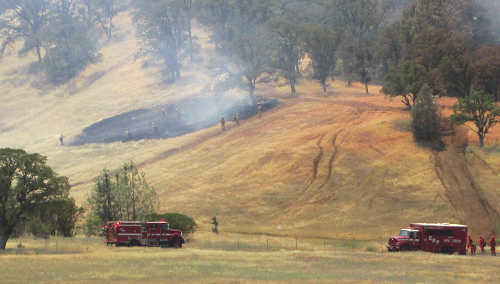
CLEARLAKE, Calif. – Firefighters on Thursday night were wrapping up work on a wildland fire that burned near Borax Lake in Clearlake.
The Borax fire, located near Borax Lake off Sulphur Bank Road, was first dispatched at approximately 1:25 p.m. Thursday, according to radio reports.
Lake County Fire Chief Willie Sapeta said the incident initially began as a smoke check before being dispatched as a wildland fire.
Sapeta said Thursday night that the fire hadn't been mapped, but estimated that it burned between seven and 10 acres.
No structures were threatened during the incident, he said.
He said a total of seven engines, two water tenders, two crews, two medic units, three aircraft and a helicopter worked the fire.
Resources came from Lake County Fire and Cal Fire, with mutual aid from agencies around the lake, he said.
Just after 3 p.m. another wildland fire was reported off Harvey Boulevard near Clearlake Oaks.
Sapeta said he began releasing resources from Cal Fire as soon as he could so they could respond to the Harvey fire, where a number of structures were threatened.
Later in the afternoon, some resources were requested to return to the Borax fire, after a fire spot kicked up over the fire line, Sapeta said.
“We were able to pick that up pretty quick,” he said.
Resources were continuing to clear the scene into Thursday evening, based on radio reports.
Sapeta said the fire's cause remains under investigation.
Email Elizabeth Larson at
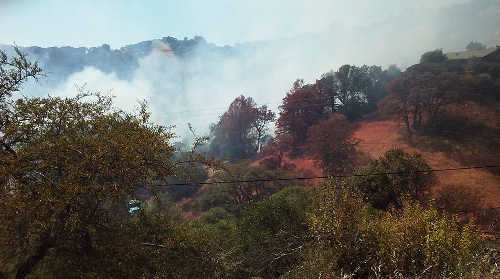
CLEARLAKE OAKS, Calif. – On Thursday evening firefighters continued to work at the scene of a fire in Clearlake Oaks that broke out earlier in the afternoon.
The Harvey fire was first dispatched just after 3 p.m. in the area of Harvey Boulevard and Highway 20, as Lake County News has reported.
In a Thursday evening report, Cal Fire reported that the fire has so far burned eight acres and is 50-percent contained.
The agency said the fire's forward progress has been stopped.
The fire threatened structures early on, with air resources – including Copter 104 and four air tankers – aggressively working the fire. Thanks to those efforts, no structures were damaged.
Local resources were stretched thin on Thursday afternoon due to another fire also burning at the same time near Borax Lake in Clearlake, with Mendocino County sending fire resources to help.
In addition to Northshore Fire and Cal Fire, agencies responding to the incident included Kelseyville Fire, Lake County Fire, Lakeport Fire, the US Forest Service, California Highway Patrol and Lake County Sheriff's Office.
Total resources assigned included 17 engine companies, one water tender, four air tankers, one helicopter, one bulldozers, three fire crews, four volunteer companies, four overhead or command personnel, and 120 personnel, Cal Fire reported.
Lake County Public Works reported early Thursday evening that Harvey Boulevard was closed to all traffic except emergency response vehicles due to the fire. That closure was to remain in effect until further notice, with the public asked to stay clear of the area.
Cal Fire said the Harvey fire's cause is under investigation.
Email Elizabeth Larson at