 How to resolve AdBlock issue?
News
LAKE COUNTY, Calif. – The Lake County Big Read will feature the timeless novel, “To Kill a Mockingbird,” for the program month of October 2015.
Written by Harper Lee, and published in 1960, this unique bestseller, and winner of the Pulitzer Prize for fiction, continues to engage readers with its relevant themes, endearing characters, and detailed setting.
Reading or re-reading of the novel can inspire many great discussions, community activities, and reflections for the creative process.
Local writers – published and aspiring – are encouraged to create a contemporary work that connects to the narrative in a genre of their choice.
From a children’s story to an opinion or editorial piece, whether in a poetry format, a short story or an essay, selected entries will be featured in The Lake County Big Read kick-off Lit Fest, which will be held on Saturday, Oct. 3, at the Mendocino College Lake Campus in Lakeport.
Additionally, those writings will be included in a printed compilation for the public, as well as in local and social media platforms.
The deadline for submission is Friday, Sept. 4. It is requested that original text be limited to 500 words or less.
For questions or for more information, contact Robin Fogel-Shrive, The Lake County Big Read program director at
Completed works may be dropped off at any of the Lake County Library branches or mailed to the main branch at 1425 N. High St., Lakeport, CA 95453.
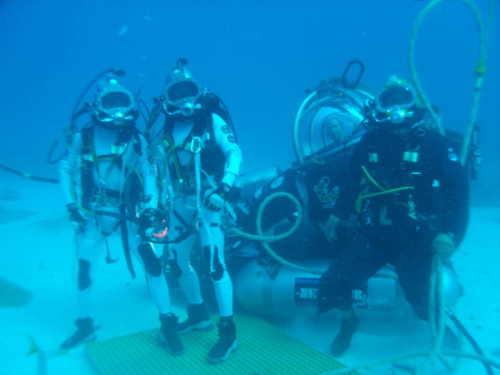
NASA will send an international crew to the bottom of the Atlantic Ocean this summer to prepare for future deep space missions during the 14-day NASA Extreme Environment Mission Operations, or NEEMO 20, expedition slated to begin July 20.
NEEMO 20 will focus on evaluating tools and techniques being tested for future spacewalks on a variety of surfaces and gravity levels ranging from asteroids to the moons of Mars and the Martian surface.
“The NEEMO team is particularly excited about this mission as it is a huge milestone to have achieved 20 missions at Aquarius over the past 15 years,” NEEMO Project Lead Bill Todd said. “Living and working in the highly operational, isolated and extreme environment of the aquatic realm has provided significant science and engineering for the benefit of human spaceflight. It has also clearly proven to be as close to spaceflight as is possible here on Earth.”
The mission will test time delays in communications due to the distance of potential mission destinations.
The crew also will assess hardware sponsored by the European Space Agency (ESA) that allows crew members to read the next step in a procedure without taking their hands or eyes away from the task using a tablet, a smartphone and a head-mounted interface.
ESA astronaut Luca Parmitano will command the NEEMO 20 mission aboard the Aquarius laboratory. Parmitano flew in space during Expeditions 36 and 37 aboard the International Space Station in 2013, where he spent 166 days living and working in the extreme environment of microgravity. He conducted two spacewalks on his first spaceflight.
Parmitano will be joined by NASA astronaut Serena Aunon, NASA EVA Management Office engineer David Coan and Japan Aerospace Exploration Agency astronaut Norishige Kanai.
The NEEMO crew and two professional habitat technicians will live 62 feet below the surface of the Atlantic Ocean in Florida International University’s Aquarius Reef Base undersea research habitat 6.2 miles off the coast of Key Largo, Florida.
For more information about NEEMO, the crews and links to follow the mission on Facebook and Twitter, visit http://www.nasa.gov/neemo .
LAKE COUNTY, Calif. – Firefighters battled and contained a series of small wildland fires around the county early Saturday, including one that was sparked by a fatal vehicle crash.
Altogether, four small fires were reported from just after 12 a.m. to just before 3 a.m., based on radio reports.
The first of the fires occurred in the 7700 block of Wight Way in Kelseyville, and was dispatched just after 12:05 a.m. Callers reported to Central Dispatch that they saw smoke and flames on the hills.
A sheriff's unit arrived on scene ahead of firefighters and helped them locate the fire, according to radio traffic.
Personnel from Lakeport Fire, Kelseyville Fire and Cal Fire responded, finding a fire burning down a hill toward a structure, based on radio reports.
Reports from the scene indicated the fire was ultimately held to about half an acre.
Just before 2:30 a.m., another call came in regarding a wildland fire in the 17000 block of Morgan Valley Road. However, additional reports clarified that a vehicle crash had occurred, causing the fire.
A sheriff's deputy on scene reported to Central Dispatch that an occupied vehicle was on its top and fully engulfed in flames, according to radio reports.
Firefighters arrived on scene shortly thereafter, stopping forward progress on the fire, which was contained to a 10-foot by 10-foot spot, based on radio reports.
Personnel at the scene reported one fatality, with Morgan Valley Road to be closed and rescue units to be dedicated to the incident for an indeterminate amount of time.
At 2:35 a.m., a report came in of a fire in the 20000 block of Highway 29 at the Bar X Ranch near Middletown, with firefighters arriving on scene reporting a quarter acre of grass burning, with a slow rate of spread.
Shortly afterward, another small grass fire was reported in the area of Highway 29 at Hofacker Lane, north of Hidden Valley Lake, according to radio reports.
Reports from the scene indicated the Bar incident was contained to a quarter-acre just before 4:45 a.m., which Fire Capt. Joe Fletcher of Cal Fire confirmed.
Fletcher said the Hofacker fire also burned a quarter-acre in total.
The California Highway Patrol reported that the roadway was clear near both fire areas.
Email Elizabeth Larson at
LAKE COUNTY, Calif. – Cal Fire said it is stepping up its resources this weekend due to forecasts of high temperatures and threats of dry lightning – and therefore greater fire threat – across Northern California.
Cal Fire's Sonoma-Lake-Napa Unit – which also serves Solano, Yolo, and Colusa counties – along with the Northern California Region increased its resources to meet the increased fire danger, officials said Friday.
Additional bulldozers, fire engines and inmate firefighting hand crews will be ready to mobilize over the weekend and as incident activity warrants, the agency said.
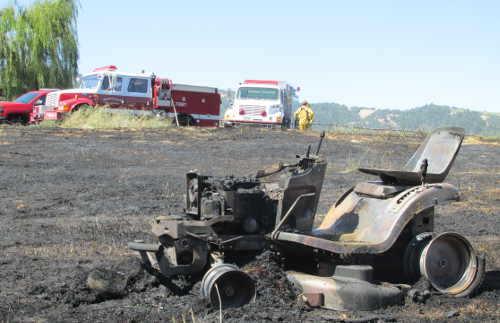
Besides preparing for the potential for fire weather, Cal Fire issued a strong remind about being cautious about mowing during the current dry conditions.
“Ninety-five percent of all wildland fires are caused by people,” Cal Fire Unit Chief Scott Upton.
“Over the last week, Cal Fire responded to fires in Sonoma, Lake and Solano counties where people were doing the 'right thing, the wrong way,'” said Upton. “Wildfires were accidentally started in dry grass by private and commercial mowing, parking vehicles in grass, and barbecuing in a designated public area where grass/lawn was dry from drought related water conservation.”
One of those mowing fires – a 4.5-acre blaze – occurred near Upper Lake last Saturday, as Lake County News has reported.
Cal Fire said dry grass should be cut before 10 a.m., when the air is moist, temperatures are low and winds are calm.
In other fire news, in Lake County on Friday, work continued at the scene of the Harvey fire, located off Harvey Boulevard in Clearlake Oaks.
The fire, which broke out on Thursday afternoon, burned a total of seven acres and was 95-percent contained on Friday evening, with Cal Fire personnel still mopping up, according to Fire Capt. Joe Fletcher.
Early Saturday, Cal Fire worked with Lakeport Fire and Kelseyville Fire on a small grass fire on Wight Way in Kelseyville.
That incident was reported to be less than one acre in size, but had threatened a structure at one point, according to radio reports.
The agency also was part of the local fire response for a fatal vehicle crash on Morgan Valley Road that caused a small spot fire and on a small grass fire reported along Highway 29 near Middletown, as Lake County News has reported.
On the weather front, Cal Fire spokesman Daniel Berlant Berlant said a red flag warning has been issued for much of northeast California, including the Northern Sierra and Tahoe Basin, due to high heat, strong winds and the possibility of dry thunderstorms with lightning.
A special weather statement also was issued for Lake County due to the dry conditions and concerns about increased fire danger, as Lake County News has reported.
Elsewhere around California, Berlant said initial attack fire activity was again high throughout much of the state.
He said firefighters were able to contain one of the large wildfires that had burning throughout the week on Thursday, but another one was sparked in San Bernardino County.
On Friday, he said nearly 3,300 firefighters remain on the front lines of five large active wildfires burning in California.
Berlant said this week there have been two incidents – in as many days – involving hobby drones that impacted firefighting operations from the air.
The first incident occurred on Wednesday evening at the Lake fire in San Bernardino County, which caused firefighters to ground all firefighting aircraft until they could find the operator and get the drone out of the area, Berlant said.
On Thursday, a drone interfered with air operations on the Sterling fire, also in San Bernardino County, according to Berlant.
He said a collision with a hobby drone “could easily result in major damage to firefighting aircraft, injuries to the pilot and crew on board as well as firefighters below, and worse, a midair collision. It is unsafe for unauthorized drones to be flown anywhere near a wildfire.”
Berlant said Cal fire officials stress to hobby drone users, “If you fly, we can’t!”
To learn about wildland fire preparedness, visit www.ReadyForWildfire.org .
A rundown of major incidents around the state follows, with size estimates through late Friday night.
Cal Fire incidents
– Otay fire: Began June 26 in San Diego County; 80 acres, 100-percent contained. Cause not reported.
Unified command fires
– Lake fire: Began June 17 in San Bernardino County; 30,526 acres, 20-percent contained. Evacuations remain in effect. Cause is under investigation.
Federal incidents
– Washington fire: Began June 19 in Alpine County; 17,622 acres, 29-percent contained. Caused by lightning.
– Sterling fire: Began June 25 in San Bernardino County; 100 acres, 75-percent contained. Arson fire.
Other incidents
– Calgrove fire: Began June 24, Los Angeles County; 415 acres, 100-percent contained.
Email Elizabeth Larson at
LAKE COUNTY, Calif. – Mark your calendar – the Lake County Weed Management Area is hosting its 12th annual “Invasive Weeds Tour” on Thursday, July 23.
The tour is free and the public is welcome and encouraged to attend.
The third week of July is California’s annual “Invasive Weed Awareness Week.”
This statewide program is designed to educate citizens about the undesirable effects and impacts of non-native invasive weeds.
Participants will gather at the Anderson Marsh ranch house at 9 a.m. for a guided walk of just over 2 miles to see the amazingly diverse array of invasive plants that flourish in the park and the effects of control mechanisms such as control burns.
At the end of the tour, lunch will be served under the trees, followed by a discussion of aquatic invasive weeds.
Please RSVP by calling Katherine at 707-263-0217 no later than July 20.
The tour is sponsored by Lake County Department of Agriculture, the Lake County Department of Water Resources, and the East Lake Resource Conservation District.
The end-of-tour lunch is free but donations to help offset the cost of lunch and refreshments will be greatly appreciated and cheerfully accepted.
It's funny, the things you notice hanging upside down in space.
Astronaut John Mace Grunsfeld remembers a quirky discovery back in 1999.
He had just arrived at the Hubble Space Telescope and climbed out of the airlock of Space Shuttle Discovery to begin a servicing mission.
Clinging to a handrail running down the side of Hubble's gleaming exterior, he ran his eyes over the blue planet 350 miles below and tried not to think too hard about the yawning starry expanse behind him.
The astronaut, Hubble, and Discovery, connected together, raced around Earth at 17,000 miles per hour.
That's when he noticed the handprints.
“The outside surface of Hubble is covered with them – scuff marks and other signs of handling by astronauts,” said Grunsfeld.
Astronauts visited the orbiting telescope five times since it was launched in April 1990, conducting 23 spacewalks to repair and improve it.
The “handprints” come from oil and silicon on the astronauts' gloves, which make an impression on Hubble's exterior foil. Initially invisible, these residues darken over time as they are exposed to solar ultraviolet radiation.
The prints Grunsfeld saw are more than chemical scuff marks, though.
“They are a symbol,” he said, “of a unique human-robotic partnership.”
Hubble's designers intended for astronauts to lay hands on Hubble. The telescope is festooned with knobs and handrails, hinged doors, and crawl spaces fit for astronauts to visit and tinker. This has allowed Hubble to do something no other spacecraft has done before – evolve.
When Hubble left Earth 25 years ago it was equipped with reel-to-reel data recorders, 1980s-era microprocessors and some of the earliest digital cameras.
Fast forward to the present: Almost every scientific instrument onboard the telescope has been replaced at least once.
Hubble now has solid-state recording devices, upgraded computers, and astronomical detectors that far outperform the older technology it originally took to space.
Astronauts have also replaced the telescope's aging solar arrays, batteries, gyroscopes, some reaction wheels and fine guidance sensors.
Keeping pace with technological advances on its home planet, Hubble is very much a creature of the 21st century.
Astronauts have done more than just upgrade Hubble. They have also saved it.
The first time was in 1993. When Hubble reached orbit, images revealed that the telescope’s mirror was flawed. It suffered from a distortion called spherical aberration. Hubble could still take pictures of the cosmos but not with the sensitivity or resolution its designers envisioned.
“The first servicing mission in 1993 took care of that,” said Grunsfeld.
That December, seven astronauts flew to the telescope onboard Space Shuttle Endeavour. Over a period of 11 days, the crew conducted 5 spacewalks and used more than 100 specialized tools, many of which were invented specifically for the mission. They installed corrective optics, a new main camera, new solar arrays, and two new gyro packages.
Not everything went smoothly.
During the mission, spacewalkers Story Musgrave and Jeff Hoffman opened a pair of service doors to swap out gyros but could not get them closed again. The door bolts would not reset. Engineers on Earth speculated that when the doors were opened, a temperature change caused them to expand or contract.
“They ended up using a makeshift ratchet to squeeze those doors together,” recalled Grunsfeld. “That was a very bad idea. It could have broken Hubble, but at the time, they didn't know that. Anyway, they squeezed the doors together using brute force.”
Evidence of the wrestling match is evident today in a confusion of “handprints” and scuff marks around the doors. The marks tell a silent story of ingenuity, risk, and triumph.
“Without that first servicing mission, Hubble would have been a nice telescope but not a great one,” opined Grunsfeld. “We would not have measured the edge of the universe, validated black holes, or discovered dark energy. The fingerprints of astronauts are all over those advances.”
Another difficult moment came in the late 1990s. Mission planners were growing nervous as Hubble's gyros unexpectedly started to fail – one in 1997, another in 1998, and a third in 1999. If one more gyro went offline, the telescope would not be able to point accurately.
The whole telescope was on the razor's edge of failure as Grunsfeld and six other astronauts readied themselves for Servicing Mission 3A. Indeed, just weeks before their Space Shuttle, Discovery, was scheduled to launch, a fourth gyro failed and Hubble science came to a screeching halt.
“We felt some urgency to get up there and fix the telescope,” he recalled.
It would be Grunsfeld's first mission to Hubble, the first time he touched the telescope, and the first time he added his own prints to those of his predecessors.
Discovery lifted off on Dec. 20, 1999. During the week-long mission, the crew installed new gyros, replaced a Fine Guidance Sensor (FGS) and swapped out the main computer. The new computer was 20 times faster and had six times the memory of the one it replaced.
“Coming out of that mission, we left the telescope in pretty good shape,” he said. “We saved Hubble.”
Little did he know, that rescue merely set the stage for a more thrilling one to come.
In 2000, engineers working on Hubble noticed a curious anomaly: The telescope's batteries were not charging as quickly as they should.
It was a tiny effect, measured in units as small as micro-ohms, but over time it could add up to catastrophe: Hubble could “go dark” as early as 2003. With detective work that insiders still remember with awe 15 years later, engineers figured out the problem. There was a subtle ground fault in the telescope's Power Control Unit – or PCU.
The PCU is essentially a bank of relays that routes power from Hubble's solar arrays to its batteries and other systems. It is a very complicated device, and the only way to service it is to turn it off. Completely. No power to Hubble at all.
“This was kind of a big deal,” said Grunsfeld. “If we didn't repair it, Hubble would die in about three years. On the other hand, if we tried to fix it, Hubble might die right away. Powering down Hubble had never been done before. Hundreds of relays would be switched to their powered-off state. A clock would be ticking because Hubble would get cold. There was a window of only a few hours to do the repairs because overnight Hubble would freeze,the optical bench would warp, and Hubble would no longer be functional.”
NASA decided to go for it, and Grunsfeld started training for the most challenging mission of his career: Hubble Servicing Mission 3B.
Flying Space Shuttle Columbia one last time before the disaster of 2003, the mission's crew would ultimately invent new tools, new training procedures, and new repair techniques to tackle the PCU problem.
“We really upped our game,” said Grunsfeld.
Around NASA, many experts worried about the PCU repair. Could it really be done? The astronauts themselves were worried.
Sleepless in space, Grunsfeld and Rick Linnehan woke up early on March 2, 2002, and started prepping for their spacewalk more than two hours ahead of schedule. NASA prepared to cut power to the telescope as soon as they were ready to step outside.
“Keep in mind that as soon as power was off, we were on a ticking clock,” said Grunsfeld. “There was a real sense of urgency, no question about it.”
Immediately something went wrong: “Astronauts Mike Massimino and Jim Newman were preparing us to go outside,” he said. “When Jim released me from the latches on the wall of the airlock, he noticed that my backpack was wet. A valve inside my spacesuit had failed and was leaking water. That's very bad. Had I gone outside, that water would have frozen, cracked an airline, and I could have been killed.”
Suddenly the spacewalkers were behind schedule. Tick. Tock. Tick. Tock. Working quickly, astronauts in the airlock helped Grunsfeld out of his suit and assembled a new one from parts of other suits that fit him.
“In less than two hours – record time, by the way – we were able to get me back into a spacesuit. By the time we started the EVA, we were about two hours late. There was some mild panic on the ground because Hubble had been cooling off,” he recalled.
The astronauts, however, were even cooler.
“You might think, 'Oh gosh, Rick and I must have been in a panic because we had already lost two hours of the day,'” said Grunsfeld, “But no. We went out the hatch as if everything was completely normal. We had that kind of focus from the training we had done. As soon as I was in the spacesuit again, I totally forgot that we had had all of those earlier problems. Rick and I went out and did it in 6.5 hours, exactly as we had trained.”
The PCU was repaired, and the telescope powered up in good condition. Hubble was saved again.
NASA retired its Space Shuttle fleet in 2011, but not before one last visit to a telescope Grunsfeld now considered “an old friend.”
Originally, plans called for Hubble to be serviced in February 2005, but the Columbia tragedy of 2003 changed everything. A trip to Hubble was deemed too risky, and for a while, it seemed that the telescope might never be serviced again.
“That would have spelled the end of Hubble,” said Grunsfeld. “The telescope's batteries were 13 years old, and they were beginning to fail. Without replacements, the mission would have ended as early as 2007.”
And it would have ended, except for the ensuing public outcry. Not only did astronomers wish to save Hubble but also millions of ordinary people did too.
For more than two years, 2004-2006, school children wrote letters to the President, public hearings were held in Congress, and the “human connection” to Hubble became as clear as the glove-marks on its gleaming foil.
NASA reconsidered.
In May of 2009, Space Shuttle Atlantis blasted off for one last mission to Hubble. On the ground below, Space Shuttle Endeavour waited on the launch pad, ready to fly to the rescue if the crew of Atlantis got into trouble. This is how NASA managed the risk of flying the soon-to-be-retired spacecraft.
“By 2009 a ton of things were going wrong on Hubble,” said Grunsfeld. “We did 5 EVAs to fix those things.”
As usual, the astronauts had to invent new procedures and do the unprecedented – “like removing hundreds of tiny screws in bulky space suits,” he recalled.
They replaced batteries, swapped out all six gyros (again), installed a new Fine Guidance Sensor, repaired two of Hubble's scientific instruments and completely replaced two others.
Mindful that astronauts might never visit Hubble again, the spacewalkers installed a soft-capture mechanism that would allow a future robotic spacecraft to grapple Hubble to ensure a safe conclusion to its operational lifespan.
For one last time, Grunsfeld saw the marks of the Hubble repair crews, the handprints of 16 spacewalkers: Story Musgrave, Jeff Hoffman, Kathryn Thornton, Thomas Akers, Mark Lee, Steve Smith, Greg Harbaugh, Joe Tanner, Mike Foale, Claude Nicollier, Rick Linnehan, James Newman, Mike Massimino, Andrew Feustel, Michael Good, and Grunsfeld himself.
“Leaving Hubble in 2009 was bittersweet,” said Grunsfeld. “I was sad to see my old friend go. However, as a crew we were thrilled that we had accomplished all of our goals and a little more, sending Hubble off in the best shape ever.”
Current estimates suggest that Hubble will continue doing great science until 2020 and possibly longer. All thanks to the human touch.
Dr. Tony Phillips works for the National Aeronautics and Space Administration.