 How to resolve AdBlock issue?
News

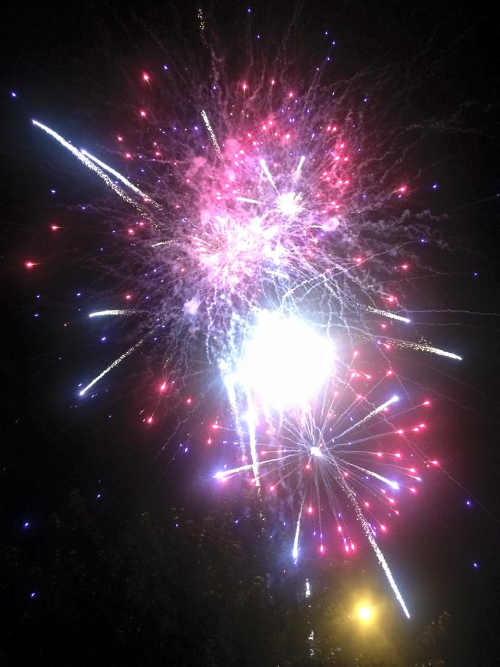
LAKE COUNTY, Calif. – Fireworks displays in communities around Lake County lit up the sky this holiday weekend.
From Clearlake Oaks to Hidden Valley Lake, residents came out to watch shows reminiscent of the original “rockets' red glare” in celebration of Independence Day.
Featured here are selected photos of the weekend fireworks displays shared by readers and Lake County News staff, as well as a drone video by Phil Harris.






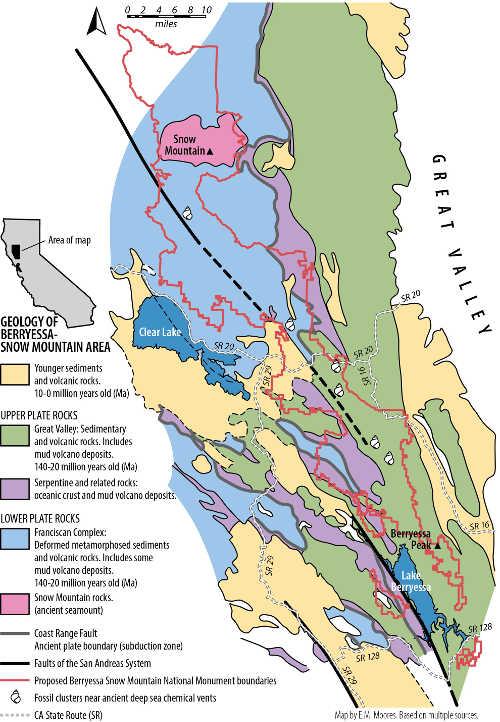
NORTHERN CALIFORNIA – The proposed Berryessa Snow Mountain National Monument region provides unparalleled access to geologic features associated with an ancient tectonic system where one plate descended beneath another.
The Coast Range Fault, noted on the map above, represents the ancient boundary between the upper North American plate and the descending lower plate.
Rocks of the upper plate include Great Valley sedimentary and volcanic rocks overlying serpentine, that is, remnants of ancient oceanic crust.
The upper plate represents part of the western edge of North America that formed 140 to 200 million years ago.
Lower plate rocks include the Franciscan complex – deformed and metamorphosed (recrystallized) sedimentary and volcanic rocks – that were scraped off the down-going plate and buried up to 12 to 20 miles beneath the North American edge as the plate went down and then uplifted to the surface by erosion.
The active San Andreas fault family was superimposed more recently on this earlier convergent plate situation.
The Great Valley sedimentary rocks themselves were deposited originally on top of oceanic crust, which had previously been incorporated into North American continental rocks.
Great Valley sediments were laid down in some 3,000 feet of marine waters at the edge of the North American continent.
Subsequent earth movements tilted these rocks from their original horizontal position to steeply inclined vertical layers.
These rocks are well exposed along the western side of the Great Valley, including in the southeast part of the Berryessa Snow Mountain region.
The serpentine and related rocks of the down-going plate represent remnants of oceanic crust formed at an oceanic spreading center and subsequently added to the North American continent.
Serpentine, scientifically called “serpentinite,” is a rock formed by combining water with rock that originally was part of the Earth's mantle, the layer beneath the Earth's crust.
Soils formed from serpentinite rocks lack certain elements required by most plants. Thus it is not surprising that the Berryessa Snow Mountain hosts unique plant species in a variety of landscapes and microclimates that have adapted to serpentine-derived soils.
Some rocks of both the Franciscan and Great Valley units constitute blocky landscapes formed by a chaotic mixture of diverse rock types.
Some of these rocks, often called “melange” after a French word meaning mixture, apparently formed as deposits of “mud volcanoes.”
Mud volcanoes are widespread in the Marianas trench area, where fluids derived from the down-going plate incorporate blocks of rock as they rise to the surface and spill over to form submarine earth flows some 20,000 feet or so on the ocean floor.
Some complex chaotic rocks found in the Great Valley and Franciscan units may have a similar origin. Other on-land exposures of similar mud volcano deposits may be present in Turkey, Iran, Afghanistan and southwest Pakistan, but none of these areas is as well-documented or as accessible as the Berryessa Snow Mountain area.
Similar tectonic processes are active today in various locations, such as off the Pacific Northwest and in the Marianas Trench National Monument.
Such modern geologic rock-forming processes lie below thousands of feet of water and are not directly observable.
To study such rocks, geologists employ deep-sea drilling and geophysical techniques of remote sensing, small deep-diving two to three-person submarines, or remotely operated submersible vehicles.
In contrast, one can walk across the preserved fossil boundary between the two former plates in the Berryessa Snow Mountain and see the rocks and geologic structures that formed during ancient plate interactions.
Snow Mountain itself represents a special feature. It contains submarine volcanic rocks, not more than 140 million years old, that look as if they were laid down only a few years ago.
However, minerals identified in the rocks indicate that they formed as an oceanic submarine volcano (seamount) far west of California, then migrated with the down-going plate to the continental edge, were buried 12 to 20 miles deep, and rose again to the Earth's surface.
Also, the Berryessa Snow Mountain area exhibits clusters of invertebrate fossils that apparently grew in deep water around chemical seeps.
Such clusters are widespread on some modern plate boundaries. The fauna live in the dark thousands of feet deep around cold to warm submarine springs that typically contain methane or hydrogen sulfide.
The animals thrive, however, using the chemicals as nutrients. About six such ancient sites lie in the Berryessa Snow Mountain area, enabling one to see such features closely and on land.
In summary, the geology of the Berryessa Snow Mountain region provides valuable instructive exposures of features and processes of a convergent tectonic plate margin. Nowhere else in the world are such features as well developed, preserved or accessible.
The proposed Berryessa Snow Mountain National Monument region is a unique region with world-class geology and biology. It is well worth national monument designation.
Eldridge Moores is a professor emeritus at the University of California, Davis. He is joined in writing this article by wife, Judith.
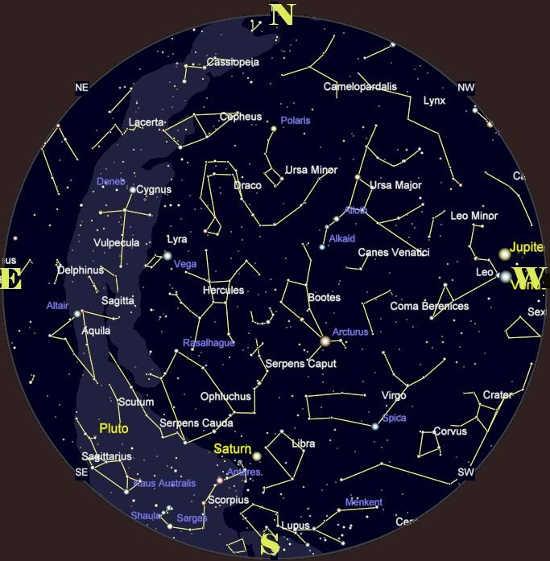
LAKE COUNTY, Calif. – This month we turn our attention to the constellation Scorpius the Scorpion.
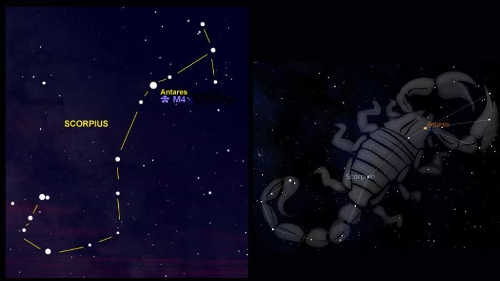
Look to the south – Scorpius crawls close to the horizon. It is one of the few constellations that actually looks like what it represents.
From the giant claws, to the long body, and finally the curved tail, Scorpius appears as though he is ready to strike!
In Greek mythology, Scorpius was the creature that was sent to kill Orion the Hunter. He succeeded, and was placed in the summer sky in recognition of his great feat.
Orion was placed in the winter sky so that he and Scorpius would not continue to fight.
Scorpius is host to Antares, the 17th brightest star in the sky. Also known as the Heart of the Scorpion, Antares is a supergiant red star, 883 times larger than our sun.
Scorpius lies in the Milky Way (see this month’s star chart). As such, a number of beautiful deep sky objects can be viewed through a telescope.
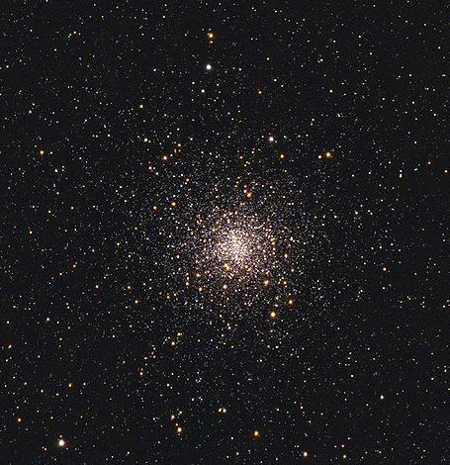
Most notable is M4, a globular cluster of stars, located near Antares. It is the closest object of this type, a mere 7,500 light years away.
M4 has over 20,000 stars – through even a small telescope it is a fascinating object.
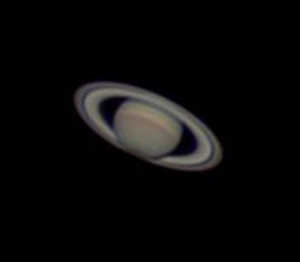
Close to Scorpius is the beautiful planet Saturn, always a rewarding sight through a telescope.
Saturn is the sixth planet from the sun and is distinguished by its beautiful rings.
John Zimmerman is a resident of Lake County and has been an amateur astronomer for more than 50 years. For more information about Astronomy and local resources, visit his Web site at www.lakecountyskies.com .
LAKE COUNTY, Calif. – Lake County Animal Care and Control will be holding a special adoption event this week, with reduced adoption costs for the featured dogs.
This week's dogs include mixes of boxer, Chihuahua, chow chow, corgi, husky, pit bull and wirehaired terrier.
For information about the adoption event and the reduced costs, see www.bit.ly/1R6ObFe .
Dogs that are adopted from Lake County Animal Care and Control are either neutered or spayed, microchipped and, if old enough, given a rabies shot and county license before being released to their new owner. License fees do not apply to residents of the cities of Lakeport or Clearlake.
If you're looking for a new companion, visit the shelter. There are many great pets hoping you'll choose them.
In addition to the animals featured here, all adoptable animals in Lake County can be seen here: http://bit.ly/Z6xHMb .
The following dogs at the Lake County Animal Care and Control shelter have been cleared for adoption (additional dogs on the animal control Web site not listed are still “on hold”).

Pit bull mix
This female pit bull terrier mix has a short gray and white coat.
Shelter staff said she is very affectionate and loving.
She's in kennel No. 25, ID No. 2536.
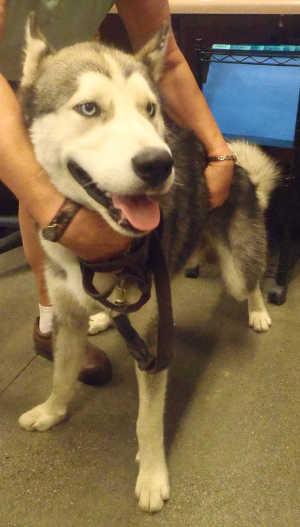
Husky mix
This male husky mix has a medium-length gray and white coat, with blue eyes.
He's in kennel No. 28, ID No. 2595.

'Rocky'
“Rocky” is a male boxer mix with a short tricolor coat.
Shelter staff said he's a sweet boy who does well with other dogs, male or female.
He's in kennel No. 29, No. 2523.

'Groot'
“Groot” is a male chow chow-corgi mix.
He has a medium-length brown coat.
He's in kennel No. 30, ID No. 2526.

'Toto'
“Toto” is a male wirehaired terrier mix.
He has a medium-length white coat.
Toto is in kennel No. 31a, ID No. 2525.

'Mimi'
“Mimi” is a Chihuahua mix.
She has a short white and tan coat. Mimi loves attention and being held.
Mimi is in kennel No. 32a, ID No. 2055.

Male Chihuahua mix
This male Chihuahua mix has a short white coat.
He's in kennel No. 32b, ID No. 2321.

'Toenail'
“Toenail” is a female pit bull terrier mix.
She has a short red and white coat, and perky ears, and loves tennis balls.
She's in kennel No. 33, ID No. 2455.
To fill out an adoption application online visit http://www.co.lake.ca.us/Government/Directory/Animal_Care_And_Control/Adopt/Dog___Cat_Adoption_Application.htm .
Lake County Animal Care and Control is located at 4949 Helbush in Lakeport, next to the Hill Road Correctional Facility.
Office hours are Monday through Friday, 11 a.m. to 5 p.m., and 11 a.m. to 3 p.m., Saturday. The shelter is open from 11 a.m. to 4 p.m. Monday through Friday and on Saturday from 11 a.m. to 3 p.m.
Visit the shelter online at http://www.co.lake.ca.us/Government/Directory/Animal_Care_And_Control.htm .
For more information call Lake County Animal Care and Control at 707-263-0278.
Email Elizabeth Larson at
Algae are complicated. The little plants can be both good and bad.
Single-celled algae called phytoplankton are a main source of food for fish and other aquatic life, and account for half of the photosynthetic activity on Earth – that’s good.
But certain varieties such as some cyanobacteria produce toxins that can harm humans, fish and other animals.
Under certain conditions, algae populations can grow explosively – a spectacle known as an algal bloom, which can cover hundreds of square kilometers.
For example, in August 2014, a cyanobacteria outbreak in Lake Erie prompted Toledo, Ohio, officials to ban the use of drinking water supplied to more than 400,000 residents.
With support from NASA, the EPA has developed an app to track algae that can threaten fresh water supplies.
In the United States alone, freshwater degradation from “bad” algae costs the economy about $64 million a year.
NASA, the U.S. Environmental Protection Agency (EPA), National Oceanic and Atmospheric Administration, and U.S. Geological Survey are doing something about it. NASA has long used Earth observing satellites to locate algal bloom outbreaks in the ocean.
But now, this unique satellite data will be routinely produced in a form that helps US water quality managers monitor our freshwater. Water quality managers will soon, with a peek at their cell phones, have an answer to “how's the water?”
The four agencies are working on a joint project, sponsored by NASA, to transform satellite data into an indicator of cyanobacteria outbreaks in our freshwater supply. The data will be integrated into an EPA Android smart phone application so environmental officials can see – at a glance – the condition of a specific water body.
“With our app, you can view water quality on the scale of the US, and zoom in to get near-real-time data for a local lake,” explains the EPA's Blake Schaeffer, Principal Investigator for the project. “When we start pushing this data to smartphone apps, we will have achieved something that's never been done – provide water quality satellite data like weather data. People will be able to check the amount of 'algae bloom' like they would check the temperature.”
Here’s how it works:
A harmful species of cyanobacteria emits chlorophyll and fluorescent light at various points in their life cycles.
Landsat and NASA’s Moderate Resolution Imaging Spectroradiometer (MODIS) can detect these “ocean color” signals, which reveal the location and abundance of cyanobacteria.
The project team will collect this data for freshwater bodies and convert it into a form accessible through web portals and the EPA mobile app.
In addition to MODIS, they'll draw data from the European Space Agency's Sentinel-2 and Sentinel-3.
With early warning about a developing bloom, officials at water treatment plants will be better able to determine when, where, and how much to treat the water to keep consumers safe.
That means unnecessary – and expensive – overtreatment may be avoided. The data will also help park managers alert swimmers, boaters, and other recreational users to hazardous conditions.
Says NASA Administrator Charles Bolden: “We’re excited to be putting NASA’s expertise in space and scientific exploration to work protecting public health and safety.”
The project will also help scientists understand why “bad” algae outbreaks occur. By comparing the color data with landcover change data, they’ll learn more about environmental factors that spur algal growth.
The result: better forecasts of bloom events. So we’ll know when an algae bloom is safe or harmful.
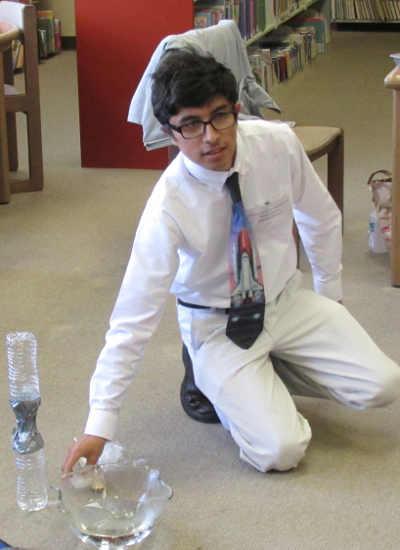
LAKEPORT, Calif. – The Lake County Library invites the public to get to know about Kelseyville’s Taylor Observatory-Norton Planetarium in the July installment of the library’s free lecture series Know Lake County.
Eduardo Alatorre will describe the observatory’s programs and functions at the Lakeport Library, 1425 N. High St., at 2 p.m. Saturday, July 18.
Beneath Lake County's coal black skies, where stars shine like precious gems, sits Taylor Observatory at 5725 Oak Hills Lane in Kelseyville.
As a program of the Lake County Office of Education for the past 35 years this remarkable facility has thrilled thousands of students and families with entertaining and educational astronomy programs.
In recent years Taylor has expanded into robotics and other sciences to help the students of Lake County jump into Science, Technology, Engineering and Mathematics, or STEM.
More information and a printable brochure can be found at http://www.lakecoe.org/programs/taylor_observatory .
Alatorre had a strong interest in astronomy and physics from a young age. In high school he volunteered as a high school docent for Taylor Observatory for more than a year and half.
Since November 2013 he has been working for Taylor Observatory as an observatory assistant and he is on the Friends of Taylor Observatory Board of Directors.
He is currently studying for an AA degree in mathematics with plans to transfer to a university.
The Know Lake County programs take place on the third Saturday of each month from February through December at 2 p.m. at Lakeport Library.
Know Lake County delves into many facets of Lake County with family-friendly programs designed to inform and entertain local residents about Lake County.
Lectures scheduled in coming months will feature the Anderson Marsh Interpretive Association; Lake County’s pre-history; the Konocti Regional Trails, the Soper-Reese Theatre and the Children’s Museum of Art and Science.
Know Lake County’s full schedule is posted on the Know Lake County Web site at http://co.lake.ca.us/Government/Directory/Lake_County_CA__Library/KLC.htm . The schedule is subject to change without notice.
The Lake County Library is on the Internet at http://library.co.lake.ca.us and Facebook at www.facebook.com/LakeCountyLibrary .
Library events are also posted at www.co.lake.ca.us/Government/Directory/Lake_County_CA__Library/Calendar.htm .
For more information about Know Lake County and other library programs call 707-263-8817.
Jan Cook works for the Lake County Library.