 How to resolve AdBlock issue?
News
LAKE COUNTY, Calif. – Authorities are continuing their investigations into three fatal vehicle crashes that have occurred over the past month.
The crashes occurred June 27, July 2, July 6, and claimed a total of four lives.
In the first, two men died when the 2005 Toyota Scion they were traveling in on Morgan Valley Road near Lower Lake went off the road, hit a tree and burst into flames.
The Lake County Sheriff's Office is leading the coroner's investigation.
Officer Kory Reynolds of the California Highway Patrol's Clear Lake Area office said the effort to identify the two men is still under way.
The second incident, which occurred on July 2, involved a box truck and two vehicles on Highway 29 south of Highway 175/Cobb.
Truck driver Robert Ochoa, 27, from Meridian died from injuries he sustained when the truck he was driving overturned after hitting two passenger vehicles, according to the CHP.
Witnesses said they saw 24-year-old Justin Brink of Clearlake – driving a 2013 Mazda 3 southbound – cross the double-yellow lines into the northbound lanes and into the path of the 2008 International refrigerated box truck Ochoa was driving.
Reynolds said investigators haven't yet determined why Brink's vehicle went into Ochoa's path.
“All aspects are being looked into,” from texting to the possibility that substances were involved, Reynolds said.
The third incident still under investigation is a fatal hit-and-run on Highway 20 west of Saratoga Springs near Upper Lake on the night of July 6.
A man was found unresponsive on the south shoulder of the highway, the CHP said. He subsequently was declared dead at the scene by firefighters.
Authorities have not yet released the name of the man, Reynolds said.
Reynolds previously reported that an autopsy ruled that the man's cause of death was blunt force trauma caused by a motor vehicle collision.
The CHP and the Lake County Sheriff's Office are jointly investigating the crash.
Reynolds said the man who died was walking alone along the highway when he was hit by a vehicle which authorities are still working to identify.
The CHP has been able to confirm that the man had made contact that night with some people in the area who had given him a sweatshirt, Reynolds said.
Reynolds acknowledged that the case so far has been a baffling one for investigators.
He said the CHP is continuing to follow up on leads and is creating a timeline of the events leading to the man's death.
Anyone with information about the crash should contact the CHP's Clear Lake Area office, 707-279-0103.
Email Elizabeth Larson at
LAKE COUNTY, Calif. – California's and the nation's unemployment numbers had a modest improvement in June, while Lake County's numbers remained unchanged over the previous month.
The Employment Development Department's Friday report said Lake County's June unemployment was 6.8 percent in June, the same as it had been in May but improved from the 8.3 percent recorded in May 2014.
The agency said California’s unemployment rate decreased to 6.3 percent in June, down from 6.4 percent in May and 7.5 percent in June 2014.
California's unemployment rate is derived from a federal survey of 5,500 California households.
The Bureau of Labor Statistics reported that the United States unemployment rate was 5.3 percent, down from 5.5 percent in May and 6.1 percent the previous June.
Lake County's statewide ranking in June was No. 32. Lake's neighboring counties ranked as follows: Colusa, 12.9 percent, No. 57; Glenn, 8.6 percent, No. 45; Mendocino, 5.1 percent, No. 14; Napa, 4.1 percent, No. 5; Sonoma, 4.3 percent, No. 6; and Yolo, 6 percent, No. 23.
San Mateo County had the lowest unemployment rate statewide, with 3.3 percent, while Imperial County, with 21.1 percent, had the highest rate for June.
Lake County had a civilian workforce composed of 30,570 people in June, of which 2,080 were unemployed, compared to a May workforce that also totaled 30,570 but with 2,090 unemployed. The June 2014 civilian workforce totaled 29,810, with 2,490 unemployed.
Most local industries under the heading of “nonfarm” showed modest job growth in June as compared to May, for a “total nonfarm” category rate of 0.6 percent, while “total farm” had a -3.9 percent change over the month.
From May to June, within the total nonfarm category, goods producing grew by 2.4 percent; total private, 0.7 percent; private service providing, 0.6 percent; and service providing, 0.5 percent.
June's job growth compared to the previous year showed a -1.6 percent change in total farm and 4.9 percent in total nonfarm.
Within total nonfarm, goods producing has shown a 10.3-percent increase compared to June 2014, while service providing has grown by 4.6 percent; total private, 4.4 percent; and private service providing, 4.1 percent.
Across the rest of the state, nonfarm jobs in California totaled 16,069,000 in June, an increase of 22,900 jobs over the month – following a gain of 46,200 jobs in May – according to a survey of 58,000 California businesses that measures jobs in the economy.
The year-over-year change, June 2014 to June 2015, showed an increase of 461,800 jobs, or a 3-percent increase, while there has been a total gain of 1,947,700 jobs since the recovery began in February 2010, the EDD reported.
The federal survey of households, done with a smaller sample than the survey of employers, showed an increase in the number of employed people.
The EDD said that survey estimated the number of Californians holding jobs in June was 17,848,000, an increase of 35,000 from May, and up 483,000 from the employment total in June 2014.
The number of people unemployed in California was 1,195,000 – down by 18,000 over the month, and down by 217,000 compared with June of last year, the EDD said.
Statewide, six categories – manufacturing; trade, transportation and utilities; financial activities; professional and business services; educational and health services; and other services – added jobs over the month, gaining 33,000 jobs. Professional and business services posted the largest increase over the month, adding 12,700 jobs, according to the EDD.
The EDD said five categories – mining and logging; construction; information; leisure and hospitality; and government – reported job declines over the month, down 10,100 jobs. Leisure and hospitality posted the largest decrease over the month, down 5,800 jobs.
Ten categories – construction; manufacturing; trade, transportation and utilities; information; financial activities; professional and business services; educational and health services; leisure and hospitality; other services; and government – posted job gains over the year, adding 463,800 jobs, according to the report.
The EDD said professional and business services posted the largest gains on a numerical basis, adding 133,100 jobs, a 5.5-percent increase. Construction posted the largest gains on a percentage basis, up 7.0 percent, adding 47,000 jobs.
One category, mining and logging, posted job declines over the year, down 2,000 jobs, or a 6.4 percent decrease, the state said.
The report also included an update in Unemployment Insurance recipients.
The EDD reported that there were 362,157 people receiving regular Unemployment Insurance benefits during the June survey week, compared with 379,996 in May and 418,927 in June of last year.
At the same time, new claims for Unemployment Insurance were 45,591 in June, compared with 42,929 in May and 62,749 in June of last year.
Email Elizabeth Larson at
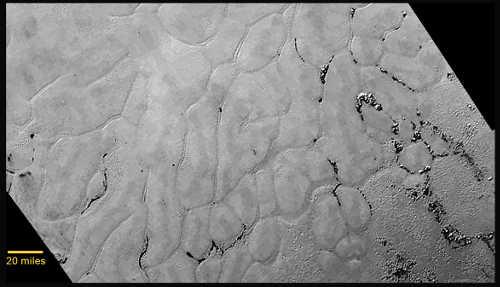
In the latest data from NASA’s New Horizons spacecraft, a new closeup image of Pluto reveals a vast, craterless plain that appears to be no more than 100 million years old, and is possibly still being shaped by geologic processes.
This frozen region is north of Pluto’s icy mountains, in the center-left of the heart feature, informally named “Tombaugh Regio” (Tombaugh Region) after Clyde Tombaugh, who discovered Pluto in 1930.
“This terrain is not easy to explain,” said Jeff Moore, leader of the New Horizons Geology, Geophysics and Imaging Team (GGI) at NASA’s Ames Research Center in Moffett Field, California. “The discovery of vast, craterless, very young plains on Pluto exceeds all pre-flyby expectations.”
This fascinating icy plains region – resembling frozen mud cracks on Earth -- has been informally named “Sputnik Planum” (Sputnik Plain) after the Earth’s first artificial satellite.
It has a broken surface of irregularly-shaped segments, roughly 12 miles (20 kilometers) across, bordered by what appear to be shallow troughs.
Some of these troughs have darker material within them, while others are traced by clumps of hills that appear to rise above the surrounding terrain.
Elsewhere, the surface appears to be etched by fields of small pits that may have formed by a process called sublimation, in which ice turns directly from solid to gas, just as dry ice does on Earth.
Scientists have two working theories as to how these segments were formed. The irregular shapes may be the result of the contraction of surface materials, similar to what happens when mud dries. Alternatively, they may be a product of convection, similar to wax rising in a lava lamp.
On Pluto, convection would occur within a surface layer of frozen carbon monoxide, methane and nitrogen, driven by the scant warmth of Pluto’s interior.
Pluto’s icy plains also display dark streaks that are a few miles long. These streaks appear to be aligned in the same direction and may have been produced by winds blowing across the frozen surface.
The Tuesday “heart of the heart” image was taken when New Horizons was 48,000 miles from Pluto, and shows features as small as one-half mile across. Mission scientists will learn more about these mysterious terrains from higher-resolution and stereo images that New Horizons will pull from its digital recorders and send back to Earth during the next year.
The New Horizons Atmospheres team observed Pluto’s atmosphere as far as 1,000 miles above the surface, demonstrating that Pluto’s nitrogen-rich atmosphere is quite extended. This is the first observation of Pluto’s atmosphere at altitudes higher than 170 miles above the surface.
The New Horizons Particles and Plasma team has discovered a region of cold, dense ionized gas tens of thousands of miles beyond Pluto – the planet’s atmosphere being stripped away by the solar wind and lost to space.
“This is just a first tantalizing look at Pluto’s plasma environment,” said New Horizons co-investigator Fran Bagenal, University of Colorado, Boulder.
"With the flyby in the rearview mirror, a decade-long journey to Pluto is over – but, the science payoff is only beginning,” said Jim Green, director of Planetary Science at NASA Headquarters in Washington. "Data from New Horizons will continue to fuel discovery for years to come.”
Alan Stern, New Horizons principal investigator from the Southwest Research Institute, Boulder, Colorado, added, “We’ve only scratched the surface of our Pluto exploration, but it already seems clear to me that in the initial reconnaissance of the solar system, the best was saved for last."
Follow the New Horizons mission on Twitter and use the hashtag #PlutoFlyby to join the conversation. Live updates are also available on the mission Facebook page.
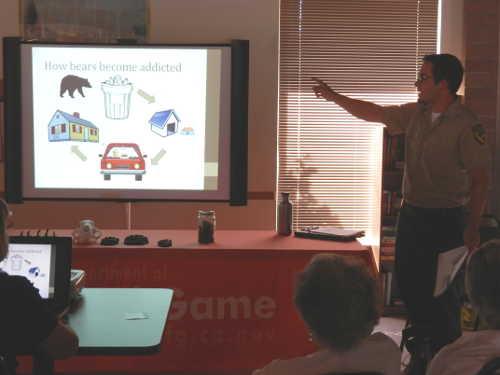
CLEARLAKE OAKS, Calif. – The California Department of Fish and Wildlife delivered a “bear aware” presentation Thursday evening at Orchard Shores in Clearlake Oaks, providing area residents with tips for living responsibly in bear country.
“All of Lake County is bear habitat,” said CDFW informational officer Janice Mackey. “You have lots of bears here.”
CDFW's mission is to manage the state's diverse fish, wildlife and plant resources, and the habitats upon which they depend, for their ecological values and for their use and enjoyment by the public.
Wildlife biologist Joshua Bush said the goal of the management program and the evening presentation was to keep the bear playing its significant role in nature.
“People who live in or visit bear habitat have a responsibility to the wildlife whose habitat they are sharing,” Bush said. “This means securing food and trash at all times.”
Bush said unsecured garbage is the primary reason bears infringe on residential areas in the community.
Water sources are another, he said. “If you are by a creek, you can expect wildlife to be moving through there all the time.”
Bush said bears have a keen sense of smell and can detect food from miles away, and, as omnivores, they will eat almost anything including human food, pet food, bird seed and garbage.
He said if bears are allowed access these foods, they will quickly become conditioned to humans.
“When this happens, bear-human conflicts occur,” Bush said. “Bears lose their fear of humans. The more they are around you, the less of a threat you become.”
Bears generally breed every other year and typically have two cubs. The cubs usually stay with the mother bear for up to two years, all the while, learning to do what she does, including how and where to find food. Bush said this can result the conditioning of generations of bears.
Bears can cause extensive property damage if they become conditioned to human food. Bush said they can take doors off hinges, tear off siding from a home or cabin and even get into vehicles.
“Bears are incredibly strong. Not much is bear-proof. If they get habituated and they want that source of food, they will find a way to get it,” he said.
The key to keeping bears wild, Bush said, is proper storage of food and trash, which he said requires the action and commitment from everyone in the community. “Just one house with unsecured trash puts a whole neighborhood at risk,” he said.
Bears that lose their natural fear of humans can become aggressive and dangerous. Bush said if a person finds a bear in their home, they should get out of its way and call 911.
He said if people come across bears in their yard or in the wilderness, they should make noise and give the animals plenty of room. In most instances, if given an escape route, the bear will usually take it, Bush said.
He said air horns, paintball guns and barking dogs are good deterrents against a bear. If you are attacked, he said, fight back and do not play dead.
Bush said bears that have become conditioned to human food and that have caused property damage and/or killed pets or livestock may be killed under state law.
“Once conditioned, bears cannot successfully be relocated,” he said. “This just moves the problem somewhere else. Bears regularly return to the same property or another property where they continue their same destructive behavior.”
Additionally, Bush said, with the high population of bears in the state, it is assumed that another bear already occupies any territory in which the menace bear could be relocated. This causes perpetual displacement among the bears. Risk of disease also is a factor.
“The bottom line is what I like to stress,” he said. “A fed bear is a dead bear.”
According to state law, a bear may be killed immediately if it threatens human life or is caught in the of harassing or injuring livestock.
In addition, CDFW may issue a depredation permit to a landowner or tenant who has experienced property damage from bears. The permit allows the permit-holder or designee to kill the offending bear.
“But a depredation permit is the last step in a series of steps taken to eliminate the problem,” Bush said.
According to Bush, California black bears are the only species in the state and have an estimated population of 35,000. “That number is not going down anytime soon,” he said.
Feeding bears, and any other wildlife, intentionally or unintentionally, is illegal and may result in a citation and hefty fine.
Game Warden Ryan Stephenson urged those who witness someone intentionally feeding wildlife or engaging in poaching activities to call Cal-Tip at 1-888-334-2258.
He said an investigation will be conducted that could possibly result in criminal prosecution. Callers can remain anonymous, however, it's beneficial if they do not.
“It is nice to talk to the reporting party. That's you guys,” Stephenson said. “Sometimes we can get more information from you than our dispatch.”
Stephenson said mitigation efforts will always be taken before a menace bear is dispatched. “I can't stress enough to you guys, we are available,” he said.
Mackey said CDFW provides an array of resources for educating the public and mitigating any problems associated with area wildlife. She said school and group presentations are available upon request as well.
The presentation at Orchard Shores was provided in response to bear sightings in the area.
Additionally, Kris Byrd, manager of the Eastlake Landfill in Clearlake, said from the audience that a bear is infringing on boundaries at dumps as well.
Bear sightings and mitigation efforts also have occurred in the area of Dam Road this year. Stephenson said everyone in that particular neighborhood took proper action and the bear relocated itself to the other side of Cache Creek. He said mitigation efforts with that bear continue.
The CDFW offers the following tips for living responsibly in bear country:
Bear-proofing your trash
– Keep your yard clean and clear of trash.
– Secure garbage in bear-proof trash cans.
– If using traditional cans, keep stored in a locked shed or garage until morning of collection day.
– Clean garbage cans often with bleach or ammonia.
– Freeze scraps of food with a strong scent and put in trash on collection day.
Bear-proofing your yard
– Never leave human food, pet food, trash or scented items outside (not even suntan lotion).
– Avoid using bird feeders.
– Clean barbecue grill after use.
– Keep vehicles free of food, food packaging or scented items.
– Install motion-activated sprinklers, lights and/or alarms.
– Install electric bear-exclusion fencing.
Bear-proofing your home
– Keep doors and windows closed and locked.
– Don't leave food out on the counter.
– Clean oven and countertops.
– When closing a cabin for the season, remove all food (even canned food and bottled drinks).
– Block access to potential den sites around your home.
– Consider electrifying doors and windows.
For more information on the CDFW's “Keep Me Wild” campaign, visit the www.keepmewild.org .
Additionally, Mackey can be reached at 916-332-8908 for more information about school and group presentations.
Contact reporter Denise Rockenstein at
LAKEPORT, Calif. – Five mosquito samples collected in Lake County tested positive for West Nile virus this week, according to a report from Lake County Vector Control.
The mosquito samples, all Culex tarsalis – or western encephalitis mosquito – were collected in Clearlake Oaks, Upper Lake and Kelseyville, Vector Control reported.
This is the first detection of WNV in Lake County in 2015, said Dr. Jamesina Scott, Ph.D., district manager and research director of the Lake County Vector Control District.
“High temperatures and warm nights are perfect for the virus and the mosquitoes to multiply quickly,” said Scott. “In 2014 we had 71 West Nile virus-positive mosquito samples from locations all over the county, and this looks the start to another active season.”
No other West Nile virus activity has been detected in Lake County yet this year, Scott said.
Statewide, 31 California counties have detected West Nile virus this year, mainly in mosquitoes and dead birds. No human cases have been reported in California this year.
More West Nile virus has been detected in California mosquitoes this year than in 2014 at this date, raising concerns that this may be another record-setting year for the virus, officials said.
While less than 1 percent of individuals – about 1 in 150 people – infected with West Nile virus will develop severe illness from West Nile virus infection, the disease can cause symptoms that can last for several weeks, and neurologic effects can be permanent. In some individuals, the infection can be fatal.
People over age 50 and diabetics are at risk for the more severe forms of the disease. The most recent confirmed case of West Nile virus infection in Lake County was in 2014.
“Since there is no West Nile Virus vaccine for humans, the best protection is to prevent mosquito bites,” said Lake County Health Officer, Dr. Karen Tait. “Taking precautions against mosquito bites is a habit that should be practiced consistently as long as mosquitoes are active. We are fortunate to have had only a few cases of human illness, but presence of the virus in mosquitoes is a reminder that we must take precautions throughout the West Nile virus season.”
Tait said that staying indoors during early morning and evening hours, keeping window screens in good repair, wearing protective clothing and use of insect repellents according to package instructions will help reduce the risk of catching the infection.
“In drought years like this, many of us are collecting water in containers, and that creates a perfect home for mosquitoes,” she said. “We’re asking residents to use saved water within 3 days or to keep containers covered or screened so mosquitoes cannot lay their eggs there.”
The mosquitoes that transmit West Nile virus develop in rain barrels, out-of-service swimming pools and spas, animal watering troughs, ornamental ponds, and other sources of standing water.
Vector Control has free mosquito-eating fish to control mosquitoes in these sources. Residents are encouraged to contact the district to report neglected pools, request service for mosquito problems, or to get mosquito fish at 707-263-4770 or to fill out a service request online at www.lcvcd.org .
Vector Control traps and tests mosquitoes throughout the county to identify the areas that have the highest risk, and targets those areas for source reduction and treatment using an integrated vector management program.
Residents with questions, or who would like help with a mosquito problem should contact the Lake County Vector Control District at 707-263-4770 or visit their Web site at www.lcvcd.org .
For more information about West Nile virus, visit http://www.westnile.ca.gov/ .
Information about mosquito repellents can be found on the US Centers for Disease Control and Prevention Web site at http://www.cdc.gov/westnile/faq/repellent.html .
LAKE COUNTY, Calif. – The Independence Day holiday is typically a busy one in Lake County, as residents and visitors alike come out to enjoy the summer celebration.
Law enforcement also is out in force during the holiday due to concerns about drunk driving.
During this year's July 4 weekend, however, arrests for drunk driving were half of what they were last year, according to Officer Kory Reynolds of the California Highway Patrol's Clear Lake Area office.
Reynolds said that the CHP's drunk driving arrests during the 2014 holiday totaled eight, compared to four this year, Reynolds said.
The arrests occurred during the CHP's “maximum enforcement period,” which takes place during the year's major holidays and events as a way of keeping the roadways safe.
This year, the Independence Day Maximum Enforcement Period ran from 6 p.m. Friday, July 3, to 11:59 p.m. Sunday, July 5.
Officers were out on the roads, keeping an eye out for those driving under the influence of alcohol and drugs, and for speed violations and other issues, such as seat belt use.
Maximum enforcement periods typically take place at New Year's, Memorial Day, Independence Day, Labor Day, Thanksgiving and Christmas.
Email Elizabeth Larson at