How to resolve AdBlock issue?
News
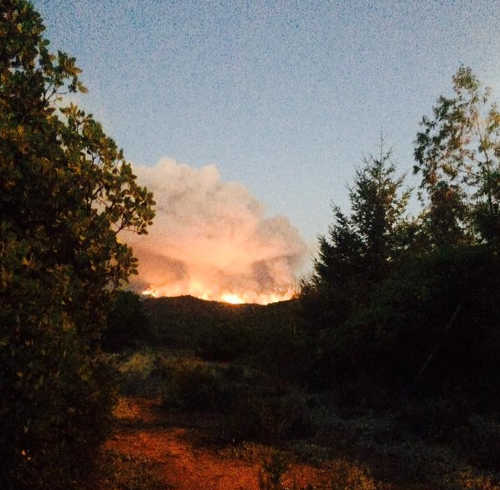
LOWER LAKE, Calif. – The Rocky fire, which started Wednesday afternoon has grown to 8,000 acres since five a.m., according to Cal Fire. No containtment has been reported.
An evacuation center is opened at the Highland Senior Center, 3245 Bowers Road, Clearlake.
An animal evacuation center is opened at the Lower Lake Social Services parking lot, 15975 Anderson Ranch Parkway, Lower Lake.
Road closures are in effect for Morgan Valley Road at Bonham, Rocky Creek Road, Dam Road, Mustang Court, Quarterhorse Road and Sleepy Hollow.
Evacuations remain in place for the North side of Morgan Valley Road for 5 miles east of Bonham Rd.
South of Lower Lake evacuations in place at Spruce Grove Rd. NORTH, Noble Ranch, Jerusalem Grade, and Cantwell Ranch.
Lower Lake proper and Hidden Valley Lake are not subject to evacuation.
As of seven a.m. Cal Fire reports that several outbuildings have been destroyed.
Agencies involved include CAL FIRE, Kelseyville FPD, South Lake FPD, Northshore FPD, Lake County Sheriff, CHP, Lake Evacuation and Animal Protection (LEAP), Lake County Office of Emergency Services and North Bay Incident Management Team. Resources working the fire include 315 fire personnel, 35 engines, eight fire crews, eight airtankers, eight helicopters, nine dozers and four water tenders.
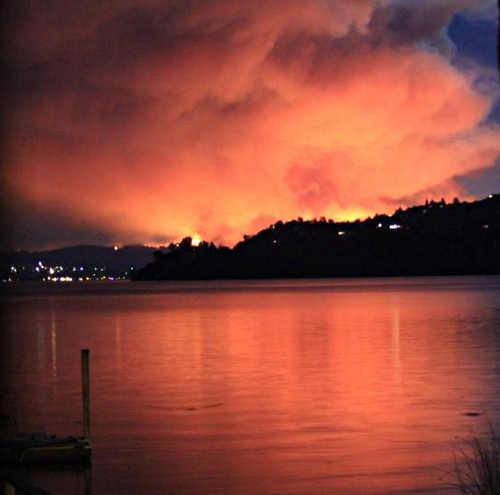
LOWER LAKE, Calif. – As local and state firefighters worked through the night to contain a growing wildland fire, local officials called for more evacuations that forced hundreds from their homes.
The Rocky fire broke out Wednesday afternoon near Morgan Valley Road and Rocky Creek Road, east of Lower Lake.
Within hours the fire had scorched 3,000 acres in difficult-to-access, rugged terrain covered with heavy brush and timber, sending up a huge plume of smoke that was traveling into neighboring counties and had worked its way up along the Northshore.
Shortly before 5 a.m., Cal Fire reported that the fire had grown to 5,000 acres, with no containment.
More than 300 firefighters were committed to the incident Wednesday night, and resources were called in from other major incidents around the region, such as the 7,500-acre Wragg fire in neighboring Napa County that's nearing full containment.
As of early Thursday, the fire had destroyed several outbuildings, but officials are holding off on further damage assessments while they focus on fighting the fire.
No injuries have been reported.
Cal Fire said the fire has forced the evacuations of 500 Lower Lake area residents.
On Wednesday afternoon, mandatory evacuation orders were issued in the Lower Lake area for Morgan Valley Road, east of Bonham Road, with residents in an area south of Lower Lake – Spruce Grove Road, north of the intersection with Jerusalem Grade Road, along with Noble Ranch, Jerusalem Grade and Cantwell Ranch roads – being ordered to evacuate late Wednesday night.
Lower Lake proper and Hidden Valley Lake were not under evacuation orders, county officials said early Thursday morning.
A Red Cross evacuation center is open at the Highland Senior Center in Clearlake, 3245 Bowers Ave., with county officials reporting early Thursday that Middletown High School, 20932 Big Canyon Road, also had been opened as a shelter location.
An evacuation center for animals has been set up in the parking lot of the Lake County Department of Social Services, located off of Highway 53 at 15975 Anderson Ranch Parkway in Lower Lake.
The Lake County Emergency Operation Center, located in the county offices in Lakeport, was activated as a result of the fire, the first time it's been needed since a severe storm incident in December.
County emergency officials reported early Thursday that the fire was forcing a closure – until further notice – of all summer school programs in Lower Lake, Hidden Valley Lake and Middletown.
Several local and regional agencies are working together on the fire, including Cal Fire, Lake County Fire, Kelseyville Fire, Northshore Fire, South Lake County Fire, the Lake County Sheriff's Office, the California Highway Patrol, Lake Evacuation and Animal Protection, Lake County Office of Emergency Services and North Bay Incident Management Team.
Resources committed to the fire included 315 firefighters, 35 fire engines, eight fire crews, eight air tankers, eight helicopters, nine dozers and four water tenders.
Road closures are in effect for Morgan Valley Road at Bonham, Rocky Creek Road, Dam Road, Mustang Court, Quarterhorse Road and Sleepy Hollow, Cal Fire said.
The fire's cause is under investigation, Cal Fire said.
Email Elizabeth Larson at
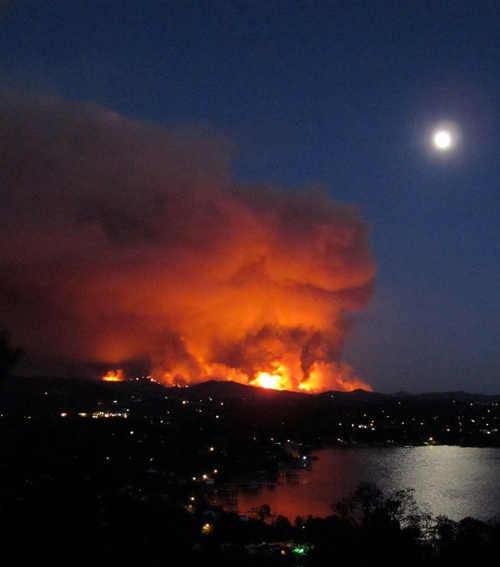
LOWER LAKE, Calif. – As the Rocky fire near Lower Lake continued to grow through the night, the Lake County Sheriff's Office expanded evacuations in the fire area.
Shortly before midnight on Wednesday, the sheriff's office reported that it had issued an order for the latest round of mandatory evacuations, this time for an area south of Lower Lake.
Those evacuations were for Spruce Grove Road, north of the intersection with Jerusalem Grade Road; Noble Ranch Road; Jerusalem Grade Road; and Cantwell Ranch Road.
Earlier on Wednesday, mandatory evacuation orders were issued in the Lower Lake area for Morgan Valley Road, east of Bonham Road, according to the Lake County Office of Emergency Services.
As of early Thursday, Lower Lake proper and Hidden Valley Lake were not under evacuation orders, county officials said.
A Red Cross evacuation center is open at the Highland Senior Center in Clearlake, 3245 Bowers Ave., with county officials reporting early Thursday that Middletown High School, 20932 Big Canyon Road, also has been opened as a shelter location.
Animals are being evacuated to the parking lot of the Department of Social Services off of Highway 53 at 15975 Anderson Ranch Parkway in Lower Lake.
County officials also reported that all summer school programs in Lower Lake, Hidden Valley Lake and Middletown are canceled until further notice.
The Lake County Emergency Operation Center also was activated late Wednesday.
The Lake County Office of Emergency Services has an information line set up at 707-263-2360 and is posting updates on the Lake County OES Facebook page.
NORTHERN CALIFORNIA – Several new major wildland fires broke out during Wednesday's hot conditions, with the new incidents ranging from Shasta County to Lake County.
Cal Fire said the Wednesday afternoon fire activity in Northern California significantly increased as temperatures hit the triple digits and the winds became very gusty.
Despite the extremely challenging weather conditions, firefighters were able to contain some of the dozens of new wildland fires that were sparked, but the drought-caused dry vegetation, along with windy conditions, caused five of the wildland fires to grow, officials said.
Those new incidents included the Rocky fire near Lower Lake in Lake County; the Big Creek fire in Tuolumne County; the China and Mallard fires, both in Shasta County; and the Swedes fire in Butte County, Cal Fire reported.
Hundreds of residents were evacuated as a result of those five new incidents, fire officials said.
Hot, dry conditions with elevated fire danger are expected to continue on Thursday, according to Cal Fire.
For information on wildland fire preparedness, visit www.ReadyForWildfire.org .
The following is a summary of major wildfire incidents around the state, with size estimates through late Wednesday night.
Cal Fire incidents
– Rocky fire: Began July 29 near Lower Lake in Lake County; 3,000 acres, zero containment. Evacuations in effect. Cause is under investigation.
– Big Creek fire: Began July 29 in Tuolumne County; 150 acres, zero containment. Cause is under investigation.
– China fire: Two fires that began July 29 in Shasta County; 150 acres, 50-percent contained. Evacuations in effect. Cause is under investigation.
– Mallard fire: Began July 29 in Shasta County; 75 acres, 50-percent contained. Evacuations in effect. Cause is under investigation.
– Swedes fire: Began July 29 in Butte County; 500 acres, 10-percent contained. Evacuations in effect. Cause is under investigation.
– Lowell fire: Began July 25 in Nevada County; 2,303 acres, 50-percent contained. Evacuation advisories in effect. Six injuries. Cause is under investigation. Estimated full containment: Aug. 3.
– Wragg fire: Began July 22 in Napa and Solano counties; 7,500 acres, 80-percent contained. Evacuations remain in effect. Two outbuildings destroyed, three outbuildings and one residence damaged. No injuries reported. Cause is under investigation. Estimated full containment: Aug. 2.
– Queen fire: Began July 25 in Humboldt County; 158 acres, 75-percent contained. Two injuries. Cause is under investigation.
Federal incidents
– Cabin fire: Began July 29 in Tulare County; 180 acres, no containment. Caused by lightning.
– Willow fire: Began July 25 in Madera County; 2,077 acres, 30-percent contained. No injuries reported. Caused by arson.
– Cutca fire: Began July 24 in San Diego County; 167 acres, 75-percent contained. No injuries reported. Cause is unknown.
– Kyburz fire: Began July 23 in El Dorado County; 75 acres, 100-percent contained. No injuries reported. Cause is under investigation.
– Pines fire: Began July 17 in Los Angeles County; 200 acres, 100-percent contained. No injuries reported. Cause is under investigation.
– Lake fire: Began July 16 in San Bernardino County; 31,359 acres, 98-percent contained. No injuries reported. Human caused; remains under investigation.
– Washington fire: Began June 19 in Alpine County; 17,790 acres, 99-percent contained. No injuries reported. Caused by lightning. Estimated full containment: July 31.
Email Elizabeth Larson at
When someone says “Once in a blue moon,” you know what they mean: Rare, seldom, even absurd.
This year it means “the end of July.”
For the second time this month, the Moon is about to become full. There was one full Moon on July 2, and now a second is coming on July 31.
According to modern folklore, whenever there are two full moons in a calendar month, the second one is “blue.”
The second full moon of July is just around the corner. According to modern folklore, it is a “blue moon.”
This definition of a blue moon is a recent thing.
If you told a person in Shakespeare's day that something happens “once in a blue moon” they would attach no astronomical meaning to the statement. Blue moon simply meant rare or absurd, like making a date for “the Twelfth of Never.” Since then, however, its meaning has shifted.
The modern definition sprang up in the 1940s. In those days the Maine Farmer's Almanac offered a definition of blue moon so convoluted many astronomers struggled to understand it.
It involved factors such as ecclesiastical dates of Easter and Lent, tropical years, and the timing of seasons according to the dynamical mean sun.
Aiming to explain blue moons to the layman, Sky & Telescope published an article in 1946 entitled “Once in a Blue Moon.” The author, James Hugh Pruett (1886-1955), cited the 1937 Maine almanac and opined that the “second [full moon] in a month, so I interpret it, is called Blue Moon.”
This was not correct, but at least it could be understood. And thus the modern blue moon was born.
Most blue moons look pale gray and white, just like the moon you've seen on any other night. Squeezing a second full moon into a calendar month doesn't change its color.
Nevertheless, on rare occasions the moon can turn blue.
A truly-blue moon usually requires a volcanic eruption.
Back in 1883, for example, people saw blue moons almost every night after the Indonesian volcano Krakatoa exploded with the force of a 100-megaton nuclear bomb. Plumes of ash rose to the very top of Earth's atmosphere, and the moon … it turned blue!
Krakatoa's ash was the reason. Some of the plumes were filled with particles 1 micron wide, about the same as the wavelength of red light. Particles of this special size strongly scatter red light, while allowing blue light to pass through. Krakatoa’s clouds thus acted like a blue filter.
People also saw blue-colored moons in 1983 after the eruption of the El Chichon volcano in Mexico. And there are reports of blue moons caused by Mt. St. Helens in 1980 and Mount Pinatubo in 1991.
Forest fires can do the same trick. A famous example is the giant muskeg fire of September 1953 in Alberta, Canada. Clouds of smoke containing micron-sized oil droplets produced lavender suns and blue moons all the way from North America to England.
At this time of year, summer wildfires often produce smoke with an abundance of micron-sized particles – just the right size to turn the Moon truly blue.
On the other hand, maybe it will turn red. Often, when the moon is hanging low, it looks red for the same reason that sunsets are red. The atmosphere is full of aerosols much smaller than the ones injected by volcanoes. These aerosols scatter blue light, while leaving the red behind.
For this reason, red blue moons are far more common than blue blue moons.
Sounds absurd? Yes, but that's what a blue moon is all about. Step outside at sunset on July 31, look east, and see what color presents itself.
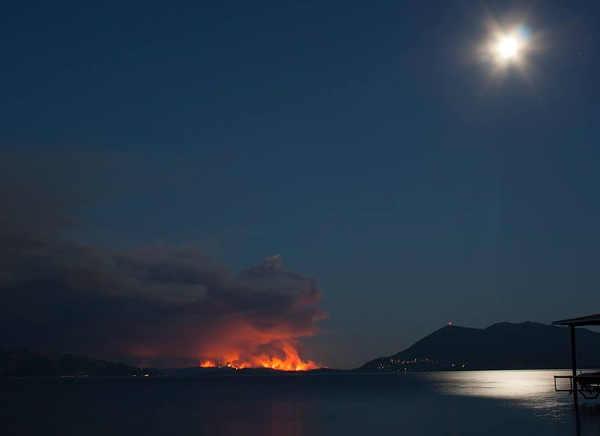
LOWER LAKE, Calif. – Firefighters on Wednesday night were continuing to be challenged by a growing wildland fire that has so far consumed 3,000 acres near Lower Lake.
The Rocky fire – originally called the “Rock” fire – has been burning since about 3:30 p.m. Wednesday near Morgan Valley and Rocky Creek roads, east of Lower Lake.
Shortly after 7 p.m. Cal Fire reported that the fire had reached 1,000 acres. It continued to grow rapidly, expanding to 3,000 acres in another two hours' time.
No containment has been reported on the fire so far.
Cal Fire said evacuations are in place for the north side of Morgan Valley Road to five miles east of Bonham Road.
A home was reported to be on fire in the 21000 block of Morgan Valley Road shortly before 9:30 p.m., with people inside. Two strike teams were dispatched to the scene.
Evacuees are continuing to be directed to a Red Cross evacuation center at the Highlands Senior Center at 3245 Bowers Ave. in Clearlake, while an animal evacuation center is open at the Lower Lake Social Services parking lot, 15975 Anderson Ranch Parkway.
A number of road closures also are in effect, including Morgan Valley Road at Bonham, Rocky Creek Road, Dam Road, Mustang Court, Quarterhorse Road and Sleepy Hollow, Cal Fire said.
The resources on scene Wednesday night from Cal Fire and agencies around the lake included 315 personnel, 35 engines, eight fire crews, eight air tankers, eight helicopters, nine dozers and four water tenders.
Additional resources have been ordered and are responding, Cal Fire said.
Email Elizabeth Larson at