 How to resolve AdBlock issue?
News
LAKE COUNTY, Calif. – The Lake County Air Quality Management District said it is monitoring the impacts of the Rocky fire, burning since Wednesday near Lower Lake.
The growing fire has resulted in smoke, haze and degraded air quality for portions of Lake County, with the weather patterns east and south pushing the smoke to certain areas, the district reported.
Additional air monitoring has been implemented in the impacted area, according to the district.
The district said the current one-hour average measurement in Lakeport is healthy, with particulate levels at 25 percent of allowed state health-based particulate standards for small respirable particulate and the ultrafine, inhalable particulate.
Those levels are expected to rise, the district said, with the potential for moderate to unhealthy air in areas of Clearlake, Spring Valley, Lower Lake, Morgan Valley, Twin Lakes, Hidden Valley Lake, Jerusalem Grade and possibly portions of Middletown until the Rocky fire is contained.
Impacts are anticipated primarily in the overnight and morning hours, generally clearing by midday.
Regional weather patterns suggest moderate west winds for the next couple days, which will help keep the smoke out of populated areas.
Residents are advised to be cautious in resuming normal outdoor activities. Variable weather conditions and ongoing fire activity may result in localized areas of reduced air quality, which could still pose health risks to people with underlying health conditions.
Since officials can’t always predict when and where “pockets” of poorer air quality may occur, the district suggested that it is prudent to be careful until conditions stabilize.
Smoky conditions can cause irritation of the eyes, nose and air passages, which can be hazardous in young children, the elderly, individuals with heart conditions or chronic lung disease such as asthma, bronchitis and other respiratory conditions.
Air conditioning that recirculates indoor air should be used, when available. Drinking plenty of water to avoid drying of the airways is recommended, unless restricted for medical reasons.
Regional haze and particulates from the Rocky fire are expected to continue throughout Lake County until the fire is out, the district said.
With record-breaking heat throughout much of the state in June, Californians continued to conserve water, reducing water use by 27.3 percent and exceeding Gov. Jerry Brown’s 25-percent mandate in the first month that the new emergency conservation regulation was in effect.
The results show that Californians understand the severity of the drought and are taking action, according to Felicia Marcus, chair of the State Water Resources Control Board.
“We didn’t know if the positive showing in May was due in part to cooler temperatures. This report shows that residents knew they had to keep conserving even during the summer heat and they kept the sprinklers off more than they would in a normal year. That’s the right attitude as we head into August and September heat – in the drought of the century with no certain end date,” Marcus said.
Despite being the hottest June on record, California’s urban water suppliers exceeded the statewide conservation goal, saving 59.4 billion gallons (182,151 acre-feet), as compared to the same time in 2013. June conservation efforts put the state on track to achieve the 1.2 million acre-feet savings goal by February 2016, as called for by the governor in his April 1 executive order.
Smaller water suppliers of 3,000 connections or less do not need to follow the monthly reporting requirements.
Most of the systems serving Lake County fall into that category, with the exception of California Water Service Co., which owns the Lucerne system.
Lucerne is included in Cal Water's Redwood Valley District, which is subject to the urban water suppliers' rules due to having a population of 3,628 people.
The June reported showed that Cal Water's Redwood Valley District had a cumulative savings of 38 percent, surpassing its requirement by 22.1 percent.
Water suppliers have made significant investments in their education and outreach programs to communicate the need to conserve to their customers, and June’s enforcement statistics highlight the growing awareness of how water is used locally as a result of these programs.
Suppliers reported that their compliance and enforcement programs saw an almost twofold increase in the number of complaints of water waste which resulted in a big jump in reported penalties.
Monthly water use reports are required by the emergency water conservation regulation, and are provided to the State Water Board by urban water suppliers.
Urban water suppliers are expected to meet, or exceed, their individual conservation standard starting in June and continuing through February 2016. The year 2013 serves as the baseline for determining water savings statewide.
Millions of people take part in saving water
The percent of water saved by the state’s large urban water agency suppliers decreased from 29.1 percent in May to 27.3 percent in June, in same-month water use comparisons of 2015 to 2013. June 2015 was the warmest June on record.
The amount of water saved in June 2015 (59.4 billion gallons) is six times more than the amount of water saved during the same month in 2014 (9.6 billion gallons), when the state’s voluntary 20 percent conservation goal was in effect.
The June 2015 savings are 15 percent of the statewide savings goal of 1.2 million acre-feet of water needed by February 2016.
Two hundred and sixty five water suppliers, serving 27.2 million people, met or exceeded their conservation standard. Almost 40 percent of all urban water suppliers reduced their water use by 30 percent or more.
In April, water suppliers began reporting on their compliance and enforcement efforts to promote conservation and reduce water waste.
The June statistics demonstrate community and water supplier commitment to identify and correct wasteful practices:
– 43,942 water waste complaints were reported statewide (by 371 suppliers), compared with 28,793 complaints reported in May (by 353 suppliers);
– 35,295 formal warnings were issued for water waste statewide (by 307 suppliers), compared with 36,082 formal warnings in May (by 279 suppliers); and
– 9,582 penalties were issued statewide (by 52 suppliers), compared with 1,928 penalties issued in May (by 49 suppliers).
By the end of June, four suppliers (1 percent) had not imposed mandatory irrigation restrictions, and 19 suppliers (5 percent) reported that they still allow outdoor watering seven days a week.
“In normal years, water use rises dramatically in the hot summer months. But this year, during the hottest June on record, Californians proved that that they have the ingenuity and commitment to meet this challenge,” said Marcus. “Agencies have stepped up to the plate to engage with their customers and it shows. The public knows how bad the drought is, and agencies need to help them know what to do. Letting lawns go golden, taking shorter showers, and other actions can pay off in greater urban water security in the event of more dry years, but, at the same time, we need to be clear that trees should be watered.”
Dozens of communities achieved conservation levels of more than 30 percent in June.
Of the 405 water suppliers reporting, 265 suppliers (65 percent) met, or were within 1 percent of, their conservation standard; 53 suppliers (13 percent) are between 1 and 5 percent of meeting their conservation standard; and 71 suppliers (18 percent) are between 5 and 15 percent of meeting their conservation standard.
However, there are 16 suppliers (4 percent) that are more than 15 percent from meeting their conservation standard.
The State Water Board will be contacting all suppliers more than 1 percent away from meeting their conservation standard and requiring many to provide information about their existing conservation programs and the steps they are taking to boost conservation. The suppliers furthest from meeting their conservation standard will be directed to take additional actions, such as imposing further restrictions on outdoor irrigation and increasing outreach and enforcement.
In his April 1 executive order, Gov. Brown mandated a 25-percent water use reduction for cities and towns across California.
In May, the State Water Board adopted an emergency regulation requiring an immediate 25 percent reduction in overall potable urban water use.
The regulation uses a sliding scale for setting conservation standards, so that communities that have already reduced their residential gallons per capita per day (R-GPCD) through past conservation will have lower mandates than those that have not made such gains since the last major drought.
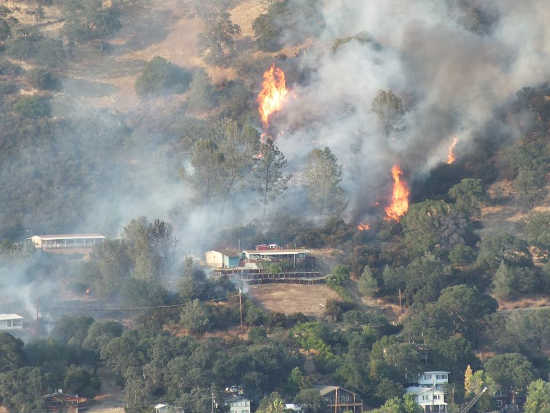
CLEARLAKE, Calif. – Firefighters are on the scene of a wildland fire in Clearlake that began early Thursday evening and led to evacuations of some nearby homes.
The fire was first dispatched at around 6:30 p.m. on Lakeshore Drive at San Joaquin Avenue, according to reports from the scene.
Originally reported as a 30-foot by 30-foot spot, the fire quickly grew to between five and 10 acres, according to reports from Cal Fire and units on scene.
The Clearlake Police Department evacuated two nearby homes, but had difficulty getting people out of one of the residences on San Joaquin, reports indicated.
Lake County Fire and Cal Fire – both of which have been committed to working on the Rocky Fire – sent resources, also calling in mutual aid assistance from Kelseyville Fire and Northshore Fire.
Cal Fire sent a full wildland response, including air resources that arrived to work the fire, but there were indications that the number of people in the area possibly was hampering the use of the air tanker.
Firefighters reported power lines were down and arcing on Terrace Drive.
At about 7:20 p.m. the forward progress had all but been stopped, with hose lays around the fire, according to units on scene, but there had been one spot fire and there were concerns about the potential for more.
If the fire managed to move forward any more, firefighters said it might move into the area of a recent fire near Borax Lake.
Additional information will be posted as it becomes available.
Email Elizabeth Larson at
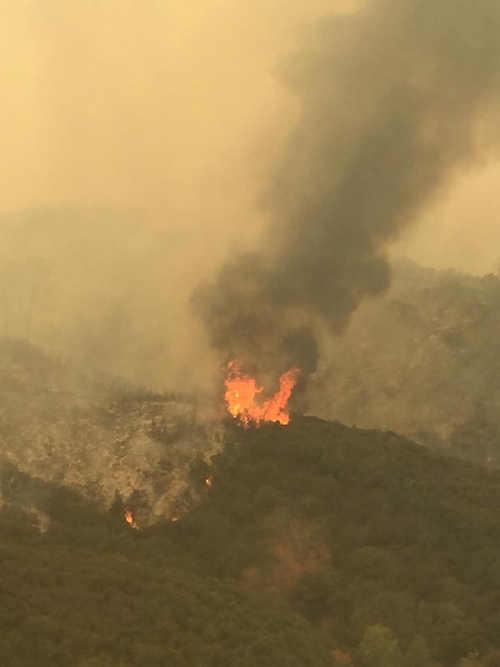
LOWER LAKE, Calif. – The acreage on the Rocky fire near Lower Lake continued to grow on Thursday afternoon, but firefighters also began to get containment on the blaze.
The fire, which began Wednesday near Morgan Valley and Rocky Creek roads east of Lower Lake, had burned 8,500 acres as of Cal Fire's latest report on Thursday afternoon.
Cal Fire said 5-percent containment has been reached on the incident so far.
The fire is primarily affecting wildlands, officials said, and has entered the Cache Creek Wilderness Area and the newly designated Berryessa Snow Mountain National Monument Area.
However, the Rocky fire also is impacting residents of some areas near Lower Lake, where three structures have been destroyed, with multiple outbuildings also destroyed or damaged, Cal Fire said.
It also has resulted in the mandatory evacuations of some 650 Lower Lake area residents, officials said.
Cal Fire reported that approximately 630 firefighting personnel were assigned to the fire as of Thursday afternoon, along with a total of 60 fire engines, 36 dozers, 14 fire crews, 12 water tenders, 11 helicopters and eight helicopters.
Some of those resources have been brought to Lake County from the Wragg fire in Napa and Solano counties, which remains at 7,500 acres and 80-percent containment, Cal Fire said.
No new evacuations have been reported since 1 a.m. Thursday, according to the Lake County Emergency Operation Center, which opened Wednesday night under the auspices of the Lake County Office of Emergency Services.
Current evacuation orders continue for both sides of Morgan Valley Road to Knoxville Road, Dam Road, Mustang Court, Bonham Road, Quarterhorse, Sleepy Hollow, Jerusalem Grade Road, Spruce Grove Rd (north), Noble Ranch Road and Cantwell Ranch Road, county officials said.
Officials have directed displaced residents to evacuation centers at the Highlands Senior Center in Clearlake and Middletown High School.
However, on Thursday afternoon, the Lake County Office of Emergency Services said that the Clearlake evacuation center – which was busy overnight, but had far fewer people on Thursday – was being closed and consolidated with the Middletown High School shelter.
Evacuees are now being directed to the high school, located at 20932 Big Canyon Road in Middletown, telephone 707-312-0395.
An evacuation center for animals remains in place at the Lake County Department of Social Services parking lot, 15975 Anderson Ranch Parkway in Lower Lake.
If new evacuations become necessary, county officials said residents will be notified in a variety of ways, including Nixle alerts, 911 reverse telephonic messaging and personal door-to-door notification, or through posts on the Lake County OES Facebook page.
Residents can sign up for the CityWatch emergency notification system at http://www.lakesheriff.com/ by choosing the “Public Resources” tab and selecting “Emergency Notifications” from the dropdown menu.
Lake County residents can sign up for Nixle Alerts by texting their zip code to 888777, or they can sign up online at www.nixle.com .
The Lake County Office of Emergency Services, which is partnering with the California Governor’s Office of Emergency Services Coastal Region in its response to the fire, also has a prerecorded information line set up at 707-263-2360.
Email Elizabeth Larson at
LAKE COUNTY, Calif. – Officials have activated the Lake County Emergency Operation Center and announced closures of some county lands due to the need to reallocate resources while dealing with the Rocky fire.
Lake County Office of Emergency Services Manager Marisa Chilafoe activated the Lake County Emergency Operation Center, or EOC, at 7 p.m. Wednesday.
Undersheriff Chris Macedo, the Lake County Law Enforcement Mutual Aid coordinator, and Lakeport Fire Chief Doug Hutchison, the Lake County Fire/Rescue coordinator, have been stationed in the EOC and continue to stay in close contact with Cal Fire to coordinate evacuation plans for areas being threatened by fire.
No new evacuation orders have been put in place since 1 a.m. Thursday, officials said.
Current evacuation orders continue and those orders include:
– Morgan Valley Road, east of Bonham Road.
– Spruce Grove Road, north of intersection with Jerusalem Grade Road.
– Noble Ranch Road.
– Jerusalem Grade Road.
– Cantwell Ranch Road.
Sheriff Brian Martin told Lake County News on Thursday that officials are closely monitoring the situation, but that no new evacuations were being immediately considered.
If new evacuations become necessary, county officials said residents will be notified through a variety of ways, including 911 reverse telephonic messaging, personal door-to-door notification, Nixle Alerts or official social media, primarily the Lake County OES Facebook page.
For those notified of the need to evacuate, it is important to take necessary medications and any other special equipment or supplies. To prepare for evacuation have a “go bag” ready for both your family and your pets.
Lake County residents can sign up for Nixle Alerts by texting their zip code to 888777, or they can sign up online at www.nixle.com .
Evacuation shelters have been set up at the Highlands Senior Center in Clearlake, 3245 Bowers Ave., and at Middletown High School, 20932 Big Canyon Road.
Animals are being evacuated to the parking lot of the Lake County Department of Social Services off of Highway 53 at 15975 Anderson Ranch Parkway, Lower Lake.
All summer school programs in Lower Lake, Hidden Valley Lake and Middletown are canceled until further notice, officials said.
Starting immediately, the Mount Konocti County Park and the Highland Springs Recreation Area are closed to the public until further notice due to the need to reallocate county resources to dealing with the Rocky fire, not due to current fire danger at those locations, officials said.
The Lake County Office of Emergency Services has a prerecorded information line set up at 707-263-2360, and will be posting information on the Lake County OES Facebook page.
LOWER LAKE, Calif. – Multiple outbuildings and three homes have been reported destroyed by the Rocky fire while 650 people have been evacuated. The fire has now grown to 8,300 acres after starting Wednesday afternoon.
Cal Fire's primary focus for today, air resource and ground crews, is working on containment lines according to Suzie Blankenship. Last night firefighters were heavily committed to evacuations and structure defense.
Mandatory evacuations are in place for residents in the Morgan Valley area. The terrain is rugged, steep, with difficult access, in heavy brush and timberland.
The fire has entered into the Cache Creek Wilderness Area and BLM Berryessa Snow Mountain National Monument Area. Additional resources are ordered.
There are approximately 650 evacuees. Two evacuation centers are opened - Highland Senior Center, 3245 Bowers Road, Clearlake and Middletown High School, 20932 Big Canyon Road, Middletown. An animal evacuation center is opened at the Lower Lake Social Services parking lot, 15975 Anderson Ranch Parkway, Lower Lake.
The fire has destroyed multiple outbuildings and three structures. Incident damage inspection is continuing.
The number of personnel working the fire has now reached 630 with 60 engine companies, eight air tankers, 36 bulldozers, 11 helicopters, 14 fire crews, 75 overhead personnel and 12 water tenders included.
Evacuatons: Mandatory - Morgan Valley Rd, both sides of the road to Knoxville Rd, Dam Rd, Mustang Court, Boham Rd, Ouarterhorse, Sleepy Hollow, Jerusalem Grade Road, Spruce Grove Rd (north), Noble Ranch Rd and Cantwell Ranch Rd
Road Closures: All mandatory evacuated (listed above) roads and Morgan Valley Road at Hwy 53.
CAL FIRE, Kelseyville FPD, South Lake FPD, Northshore FPD, Lake County Sheriff, CHP, Lake Evacuation, Animal Protection (LEAP), Lake County Office of Emergency Services, North Bay Incident Management Team, BLM, Red Cross and multiple local fire agencies are all working the fire.