 How to resolve AdBlock issue?
News
LAKE COUNTY, Calif. – There was both good and bad news from the front lines of the Jerusalem and Rocky fires on Friday evening.
For the good, officials reported that the state's largest wildland fire, the Rocky incident, was brought to full containment during the course of the day.
The Rocky fire has scorched 69,438 acres and burned close to 100 structures – about half homes and the rest outbuildings – since it began burning east of Lower Lake on July 29.
Also good news, on the Jerusalem fire firefighters once again held its growth down from its average over previous days, with Friday's final size estimate up to to 25,054 acres, an increase of approximately 499 acres from Cal Fire's morning report.
In addition, firefighters pushed containment up significantly to 71 percent, a jump of 19 percent since the day began, and there have been no injuries, according to Cal Fire.
However, the bad news on Friday came after Cal Fire officials were able to get into the Jerusalem fire area when it was safe to verify and assess damages, according to Cal Fire spokesman Scott McLean.
At that point, McLean said they confirmed that four residences and 13 outbuildings have been destroyed by the blaze, which has been burning since Aug. 9 in the Jerusalem Valley area northeast of Middletown.
The Jerusalem fire has threatened a total of 50 structures – a fraction of the thousands of homes and structures that at one point had been in the Rocky's path – with mandatory evacuations and advisory evacuation still in place, and a Red Cross evacuation center remaining open at Kelseyville High School, Cal Fire said. Road closures also remain in effect in the fire area.
McLean said firefighters remain concerned about large patches of brush that have not burned in the center and the northeast area of the Jerusalem fire's perimeter.
“We want to get them ringed with hand lines and dozer lines,” he said.
On Friday, another concern was the forecast for winds overnight and into early Saturday, with wind speeds predicted to top out at nearly 30 miles per hour, conditions that Cal Fire said could contribute to spot fires.
There also is a weekend forecast that includes temperatures in the upper 90s and lower relative humidity, Cal Fire said.
McLean said firefighters are watching the conditions to see how the fire lines hold.
Full containment has been pushed back on the Jerusalem fire to Aug. 21, McLean said.
“We’ve still got a lot of work to do and the terrain is unforgiving,” he added.
Resources assigned to the Jerusalem incident have continued to increase. On Friday evening, Cal Fire reported that 2,451 personnel were committed, along with 169 engines, 67 hand crews, 34 dozers, 21 water tenders, 12 helicopters and four air tankers.
Meanwhile, within the Rocky fire's massive perimeter, McLean said patrol will continue for some weeks as crews make sure all hot spots are out.
He said the investigations into the causes of both fires are continuing.
Email Elizabeth Larson at
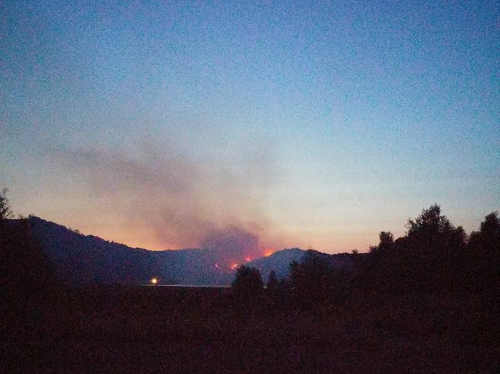
CLEARLAKE, Calif. – Firefighters from local and state agencies worked to control to a wildland fire reported Friday night in Clearlake.
The fire was reported shortly before 8:30 p.m. Friday on Sulphur Bank Road and North Drive, in the Clearlake Park area near the Clearlake city limit, based on radio reports.
Units arriving on scene found the fire moving uphill, putting the size initially at about two acres, with estimates a short time later putting it at closer to 10 acres, according to reports from the scene.
Scanner reports indicated Lake County Fire, Northshore Fire and Cal Fire were responding to the incident.
Clearlake Police officers also were requested by the fire chief on scene to assist with closing down the roadway in both directions to all but emergency traffic while firefighters are at work.
Incident command estimated that significant resources were needed on the fire, including dozers to build line around it.
Dozers quickly arrived on scene and worked on the fire's flanks, according to radio reports.
At around 9:20 p.m., firefighters at the scene estimated the blaze had burned between 20 and 30 acres, with a two- to four-hour commitment of resources anticipated at that time.
However, when the fire was finally reported contained just before 11:45 p.m., incident command backed the acreage estimate down to between eight and 10 acres.
Mop up was expected to continue for about two hours, reports indicated.
Additional information will be posted as it becomes available.
Email Elizabeth Larson at
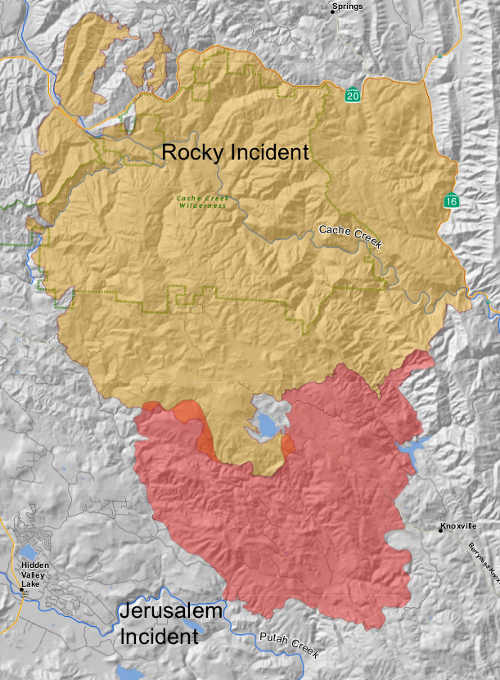
LAKE COUNTY, Calif. – More relatively modest growth took place on the Jerusalem fire overnight and containment continued to increase, however fire officials have raised concerns due to a forecast of increasing winds overnight Friday and into Saturday.
The fire, burning since Sunday in the Jerusalem Valley area northeast of Middletown, reached 24,555 acres and 52-percent containment on Friday morning, according to Cal Fire.
The fire is burning not just in Lake County but in Napa and Yolo counties as well, with one edge of the fire moving closer – but not into – the border of Colusa County, according to the latest fire map.
Cal Fire said the Jerusalem fire is burning in dense vegetation within the fire perimeter, which is creating significant amounts of smoke and heat, and spot fires remain a threat to the fire control lines.
Cal Fire spokesman Daniel Berlant said most of the fire's activity on Thursday was within the perimeter.
The weekend weather is a concern for fire officials due to the forecast of hot, dry conditions with an increase in temperatures into the upper 90s and single digit relative humidity. Officials said this week's cooler conditions have aided the firefighting effort.
Berlant said winds are expected to increase on Friday night, when 17 mile per hour winds are forecast.
In the early morning hours of Saturday, peaking at around 4 a.m., wind speeds are expected to increase up to 29 miles per hour in the fire area, Berlant said.
“That's really going to test the line that firefighters have made around the fire,” Berlant said, explaining that fire typically drops overnight in the cooler conditions.
Efforts remain focused on the fire's southern and eastern flanks of the fire, where firefighters are working to construct the fire line that ultimately will control the fire while defending structures, Cal Fire said.
Cal Fire said there has been no damage to any of the 50 threatened structures in the fire area, but mandatory and advisory evacuations remain in place for areas listed here: http://cdfdata.fire.ca.gov/incidents/incidents_details_info?incident_id=1193 .
The Red Cross evacuation center at Kelseyville High School remains open, officials said.
Continuing road closures include Jerusalem Valley Road at Spruce Grove Road, Morgan Valley Road from Reiff Road southeast to the Napa County line, Reiff Road from Morgan Valley east to the Yolo County line and Berryessa Knoxville Road closed from Lake Berryessa north.
The agency also reported that there have been no injuries.
Resources assigned on Friday included 2,214 personnel, 164 engines, 62 hand crews, 30 dozers, 21 water tenders, 15 helicopters and four air tankers, Cal Fire said.
The Jerusalem fire is expected to be fully contained on Monday, according to Cal Fire's latest report.
Nearby on the Rocky fire, Cal Fire's size estimate remained at 69,438 acres, with containment also still at 95 percent. Cal Fire has estimated it will have the incident fully contained – after two and a half weeks – on Saturday.
Email Elizabeth Larson at
NORTHERN CALIFORNIA – Cal Fire investigators said Friday they have determined the cause of last month's Wragg fire that burned in Napa and Solano counties.
The agency's investigators concluded the wildfire was the result of a vehicle exhaust contacting dry grass, which then ignited the surrounding brush and the vehicle as well.
The Wragg Fire was reported at 2:24 p.m. Wednesday, July 22, off of Highway 128 near Wragg Canyon Road and the Lake Berryessa Dam.
The fire burned through heavy brush and steep rugged terrain, eventually ending 4 miles west of the city of Winters and just north of Mix Canyon Road near Vacaville, Cal Fire said.
During initial operations a Cal Fire helicopter was used for the emergency rescue of multiple hikers in the Cold Canyon area. One hiker suffered a heat related illness and was transported to a local hospital by ground ambulance.
The fire burned 8,051 acres, destroyed two outbuildings, and damaged four outbuildings and one residence. The Wragg fire was fully contained on Aug. 5, according to Cal Fire.
“With the critical fire conditions we are seeing this year combined with 4 years of drought, we are asking the public to be extra cautious in not sparking a wildfire,” said Cal Fire Unit Chief Scott Upton. “With hunting season and other outdoor activities at their peak it is imperative that we remain aware of how easily dry grass can ignite a wildfire with devastating consequences.”
With drought conditions, Cal Fire continues to urge the public to be careful outdoors. Pulling over in dry grass can easily ignite a wildfire.
Learn more tips on how to operate and maintain your vehicle safely at www.ReadyForWildfire.org or on the infographic below.

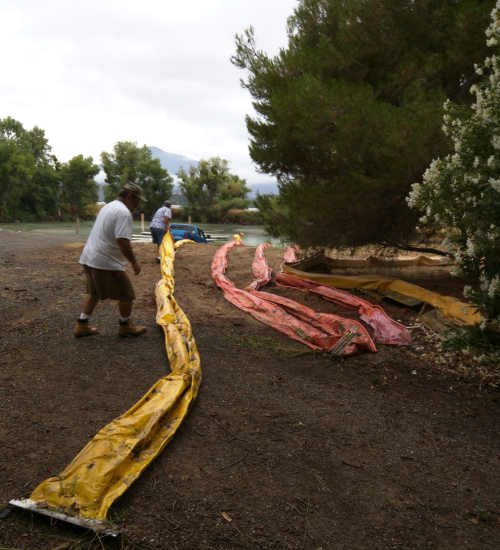
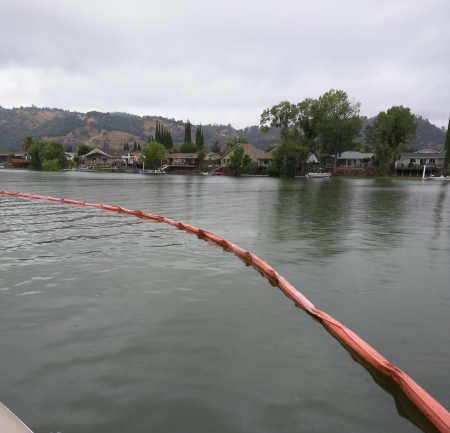
CLEARLAKE OAKS, Calif. – A group of Clearlake Oaks residents are working to find solutions to algae's impacts on their community, including expanding a project to use booms to control where the algae travels.
In 2013 members of the Clearlake Keys Property Owners Association first installed floating booms borrowed from the county at the mouth to the subdivision's channels, as Lake County News has reported: bit.ly/12L1g9K .
This year, a group of concerned citizens led by Doug Smith, Ed Legan and Leroy Dubrall are spearheading the effort to expand the project and its positive benefits.
Prior to the project, the Keys' channels had become filled with bright green, dying blue-green algae mats, which caused a mess for residents and resulted in a foul-smelling stench, according to Dubrall.
Since then, however, Dubrall said the situation has improved. The blue-green algae, or cyanobacteria, was very minimal in the Keys in 2014.
This year, there has been an increase in the algae, which Dubrall believes is due to the increase of the invasive aquatic plant creeping water primrose, which took root during last year's low water year.
Dubrall said this year the 800-foot-long booms – which took about three days to put in place early last month – are in roughly the same location as the two previous years, at the mouth of the Keys, but have been secured by attaching them to four metal poles placed in the Keys' jurisdiction.
It cost about $3,500 to place those booms, with homeowners association President Joe Stella getting them the money and contractor Bob Milano giving the group a good price on placing the poles, Dubrall said.
The booms protect the Keys' channels, swim beach, a public launch ramp at the nearby county park, Clarks Island and the Island RV Park, Dubrall said.
He said the county's Lakebed Management division waived more than $1,000 in permit fees to help with the placement of all of the poles.
Lake County Vector Control Director Jamie Scott said the Keys boom project has had an added benefit: It has helped cut down on mosquito activity.
She said the wind pushed the algae into the Keys' channels, where it got very warm.
“Not all algae creates mosquito habitats,” but she said that was the case in the Keys.
Before the boom project, the algae – in particular, a type called lyngbya – was getting pushed up into the channels, where it was dying and decaying. Scott explained that the decomposition process pulled the oxygen from the water, which killed off the predators that kept the mosquitoes in check.
Scott said that, over the years, Vector Control has rarely detected significant numbers of mosquitoes in the Clearlake Keys.
However, she said that in 2012 her staff detected “extraordinary numbers” of immature and Culex mosquitoes in the Clearlake Keys.
The Culex mosquitoes are carriers – or vectors – of West Nile virus, and as a result there was an associated increase in the virus in that area that year. Scott said district staff found Culex mosquito larvae developing in the emergent vegetation and along the edges of the algal mats.
However, the installation of the booms “made a huge difference” in significantly reducing mosquito numbers in 2013, according to Scott, who has given her support to the ongoing boom project.
There was an increase in mosquitoes in 2014, but the numbers remained much lower than in 2012, with none of the mosquitoes tested in that area showing West Nile virus, she said.
This year, however, there has been a new issue, with the increase in creeping water primrose, which has grown thick in the channels. Like lyngbya, the creeping primrose causes oxygen levels to drop and kills the mosquito-eating fish and other creatures, Scott said.

She said that as a result there has begun to be an increase in mosquitoes again this year, with her agency out treating for larvae and adult mosquitoes.
Dubrall said expanding the boom project is estimated to cost as much as $4,000, which will cover the cost and placement of the three new boom poles, the required navigation lights and the individual lights to be placed upon the booms themselves.
With neither the county nor the homeowners' association having the funding available, Dubrall and his colleagues are going out to ask for private donations.
As of the start of this month, Dubrall said they had received more than $800 in private donations, with the Clearlake Oaks Glenhaven Business Association pledging matching funds.
The group is expecting to expand its fundraising efforts further in the community, Dubrall said.
The new project is waiting not just on funding but also on water levels going down a few feet to make the installation easier, said Dubrall.
The homeowners association also is continuing to pursue its other manners of weed and algae control, including the use of its weed harvester, he said.
“Our harvester is on its last legs,” said Dubrall, noting the association has owned it since 1990.
“It's done a lot of good,” but needs a lot of repairs, said Dubrall.
They're working with the county on exploring options for getting a new harvester, which is estimated to cost about $68,000.
“It's all up in the air right now,” he said.
For those wanting to donate or otherwise assist with the project, call Dubrall at 707-400-9251.
Email Elizabeth Larson at
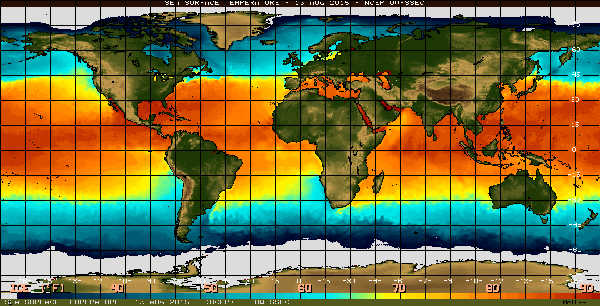
While weather forecasters are predicting a strong El Niño that could signal the arrival of significant rain in the coming fall and winter season, the state climatologist is urging Californians to lower their expectations with respect to the weather phenomenon.
“California cannot count on potential El Niño conditions to halt or reverse drought conditions,” State Climatologist Michael Anderson said Thursday.
“Historical weather data shows us that at best, there is a 50/50 chance of having a wetter winter,” Anderson added. “Unfortunately, due to shifting climate patterns, we cannot even be that sure.”
The current drought has resulted in observations of new, record-high temperatures and record low snowpack for California.
Five of the lowest 10 snowpacks on record have occurred in the last decade, including the past four years, officials reported.
The seasonal snowpack is a key element to California’s water resources management, modulating winter precipitation into spring runoff for beneficial use through the dry summer.
As California heads into a new water year – which takes place from Oct. 1 to Sept. 30 – with a potential fifth year of drought and expectations of El Niño impacts in play during the winter, questions mount on what can be expected of winter temperatures, precipitation and snowpack for California.
The El Niño-Southern Oscillation, or ENSO, is “characterized by year-to-year fluctuations in sea surface temperatures along the equator in the Pacific Ocean between Peru and the International Date Line, and concomitant fluctuations in sea level air pressures between Tahiti and Darwin, Australia,” according to a July report from the Western Regional Climate Center.
The report, which can be seen below, gives more detail and information on the unpredictable nature of the El Niño phenomenon.
Officials like Anderson are pointing out that a historical look at past years with similar El Niño conditions as currently forecasted provide little guidance as to what California might expect this winter.
Of the seven years since 1950 with similar El Niño signals – 1958, 1966, 1973, 1983, 1988, 1992 and 1998 – three were wet years, one was average and three were dry, with water year 1992 perpetuating a drought, officials said.
Past years were cooler than the temperatures California is experiencing now, which officials said also will impact the rain/snow boundary for any storms that materialize this winter.
The Western Regional Climate Center report explains that the ENSO cycle is expressed as three states: neutral conditions, El Niño (warm ocean phase), and La Niña (cold ocean phase).
The National Oceanic and Atmospheric Administration’s Climate Prediction Center ENSO diagnostic discussion is predicting a 90-percent chance of El Niño conditions in the fall and early winter, based on the climate center's report.
However, that may not translate into much rain for Lake County and other Northern California areas, the center suggested.
“There is almost no correlation between precipitation and El Niño conditions in Northern and Central California. ENSO’s strongest signal in California is for Southern California to be drier than average in La Nina years,” the report stated.