 How to resolve AdBlock issue?
News
LAKE COUNTY, Calif. – Lake County Special Districts has issued a boil water notice for the Soda Bay water system Lake County CSA #20 Soda Bay Water System #1710022.
The Soda Bay water system is on a boil water notice due to the system not being able to meet the surface water treatment turbidity standard.
A change in Clear Lake water quality is causing treatment challenges, according to Special Districts. The water system is not able to meet treatment turbidity standards.
The water system is experiencing severe challenges with producing water and Special Districsts asks all customers to only use the bare minimum needed this weekend.
Special Districts reports that the storage tank is full, but the ozone unit is not able to keep up with water demand.
High temperatures are expected this weekend and the system could run out of water this weekend, according to Special Districts. Customers of the Soda Bay water system are advised to use water sparingly and help spread the word to your neighbors.
Approximately 1,400 consumers in the district are affected by this advisory which includes 640 connections. The Advisory was handed out around 10am Saturday,
August 15. The duration that the advisory will be in place is unknown at this time.
The Mendocino District DDW is working with the operators to help get the treatment plant to make compliant water. Public inquiries inquiries can be made to
Special Districts at 707-263-0119 Monday through Friday 8 a.m. to 5 p.m.. Lake County Special Districts is located on the web at http://lcsd.lakecountyca.gov/ and on Facebook at http://www.facebook.com/lakecountyspecialdistricts.

One of the best ways to learn how our solar system evolved is to look at younger star systems in the early stages of development.
Recently, a team of astronomers including NASA scientists discovered a Jupiter-like planet within a young system that could serve as a decoder ring for understanding how planets formed around our sun.
The new planet, called 51 Eridani (Eri) b, is the first exoplanet discovered by the Gemini Planet Imager (GPI), a new instrument operated by an international collaboration, and installed on the 8-meter Gemini South Telescope in Chile.
The GPI was designed specifically for discovering and analyzing faint, young planets orbiting bright stars via “direct imaging,” in which astronomers use adaptive optics to sharpen the image of a target star, then block out its starlight.
Any remaining incoming light is then analyzed, and the brightest spots indicate a possible planet.
“This is exactly the kind of planet we envisioned discovering when we designed GPI,” said James Graham, professor at the University of California, Berkeley, and project scientist for GPI.
Other methods of planet detection are indirect, such as the transit method used by NASA's Kepler mission, in which it discovers planets by measuring the loss of starlight when a planet passes in front of its star.
As Bruce Macintosh, a professor of physics at Stanford University and member of the Kavli Institute for Particle Astrophysics and Cosmology figuratively described, to detect planets, Kepler sees their shadow while GPI sees their glow.
As far as the cosmic clock is concerned, 51 Eridani is young – only 20 million years old – and this made the direct detection of the planet possible. When planets coalesce, material falling into the planet releases energy and heats it up. Over the next hundred millions years, they radiate that energy away, mostly as infrared light.
“Many of the exoplanets astronomers have imaged before have atmospheres that look like very cool stars,” said Macintosh, who led the construction of GPI and now leads the planet-hunting survey. “This one looks like a planet.”
GPI observations revealed that 51 Eri b is roughly twice the mass of Jupiter. Other directly-imaged planets are five times the mass of Jupiter or more.
In addition to being the lowest-mass exoplanet ever imaged, it's also the coldest – 800 degrees Fahrenheit, whereas others are around 1,200 F – and it features the strongest atmospheric methane signal ever detected on an alien planet.
Previous Jupiter-like exoplanets have shown only faint traces of methane, far different from the distinctive signatures of methane seen in the atmospheres of the gas giants in our solar system.
All of these characteristics, researchers say, point to a planet that is very much what models suggest Jupiter was like in its infancy.
In the atmospheres of the cold giant planets of our solar system, carbon is found as methane, unlike most exoplanets where carbon has mostly been found in the form of carbon monoxide.
“Since the atmosphere of 51 Eri b is also methane rich, it signifies that this planet is well on its way to becoming a cousin of our own familiar Jupiter,” said Mark Marley, an astrophysicist at NASA’s Ames Research Center in Moffett Field, California, co-lead for theory and a team member responsible for helping to interpret GPI observations.
In addition to expanding the universe of known planets, GPI will provide key clues as to how solar systems form.
Astronomers believe that the gas giants in our solar system formed by building up a large, core over a few million years and then pulling in a huge amount of hydrogen and other gasses to form an atmosphere.
But the Jupiter-like exoplanets that have been discovered are much hotter than models have predicted, hinting that they could have formed much faster as material collapsed quickly to make a very hot planet. This is an important difference.
Using GPI to study more young solar systems such as 51 Eridani will help astronomers understand the formation of our neighbor planets, and how common that planet-forming mechanism is throughout the universe.
“The newly discovered 51 Eri b is the first planet that's cold enough and close enough to the star that it could have indeed formed right where it is the 'old-fashioned way,” Macintosh said. “This planet really could have formed the same way Jupiter did – the whole solar system could be a lot like ours.”
The results are published in the current issue of Science Express and in the August 20 issue of Science.
GPI was constructed by a consortium of American and Canadian institutions, funded by the Gemini Observatory, which is an international partnership comprising the United States, United Kingdom, Canada, Australia, Argentina, Brazil and Chile.
The Gemini Planet Imager Exoplanet Survey (GPIES) campaign is partially funded by National Science Foundation (NSF), NASA, the University of California and the Laboratory Directed Research and Development funding at the Lawrence Livermore National Laboratory.

LAKE COUNTY, Calif. – After spending weeks devoted to assisting with evacuating animals from the path of two large local wildland fires, work at Lake County Animal Care and Control is transitioning back to finding animals new homes.
As the new week begins, four cats – three females and a male – are being offered for adoption.
All are tabbies, from gray and brown to orange.
In addition to spaying or neutering, cats that are adopted from Lake County Animal Care and Control are microchipped before being released to their new owner. License fees do not apply to residents of the cities of Lakeport or Clearlake.
If you're looking for a new companion, visit the shelter. There are many great pets there, hoping you'll choose them.
In addition to the animals featured here, all adoptable animals in Lake County can be seen here: http://bit.ly/Z6xHMb .
The following cats at the Lake County Animal Care and Control shelter have been cleared for adoption (other cats pictured on the animal control Web site that are not listed here are still “on hold”).

Male orange tabby
This male orange tabby cat has a short coat.
He's in cat room kennel No. 15, ID No. 3020.

Female domestic short hair mix
This female domestic short hair mix has a brown and gray tabby coat.
She's in cat room kennel No. 78, ID No. 2984.

'Rosie'
“Rosie” is a female domestic short hair mix with an orange tabby coat.
She's in cat room kennel No. 99, ID No. 3015.

Female domestic short hair mix
This female domestic short hair mix has a brown tabby coat.
She's in cat room kennel No. 100, ID No. 3005.
Adoptable cats also can be seen at http://www.co.lake.ca.us/Government/Directory/Animal_Care_And_Control/Adopt/Cats_and_Kittens.htm or at www.petfinder.com .
Please note: Cats listed at the shelter's Web page that are said to be “on hold” are not yet cleared for adoption.
To fill out an adoption application online visit http://www.co.lake.ca.us/Government/Directory/Animal_Care_And_Control/Adopt/Dog___Cat_Adoption_Application.htm .
Lake County Animal Care and Control is located at 4949 Helbush in Lakeport, next to the Hill Road Correctional Facility.
Office hours are Monday through Friday, 11 a.m. to 5 p.m., and 11 a.m. to 3 p.m., Saturday. The shelter is open from 11 a.m. to 4 p.m. Monday through Friday and on Saturday from 11 a.m. to 3 p.m.
Visit the shelter online at http://www.co.lake.ca.us/Government/Directory/Animal_Care_And_Control.htm .
For more information call Lake County Animal Care and Control at 707-263-0278.
Email Elizabeth Larson at
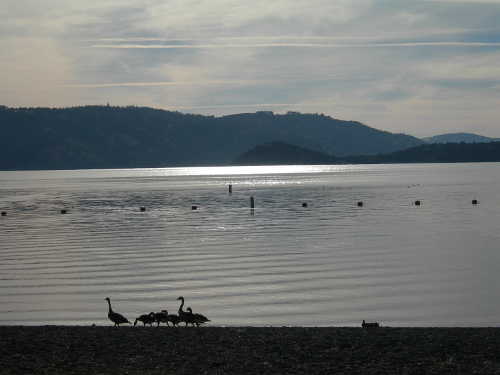
“Everybody needs beauty as well as bread, places to play in and pray in, where nature may heal and give strength to body and soul alike.” – John Muir
KELSEYVILLE, Calif. – Clear Lake State Park is one of two state parks in Lake County, with Anderson Marsh State Historic Park being the other.
According to the brochure put out by California State Parks, “The Mission of California State Parks is to provide for the health, inspiration and education of the people of California by helping to preserve the state's extraordinary biological diversity, protecting its most valued natural and cultural resources, and creating opportunities for high-quality outdoor recreation.”
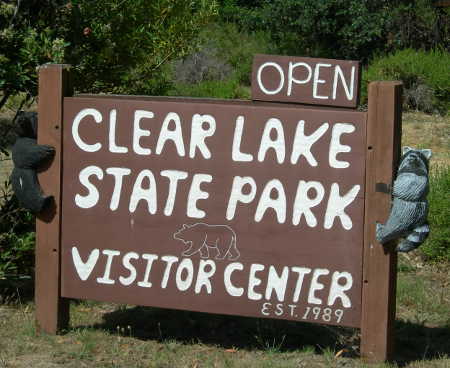
The park does indeed function as a grand outdoor classroom, being set upon California's, if not North America's, oldest natural lake, dating back over one and a half million years to the early Pleistocene era.
Clear Lake State Park is located at 5300 Soda Bay Road in Kelseyville, on the southwestern shore of Clear Lake.
The park has something for everyone with boating and water skiing opportunities, camping, cabins, a swimming beach, picnic areas and hiking trails.
Lake County is rich in cultural history. Here by the shores of Clear Lake the Pomo Indians lived. It 's easy to understand why this area was selected by the Pomo, with the bounty of the waters, forests and streams around them.
Proud Mt. Konocti watched over the lake and was considered a sacred site. Mt. Konocti, a dormant volcano, provided useful igneous obsidian rock used to form a variety of tools and arrowheads.
Once upon a time the lake was encircled by tule reeds – nature's filter.
The abundant tule reeds were a fish spawning area and provided safe and secure nesting places for a variety of water fowl.
Tule reed boats were constructed by the Pomo Indians, and the reeds and many other uses then.
Once on the lake you'll have the opportunity to come up close and personal to thermal vents which bubble up near the swimming beach at Soda Springs.
The park has a fantastic visitor center, which is situated by the boat launch parking lot.
The center has displays which depict the area's cultural past, a large aquarium, and interpretive dioramas to inform you on wildlife which lives in the park and the surrounding area, panels on the remarkable geology of the lake, as well as a gift shop.
Activities at the lake include bird watching which is sometimes let by the local Redbud Audubon chapter.
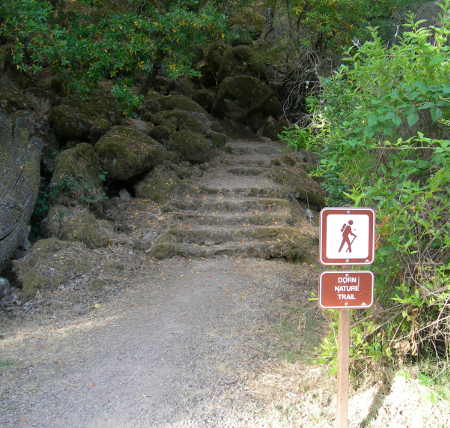
Hiking trails abound in the park, including the moderately difficult-to-climb two-mile Dorn Nature Trail with its lofty oaks, manzanita and colorful native wildflowers, during springtime.
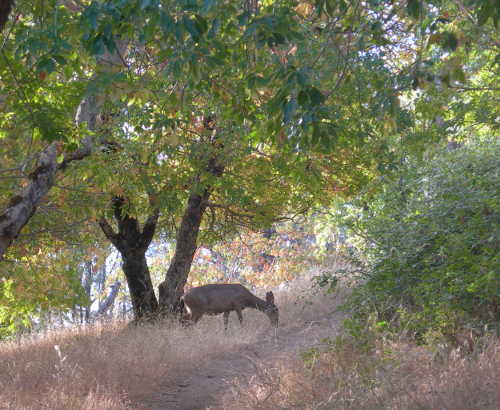
The Indian Nature Trail is an easy half-mile trek, which informs hikers of the native plants used by the local Pomo Indians when the lake lands were their domain.
Campers can reserve a site from among 147 sites, along with two hike/bike sties and cabins. There is a fire ring and food locker at each site. With the group camp site you will have at your disposal campfire rings, barbecue stoves and picnic tables. Most of the campgrounds have restrooms and showers.
Ask the ranger about activities which occur at the park, such as nature walks and campfire programs.
The lake is a fishing paradise. Fisherman enjoy catching largemouth bass, catfish and crappie.
Clear Lake State Park's boat launch and marina are situated by Cole Creek, and boast battery charging outlets for boats, and a well-lit parking lot with a restroom.
For more information on Clear Lake State Park, you can view the park brochure at http://www.parks.ca.gov/?page_id=473 .
Kathleen Scavone, M.A., is an educator, potter, writer and author of “Anderson Marsh State Historic Park: A Walking History, Prehistory, Flora, and Fauna Tour of a California State Park” and “Native Americans of Lake County.” She also writes for NASA and JPL as one of their “Solar System Ambassadors.” She was selected “Lake County Teacher of the Year, 1998-99” by the Lake County Office of Education, and chosen as one of 10 state finalists the same year by the California Department of Education.
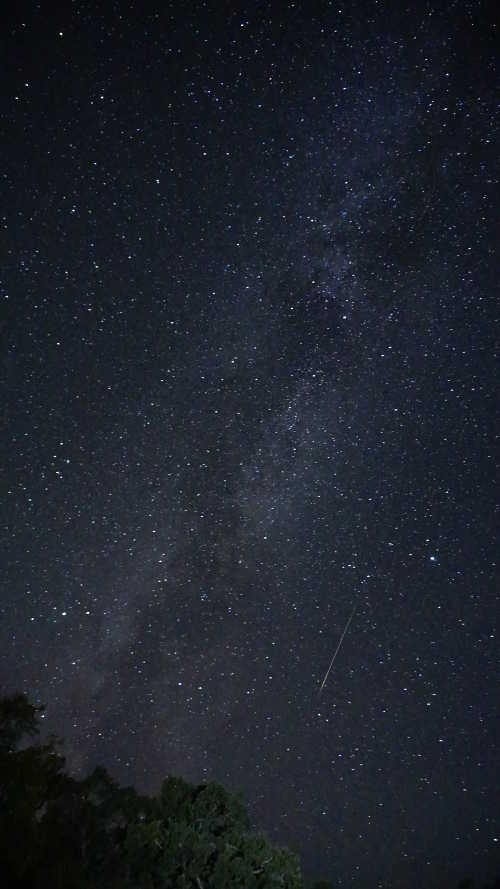
LAKE COUNTY, Calif. – Stargazers were able to see the height of one of the year's main meteor showers this past week.
The Perseids – which radiate from the constellation Perseus – are active until Aug. 26, but were expected to peak in the early morning hours of Tuesday through Thursday, when a moonless sky improved viewing conditions.
John Jensen and Elizabeth Larson of Lake County News headed out to the Rodman Slough area on Wednesday and Thursday and captured some images of the meteors streaking across the sky, which are shown in the photos above and below.
NASA reported that the year's remaining meteor showers and their peak times are the Orionids in October, the Leonids in November and the Geminids in December.


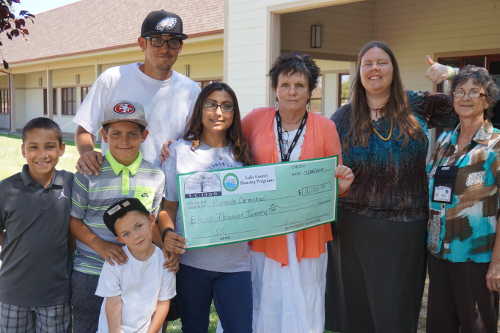
LAKE COUNTY, Calif. – Earlier this month, a local family of five and several staffers at Lake County Social Services met for the first time around a glossy $11,000 check the size of a Publishers Clearing House award.
The Carmichaels have been working with Social Services Director Carol Huchingson, and department staffers Jill Wicks and Annette Adkins for more than three years, but it was only recently that they met in person.
Seated at a large table, parents Miranda and Chris Carmichael – along with their three young sons, Edward, Quentin and Christian – shared the story of how a little-known program changed their lives.
For the last three years Wicks, the housing coordinator for the Section 8 housing program, and Adkins, who is part of the housing eligibility staff, have been working with the Carmichaels through Section 8’s Family Self-Sufficiency Program.
The Family Self-Sufficiency Program helps families set long-term goals aimed at empowering breadwinners to increase their earning potential and live independently from government aid.
Miranda Carmichael shared that before she and her husband Chris came together, she was the victim of domestic violence while in a relationship with the father of her first two sons.
“I grew up with my family in poverty,” she said. “It was really hard in the beginning by myself with two boys.”
She added that soon after her sons’ father was sent to prison, she made up her mind to go school. That’s where she met Chris, a former classmate from junior high school.
“He was a really good person for the kids, a good father figure,” she said. “He helped take care of us.”
The couple are happily married, but even with Chris’ added support, and after the birth of their youngest son, Christian, it was hard to make ends meet.
“He started out working a four-hour job as a cook,” Miranda Carmichael said. “And we were on Section 8 and food stamps and Medi-Cal …”
“That was the least money I’ve made in my life,” Chris Carmichael added.
Before returning to his native Lake County, Chris Carmichael spent 10 years learning the heating and air trade in Modesto where he was well-paid. But the lack of work and hours in Lake County hit the Carmichaels hard.
When the couple signed up for Section 8, they were offered the chance to participate in the Family Self-Sufficiency Program.
“We weren’t sure how that would work out,” Miranda Carmichael said. “Honestly, I didn’t have that much hope that we might get to finish.”
Typically, Family Self-Sufficiency Program participants agree to a three- to five-year contract during which time they work with a counselor who provides referral and case management services to help them address educational and employment barriers.
Additionally, the program takes the difference of their rent – which may increase as a result of higher earned income – and places it in an escrow account that the family gains access to at the end of their contract.
“When the family graduates from the program, they have access to the escrow account to use for any purpose, including as a down payment on a house,” Huchingson said.
The $11,000 check in the middle of the table, the total amount the Carmichaels saved in the program, is a visible testament to the hard work that Chris and Miranda Carmichael put toward their goals over the last three years.
As the Carmichaels earned more, they had to become less reliant on the forms of aid that had supported them in the past.
“At first it was hard,” Chris Carmichael said. “But we’re pretty dialed in now.”
“We do a lot of referrals,” said Wicks when asked about some of the services provided. “We keep in touch with job fairs too.”
Today, Miranda Carmichael is close to finishing her schooling and her husband has found fulfilling work in his trade.
When asked what life looks like for them now, the family exchanged amused glances.
“Busy,” Miranda Carmichael said. “It’s busy but rewarding at the same time. With the kids, we want them to be in sports, in everything!”
“We’re playing the Trojans and we just got our cleats today,” their eldest son Edward said.
“I didn’t think I would want to do social work, until I signed up for Section 8,” Miranda Carmichael said. “That’s when I was like, that’s really cool, helping out people like that, the way we needed help.”
Carol Huchingson takes the opportunity to let Miranda Carmichael in on a little secret.
“Hopefully you’re keeping track of what positions we have open,” Huchingson said. “If not we’ll let you know.”
Miranda Carmichael smiled warmly. “There’s just so many different things I can do now, “ she said, “[because of] their help, the Family Self-Sufficiency Program.”
Email Shari Shepard at