How to resolve AdBlock issue?
News
I want to thank Monica Rosenthal for opposing a Dollar General store in Middletown’s historic downtown.
Monica was the only candidate for District 1 supervisor who spoke against Dollar General’s plan at the Lake County Planning Commission. She understands that maintaining Middletown’s community standards will protect our small town quality of life. She referenced the Middletown Area Plan, which clearly states opposition of the community to just this sort of incursion.
It is clear that Monica doesn’t want our community to lose its heritage and become just another road stop of fast food restaurants and cheap corporate chain stores. Especially those whose corporate management plan includes hiring only minimum wages employees, understaffing the stores and providing only part-time work to avoid having to pay benefits.
Monica Rosenthal was the only candidate who stood with the community when we needed her. That’s why I’m voting for Monica Rosenthal for county supervisor.
Greta Zeit owns Backyard Garden Oasis bed and breakfast in Middletown, Calif.
LAKEPORT, Calif. – The Lake County Registrar of Voters Office reported that it will begin processing vote-by-mail – or absentee – ballots for the June 7 presidential primary election at 9 a.m. Tuesday, May 17.
The processing of the vote-by-mail voter ballots will continue through Election Day as well as,
during the official canvass.
Results will not be announced until after the close of the polls at 8 p.m. June 7.
The official canvass will commence on Thursday, June 9, at 9 a.m. and will continue daily (Saturdays, Sundays and holidays excluded) until completed.
Observers are invited to view the processing and counting of the ballots, but shall not interfere with the election process.
The Registrar of Voters Office is located in Room 209 on the second floor of the Lake County Courthouse, 255 N. Forbes St., Lakeport.
LAKEPORT, Calif. – The Lake County Fair Board will meet on Monday, May 23.
The meeting will begin at 4 p.m. at the fairgrounds administration office, 401 Martin St., Lakeport.
Action items include the selection of the 2016 fair grand marshal.
There also will be a discussion of the Memorial Day event and the fair, which runs this year Sept. 1 through 4; committee reports; a strategic planning session followup; the Lake County Fair Foundation; and the chief executive officer's report.
The fair board's membership include Janeane Bogner, Marcia Chauvin, James Cochrane, Katherine McDowell, Annette Hopkins, Meyo Marrufo and Jerry McQueen.
CLEARLAKE, Calif. – The men’s and women’s ministries of the Clearlake Church of the Nazarene are sponsoring a barbecue and Classic Car Show N Shine on Saturday, June 25.
The show will take place from 11 a.m. to 2 p.m. at the church, located at the corner of Highway 53 and Olympic Drive.
They will be serving hot dogs, hamburgers and nachos with a beverage provided. The food is free, but a donation box is available should you desire to make a donation.
There will be live music provided by a band consisting of members of the church’s worship team. They will be performing songs from the 1950s and 1960s including some the band likes to call “sanctified oldies.”
The car clubs of Lake County and all car enthusiasts are welcome to enter their classic cars, hot rods. muscle car, foreign or domestic, trailer queen or a drivable project car. The main criteria is that the car must be a “classic.”
There is no registration fee and cars may begin arriving at 9:30 a.m. and must be parked by 10:30 a.m. There will be a free dash plaque for the first 50 cars to arrive.
A “people’s choice” award will be given to the car that those in attendance think is the “coolest.”
Be sure to come, enjoy the music, the food and vote for the ”coolest” car at the event.
Religious live fish releases
Question: I am looking for a place/beach to release live fish. Our religion says it is very good to release a live fish because you save a life and also you learn to be merciful to all of the lives in the world.
I live in Orange County, but any places/beaches in Los Angeles or Orange County works for us. We have friends who get permission in Europe to do this.
The government allows them to release only certain fish species in specific areas only. (Joo Pheng, Ooi)
Answer: What you are proposing cannot be authorized in California, even for religious purposes. It is illegal for biological reasons to transport live fish for release into waters different from where taken.
According to California Department of Fish and Wildlife (CDFW) Marine Aquaculture Coordinator Kirsten Ramey, prayer animal release can pose a serious risk to natural resources and society through the introduction of non-native and/or invasive species.
California currently faces a variety of significant and lasting impacts from introductions of non-native and invasive species in both fresh and coastal waters.
Just a few of these impacts include reduced diversity and abundance of native plants and animals (due to competition, predation, parasitism, genetic dilution, introduction of pathogens, smother and loss of habitat to invasive species), threats to public health and safety (via parasites and disease) and increased costs to business, agriculture, landowners and government (for invasive pest treatment and clean up).
One of California’s costly introductions was attributed to the aquarium trade, based on DNA evidence. Caulerpa taxifoli, an invasive algae originally from the Mediterranean Sea, has cost California more than $6 million to eradicate.
In terms of ecological impacts, the introduction of invasive species is thought to be second only to habitat loss in contributing to declining native biodiversity throughout the United States.
California has been invaded by many aquatic plants and animals which have altered native ecosystems and taken a toll on recreation, commercial fishing and sensitive native species.
For these reasons and more, it is unlawful to place, plant or cause to be placed or planted, in any of the waters of this state, any live fish, any fresh or salt water animal, or any aquatic plant, whether taken without or within the state, without first securing the written permission from CDFW (Fish and Game Code, section 6400).
Since releasing fish into public waters is not legal, here are a couple of other options for you. You can get involved with CDFW’s Trout in the Classroom program in which instructors and their students set up an aquarium in the classroom to raise fish for an eventual field trip to an approved local stream or river where the fish are released.
You might also contact one of the registered aquaculture farms found on CDFW’s Aquaculture Web site. These businesses raise different species of fish and have private stocking permits allowing them to plant fish in approved private waters within the state.
Perhaps one of these businesses will allow you to assist and plant one of the fish they will be stocking. Good luck!
Using black or blue rockfish for lingcod bait?
Question: Can one use black or blue rock fish as bait to catch lingcod?
I have seen people do this but I believe you cannot since rockfish are considered to be a game fish. (John C., Roseville)
Answer: Yes, anglers can take black or blue rockfish that they have caught to send back down on a hook to catch lingcod.
However, while those two species do not have minimum size limits, any legal rockfish you use as bait count toward your daily bag limit of rockfish.
License required for a nuisance coyote?
Question: Does someone need a hunting license to shoot a nuisance coyote on their property, or near their property, if they are the legal distance away from a residence to discharge a firearm? (Carol S.)
Answer: Coyotes are classified as nongame mammals in the Fish and Game Code (FGC) and if found to be “injuring growing crops or other property” (FGC section 4152), they can be taken on your property without obtaining a hunting license.
However, if a coyote is NOT injuring your property, you will need to obtain a hunting license before taking it (FGC, section 3007).
Before you do anything though, you should first check with your local sheriff's department regarding any city, county, municipality laws and regulations that may apply to be sure this will be legal to do in your area.
Fish and game regulation of groundfish
Question: Current fish and game regulations limit the fishing depth for groundfish in Southern California to 60 fathoms or 360 feet.
I need to know how far from the shore line this depth limitation is enforced. I saw from another link on your Web site that the State of California’s fishing jurisdiction only goes out to three miles from shore. (James J.)
Answer: The depth limit is enforced out to 200 nautical miles from shore.
Groundfish are jointly managed by the states and federal government, and the U.S. Exclusive Economic Zone (EEZ) extends from California’s three nautical mile state waters boundary out 200 nautical miles.
CDFW is authorized to enforce California laws throughout the EEZ regarding individuals and vessels operating out of California ports. CDFW wildlife officers have also been delegated authority to enforce several federal laws in the EEZ.
Also, keep in mind that depth limits may differ depending upon which groundfish management area you are fishing in.
Carrie Wilson is a marine environmental scientist with the California Department of Fish and Wildlife. While she cannot personally answer everyone’s questions, she will select a few to answer each week in this column. Please contact her at
LAKE COUNTY, Calif. – An organization that responded to assist dozens of families, their livestock and horses following the Valley fire has closed its Kelseyville donations depot.
Sonoma Action for Equine Rescue ended its Valley fire relief work at the end of April, according to founder Kate Sullivan.
“In the end, we did not turn down a single person,” Sullivan told Lake County News.
Sullivan said her organization provided food and supplies out of its Kelseyville depot – as well as another location in Middletown – to 60 families and individuals.
“In the first week or so we just filled up trucks that were going into the fire zones to feed animals or taking stuff to Middletown,” she said. “We gave four semis of hay out to the Butte fire victims as well.”
Sonoma Action for Equine Rescue – SAFER for short – was one of the countless organizations from inside and outside of Lake County involved in relief and assistance for Valley fire survivors, as Lake County News has reported.
The organization – founded in 2007 by Sullivan, who lives in Sebastopol – has worked in Lake County for years, offering a hay assistance program in partnership with Rainbow Ag.
SAFER sprang into action immediately after the fire began on Sept. 12, eventually burning more than 76,000 acres over a month's time. Sullivan was driving back from a horse auction in the Central Valley with a trailer load of horses when she heard about the fire.
The day after the fire began its horrific sweep through southern Lake County, Sullivan and SAFER began offering help for large animals and livestock and their owners.
Since that time, SAFER had operated hay depots in donated space in Middletown and at Adobe Creek Packing in Kelseyville, she said.
“I had no idea how big it was going to be,” said Sullivan.
Sullivan said that, based on her need to find homes for horses, she had established a good network around Northern California.
“I put it out there, I said, 'Help, help now,'” she said.
Her network responded, donating hundreds of thousands of dollars worth of tack, equipment, hay and other food for cows, goats, horses, llamas and sheep for nearly eight months.
As a sample of the many donations, Sullivan said riding groups from around the region brought tack and equipment. People donated money. Veterinarian Dr. Lisa Takesue collected donations and matched them. Highway 20 Feed brought fencing. Adobe Creek Packing donated 300 new pallets for stacking supplies, plus space for the depot.
Cash donations were used to purchase gift certificates at Kelseyville Lumber, said Sullivan.
One of the concerns was food supply for the animals. “I recognized immediately what went up in flames was the entire year's worth of hay,” she said, explaining that by September most people had the hay their animals needed for the winter purchased and secured.
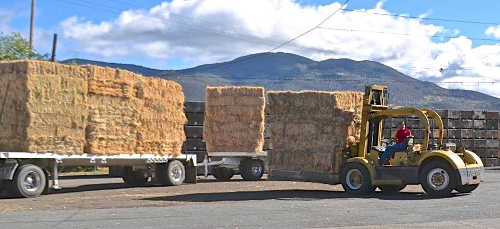
Sullivan estimated that they took in at least 20 semi truck loads of hay – some of them double semi loads – plus a semi load of Equine Senior horse feed.
Sullivan said SAFER received a grant from the American Society for the Prevention of Cruelty to Animals. Some of those funds were used to purchase more hay from a Kelseyville farmer, she said, adding that they wanted to make purchase from local businesses.
As they were collecting the donations, Sullivan said they needed a storage depot. She said Adobe Creek packing was perfect, offering them the safe, secure and sheltered space where hay and tack could be stored through the winter months. The location also was accessible to the semi trucks delivering supplies.
She said they had no theft issues. That was a concern because they had heard many stories of survivors being ripped off, coming home to find barns and tack rooms still standing but tack and equipment gone – probably heading to auctions in the Central Valley.
Getting the help to those who needed it
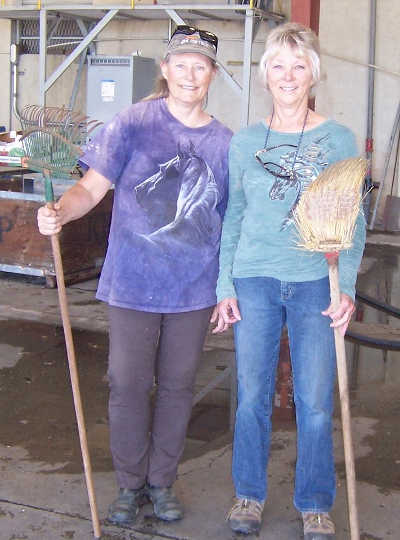
Sullivan downplayed her own role in the relief effort – “My job is to have the right ideas at the right time and keep the organization afloat” – and gave much of the credit to Lakeport resident Carleene Cady, who coordinated not just receiving supplies but distributing them.
Cady brought to the work skill sets that were tailor made for the need – she's a horsewoman herself and a retired nurse practitioner who had worked in a Sonoma County hospital emergency room.
Not only is Cady meticulous and ordered, she knows how to relate to people experiencing deep, life-shaking trauma with patience and mercy.
Sullivan called Cady's work “just unbelievable,” adding, “She found out what the exact needs were, what was standing between them and getting back on their land.”
Cady, who met with Lake County News at the depot as it was continuing to operate during the winter, would arrange to meet with people who needed supplies, and kept specific, detailed records of donations and distributions, which Sullivan said was necessary for tax reporting.
Cady said that what became clear to them during their response to the disaster was that sometimes in the midst of great trials it's the little things – and the items normally taken for granted – that are the dearest: a hoof pick, a roll of duct tape, a new pair of hay hooks, a screwdriver.
In her interactions with Valley fire survivors, Cady heard harrowing stories of rescues, such as how several young women, riding bareback, ponied horses out of harm's way.
And, of course, there was the deep loss for those whose animals died or were injured so seriously they had to be euthanized.
Sullivan said Cady worked primarily with horse people, while Kevin Tighe of North Coast Barns in Middletown helped those who had cattle, distributing hay from a depot set up there.
Initially, SAFER had anticipated having completed its work earlier in the spring, but Sullivan said they needed to remain open longer while people worked to rebuild place for their animals, hay and equipment.
“We held that in trust for dozens of people,” she said.
But they also knew that at some point, once people began receiving their insurance payments and rebuilding, they had to return to local commerce. “They had to support their feed stores and hay growers,” Sullivan said.
On the SAFER Facebook page, the Simon family left a message at the start of March thanking the organization for its help.
Annie Simon wrote that because of the fire, they lost their barn, a year's worth of hay, grain, horse medications and all of our tack.
“With 4 horses, 2 ponies and a mini we were worried. SAFER was there to provide hay, grain, tack, brushes, fencing materials, you name it! I don't know what we would have done without them,” she said, adding high praise for Cady. “SAFER got us through the winter. Thank you!”
“We know what a difference we made in those lives and it was incredibly satisfying and it was incredibly successful,” Sullivan said of those they were able to help.
Altogether, Sullivan said SAFER took in the most donations in its history – more than $300,000, mostly in the form of supplies, not cash. All of it was disbursed to Valley fire survivors.
In closing up the last depot at the pear packing shed in Kelseyville, Sullivan said Cady “just spit polished that place,” even taking hay out of the remaining pallets. “It makes me proud that we left the place brand spanking new.”
Meanwhile, SAFER is continuing its horse rescue work. “I'm getting ready to go out to the auction again,” Sullivan said. “I love to do this. I wish it paid better. I wish it paid at all.”
In a sort of postscript to SAFER's Valley fire efforts, Sullivan said the organization has just taken in a horse that survived the fire.
It's the only Valley fire horse that was surrendered to SAFER, she said. For the most part, “People were quite desperate to get them back.”
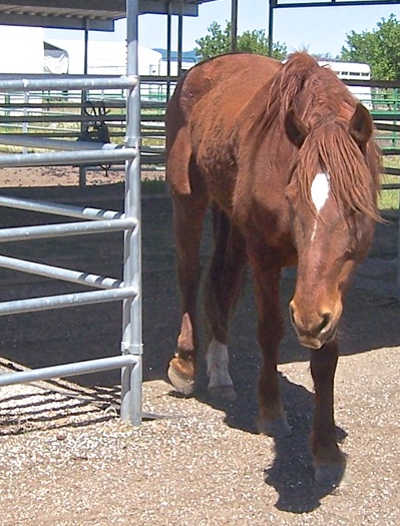
SAFER provided hay for the owners of the sorrel horse, named “GT,” but he's had a lot of health issues and they decided to turn him over to the rescue group, Sullivan said.
GT and another horse were set loose during the evacuation, and he suffered some burns on his legs and the underside of his body, she said.
“I so relate to this guy. I get it,” said Sullivan, explaining that she believes that GT – who arrived in Sonoma County last Sunday – has post traumatic stress disorder, which is contributing to the fear he is experiencing.
GT is a handsome 11 year old gelding, standing 16 hands tall. He's sorrel in color, with a rear left white sock and a white star on his forehead.
Sullivan said GT is in need of an advocate and a permanent home. He is a very well-trained horse that had been used in competition at some point but later left in a field for eight years, and could again be a nice riding horse, Sullivan added.
For more information about SAFER, as well as how to donate or adopt, visit http://www.saferhorse.com/ or follow the group on Facebook at https://www.facebook.com/SAFERHORSE/ .
Email Elizabeth Larson at