 How to resolve AdBlock issue?
News
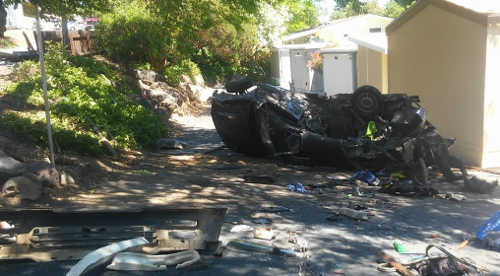 KELSEYVILLE, Calif. – Three people were injured – two of them seriously – in a two-vehicle crash that occurred near Kelseyville early Thursday afternoon, with one of the drivers arrested on suspicion of driving under the influence.
The California Highway Patrol's Clear Lake Area office reported that the wreck occurred just after noon on Highway 281/Soda Bay Road east of Montezuma Way.
Clearlake residents David Rank Jr., 37, and Carl Gott, 34, suffered major injuries in the wreck, while 77-year-old Kelseyville resident George Adams had minor injuries, the CHP said.
The CHP said Rank was driving a 1992 Acura with Gott riding as his passenger.
Prior to the collision, witnesses reported seeing Rank speeding, and passing on blind curves and crossing double-yellow lines, the CHP said.
Rank was driving the Acura eastbound on Soda Bay Road at 65 miles per hour in a 55-mile-per hour zone, while Adams was traveling westbound in a 2006 Dodge pickup at approximately 40 miles per hour, according to the CHP report.
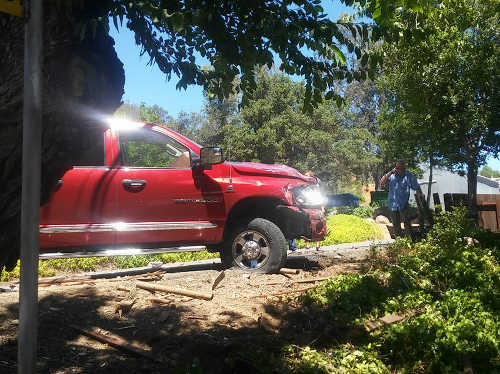
The CHP said that, due to Rank's unsafe speed, he lost control of his vehicle and crossed into the opposing lane. He traveled directly into Adams' path, and the right side of the Acura collided with the front of the pickup.
Rank and Gott were transported by air ambulance to Santa Rosa Memorial Hospital, the CHP said.
The CHP placed Rank under arrest for suspicion of driving under the influence of drugs. Due to the severity of his injuries, he was cited and released to the hospital.
Witnesses at the scene reported that the Acura was destroyed by the crash, and appeared to have been smashed flat after rolling onto its roof.
Pictures of the wreck shared by Amber Holland, which are posted above and below, indicated that after it hit the pickup the Acura went through a fence and rolled down a small embankment, narrowly missing some nearby homes. The Dodge pickup sustained significant front end damage.
Email Elizabeth Larson at
NORTH COAST, Calif. – While recent rains this winter and spring have been a welcome sight in California, drought conditions continue to increase fire danger in the region, prompting Cal Fire to suspend all burn permits for outdoor burning within the State Responsibility Area of 14 Northern California counties.
The counties, located primarily in the Bay Area and on the North Coast, include Lake County, as well as Alameda, Colusa, Contra Costa, Mendocino, Napa, San Mateo, Santa Clara, Santa Cruz, Solano, Sonoma, Yolo, and areas west of Interstate 5 in Stanislaus and San Joaquin counties.
This suspension takes effect Monday, June 27, at 12:01 a.m. and bans all outdoor burning except for campfires within organized campgrounds or on private property with landowner permission.
Campfires may be permitted if the campfire is maintained in such a manner as to prevent its spread to the wildland. A campfire permit can be obtained at local Cal Fire fire stations and online at www.PreventWildfireCA.org .
The department may issue restricted temporary burning permits if there is an essential reason due to public health and safety. Agriculture, land management, fire training, and other industrial-type burning may proceed if a Cal Fire official inspects the burn site and issues a special permit.
Since Jan. 1, Cal Fire and firefighters across the state have already responded to approximately 2,100 wildfires that have burned over 32,000 acres.
While outdoor burning is no longer allowed, Cal Fire is asking residents to ensure that they are prepared for wildfires by maintaining a minimum of 100 feet of defensible space around every home.
“As conditions across California are drying out further we must take every step to prevent new wildfires from sparking,” said Chief Ken Pimlott, Cal Fire director. “Residents must ensure they have defensible space by removing dead trees and overgrown vegetation from around their homes, but do so safely.”
Cal Fire offers the following tips to help prepare homes and property:
– Clear all dead and or dying vegetation 100 feet from around all structures.
– Landscape with fire resistant/drought tolerant plants.
– Find an alternative way to dispose of debris such as chipping.
For additional information on how to create defensible space, as well as tips to prevent wildfires, visit www.ReadyForWildfire.org .

LAKEPORT, Calif. – Visitors from Way to Wellville communities across the country said they see leadership, collaboration and a sense of boldness during an annual conference in Spartanburg, SC.
Way to Wellville, a project designed to measure and improve an area's health, selected Lake County in August 2014 as one of five communities for the five-year challenge.
Lake County representatives attended an annual gathering of the communities – Clatsop County, Ore.; Greater Muskegon, Mich.; Lake County, Calif.; Spartanburg, S.C.; and Niagara Falls, N.Y. – in Spartanburg in early June.
“It’s eye opening to see what other populations under a hundred thousand people are doing, and hear about best practices from other communities,” said Allison Panella of Sutter Lakeside Hospital. “The conference sparked a lot of excitement about what’s possible in Lake County.”
“The word I think of is ‘inspired’,” said Kim Tangermann, Mendocino Community Health Clinic. “Coming together as a group made me realize that other counties struggle with a lot of the same things we do, but everyone is pushing for change. What can we do that’s outside the box? Who else can we get involved?
“We’re all committed to giving every individual the opportunity to have a great life here. Making changes is difficult work, but there’s an undeniable opportunity happening right now and that, to me, is encouraging
“We work in a community impacted by poverty, which is partly a function of childhood experiences,” said Jen Dalton, North Coast Opportunities. “A big part of North Coast Opportunities’ mission is to create environments for people to have access to similar experiences. A lot of our work is about community engagement, and that’s something we really heard a lot of from the other communities. The community’s voice is the most important voice.”
Lake County recently completed its triennial Community Health Needs Assessment, which identifies top health priorities with the goal of developing strategies to address such needs. Way to Wellville participants plan to use the data from the CHNA as a springboard to take on areas of most critical need, according to Dalton.
“The conference was a productive mix of practical ideas and bigger picture inspiration,” said Shelly Mascari, Adventist Health. “The work in Lake County is far bigger than any one agency, person, or initiative. It really will take every single one of us functioning at the highest capacity to accomplish change. Every person who attended has an action plan that supports shifting our health ranking; I left re-inspired by the amazing people we have working in Lake County.”
Kimberley Sims, mayor of the city of Muskegon Heights, Mich., said she has learned a lot during her first visit to Spartanburg.
“Health care is something that honestly I never found a whole lot of interest in, but being a part of Wellville has really enabled me to see what my role in health needs to be from the leadership and the local government perspective,” she said.
Sims said she will be taking several ideas back with her to Michigan.
Marcus Robinson, with the Chicago-based Social Innovation Group, was invited to the conference as an expert on community building and development. He said his greatest take away from the conference is realizing that major change is a long process, not a quick fix.
“It takes vision and courage and people who have gravity and a stake in the community to pull everybody along,” he said.
“We have to focus on what’s possible instead of what’s holding us back,” said Dalton. “We have to keep moving forward.”
LAKEPORT, Calif. – The Lake County Fair Board will meet on Monday, June 27.
The meeting will begin at 4 p.m. at the fairgrounds administration office, 401 Martin St., Lakeport.
The board will finalize the selection of the 2016 fair grand marshal; hear committee reports and the chief executive officer's report; and discuss the Lake County Fair, which takes place in September.
The fair board's membership include Janeane Bogner, Marcia Chauvin, James Cochrane, Katherine McDowell, Annette Hopkins, Meyo Marrufo and Jerry McQueen.
NORTH COAST, Calif. – Caltrans reports that the following road projects will be taking place around Lake County and the North Coast during the coming week.
Included are Mendocino County projects that may impact Lake County commuters.
LAKE COUNTY
Highway 20
– Pavement repairs from Sayre Avenue to the Paradise Cove subdivision will continue. One-way traffic control will be in effect during nighttime paving, which will take place between 8 p.m. and 7 a.m. Monday night through Thursday night. One-way traffic control will also be in effect from 7 a.m. to 6 p.m. weekdays. Motorists should anticipate 10-minute delays.
– The Mine Restoration Project has been issued a long-term Caltrans Encroachment Permit to allow trucks to access their worksite near the Colusa County Line. Traffic will be restricted to one lane in each direction from 7 a.m. to 9 a.m. Motorists should anticipate minor traffic slowdowns.
Highway 29
– AT&T has been granted a Caltrans Encroachment Permit to perform utility work near Kelseyville Auto Salvage. One-way traffic control will be in effect from 9 a.m. to 3 p.m., weekdays. Motorists should anticipate five-minute delays.
MENDOCINO COUNTY
Highway 1
– PG&E has been granted a Caltrans Encroachment Permit to perform utility work between near the north limits of Caspar on Thursday, June 30. Lane and shoulder closures will be in effect from 9 a.m. to 3 p.m. Motorists should anticipate five-minute delays.
– Highway repairs a quarter-mile north of Ocean Meadows Circle will continue. One-way traffic control with a temporary signal will be in effect 24 hours per day, seven days per week. Motorists should anticipate five-minute delays.
Highway 20
– Paving operations between Harmon Lane and the Wildwood Campground began Monday, June 20. One-way traffic control will be in effect from 7 a.m. to 3 p.m., weekdays. Motorists should anticipate 15-minute delays.
Highway 101
– Caltrans will perform slide repairs near the Korean War Veterans Memorial Bridge (near Frog Woman Rock). Northbound traffic will be restricted to one lane 24 hours per day, seven days per week. Motorists may experience minor traffic slowdowns.
– Highway construction from 0.6 mile south of Upp Creek to the north Willits railroad crossing will continue. Intermittent one-way traffic control will be in effect from 5 a.m. to 5 p.m. weekdays. Motorists should anticipate five-minute delays.
– Pavement repairs from Road 307 to Rattlesnake Creek will continue. One-way traffic control will be in effect from 7 a.m. to 5 p.m. weekdays. Motorists should anticipate 15-minute delays.
– The Kate Wolf Music Festival has been granted a Caltrans Encroachment Permit to hold a special event at the Black Oaks Ranch beginning Thursday, June 23. Northbound traffic will notice the addition of a temporary left-turn lane to access the event, and through traffic will detour around the temporary lane. These traffic conditions will be in place until 3 p.m. Monday, June 27.
– Emergency slide repairs just south of Standish-Hickey State Park will continue. One-way traffic control with a temporary signal will be in effect 24 hours per day, seven days per week. Motorists should anticipate seven-minute delays.
Highway 162
– Turnout construction between the Outlet Creek Bridge and Poonkiny-Fairbanks began Monday, June 6. One-way traffic control will be in effect from 7 a.m. to 3 p.m., weekdays. Motorists should anticipate 15-minute delays.
– PG&E has been granted a Caltrans Encroachment Permit to perform utility work near the Corral Creek Bridge on Tuesday, June 28. One-way traffic control will be in effect from 9 a.m. to 4 p.m. Motorists should anticipate five-minute delays.
Highway 253
– Highway repairs from Cattle Pass to Butler Ranch will continue. One-way traffic control with a temporary signal will be in effect from 7 a.m. to 5 p.m. weekdays. Motorists should anticipate 10-minute delays.
The Caltrans Traffic Operations Office has reviewed each project and determined that individual project delays are expected to be less than the statewide policy maximum of 30 minutes, unless noted otherwise above.
For information pertaining to emergency roadwork or for updates to scheduled roadwork, please contact the California Highway Information Network (CHIN) at 1-800-GAS-ROAD (1-800-427-7623).
EMERYVILLE, Calif. – Fatal crashes involving drivers who recently used marijuana doubled after Washington state legalized the drug, according to the latest research by the AAA Foundation for Traffic Safety.
This raises serious concerns about marijuana-impaired driving and enforcement, especially when recent research indicates that legal limits for marijuana and driving are arbitrary and unsupported by science.
Washington legalized marijuana in December 2012. Since then the percentage of drivers involved in fatal crashes who recently used marijuana more than doubled from eight to 17 percent from 2013 to 2014 and one in six drivers involved in fatal crashes in 2104 had recently used marijuana, according to the AAA Foundation for Traffic Safety.
The foundation used the experience in Washington to conduct research into the impact of legalization of marijuana on traffic safety.
To enforce drug-impaired driving laws, many states have created legal limits or per se limits to specify the maximum amount of active THC – the chemical that induces marijuana’s effects – that drivers can have in their systems based on a blood test.
These laws are similar to blood alcohol concentration, or BAC, limits used to enforce driving under the influence of alcohol.
However, researchers examined lab results of drivers arrested for impaired driving and the results suggest that legal limits or per se laws for marijuana and driving are problematic because:
· There is no science showing that drivers reliably become impaired at a specific level of marijuana in the blood. Marijuana levels differ from alcohol where it is clear that crash risk increases significantly at higher BAC levels. With marijuana it depends on the individual. Drivers with relatively high levels of the marijuana in their system might not be impaired, while others with low levels may be unsafe behind the wheel.
· High THC levels may drop below legal thresholds before a test in administered to a suspected impaired driver. It takes an average of two hours to collect blood from a suspected driver because it typically requires a warrant and transport to a facility. Active THC blood levels may decline significantly and could drop below legal limits during that time.
· Marijuana can affect people differently, making it challenging to develop consistent and fair guidelines. For example, frequent users of marijuana can exhibit persistent levels of the drug long after use, while drug levels can decline more rapidly among occasional users.
If a state relies only on standard per se laws regarding blood limits, some unsafe motorists would go free and others would be wrongfully convicted for impaired driving because it is not possible to determine whether a driver is impaired based solely on the amount of the drug in their body.
AAA urges states to use more comprehensive enforcement measure to improve road safety.
Rather than relying on arbitrary legal limits (per se laws), states should use a two-component system that requires (1) a positive test for recent marijuana use, and more importantly, (2) behavioral and physiological evidence of driver impairment.
This system would rely heavily on two current law-enforcement training programs: “Advanced Roadside Impairment Driving Enforcement” (ARIDE) and the 50-state “Drug Evaluation and Classification” (DEC). These programs train law enforcement officers to more effectively recognize drug-impaired driving.
“Marijuana can affect driver safety by impairing vehicle control and judgment. Whether the use of marijuana is legal or not, all motorists should avoid driving while impaired,” said Cynthia Harris , AAA northern California spokesperson. “Drivers who get behind the wheel while impaired put themselves and others on the road at risk.”
Two new studies by the AAA Foundation highlight marijuana and driving:
· Prevalence of Marijuana Involvement in Fatal Crashes: Washington, 2010-2014.
· An Evaluation of Data from Drivers Arrested for Driving Under the Influence in Relation to Per se Limits for Cannabis.
The foundation also is releasing research into marijuana and driving, including:
· Cannabis Use Among Drivers Suspected of Driving Under the Influence or Involved in Collisions: Analysis of Washington State Patrol Data.
· Driving Under the Influence of Alcohol and Marijuana: Beliefs and Behaviors, United States, 2013-2015.
· Advancing Drugged Driving Data at the State Level: Synthesis of Barriers and Expert Panel Recommendations.
· Overview of Major Issues Regarding the Impacts of Alcohol and Marijuana on Driving.
Established by AAA in 1947, the AAA Foundation for Traffic Safety is a 501(c)(3) not-for-profit, publicly supported charitable research and educational organization.
Dedicated to saving lives and reducing injuries on our roads, the foundation’s mission is to prevent crashes and save lives through research and education about traffic safety.
The foundation has funded more than 300 research projects designed to discover the causes of traffic crashes, prevent them and minimize injuries when they do occur.
Visit www.AAAfoundation.org for more information on this and other research.