How to resolve AdBlock issue?
News
NORTH COAST, Calif. – The California Community Colleges Board of Governors approved the proposed transfer of territory from Redwoods Community College District to the Mendocino-Lake Community College District at its meeting on Monday.
As a result of this action, the coastal communities of Fort Bragg and the town of Mendocino along with the surrounding areas will be incorporated into the Mendocino-Lake Community College District on July 1, 2017.
The transfer of territory will allow the Mendocino-Lake Community College District to formally take charge of the programs and facilities in the service area and assure local residents the opportunity to attain a first rate education with exceptional support services close to their home.
“This is an incredibly exciting time for our district and the entire county,” said District Superintendent/President Arturo Reyes. “Our trustees had the vision and courage to believe in this idea and the strong support of our staff and faculty brought it to fruition. Now, we must partner with the coastal communities to ensure the Mendocino Coast Center becomes a thriving educational hub for the region.”
Mendocino College began offering courses at the instructional center on Del Mar Drive in Fort Bragg in the fall of 2014 under an agreement with the Redwood Community College District. Since then many new course offerings have been added and the class schedule continues to grow.
With this transfer, Mendocino College will extend its high-quality and innovative instruction with individual attention to student needs in an inclusive and accessible learning environment to the coast.
As stated in its mission statement, Mendocino College truly “embraces its role as an intellectual, economic and cultural anchor” for the entire region.
Such a significant community college district transfer of territory has not taken place in California for over a quarter of a century.
This multifaceted and lengthy process required the complete support, attention, and collaboration of Mendocino College administrators, trustees, staff and faculty; the Mendocino County Office of Education; the Mendocino County Board of Education; the California Department of Education; the California Community College Chancellor’s Office staff; legal counsel; bond counsel; the Mendocino County Committee on School District Organization; Tom Henry and the College of the Redwoods team; and the Community College Board of Governors.
The district thanked these individuals for their participation, thoughtfulness and excitement in this endeavor.
U.S. Reps. Mike Thompson (D-St. Helena, CA) and Jared Huffman (D-San Rafael, CA) on Wednesday applauded the Obama Administration for its announcement of a cross government partnership, the “Clean Energy Savings for All Americans Initiative,” which includes an expansion of Property Assessed Clean Energy (PACE) programs.
This administrative action comes after Reps. Thompson and Huffman urged the Department of Veterans Affairs (VA) to enable veterans to receive VA-secured home loans to take advantage of PACE programs.
Under this new initiative, the administration will work to ensure that every American household has access to solar power to cut their energy bills, combat air pollution and tackle climate change.
The Obama Administration will take several actions to allow American homeowners, including low- and moderate- income households and veterans to use PACE financing.
Specifically, the Federal Housing Administration (FHA) released guidance outlining how properties with PACE assessments can be purchased and refinanced with an FHA-insured mortgage, the VA issued policy guidance on PACE-financed homes, clarifying when veterans are able to access PACE programs, and the Department of Energy provided best practices for new and existing residential PACE programs throughout the country, as well as committing to provide technical assistance to support these programs.
“By providing homeowners with an innovative financing tool to make energy efficient retrofits to their homes, PACE programs not only enable significant reductions in energy consumption, but they create jobs and can increase a property’s value – without costing taxpayers a dime,” said Rep. Thompson. “I’m glad to see the Obama Administration take this important step to ensure that more homeowners in California and across our country – including veterans – can take advantage of PACE programs.”
“PACE financing is truly a win-win: it helps reduce energy consumption and cuts greenhouse gas emissions, while also slashing energy bills for Americans,” said Rep. Huffman. “I thank President Obama and the VA for listening to those of us who have been urging bold action on PACE, for expanding access to these programs to include veterans, and for taking these concrete actions towards a cleaner energy future.”
After the Federal Housing Finance Agency (FHFA) issued a ruling in 2010 that essentially prohibited federal financing of PACE programs, Thompson introduced legislation, known as the PACE Assessment Protection Act, in three consecutive Congresses to overturn the FHFA’s ruling and has been a leader in the bipartisan effort to encourage the administration to find a solution that will allow PACE programs to continue.
In August 2015, the Department of Housing and Urban Development (HUD) announced that it intended to allow FHA-financed properties to use the PACE program if it met certain conditions. This week’s announcement by the Administration makes good on that promise.
The administration announced the following actions.
Supporting the scale up of Property-Assessed Clean Energy (PACE) financing
Since 2009, the Obama Administration has been working to provide homeowners the opportunity to finance solar and energy efficiency improvements at no upfront cost through a mechanism called PACE, including through the Middle Class Taskforce and by releasing a Policy Framework for PACE Financing Programs.
The Obama Administration is taking a number of new actions to allow American homeowners, including low- and moderate- income households and veterans to use PACE financing.
This innovative financing mechanism allows homeowners to benefit from energy improvements immediately and pay back the cost over time through their property taxes.
If the property is sold, including through foreclosure, the remaining PACE assessment will stay with the energy efficient property and the next owner will become responsible for the remaining PACE assessment.
The PACE initiatives announced today will unlock alternative sources of capital for low- and moderate- income Americans and veterans to scale up solar, promote energy and water efficiency retrofits, and create more resilient homes, leading to reduced energy bills, more empowered consumers, and cleaner communities.
Issuing guidance on how to use FHA Mortgage Insurance with PACE financing
For more than 80 years, the Federal Housing Administration (FHA) has provided low- and moderate- income households and underserved communities access to safe and affordable housing through FHA mortgage insurance.
Each day, more than 3,000 people close on a home for which the mortgage is insured by FHA. Today, FHA is releasing guidance outlining how properties with PACE assessments can be purchased and refinanced with an FHA-insured mortgage.
This action is intended to support renewable energy and energy efficiency investments in single family housing, support retrofits that boost resilience to climate risks, and remove existing barriers to using PACE financing.
The key requirements outlined in FHA’s guidance are – the PACE assessment does not take first lien position ahead of the mortgage and the assessment transfers from one property owner to the next, including through a foreclosure sale.
The guidance also requires appraisers to analyze and report on the impact of PACE-related improvements to the value of the property.
Unlocking PACE financing for veterans
In support of the administration's longstanding commitment to create a clean-energy economy and help Americans take advantage of clean energy technologies, the Department of Veterans Affairs (VA) is issuing policy guidance on PACE-financed homes.
The guidance will clarify the circumstances under which Veterans are able to take advantage of PACE programs in conjunction with their VA Home Loan Guaranty benefit, providing a new opportunity for veterans to participate in the clean energy economy and save on their energy bills.
Providing best practices for new and existing residential PACE programs throughout the country
DOE is releasing a draft of their updated Best Practices Guidelines for Residential PACE Financing for public comment from stakeholders, including consumer advocates, public policy leaders, and industry.
This public comment period is critical to ensuring the highest levels of consumer and lender protections. Across the nation, 15 states have already adopted residential PACE-enabling legislation.
Overall, nearly 100,000 households have utilized PACE programs to finance over $2 billion in energy saving improvements to their homes.
The updated guidelines reflect the evolving structure of the PACE market and incorporates lessons learned from various PACE programs that have been successfully implemented since the original guidelines were issued.
They provide best practices for residential PACE programs, including protections to both consumers who voluntarily opt into PACE programs, and to lenders who hold mortgages on properties with PACE assessments.
The guidelines can also be used by PACE program administrators, contractors and consumers to plan, develop and implement programs and improvements that effectively deliver home energy and related upgrades.
DOE’s updated Best Practice Guidelines for Residential PACE Financing rely upon important progress that the Department has made in a critical partnership with industry, including a formal partnership with the Appraisal Foundation to develop guidance on valuation of energy efficiency in residential and commercial buildings that was launched in 2011.
DOE is also partnering with the Appraisal Institute to integrate energy efficiency into appraisals and real estate transactions and deliver education and training to appraisers through the Better Buildings Home Energy Information Accelerator, where they have enlisted the support of the Real Estate Standards Organization, the Council of MLS, Homes.com, and National Association of Realtors.
Providing technical assistance to make it easier for states and communities to stand up smart PACE programs
DOE will provide technical assistance to support the design and implementation of effective PACE programs, including conducting a series of webinars and online workshops to facilitate peer exchange and provide access to PACE experts; conducting research on the lessons learned from state and local residential PACE programs, including analysis of the impact of PACE on community adoption rates of energy efficiency improvements and per household energy consumption, and various program design strategies, and effectiveness of PACE relative to other financing mechanisms.
DOE is also working with state energy offices, local government representatives, residential PACE industry representatives, and subject matter experts to focus on residential PACE program design (including consumer protection options) and the development and dissemination of detailed program best practices.

LOWER LAKE, Calif. – Lake County's jazz sensation, The Rural Jazz Project, will be the featured musical guest on Aug. 6, from 7 to 10 p.m. at the Lower Lake School House Museum, located at 16435 Main St., Lower Lake.
The band will be performing in celebration of Lake Co-op's recent transition from a cooperatively owned online food ordering and distribution business to a privately owned business now known as Lake County Organics Plus.
The event is open to the public.
Lake Co-op, started in 2008 as part of a multi-faceted initiative-based grass roots local food movement in Clearlake, turned over their online operations in January to Val and Veronica Rasmussen.
They continue to offer and deliver local organic produce and other food items to their customers through their online store at http://www.lakecountyorganicsplus.com/ , keeping with the Co-op's mission to deliver local, fresh, quality organic produce and other products to the residents of Lake County.
The Rural Jazz Project, featuring Tom Aiken on keyboards, Jim Leonardis on sax and clarinet, Will Siegel on guitar and vocals, Steve Baird on bass, trumpet and vocals, and Jim Conlin on drums, will head up the festivities that include snacks, beverages and a 50/50 split the pot raffle. Doors open at 6:30 p.m.
"This has really been an amazing journey for all of us connected with the Co-op," noted Lake Co-op Board President Jim Leonardis. "We're all so glad to see our original vision and initiatives carried on by other individuals and organizations in the county. This gathering is just a way to celebrate that."
For more information and to purchase tickets for the event, visit https://transitionparty.yapsody.com/ or https://www.facebook.com/lakecoop , or call 707-350-1719.
For more information on, or to book, the Rural Jazz Project, visit https://www.facebook.com/ruraljazzproject or call 707-483-4004.
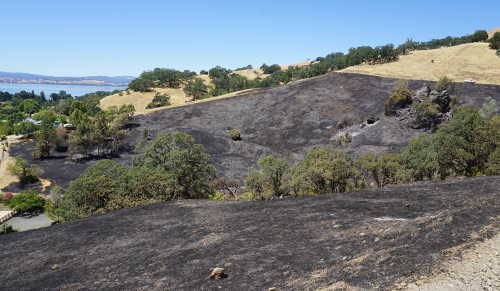 LUCERNE, Calif. – Firefighters on Wednesday continued their efforts to fully contain a wildland fire in Lucerne.
The Foothill fire has burned a total of 69 acres, with containment rising to 90 percent by Wednesday evening, according to Suzie Blankenship, a fire prevention specialist with Cal Fire.
The fire began shortly after 5 p.m. Tuesday in the area of Foothill and Country Club drives, burning up along the Robinson Road area.
The incident came close to several homes, which had led to a limited number of brief evacuations on Tuesday evening that were lifted later that night, according to the Lake County Sheriff's Office.
Blankenship's report said firefighters saved three homes, with a dollar saved estimate of $550,000.
On Wednesday evening, four Cal Fire crews, seven engines, three water tenders and 100 personnel – three of them overhead/command staff – remained committed to the fire, Blankenship reported.
The Cal Fire crews and engines, plus a bulldozer and a helicopter, were busy in the fire's charred footprint on Wednesday afternoon.
Working alongside of the Cal Fire crews were US Forest Service units including the Elk Mountain Hotshots.
Firefighters on the ground cut trees, worked on hot spots and strengthened containment line.
The helicopter made repeated trips between the lake and the hillside with a bucket, dropping water in an area of trees where there still appeared to be a small amount of white smoke.
By day's end, Blankenship said heavy mop up work had begun within the fire perimeter.
Blankenship said fire crews will remain working on the fire line throughout the night, with a day shift of firefighters assigned to the incident on Thursday.
The cause of the fire remains under investigation, Blankenship said.
Email Elizabeth Larson at

KELSEYVILLE, Calif. – Kelseyville's next “Kickin' in the Country” street dance will take place on Thursday, July 21.
The Kelseyville Business Association hosts the free monthly events with live music from 7 to 10 p.m. on Main Street.
This week's featured band is The Funky Dozen.
Other dances this summer will take place on Aug. 18 and Sept. 15.
For more information contact the Kelseyville Business Association at 707-279-9022, visit the association's Web site at http://www.visitkelseyville.com/ or its Facebook page, https://www.facebook.com/visitKelseyville .
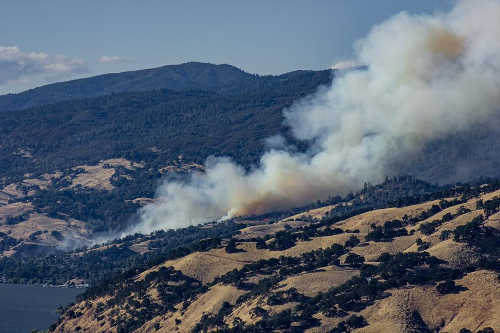 LUCERNE, Calif. – Firefighters late Tuesday reached the halfway point in the effort to contain a wildland fire burning in the hills above Lucerne.
The Foothill fire was first reported at approximately 5:17 p.m. Tuesday in the area of Foothill and Country Club drives, according to Fire Captain Specialist Russell West of Cal Fire.
Agencies responding to the fire included Cal Fire, Northshore Fire, the United States Forest Service and the Lake County Sheriff Office, West said.
The fire extended up into the area's hillsides, where Cal Fire's air resources – including six air tankers and three helicopters – worked aggressively on it throughout the evening, according to reports from the scene.

Two helicopters, including Cal Fire's Copter 104, dropped water on the ground at the Marymount California University Lakeside Campus, known as “The Castle,” located on Country Club Drive, so they could land and stage at the building early Tuesday evening.
By nightfall, West said the fire had burned 60 acres of grass and brush, with forward progress stopped.
West reported late Tuesday that the incident was 50-percent contained.
Early in the incident, the sheriff's office had reported evacuating five homes. By the time of West's nighttime report, he said the structure threat had been mitigated and no evacuations or road closures were in place.
He said no structures were damaged in the fire.

Resources committed to the incident Tuesday night included 130 fire personnel, eight overhead/command personnel, 17 engine companies, four fire crews, two volunteer companies and two water tenders, according to West.
West said the fire's cause has not yet been determined.
The incident is the largest so far in the 2016 fire season.
Email Elizabeth Larson at