 How to resolve AdBlock issue?
News
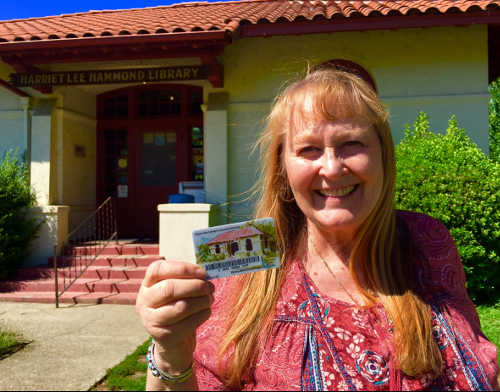 LAKEPORT, Calif. – In honor of the upcoming centennial celebration for Upper Lake’s Harriet Lee Hammond Library, the Lake County Library has begun issuing commemorative library cards this month.
The new cards feature a painting of the Hammond Library by Upper Lake artist J. P. Sarlande.
The new cards will be available from all branches of the Lake County Library while supplies last.
To get a library card in Lake County bring your identification and proof of current mailing address to any branch. Children under 18 will need a parent’s identification.
September is Library Card Sign-up Month which coincides well with the October celebration for Upper Lake’s historic library.
The library centennial will take place on Oct. 16 from 2 to 5 p.m. at the library, located at 310 Second St.
The celebration will include entertainment, refreshments and a lot of fun and surprises.
The Upper Lake Women’s Protective Club started Upper Lake’s first library in borrowed space in J.N. League’s general store in 1914, but the club members always hoped for a permanent library building.
With a donation of land from Lottie Mendenhall and Amy Murdock and $6,000 from Harriet Lee Hammond, Upper Lake’s new library building took shape over the summer of 1916 and opened that October.
Although the building might appear to have started out as a house, it has always been a library. Its 100-year history as a library makes it one of Upper Lake’s oldest businesses.
For more information about the centennial contact the library at 707-275-2049 or the main library in Lakeport at 707-263-8817.
The Lake County Library is on the Internet at http://library.lakecountyca.gov and Facebook at www.Facebook.com/LakeCountyLibrary .
Jan Cook works for the Lake County Library.
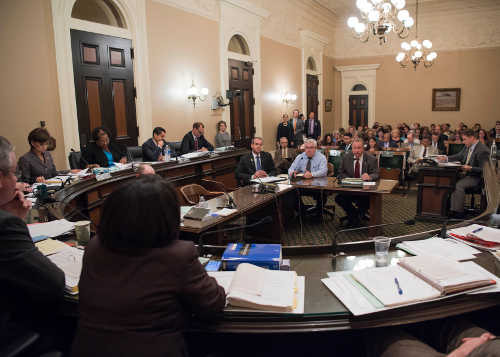
The Equal Pay for Equal Work Act of 2016 by Assemblyman Bill Dodd (D-Napa) passed the state Legislature at the end of August with bipartisan support.
The act, also known as Assembly Bill 1890, would ensure companies that do business with the state of California have fair compensation policies and practices that do not unlawfully discriminate based on gender or race.
The announcement of the bill's passages came on Aug. 26, Women’s Equality Day, which commemorates the certification of the 19th Amendment to the Constitution, guaranteeing women the right to vote.
“We continue the fight against wage inequities that still exist for women across California,” said Sue Miller, chair of the American Association of University Women of California Public Policy Committee. “The wage gap remains constant and women are still paid less in nearly every occupation. Women and their families suffer the consequences of a pay gap from their first paycheck to their last Social Security check. It is imperative that our legislature and our governor continue to support progressive reforms that move toward a more equitable future for all Californians. AAUW California asks the governor to sign AB 1890 as one more tool to help us in our fight.”
The gender pay gap has remained relatively unchanged in recent years, with full-time working women in the U.S. averaging just 77 cents for every dollar earned by their male counterparts over the last decade.
The disparity is even greater for women of color, and numerous studies have found a gap persists even when controlling for factors like education and career field.
In 2014, the pay gap between men and women averaged nearly $11,000 annually in lost income.
“The state of California spends billions of dollars annually on state contracts, and we need to ensure taxpayer money is going to companies that follow our existing gender pay equity laws,” said Dodd. “I’m hopeful Gov. Brown will seize this opportunity to have California once again set the example for the nation. We can’t idly sit by and leave a state where my granddaughters are valued less than my grandsons. We owe it to hard working women and future generations to close the pay gap.”
The act, will require companies that contract with the state to have policies in place to help ensure compliance with the equal pay laws.
Additionally, the bill would require contractors to provide the state with data on employee pay by gender and race.
Collecting this data will help the state in appropriately targeting its efforts to reduce and eliminate the wage gap in California. The U.S. Equal Employment Opportunity Commission is currently considering similar reporting requirements at the federal level.
“As a society we need to ensure people aren’t paid less for doing the same job simply because of their gender or the color of their skin. The advancement of gender pay equity has been overlooked for too long,” said gender pay equity advocate, K. Patrice Williams, of Vallejo. “This legislation marks another step towards closing the gender pay gap in California. I’d like to thank Assemblymember Dodd for his effort in promoting this positive change.”
Last year, Dodd co-authored the California Fair Pay Act of 2015, which was signed by Gov. Brown to create the strongest equal pay laws in the nation.
Hoping to build of last year’s success, Dodd’s legislation would advance gender pay equity by ensuring those standards are actually followed by state contractors.
The bill now heads to the governor’s desk where it awaits his signature to become law.
Dodd represents the Fourth Assembly District, which includes all or portions of Napa, Sonoma, Solano, Yolo, Lake and Colusa counties. Visit his Web site at www.asm.ca.gov/dodd .
Expanding Head Start is good public policy and will pay for itself, according to new research by faculty in the University of California, Berkeley’s economics department and Goldman School of Public Policy.
According to the U.S. Department of Health and Human Services, the average Head Start expenditure per child is about $8,000.
The UC Berkeley researchers found that every dollar invested generates $2 in future earnings for children enrolled in the program.
According to UC Berkeley economics professor Christopher Walters, “Many children who attend Head Start would otherwise attend other subsidized preschools. Moving kids from one form of preschool to another yields minimal benefits but also entails little cost to taxpayers. And since preschools tend to be oversubscribed, Head Start may add significantly to total preschool enrollment, which our estimates (along with a large existing literature) suggest pays for itself.”
Head Start, the federal preschool program for children from low-income families, has been studied widely since its inception in 1965, and experts have found the results to be a mixed bag.
Early research found large positive effects on children’s cognitive skills, while the Department of Health and Human Services’ large 2002 Head Start Impact Study seemed to show fewer benefits.
The latter study, which began following enrollees in 2002 and stayed with them through third grade, found that all the academic advances the children had made during their Head Start year faded quickly over time.
The policy brief, based on research by faculty affiliated with UC Berkeley’s Institute for Research on Labor and Employment, “Revisiting the impact of Head Start,” highlights new data showing that the earlier negative results from the Head Start Impact Study were misleading.
The brief finds errors in earlier studies, clarifies what was being measured and clearly shows that Head Start is of great benefit to the disadvantaged children it serves over the course of their lives, according to its author, Claire Montailoux.
“Researchers have often estimated the effects of attending Head Start compared to a mix of home care and other preschool programs. When Head Start is compared specifically to at-home care, we find that it has large positive impacts on test scores for low-income children.” said Walters.
Key findings include:
• Head Start raises children’s cognitive and social development. Earlier studies showing limited benefits to children in Head Start compared them to a control group made up of children in other preschool programs and children receiving care at home, diluting the positive impacts seen in the Head Start group.
• Head Start dramatically increases parents’ involvement with their children while in preschool and after. For example, participation in Head Start increases the time parents spend reading to children by 20 percent, and Head Start leads absent fathers to spend one additional day per month with their children.
• Taking into account the new estimates of the benefits of Head Start – including better health outcomes, lower criminality and higher future earnings – a cost-benefit analysis shows that the benefits of Head Start well exceed its costs.
The brief also drew largely from other analyses of Head Start by UC Berkeley researchers.
 LAKEPORT, Calif. – Terrace Middle School Parent Teacher Organization, and the Westshore Youth Basketball League have teamed up to bring much-needed equipment to Terrace Middle School.
In the past year the two groups worked together to purchase both indoor basketball hoops and pads for the Terrace Gym, spending more than $14,000.
Both groups recognized that there was a safety hazard with the old equipment and jumped into action to make sure youth would be safe while playing basketball.
Terrace PTO offered thanks for the dedication of parents and teachers and Westshore Youth Basketball thanked its sponsors in the effort.
The list of supports for the effort includes Brian Grey, D.D.S.; Granite Construction; Habematolel Pomo of Upper Lake; Meek Construction; Running Creek Casino; #playforstump; 3 Brothers Chevron, Carl's Jr. & Baskin-Robbins; Carlton Tire; Clearlake Redi-Mix; De Leon Engineering; Details Count Photography; I E Wood Products; Konocti Christian Academy; Lake County Electric Supply; Lake County Safety Employees Association; Lake County Woodcrafters; Lawler family; Perry's Deli; Pivniska Water Haul; Plaza Paints; Poppy's Nursery; S&K Automotive; Salas family; Scott family; and Smart Stars.
Ever since the 1950s discovery of the solar wind – the constant flow of charged particles from the sun – there’s been a stark disconnect between this outpouring and the sun itself.
As it approaches Earth, the solar wind is gusty and turbulent. But near the sun where it originates, this wind is structured in distinct rays, much like a child’s simple drawing of the sun.
The details of the transition from defined rays in the corona, the sun’s upper atmosphere, to the solar wind have been, until now, a mystery.
Using NASA’s Solar Terrestrial Relations Observatory, or STEREO, scientists have for the first time imaged the edge of the sun and described that transition, where the solar wind starts.
Defining the details of this boundary helps us learn more about our solar neighborhood, which is bathed throughout by solar material – a space environment that we must understand to safely explore beyond our planet.
A paper on the findings was published in The Astrophysical Journal on Sept. 1, 2016.
“Now we have a global picture of solar wind evolution,” said Nicholeen Viall, a co-author of the paper and a solar scientist at NASA’s Goddard Space Flight Center in Greenbelt, Maryland. “This is really going to change our understanding of how the space environment develops.”
Both near Earth and far past Pluto, our space environment is dominated by activity on the sun. The sun and its atmosphere are made of plasma – a mix of positively and negatively charged particles which have separated at extremely high temperatures, that both carries and travels along magnetic field lines. Material from the corona streams out into space, filling the solar system with the solar wind.
But scientists found that as the plasma travels further away from the sun, things change: The sun begins to lose magnetic control, forming the boundary that defines the outer corona – the very edge of the sun.
“As you go farther from the sun, the magnetic field strength drops faster than the pressure of the material does,” said Craig DeForest, lead author of the paper and a solar physicist at the Southwest Research Institute in Boulder, Colorado. “Eventually, the material starts to act more like a gas, and less like a magnetically structured plasma.”
The breakup of the rays is similar to the way water shoots out from a squirt gun. First, the water is a smooth and unified stream, but it eventually breaks up into droplets, then smaller drops and eventually a fine, misty spray. The images in this study capture the plasma at the same stage where a stream of water gradually disintegrates into droplets.
Before this study, scientists hypothesized that magnetic forces were instrumental to shaping the edge of the corona. However, the effect has never previously been observed because the images are so challenging to process. Twenty million miles from the sun, the solar wind plasma is tenuous, and contains free-floating electrons which scatter sunlight. This means they can be seen, but they are very faint and require careful processing.
In order to resolve the transition zone, scientists had to separate the faint features of the solar wind from the background noise and light sources over 100 times brighter: the background stars, stray light from the sun itself and even dust in the inner solar system. In a way, these images were hiding in plain sight.
Images of the corona fading into the solar wind are crucial pieces of the puzzle to understanding the whole sun, from its core to the edge of the heliosphere, the region of the sun’s vast influence. With a global perspective, scientists can better understand the large-scale physics at this critical region, which affect not only our planet, but also the entire solar system.
Such observations from the STEREO mission – which launched in 2006 – also help inform the next generation of sun-watchers. In 2018, NASA is scheduled to launch the Solar Probe Plus mission, which will fly into the sun’s corona, collecting more valuable information on the origin and evolution of the solar wind.
STEREO is the third mission in NASA Heliophysics Division’s Solar Terrestrial Probes program, which is managed by Goddard for the Science Mission Directorate, in Washington, D.C.
Lina Tran works for NASA’s Goddard Space Flight Center Greenbelt, Md.
LAKE COUNTY, Calif. – Lake County Animal Care and Control has a small group of big dogs ready to go to new homes this week.
The available dogs include mixes of Doberman, husky and pit bull.
There also are several strays picked up from the Clayton fire area that are being held for 30 days in order to reunite them with their families.
Dogs that are adopted from Lake County Animal Care and Control are either neutered or spayed, microchipped and, if old enough, given a rabies shot and county license before being released to their new owner. License fees do not apply to residents of the cities of Lakeport or Clearlake.
If you're looking for a new companion, visit the shelter. There are many great pets hoping you'll choose them.
The following dogs at the Lake County Animal Care and Control shelter have been cleared for adoption (additional dogs on the animal control Web site not listed are still “on hold”).

'Stella'
“Stella” is a female pit bull terrier mix.
She has a short tan coat, floppy ears and brown eyes.
Stella is in kennel No. 4, ID No. 5940.

Male husky mix
This tall, lanky male husky mix with a medium-length a tan and white coat, and brown eyes. He already has been neutered.
He's in kennel No. 8, ID No. 5923.

'Athena'
“Athena” is a female Doberman Pinscher with a short black and red coat.
She is in kennel No. 10, ID No. 5976.

'Rocky'
“Rocky” is a male pit bull terrier mix.
He has a short black and white coat, brown eyes and floppy ears.
He's in kennel No. 12, ID No. 5910.

'Roadie'
“Roadie” is a handsome male pit bull terrier with a short black and white coat.
He's in kennel No. 26, ID No. 5558.
To fill out an adoption application online visit http://www.co.lake.ca.us/Government/Directory/Animal_Care_And_Control/Adopt/Dog___Cat_Adoption_Application.htm .
Lake County Animal Care and Control is located at 4949 Helbush in Lakeport, next to the Hill Road Correctional Facility.
Office hours are Monday through Friday, 11 a.m. to 5 p.m., and 11 a.m. to 3 p.m., Saturday. The shelter is open from 11 a.m. to 4 p.m. Monday through Friday and on Saturday from 11 a.m. to 3 p.m.
Visit the shelter online at http://www.co.lake.ca.us/Government/Directory/Animal_Care_And_Control.htm .
For more information call Lake County Animal Care and Control at 707-263-0278.
Email Elizabeth Larson at