How to resolve AdBlock issue?
News
In 1963, an astronomy student named Gail Smith working at an observatory in the Netherlands discovered something odd – a massive cloud of gas orbiting the Milky Way galaxy.
Smith’s cloud contained enough gas to make two million stars the size of our sun, and it was moving through space at 700,000 miles per hour.
For the next 40-plus years the cloud remained a curiosity, one of a growing number of so-called high velocity clouds circling the Milky Way – interesting but not sensational.
Then something changed.
In the mid-2000s, radio astronomer Jay Lockman and colleagues took a closer look at Smith’s Cloud using the Green Bank radio telescope in West Virginia, and they were able to calculate the cloud’s orbit.
Smith’s Cloud, it turns out, is on a collision course with the Milky Way.
Thirty million years from now, give or take a few million years, it will crash into the Perseus Arm of our galaxy. The impact will compress clouds of gas in that spiral arm, causing a brilliant burst of star formation.
There’s no real danger to the Milky Way. Smith’s Cloud is minuscule compared to the gigantic spiral of stars that makes up the backbone of our galaxy. But the coming collision has sharply increased interest in Smith’s Cloud.
“We don't fully understand the Smith Cloud's origin,” said Andrew Fox of the Space Telescope Science Institute. “There are two leading theories. One is that it was blown out of the Milky Way, perhaps by a cluster of supernova explosions. The other is that the Smith Cloud is an extragalactic object that has been captured by the Milky Way.”
To investigate these theories, Fox and colleagues recently peered into the cloud using the Hubble Space Telescope’s Cosmic Origins Spectrograph.
One of the elements they found was sulfur, absorbing ultraviolet light from the bright cores of three galaxies far beyond the cloud.
By analyzing the amount of light Smith’s Cloud absorbs, the astronomers were able to measure the abundance of sulfur in the cloud.
“The abundance of sulfur in Smith’s Cloud is similar to the abundance of sulfur in the outer disk of our own Milky Way,” Fox said.
This means we have a family relationship.
“The cloud appears to have been ejected from within the Milky Way and is now falling back,” Fox said. “The cloud is fragmenting and evaporating as it plows through a halo of diffuse gas surrounding our galaxy. It's basically falling apart. This means that not all of the material in Smith’s Cloud will survive to form new stars. But if it does survive, or some part of it does, it should produce an impressive burst of star formation.”
While Fox’s work has cleared up some of the mystery of the Smith Cloud, many questions remain: What calamitous event could have catapulted it from the Milky Way's disk, and how did it remain intact?
These are questions for future research. Thirty million years to impact: the clock is ticking!
MENDOCINO NATIONAL FOREST, Calif. – The Mendocino National Forest is seeking input on the development of the Black Butte River and Cold Creek Comprehensive River Management Plan (CRMP).
The CRMP will address how best to manage the river into the future.
The CRMP will focus on protecting the river’s free-flowing condition and water quality as well as the outstanding remarkable values and classification for which the river was designated.
A CRMP is required by the Wild and Scenic Rivers Act of 1968 for each segment to provide for the protection of the river values.
The three designated river segments on the Mendocino National Forest are:
· 16 miles of Black Butte River, from the Mendocino County Line to its confluence with Jumpoff Creek were designated as wild.
· 3.5 miles of the Black Butte River, from its confluence at Jumpoff Creek to its confluence with Middle Eel River were designated as scenic.
· 1.5 miles of Cold Creek, from the Mendocino County Line to its confluence with Black Butte River were designated as wild.
The forest is working on the initial steps needed to complete this plan and would like your input on these steps as well as on our approach and management actions.
Comments will be most useful if they are received by Oct. 28.
Comments can be sent electronically via email, mailed or faxed. Comments may also be hand-delivered to the Upper Lake Ranger District office at 10025 Elk Mountain Road from 8 a.m. to 4:30 p.m., Monday through Friday, excluding federal holidays.
For more information visit the forest Web site at http://www.fs.usda.gov/detail/mendocino/home/?cid=FSEPRD517563 .
LAKE COUNTY, Calif. – The Saw Shop Bistro’s 15th annual benefit dinner for Habitat for Humanity Lake County will be held on Monday, Nov. 7.
The multi-course, sit-down dinner will begin at 6 p.m. at the Saw Shop Bistro, 3825 Main St. in Kelseyville.
The funds received will go toward providing homes for the 2015-16 fire victims.
This is the main funding event for Habitat for Humanity Lake County. All costs of the dinner are donated to Habitat for Humanity including the food, wine and the staff hours of the Saw Shop.
Tickets are $100 each. Event sponsorship awards the sponsor with a table for eight guests in addition to recognition in Habitat’s biannual newsletter and social media forums.
Sponsorships are available by contacting Habitat for Humanity directly. Please call the Saw Shop Bistro at 707-278-0129 for reservations.
For further information, or to be an event sponsor, call the Habitat for Humanity office at 707-994-1100.
LAKEPORT, Calif. – The next free household hazardous waste dropoff event will be held Friday, Oct. 21, and Saturday, Oct. 22, at Lake County Waste Solutions Transfer Station and Recycling Yard, 230 Soda Bay Road in Lakeport.
Hours will be from 9 a.m. until 1 p.m.
Households can bring up to 15 gallons of toxic items free of charge. Fees will be charged for amounts over 15 gallons.
Items that are accepted include paint, solvents, fuels, five-gallon propane tanks (empty), pool chemicals, pesticides, herbicides, batteries, fluorescent light tubes (up to 60 linear feet) and other toxic materials that cannot be put in the trash.
Items that cannot be accepted include televisions, computer monitors, ammunition, explosives, radioactive materials or infectious wastes.
To learn how and where to properly dispose these items, please visit www.recycling.co.lake.ca.us or contact the recycling hotline at 707-263-1980.
Household hazardous waste dropoff services are provided to Lake County residential households by the Integrated Waste Management Division of the Lake County Public Services Department and the Department of Resources Recycling and Recovery (CalRecycle).
Businesses also are welcome to use this convenient service to properly dispose of hazardous waste and protect our environment, however, businesses must pay for this county-funded service and first make an appointment. Business appointments can be made by calling Lake County Waste Solutions at 707-234-6400.
Beginning in June, ask about receiving a free puncture-proof sharps container at one of these events to use for free sharps disposal.
Free recycling options for residents and businesses:
· Recycled paint is available to both residents and businesses at Lake County Waste Solutions and South Lake Refuse and Recycling Center first-come, first-served basis in five gallon containers. Colors include tan, brown, gray and pink.
· Used motor oil and cooking oil can be dropped off by businesses and residents, at Lake County Waste Solutions, South Lake Refuse & Recycling Center, and the North Shore Fire Protection District station at 6257 Seventh Ave. in Lucerne. Visit www.recycling.co.lake.ca.us for more locations.
· Electronics (e-waste) can be dropped off at Lake County Waste Solutions and at South Lake Refuse & Recycling Center.
Lake County Waste Solutions
230 Soda Bay Road, Lakeport
888-718-4888 or 707-234-6400
Monday-Saturday, 7:30 a.m. - 4 p.m.
www.candswaste.com
South Lake Refuse & Recycling Center
16015 Davis St., Clearlake
Open daily, 7:30 a.m.-3 p.m.
707-994-8614
www.southlakerefuse.com
The free Household Hazardous Waste drop off program is subsidized by the Lake County Public Services Department, Integrated Waste Management Division and CalRecycle as a public service to Lake County households.
For more information about recycling, reusing and reducing, visit www.recycling.co.lake.ca.us , call the recycling hotline at 707-263-1980 or like Lake County Public Services on Facebook at https://www.facebook.com/LCPublicServices?fref=ts .
Determining the sex of black bass
Question: We fish Lake Silverwood most of the time, and usually it’s for bass.
Is there a way to determine the sex of a largemouth bass? We are interested primarily in the fish we catch in the spring.
Also, are crayfish part of the diet for bass in Lake Silverwood? (Doug T., Hesperia).
Answer: Unfortunately, there is no easy way to sex black bass (including largemouth bass) unless they are in spawning mode.
The males move up first into the spawning areas and make the nests. The females then join them when they’re ready. When you see a pair on a nest, the male is usually the smaller of the pair and will be the most aggressive.
A single female will mate with more than one male during the spawning season. And regarding their diet, yes, crayfish are part of the black bass diet.
Deer hunting from my house?
Question: I have a house on five acres in Northern California and have some really nice bucks on my land. Every day they come within a few feet of my house and graze on my garden and plants.
If I purchase an A Zone tag this year, can I legally shoot a deer on my land from my house or porch?
My house is situated more than 200 yards from any other property or house and it is outside of the city limits. (Brian T.)
Answer: Yes. The safety zone law prohibits shooting within 150 yards of any occupied dwelling without the permission of the occupant.
As long as it is otherwise legal to discharge a firearm in this area (e.g. not in the city limits or not prohibited by county ordinance), then go for it!
Landing net size for ocean kayak fishing?
Question: What size opening on a landing net is needed for ocean fishing? I fish from a kayak between San Francisco Bay and the Mexico border, and all points in between. (Jeff K.)
Answer: A landing net is required when fishing from any vessel on the ocean.
“No person shall take finfish from any boat or other floating device in ocean waters without having a landing net in possession or available for immediate use to assist in landing undersize fish of species having minimum size limits; the opening of any such landing net shall be not less than eighteen inches in diameter” (California Code of Regulations Title 14, 28.65(d)).
Fishermen are ultimately responsible for being able to determine whether the fish they take are of legal size. When in doubt, your best bet is to consult the California Ocean Sport Fishing Regulations booklet.
What license for crabbing via a "crab snare"?
Question: A friend and I would really like to try our hand at getting some crab this year using crab snares (loop traps). I am referring to the types that have a bait cage with a bunch of snares attached and are cast out using a rod and reel.
The problem is that I'm not sure if we just need a normal fishing license or something else. Can you please clarify? (Kyle C.)
Answer: Just a normal fishing license is all that is required for crabbing.
Is ocean fishing with a crossbow legal?
Question: Is it legal to take fish in Southern California oceans using a crossbow? I know that using a bow and arrow is legal but I would like to know if crossbows are also legal.
I also realize that the usual bag limits, size limits and closures apply. (Rod)
Answer: Spears, harpoons and bow and arrow fishing tackle (including crossbows) may be used for taking all varieties of skates, rays and sharks, except white sharks.
Such gear may not be possessed or used within 100 yards of the mouth of any stream in any ocean waters north of Ventura County, nor aboard any vessel on any day or trip when broadbill swordfish or marlin have been taken.
Bow and arrow fishing tackle may also be used to take finfish other than giant (black) sea bass, garibaldi, gulf grouper, broomtail grouper, trout, salmon, broadbill swordfish and white shark (CCR Title 14, section 28.95).
For hunting purposes, crossbows are not considered to be archery equipment (see CCR Title 14, section 354). But under the fishing regulations, crossbows qualify as bow and arrow fishing tackle.
It does not matter what type of bow or crossbow is used under legal bow and arrow fishing, but a line must be attached to the bow and the arrow/bolt (CCR Title 14, section 1.23).
If using a crossbow for shark fishing, be sure of the species and any associated size and/or bag limits before pulling that trigger.
Carrie Wilson is a marine environmental scientist with the California Department of Fish and Wildlife. While she cannot personally answer everyone’s questions, she will select a few to answer each week in this column. Please contact her at
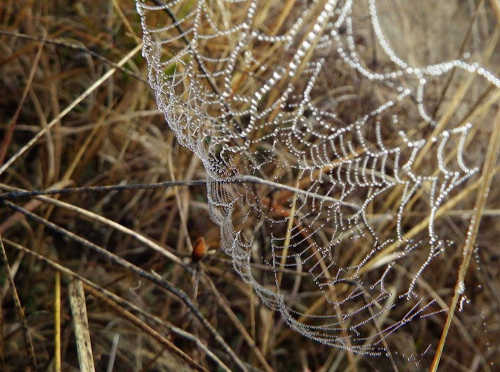
NORTHERN CALIFORNIA – With Halloween coming, spider web motifs are everywhere.
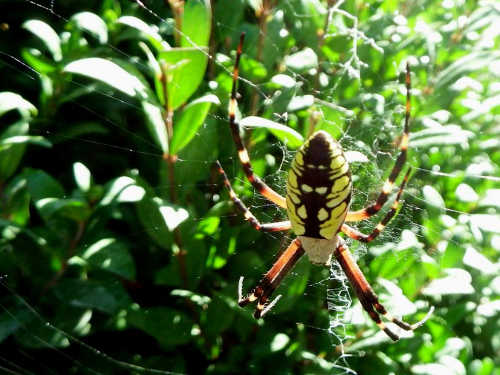
Although in nature there are many different types of webs, the ones with which we’re all most familiar are those spiral bicycle-wheel shaped webs found in gardens, forests and grassland fields made by the orb-weaver spiders.
The oldest known orb-weaver was a species known as Mesozygiella dunlopi, a now extinct spider that lived during the Lower Cretaceous period (about 125 to 140 million years ago).
Today, there are actually more than 2,800 species of orb-weavers across the globe, and they vary greatly in size, shape and coloring.
The one thing most of them have in common is the way they build their webs ... And most of the webs you see are built by the females.
Among orb-weavers, females are usually several times larger than the males, and the males only build webs for themselves when they’re very young.
When sexually mature, the males will venture out onto the female’s web, albeit very carefully because female orb-weavers are cannibalistic and will readily eat the males if they loiter for more than about 5 or 10 seconds.
An incredible engineer, the female orb-weaver will start her web by securing a strand of silk from her spinneret (the spider’s silk-spinning organ, usually found at the back of the abdomen) to some permanent surface like a tree limb, plant or rock.
Then the spider jumps and lets the wind carry it to another adjacent site while it continues to spin a non-sticky line of silk.
It anchors the loose end of the line to a second permanent surface, walks out across its now taut line to the center, and floats downward with a new strand of silk to form a sort of silken “Y.”
Once the Y is finished, the spider will use that as the base for its web and will continue to add more “spokes” to its circle.
Generally speaking, each of the long spokes of the web is made of non-sticky silk. The sticky-silk is saved for the spiral that runs from the center of the spoke-web, around and around to the outer edges of the web.
Once the web is completed, the spider may sit in the center of it, or hide somewhere close to the web with one appendage touching the nearest thread to feel for any movement that might indicate the web has captured some prey.
When small insects fly or blunder into the web, the spider comes out and incapacitates it with a bite.
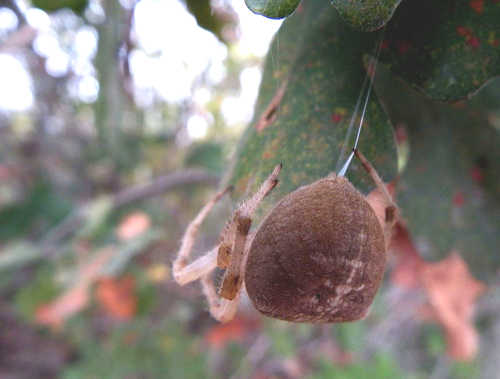
Orb-weavers do produce venom, but it is low grade and not toxic to humans. They are also typically non-aggressive spiders that won’t bite people unless they’re provoked.
If the spider doesn’t consume the prey right away, it will wrap its victim up in silk and save it for later.
If the prey turns out to be something that has a stinger of its own, like a bee or wasp, the spider will protect itself by wrapping the dangerous prey up before it bites and consumes it.
Some orb-weavers eat their webs after one day and then spin a new one in the same general location the next, while others keep using the same web as long as it’s functioning properly.
You may also see some orb-weaver webs “decorated” with lines of detritus – such as dead insects, plant materials and leftovers – or crisscrossing bands of silk called “stabilimentum.”
The trashline spider and the black-and-yellow garden spider are prime examples of species that do this.
Scientists still haven’t agreed on what purpose these decorations serve. Some believe they help to lure in prey, advertise to mates or stabilize the web structure itself.
Most recent studies suggest, however, that because the stabilimentum are so conspicuous and bright, they actually trick prey into trying to avoid the structures and thereby crash into the web itself.
So, now when you see all the webs in the Halloween decorations, you’ll be more appreciative of the work the spiders put into them.
Mary K. Hanson is a Certified California Naturalist and author of the “Cool Stuff Along the American River” series of nature guides available at www.lulu.com . Tuleyome is a501(c)(3) nonprofit conservation organization based in Woodland, Calif. For more information, see their website at: www.tuleyome.org .