 How to resolve AdBlock issue?
News
Editor's note: This story contains an account of a murder that some readers may find disturbing.
This story has been updated with information about the death of Hennis’ codefendant, Roy Corbett.
LAKE COUNTY, Calif. – A man who as a teenager was convicted of taking part in the murder of the ex-girlfriend of one of his friends has been denied release at his first parole hearing.
The Board of Parole Hearings denied parole to Paul Gordon Hennis, 41, who is serving his sentence at Kern Valley State Prison in Delano, according to Deputy District Attorney Ed Borg, who traveled to the prison on Wednesday for the lifer hearing.
Hennis and a friend, Roy Allen Corbett, were convicted in February 1994 of first-degree murder for the killing of 16-year-old Jamie Faris in May 1992 in Lakeport, Borg said.
Both Hennis and Corbett were 16 at the time of the murder and were tried as adults, while Borg said a third juvenile who was present when the murder occurred, Kevin F., reached a plea agreement and served time in the juvenile system.
Borg said Faris and Corbett had been in a dating relationship but broke up. Corbett began dating another girl but also continued to have some involvement with Faris, who had threatened to tell his new girlfriend about them.
Corbett made a statement to Hennis about wanting to kill Faris, and Hennis asked why he didn't, Borg said.
That formed the beginning of their planning to kill Faris, who they lured to a shop at the home that Hennis shared with his grandfather on May 16, 1992, according to the case's investigative documents.
Borg said Hennis provided Corbett with a baseball bat. While in the shop, as Hennis and the other juvenile looked on, Corbett tricked Faris into closing her eyes and turning around, telling her he had a surprise for her. He then came up behind her and hit her in the head with the baseball bat, knocking her to the ground.
It was at that point that Kevin F. went outside of the shop and began throwing up, Borg said.
Hennis told Corbett he had to finish Faris, and Borg said Corbett then tried to strangle her with his bare hands. When that failed, Hennis provided Corbett with spark plug wires, which Corbett used to strangle and kill her.
After Faris was dead, Corbett and Hennis put her in her car and planned to drive it up to the Hopland Grade and push it over a cliff in the hopes that it would look like she died in an accident, Borg said.
However, Borg said that on the way up the grade, Hennis – who was following Corbett in Faris' car – got a flat tire on his pickup. So Hennis and Corbett left Faris' vehicle on the side of the road and drove back to Lakeport, returning to Hennis' home, cleaning up the blood in the shop and then meeting another teen to go to a party.
Borg said they were arrested soon after the murder. The arrests came about after Hennis told another friend about killing Faris. That friend, in turn, told his mother, who reported it to law enforcement.
Throughout the case, Hennis – even at his young age – appeared extremely callous in how he prompted Corbett to commit the murder and assisted him, despite knowing Faris and not having any real animus toward her, Borg said.
Pointing out that they were all “just kids” at the time of the murder, Borg said, “It's difficult to comprehend.”
Corbett and Hennis had a fitness hearing in juvenile court, where it was determined that they should be tried as adults. Due to publicity in the case, their trial – which involved two separate juries – was moved to Sacramento, Borg said.
The case was prosecuted by then-District Attorney Stephen Hedstrom, with Hennis represented at trial by Mitchell Hauptman and Lawrence Kaplan defending Corbett, Borg said.
Borg said Corbett and Hennis were convicted in February 1994 of first-degree murder.
While Corbett's jury found he had not been lying in wait, Hennis' jury did find him guilty of that charge, which potentially made him eligible for life without the possibility of parole. However, Borg said the judge did not pursue that sentence for Hennis because he hadn't actually committed the killing himself.
Corbett and Hennis were sentenced to 25 years to life in prison in July 1994, with Borg explaining that the delay between their conviction and sentencing was due to exploring a motion for a new trial, which is normal in homicide cases.
Since that time, Corbett has died in prison, but Borg said he did not have any details about when and the cause.
Krissi Khokhobashvili, a public information officer with the California Department of Corrections and Rehabilitation, told Lake County News that Corbett died by suicide at California State Prison-Sacramento on March 5, 2005. He was 29 years old.
During his time in state prison, Hennis has been involved in a series of violent altercations that led to numerous disciplinary write ups.
Borg said Hennis also self-identified as a member of the Nazi Low Riders prison gang in 2005.
On behalf of that gang Hennis stabbed another inmate 19 times in March of 1996, assaulting another inmate three months later, according to Borg.
Hennis committed further assaults against other inmates in November 1999 and April 2000; had a total of four charges of willfully obstructing a peace officer in 1996, 1999 and 2000 for refusing to leave his cell when ordered; and in 2011 – again at the direction of the Nazi Low Riders – participated in a mass disturbance hunger strike, Borg said.
In another incident, in March of 2012 Hennis' cell was searched and prison guards found he had two gang poems that referred to killing black inmates, according to Borg.
Borg said Hennis spent time at Pelican Bay State Prison in the secure housing unit, where he was isolated from other prisoners.
In December 2012, Hennis applied to be debriefed to get out of the gang, and last year was decertified as a gang member. Borg said he then was housed in a special yard for former gang members where they're protected from violence.
Borg said Hennis had actually been eligible for his initial parole hearing in 2013 but elected not to do it then. “So this was in essence his initial hearing.”
The Wednesday hearing began at 9 a.m. and lasted until 1:30 p.m., with Hennis represented by an attorney when he appeared before the two parole commissioners. Borg was present on behalf of the Lake County District Attorney's Office.
During the hearing, a risk assessment related to Hennis' potential release was discussed, and it outlined all of Hennis' behavior issues, which the commissioners questioned him about, Borg said.
Borg said the commissioners determined that Hennis did have some insight into his crime, and that he understood it and accepted responsibility.
It also was discussed at the hearing that since 2014 Hennis has been taking classes and participating in Alcoholics Anonymous and Narcotics Anonymous groups, and so has made some progress in his personal rehabilitation, Borg said.
While Hennis hasn't had disciplinary issues in prison involving drugs or alcohol, Borg said he came from an abusive background in which both of his parents were involved with drugs, including growing marijuana. Hennis was using marijuana and drinking while living with his grandfather, who wasn't sophisticated about drug use so wasn't aware he was using.
The parole commissioners remained concerned that Hennis posed a significant risk of violence to the community if released, which Borg said was a result of the numerous violent incidents in prison as well as the fact that he was not forthcoming about his gang activity and actually downplayed it.
“It was an extremely brutal act, and I think that's one of the reasons why the parole commissioners are concerned about what he's going to be like,” Borg said.
Borg said the parole commissioners also were concerned about Hennis learning to function in the outside world, including being able to take responsibility for basic tasks such as paying bills. In response, Hennis said that if he was released he had a plan to go to a halfway house in Southern California to learn those life skills.
The risk assessment found that Hennis has a low risk of reoffending if he remains abstinent from drugs and alcohol, Borg said.
However, when it came to avoiding substance abuse, Borg said Hennis didn't have a good answer for how he would accomplish that. He told the parole commissioners he would simply go to a community where there are no drugs. Borg said the commissioners pointed out that there are drugs in every community.
Ultimately, the commissioners decided to deny Hennis parole for five years, which Borg said will give Hennis time to work on the issues that came up during the hearing.
By the time he's back up for parole consideration in 2021, Hennis will have been in custody for 29 years.
Email Elizabeth Larson at
LUCERNE, Calif. – A decision this week by the California Public Utilities Commission will offer rate cuts and a new tiered rate system for customers of California Water Service in Lucerne.
On Thursday, the CPUC issued its decision on Cal Water's required, triennial review of its operations, expenses, rates and needed water system improvements.
In its decision, the commission authorizes Cal Water to invest $1.5 million in infrastructure improvements over the next three years.
The decision enables Cal Water to make water system improvements necessary to continue providing safe and reliable water service to its customers, according to Local Manager Darin McCosker.
Among the improvements Cal Water will be able to make are $1.2 million to replace 4,480 feet of aging and high-risk water main, and $198,000 to replace aging treatment filters to maintain high-quality water in the system.
For the typical residential customer using 3,740 gallons, or 5 CCF, of water per month, the monthly water bill will decrease by $27.37 in 2017 (91 cents per day), and then increase by $1.15 (4 cents per day) in 2018 and by $1.09 (4 cents per day) in 2019.
New water rates go into effect Jan. 1, 2017.
Additionally, the CPUC allowed Cal Water to combine the rates of the Redwood Valley District – which includes Lucerne – with the Bayshore District to form the Bay Area Region.
The regional cost-sharing, which is encouraged by the State Legislature and commission, spreads infrastructure improvements and other costs among a larger base of customers and is helping to significantly reduce bills for each customer in the Redwood Valley District.
As such, Redwood Valley will be implementing tiered water rates in February 2017, which means that customers who use less water will pay a lower rate.
Company officials said the districts will continue to operate independently.
“We work hard to operate efficiently, and we are very pleased that we will be able to continue upgrading the water system while decreasing our customers’ bills,” McCosker said. “Protecting our customers’ health and safety is our highest priority, and our commitment is to do so at the lowest cost possible, even as costs for materials and services are rising across the country. This is part of our promise to our customers to provide excellent quality, service and value.”
The commission’s decision comes after an 18-month review process in which Cal Water’s operations and books are thoroughly audited.
It adopts the proposed decision issued in November 2016 by an administrative law judge and settlement achieved in September 2016 among Cal Water, the commission’s Office of Ratepayer Advocates, and other parties to the case.
Water utilities regulated by the commission, an independent state agency, are required to file such a rate review application every three years to ensure that water rates accurately reflect the costs to provide service. The next required review of rates will be filed in July 2018.
Cal Water customers will receive more details about approved water system improvements and the rate changes in their January 2017 bills.
Separately, the CPUC approved a resolution authorizing Cal Water to recover drought expenses incurred from 2014 to 2015 through a 12-month surcharge of $0.0208 per CCF on customers’ bills in the Redwood Valley District.
Cal Water serves approximately 1,900 service connections in the Redwood Valley area and about 2 million people through 480,300 service connections in California.
LAKE COUNTY, Calif. – Winter is officially less than a week away but the cold winter weather already is here, and forecasters are urging county residents to be prepared.
The National Weather Service issued a freeze watch that's in effect from 4 to 10 a.m. Sunday.
A hard freeze is defined as minimum temperatures at or below 28 degrees for at least three to five hours.
Temperatures are predicted to drop in the middle and upper 20s for several hours, the agency said.
Such low temperatures can kill plants and crops, and harm animals and livestock.
While the watch is only in effect for several hours on Sunday morning, the specific forecast for Lake County predicts very low temperatures on Saturday night as well.
On Saturday night it's forecast to be in the low 20s in the Lakeport area and around 27 in the Middletown and Clearlake areas.
The Kelseyville forecast puts Saturday night's temperature at 25 degrees, with 24 degrees in Upper Lake.
In the coming week, temperatures are expected to range between the mid and high 30s at night and the from the low 40s to mid 50s during the daytime, with mostly clear and sunny conditions.
Email Elizabeth Larson at
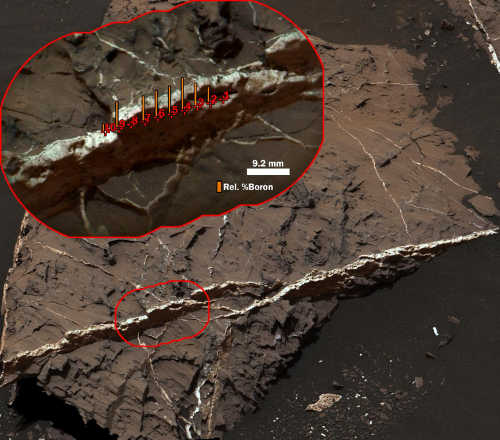
Boron has been identified for the first time on the surface of Mars, indicating the potential for long-term habitable groundwater in the ancient past.
"No prior mission to Mars has found boron," said Patrick Gasda, a postdoctoral researcher at Los Alamos National Laboratory. "If the boron that we found in calcium sulfate mineral veins on Mars is similar to what we see on Earth, it would indicate that the groundwater of ancient Mars that formed these veins would have been 0-60 degrees Celsius [32-140 degrees Fahrenheit] and neutral-to-alkaline pH."
The temperature, pH, and dissolved mineral content of the groundwater could make it habitable.
The boron was identified by the rover's laser-shooting Chemistry and Camera (ChemCam) instrument, which was developed at Los Alamos National Laboratory in conjunction with the French space agency.
Los Alamos' work on discovery-driven instruments like ChemCam stems from the Laboratory's experience building and operating more than 500 spacecraft instruments for national defense.
Boron is famously associated with arid sites where much water has evaporated away--think of the borax that mule teams once hauled from Death Valley. However, environmental implications of the boron found by Curiosity are still open to debate.
Scientists are considering at least two possibilities for the source of boron that groundwater left in the veins: It could be that the drying out of part of Gale lake resulted in a boron-containing deposit in an overlying layer, not yet reached by Curiosity. Some of the material from this layer could have later been carried by groundwater down into fractures in the rocks.
Or perhaps changes in the chemistry of clay-bearing deposits and groundwater affected how boron was picked up and dropped off within the local sediments.
The discovery of boron is only one of several recent findings related to the composition of Martian rocks. Curiosity is climbing a layered Martian mountain and finding rock-composition evidence of how ancient lakes and wet underground environments changed, billions of years ago, in ways that affected their favorability for microbial life.
As the rover has progressed uphill, compositions trend toward more clay and more boron. These and other variations can tell us about conditions under which sediments were initially deposited and about how later groundwater moving through the accumulated layers altered and transported ingredients.
Groundwater and chemicals dissolved in it that appeared later on Mars left its effects most clearly in mineral veins that filled cracks in older layered rock. But it also affected the composition of that rock matrix surrounding the veins, and the fluid was in turn affected by the rock.
"There is so much variability in the composition at different elevations, we've hit a jackpot," said John Grotzinger, of Caltech, Pasadena, Calif. As the rover gets further uphill, researchers are impressed by the complexity of the lake environments when clay-bearing sediments were being deposited and also by the complexity of the groundwater interactions after the sediments were buried.
"A sedimentary basin such as this is a chemical reactor," Grotzinger said. "Elements get rearranged. New minerals form and old ones dissolve. Electrons get redistributed. On Earth, these reactions support life."
Whether Martian life has ever existed is still unknown. No compelling evidence for it has been found. When Curiosity landed in Mars' Gale Crater in 2012 the mission's main goal was to determine whether the area ever offered an environment favorable for microbes.
Four recent drilling sites, from "Oudam" this past June through "Sebina" in October, are spaced about 80 feet apart in elevation. This uphill pattern allows the science team to sample progressively younger layers that reveal Mount Sharp's ancient environmental history.
"Variations in these minerals and elements indicate a dynamic system," Grotzinger said. "They interact with groundwater as well as surface water. The water influences the chemistry of the clays, but the composition of the water also changes. We are seeing chemical complexity indicating a long, interactive history with the water. The more complicated the chemistry is, the better it is for habitability. The boron and clay underline the mobility of elements and electrons, and that is good for life."

LAKE COUNTY, Calif. – The Umpqua Bank Wish Tree Program for Child Welfare Services was another great success this Christmas season thanks to the caring residents of Lake County.
The bank reported that every tag on its wish trees in Lakeport and Kelseyville was taken, with gifts brought back so that every child will have a very memorable holiday season.
Bank associates offered a special thank you to Bassmasters and VFW Post 2015 for their generous donations which they provide every year.

Through the kindness of so many in the community, there will be many delighted children this holiday season, the bank reported.
“We are grateful to live in such a special place. We have been involved in this program for over 25 years and the outpouring of generosity always amazes us,” said Umpqua Bank Vice President Paula Bryant.
The bank associates wished the community a wonderful holiday season and a safe, happy and prosperous new year.


KELSEYVILLE, Calif. – Dana Rae Park was born on Nov. 3, 1948, in Honolulu, Hawaii. He moved to Tracy, Calif., in 1996, and then to Lake County in 2001.
He unexpectedly passed away in his Kelseyville home on Dec. 6, 2016.
Visitation will be held at Chapel of the Lakes Mortuary, 1625 N. High St. in Lakeport on Thursday, Dec. 22, from 9 to 10 a.m., with a Christian service at 10 a.m.
A memorial lunch is planned at 11:30 a.m. at the Fore Family Vineyards Tasting Room at 3920 Main St., Kelseyville. Everyone who knew Dana or heard him sing is invited.
Dana loved Lake County and declined to return to Honolulu, where he had lived and worked for most of his life, also becoming a renowned activist against the Vietnam war.
Wherever he was, Dana always sang and played his guitar. In Honolulu he produced a popular open mic program called "Our Back Porch" at the University of Hawaii. In Tracy his open mic program event was called "Back Stage at the Odeum" and was televised on the Tracy community channel.
Dana's father, Richard Sondo Park, was born in Korea and moved to Hawaii with his family when he was very young. He met Madeline Louise Peters, Dana's mother, in Honolulu.
Dana is survived by one sister, Dicksie Park Tamanaha of Santa Rosa, Calif., and one brother, Linton L. Park, of Tracy. He has nieces and nephews from San Diego to Portland, Ore., all on the West Coast.
For further information please contact Chapel of the Lakes Mortuary at 707-263-0357 or 707-994-5611, or visit www.chapelofthelakes.com .