 How to resolve AdBlock issue?
News
WASHINGTON, D.C. – U.S. Rep. Mike Thompson’s (CA-5) bipartisan legislation, the Small Business Healthcare Relief Act, was signed into law on Tuesday by President Barack Obama after passing the Senate last week.
The bill was included as a provision of the 21st Century Cures Act, a health care package that also included funding to fight opioid addiction and support for cutting edge medical research, among other things.
Thompson’s legislation allows small employers to continue offering Health Reimbursement Arrangements, or HRAs, to help workers offset the cost of health insurance.
Employees can use HRA accounts to pay insurance premiums, or to pay for qualified health expenses. By offering HRA’s, small businesses who are not obligated to provide health insurance can help their workers purchase quality insurance plans that fit their individual budgetary and healthcare needs.
The legislation comes in response to a 2013 Treasury Department ruling that disqualified HRAs as a tax-free method of reimbursing employees.
“I am proud to see my Small Business Healthcare Relief Act become law,” said Thompson. “This bipartisan legislation will help small employers in our district and around our country continue to do right by their employees, ensuring that workers have access to the quality and affordable care they need.”
Thompson’s HRA legislation is budget-neutral, meaning it won’t add a single dollar to our deficit.
The bill is supported by the United States Chamber of Commerce, the National Federation of Independent Business (NFIB), the National Association of Manufacturers (NAM), the Retail Industry Leaders Association (RILA), the National Association of Homebuilders (NAHB), the National Association for the Self-Employed, and the Coalition for Affordable Healthcare (CAHC). The bill originally passed the House of Representatives in June as H.R. 5477.
In addition to funding efforts to combat opioid addiction, the 21st Century Cures legislation also provides more than $4 billion in funding for the National Institutes of Health, to support Vice-President Joe Biden’s Cancer Moonshot initiative, and for improvements to our mental health system.
“I am similarly pleased at the signing of the larger 21st Century Cures Act,” Thompson said. “This important legislation provides funding for many health initiatives I support – including Vice-President Biden’s Cancer Moonshot, increased Alzheimer’s research, and improvements in our mental health system. It’s critical that our country promote innovative health policies and research, and I look forward to supporting similar efforts in the future.”
Congressman Mike Thompson represents California’s Fifth Congressional District, which includes all or part of Contra Costa, Lake, Napa, Solano and Sonoma counties.
LAKE COUNTY, Calif. – Little puppies and big dogs are waiting for homes at Animal Care and Control this week.
The dogs this week include mixes of beagle, border collie, Chihuahua, Doberman Pinscher, fox terrier, Labrador Retriever, pit bull, Shar Pei, shepherd, terrier and Viszla.
Dogs that are adopted from Lake County Animal Care and Control are either neutered or spayed, microchipped and, if old enough, given a rabies shot and county license before being released to their new owner. License fees do not apply to residents of the cities of Lakeport or Clearlake.
If you're looking for a new companion, visit the shelter. There are many great pets hoping you'll choose them.
The following dogs at the Lake County Animal Care and Control shelter have been cleared for adoption (additional dogs on the animal control Web site not listed are still “on hold”).

Doberman Pinscher-shepherd mix
This male Doberman Pinscher-shepherd mix has a short black and tan coat with white markings.
He is of medium size, has a docked tail and erect ears.
He's in kennel No. 7, ID No. 6634.

'Rebel'
“Rebel” is a young male shepherd-pit bull terrier mix with a short red coat.
He's in kennel No. 8, ID No. 6653.

Shepherd-beagle mix
This female shepherd-beagle mix has a short tricolor coat.
She's in kennel No. 9, ID No. 6517.

Terrier-Shar Pei mix
This male terrier-Shar Pei mix has a short black coat with white markings and floppy ears.
He's in kennel No. 11, ID No. 6505.

Pit bull terrier
This male pit bull terrier has a short white coat with blue markings.
He's in kennel No. 12, ID No. 6628.

Pit bull mix
This female pit bull mix has a short tan and white coat.
She's in kennel No. 18, ID. No. 6671.

'Bear'
“Bear” is a border collie mix with a black and white coat.
He's in kennel No. 19, ID No. 6667.

Male pit bull
This male pit bull has a short blue and white coat.
He's in kennel No. 21, ID No. 6665.

Vizsla mix
This female Vizsla mix has a short black and brown coat.
She's in kennel No. 6537, ID No. 22a.

Vizsla mix
This male Vizsla mix has a short black coat with white markings.
He's in kennel No. 22b, ID No. 6538.

Chihuahua-fox terrier mix
This male Chihuahua-fox terrier mix puppy has a short wiry brown coat.
He's in kennel No. 23a, ID No. 6678.

Chihuahua-fox terrier mix
This male Chihuahua-fox terrier mix puppy has a short tan and white coat.
He's in kennel No. 23b, ID No. 6679.

Chihuahua-fox terrier mix
This male Chihuahua-fox terrier mix puppy has a short tan and white coat.
He's in kennel No. 23c, ID No. 6680.

Chihuahua-fox terrier mix
This male Chihuahua-fox terrier mix puppy has a short tan and white coat.
He's in kennel No. 23d, ID No. 6681.

Chihuahua-fox terrier mix
This male Chihuahua-fox terrier mix puppy has a short tan and white coat, and green eyes.
He's in kennel No. 23e, ID No. 6682.

Chihuahua-fox terrier mix
This male Chihuahua-fox terrier mix puppy has a short brown and white coat.
He's in kennel No. 23f, ID No. 6683.

'Max'
“Max” is a male Shar Pei-pit bull mix with a short black and white coat.
Shelter staff said he already has been neutered, and would do well in a home with no livestock.
He's in kennel No. 25, ID No. 6629.

Male shepherd mix
This male shepherd mix has a short tan, black and white coat.
He's in kennel No. 26, ID No. 6630.

Labrador Retriever mix
This male Labrador Retriever mix has a short black coat.
He's in kennel No. 27, ID No. 6684.

Pit bull terrier
This male pit bull terrier has a short white coat with black markings.
He's in kennel No. 34, ID No. 6612.
To fill out an adoption application online visit http://www.co.lake.ca.us/Government/Directory/Animal_Care_And_Control/Adopt/Dog___Cat_Adoption_Application.htm .
Lake County Animal Care and Control is located at 4949 Helbush in Lakeport, next to the Hill Road Correctional Facility.
Office hours are Monday through Friday, 11 a.m. to 5 p.m., and 11 a.m. to 3 p.m., Saturday. The shelter is open from 11 a.m. to 4 p.m. Monday through Friday and on Saturday from 11 a.m. to 3 p.m.
Visit the shelter online at http://www.co.lake.ca.us/Government/Directory/Animal_Care_And_Control.htm .
For more information call Lake County Animal Care and Control at 707-263-0278.
Email Elizabeth Larson at

A team led by the University of Colorado Boulder has found the mechanism behind the sudden onset of a “natural thermostat” in Earth's upper atmosphere that dramatically cools the air after it has been heated by violent solar activity.
Scientists have known that solar flares and coronal mass ejections (CMEs) – which release electrically charged plasma from the sun – can damage satellites, cause power outages on Earth and disrupt GPS service.
CMEs are powerful enough to send billions of tons of solar particles screaming toward Earth at more than 1 million miles per hour, said CU Boulder Professor Delores Knipp of the Department of Aerospace Engineering Sciences.
Now, Knipp and her team have determined that when such powerful CMEs come off the sun and speed toward Earth, they create shock waves much like supersonic aircraft create sonic booms. While the shock waves from CMEs pour energy into Earth's upper atmosphere, puffing it up and heating it, they also cause the formation of the trace chemical nitric oxide, which then rapidly cools and shrinks it, she said.
“What's new is that we have determined the circumstances under which the upper atmosphere goes into this almost overcooling mode following significant heating,” said Knipp, also a member of CU Boulder's Colorado Center for Astrodynamics Research. “It's a bit like having a stuck thermostat – it's really a case of nature reining itself in.”
Knipp gave a presentation at the 2016 fall meeting of the American Geophysical Union being held in San Francisco Dec. 12 through Dec. 16. The presentation was tied to an upcoming paper that is slated to be published in the journal Space Weather.
Solar storms can cause dramatic change in the temperatures of the upper atmosphere, including the ionosphere, which ranges from about 30 miles in altitude to about 600 miles high – the edge of space.
While CME material slamming into Earth's atmosphere can cause temperature spikes of up to 750 degrees Fahrenheit, the nitric oxide created by the energy infusion can subsequently cool it by about 930 F, said Knipp.
The key to solving the mystery came when Knipp was reviewing satellite data from a severe solar storm that pounded Earth in 1967. “I found a graphic buried deep in a long forgotten manuscript,” she said. “It finally suggested to me what was really happening.”
Because the upper atmosphere expands during CMEs, satellites in low-Earth orbit are forced to move through additional gaseous particles, causing them to experience more drag.
Satellite drag – a huge concern of government and aerospace companies – causes decays in the orbits of spacecraft, which subsequently burn up in the atmosphere.
As part of the new study, Knipp and her colleagues compared two 15-year-long satellite datasets. One was from the Sounding of the Atmosphere using Broadband Emission Radiometry (SABER) instrument riding on NASA's TIMED satellite. The other was from data collected by U.S. Department of Defense satellites.
“We found that the fastest material streaming off the sun was triggering these shockwaves, causing the atmosphere to heave up and heat up,” she said. “But it became very clear that these shock waves were at the root of creating the nitric oxide, which caused the atmosphere to shed energy and cool.”
SABER has been collecting data on nitric oxide in the atmosphere since its launch in 2001, following on the heels of another nitric oxide-measuring satellite known as the Student Nitric Oxide Explorer (SNOE).
Launched in 1998, SNOE involved more than 100 CU Boulder students, primarily undergraduates, in its design and construction. Once in orbit, SNOE was controlled by students on campus 24 hours a day for nearly six years.
Geomagnetic storms have had severe impacts on Earth. A 1989 storm caused by a CME resulted in the collapse of the Hydro-Quebec's electricity transmission system, causing six million Canadians to lose power.
In 1859 a solar storm called the Carrington Event produced auroras from the North Pole to Central America and disrupted telegraph communications, even sparking fires at telegraph offices that caused several deaths.

"Water is the driving force of all nature." – Leonardo da Vinci
LAKE COUNTY, Calif. – Lake County's average rainfall in a normal year is close to 37 inches. We are on our way to that average, according to the rain gauges.
The hillsides are soaking in the colorless fluid, and they're greening up. Streams are swelling and the lake is looking good.
It's amazing to think that water sparkles on roughly 71 percent of our planet's surface, and that it is bound up in ice caps, glaciers, oceans and aquifers.
An amazingly tiny increment, 2.5 percent of Earth's water is the only fresh water we humans have to depend upon.
Water's wondrous cycle of continuous evaporation, condensation and precipitation is an amazing feat of nature.
That H2O is vital to our lives and plays such a huge role is easy to take for granted, but is astounding to consider.
The economy depends on it for fishing and agriculture, tourism, manufacturing, and on and on. If you consider water's many properties, those of liquid, solid and gas you can think of it as having many “behaviors or temperaments.”
Water has always been important for human settlement. Our local Indian tribes always settled near lakes and streams in ancient times, then settlers followed suit.
The ancient Egyptians were centered on the Nile River, while the Chinese civilization lit on the Yangtze and Yellow Rivers, and so it went.
Water wheels, such as the historic wheel still in use today at Napa County's Bale Grist Mill State Historic Park, is an example of the work water did and does for humankind.
Then, in 1846 it was the hub of society for settlers to gather for grain grinding and gossip. Water wheels powered mighty steamboats up mighty rivers, and steam powers our famous Geysers geothermal fields.
The list of uses, needs and benefits of water for humans is seemingly never-ending.
The amazing mechanics of water-travel inside and up plants and trees happens in plant's xylem.
Vascular plants have a handy system of transport to receive needed water and nutrients. With some plants, their xylem is like a tube with cells called tracheids.
During this process “the force is with them,” and the root pressure along with transpiration combine to move the water within the plants.
Merely stepping outside your door you become privy to water's powers. View the erosion of stream banks, and how the powerful elixir exposes roots of many plants and trees. Note the smooth surfaces of water-worn rocks.
Breathe deep of the stream's negative ions, those abundant molecules that scientists claim enhance moods much like love.
Negative ions are produced near water, like streams, waterfalls and oceans, and at the mountains as the air molecules burst open in sunlight to improve our well-being.
Kathleen Scavone, M.A., is a retired educator, potter, writer and author of “Anderson Marsh State Historic Park: A Walking History, Prehistory, Flora, and Fauna Tour of a California State Park” and “Native Americans of Lake County.” She also writes for NASA and JPL as one of their “Solar System Ambassadors.” She was selected “Lake County Teacher of the Year, 1998-99” by the Lake County Office of Education, and chosen as one of 10 state finalists the same year by the California Department of Education.
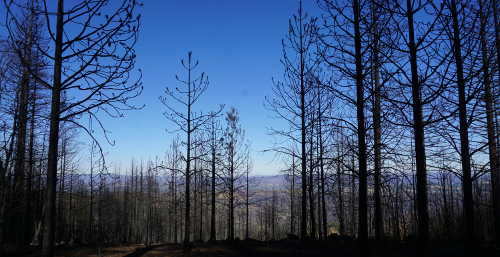
BOGGS MOUNTAIN, Calif. – More than a year after it was devastated by the Valley fire, the Boggs Mountain Demonstration State Forest remains closed as state officials work to clear dead trees and make it safe once again for public use.
Cal Fire said that the forest is closed to all public use due to hazardous conditions as a result of the Valley fire and the subsequent restoration, emergency timber operations and large pile burning operations taking place this winter.
As a result of the Valley fire, 99 percent of the forest burned, 80 percent of the mature trees are dead, and 95 percent of the conifer regeneration is dead, Cal Fire said.
The State Forest’s recreational facilities were either destroyed or heavily impacted by the September 2015 Valley fire, and state officials said it will take time and scientific intervention to aid Boggs Mountain Demonstration State Forest back to a healthy forest that is safe for the community and public to enjoy.
While there is no specific date set to reopen the forest, the crews assigned to Boggs are actively working seven days a week in order to reopen the forest for public use, Cal Fire said.
Officials said logging is still an ongoing project, not just for the burned trees but for the trees the bark beetles are killing.
There are large piles of debris, called slash, left over from the logging that has been going on throughout this past year. Cal Fire said many of those piles are currently being burned to clear the area for future trees. Some of the smaller piles will remain in place for existing habitat and to encourage growth.
Cal Fire said the area is still considered a safety hazard due to heavy equipment, burned trees, massive debris piles, piles of logs and tree tops that still need to be dealt with. The overall operation being conducted is one that takes time and personnel.
A large amount of smoke can be seen on permissive burn days over the forest from the pile burning. Cal Fire reassured the public that these burns are being done safely with minimal smoke impacts.
Cal Fire said it's eager to get Boggs open once again for public use as quickly and safely as possible. It also thanked the community for respecting and honoring the state’s decision to close the forest to public use, which allows the team to stay focused on the forest’s work plan and not enforcement of the closure.
OFFICE CHRISTMAS PARTY (Rated R)
Once upon a time, Christmas movies would serve up traditional holiday fare such as “It’s a Wonderful Life,” which continues to thrive on cable, and the Irving Berlin musical “Holiday Inn,” among others.
So far, during this holiday season we have had Billy Bob Thornton as a loutish Santa in “Bad Santa 2” and now the extreme version of a corporate holiday celebration in “Office Christmas Party.” Neither film is suitable for family viewing.
To its credit, “Office Christmas Party” has a great cast of comic characters, starting with Jennifer Aniston as the corporate boss-from-hell, T.J. Miller as the slacker boss of the Chicago branch office and Jason Bateman as the borderline nerdy tech executive.
Miller’s Clay Vanstone runs the Chicago branch of the family-owned tech firm Zenotek, but his older sister Carol (Aniston) does not share Clay’s fun-loving spirit of having a corporate culture that values its employees.
With Christmas approaching, Clay wants to have a fun office party, though Mary (Kate McKinnon), head of Human Resources wearing a non-denominational holiday sweater, is a killjoy who frets about the right cheese platter.
Getting wind of these plans, Carol cancels the Christmas festivities and threatens to close down the Chicago office, firing all of the employees and leaving her brother to live off his trust fund.
Assisted by Bateman’s tech executive Josh Parker and Olivia Munn’s tech savvy engineer Tracey, Clay and his crew go behind her back to set up a raucous party to attract a big account from potential client Walter Davis (Courtney B. Vance) who could save the branch office from closure.
The solution to keeping the Chicago office functioning beyond the holidays is the kind of stupid, futile gesture that originated with frat parties in “Animal House.” Throw the most debauched party one could imagine because it’s all going to hell anyway.
Starting off as a dance party with live reindeer, an imitation Jesus and Clay in a Santa suit, the evening gets gradually rowdier and out-of-control because it’s always a bad idea when employees get drunk with their co-workers.
A snow machine is inadvertently loaded with a bag of cocaine that loosens the inhibitions of Walter Davis. The party eventually turns into the semblance of the decaying Roman Empire’s drunken and depraved sex orgies.
Bad behavior becomes the norm for “Office Christmas Party,” but the fast pace of sight gags, one-liners and crude yet often hilarious scenes turns this holiday comedy into an amusing diversion, if you are willing to let go of any reservations about the absence of a sensible plot.
TV Corner: 'Star' on FOX Network
Banking on the success of the TV series “Empire,” the FOX Network turns to the same creator and executive producer, Lee Daniels, to pull back the curtain on music’s gritty and dark reality in the new series “Star.”
“Empire” has a strong pull for many watching this music industry soap opera of power plays and betrayals, but I’ve not been a follower of its melodramatic machinations, even though Taraji P. Henson’s Cookie is a powerful force of nature well worth watching.
From a personal point of view, I am even less likely to get past the first episode of “Star,” in which the main characters are a trio of young girls running from their pasts in order to chart a path to stardom in the treacherous music business.
“Star” is not just the name of the show. It happens that the most talented singer in the aspiring girl group is named Star (Jude Demorest), a tough-as-nails beauty who looks like she could just as easily twirl on a pole at a low-rent strip club.
Star is a young woman of unbridled ambition who escapes from a hellish foster family in Pittsburgh and heads off to rescue her younger sister Simone (Brittany O’Grady) from a similar terrible fate.
Together, the long-separated siblings head to Atlanta to team up with spoiled rich girl Alexandra (Ryan Destiny), who for reasons that don’t seem readily apparent or even logical leaves her upper-crust lifestyle in Manhattan for a dubious trek into the underbelly of the capital of Georgia.
The only connection the girls have to this Southern metropolis is beauty shop owner Carlotta Brown (Queen Latifah), the godmother to Star and Simone who takes them in but soon finds the girls are a handful.
The role of Carlotta, who sings beautifully in the church choir, allows Queen Latifah to shine with her natural talents, but given that she spends too much time coping with bickering employees, that’s about as far as it goes.
The character that might be the most believable is down-on-his-luck Jahil Rivera (Benjamin Bratt), a seedy-looking type who hangs out in dive bars and strip clubs, but still has a knack for spotting musical talent.
Having once managed singers, Jahil sees the girls as a ticket back to the industry. The ambitious manager might be interesting to watch, but there is much about “Star” that seems too contrived, and even unsettling, to stick with for the long haul.
Tim Riley writes film and television reviews for Lake county News.