How to resolve AdBlock issue?
News
NORTH COAST, Calif. – The March for Women in Ukiah will take place on Saturday, Jan. 21, at noon.
The march will start from Alex Thomas Plaza, 310 S. State St.
The group will hear talks, poems, songs and inspirational music and march to the Courthouse. Bring instruments, signs and walking shoes.
For more information visit https://www.facebook.com/events/1394236220600234/ .
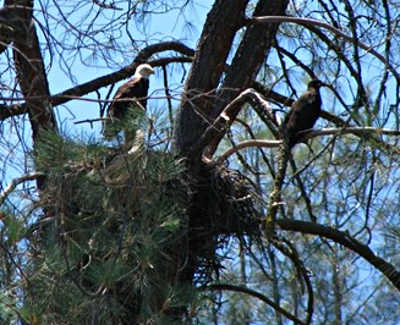
LAKE COUNTY, Calif. – The Bureau of Land Management will host free guided hikes to look for wintering bald eagles in the Berryessa Snow Mountain National Monument in Lake County on Saturdays, beginning Jan. 21 and continuing through Feb. 18.
Those interested in participating should reserve space for a specific date by calling the BLM Ukiah Field Office at 707-468-4000.
Early reservations are requested for the popular hikes, which are limited to 25 participants each and fill quickly.
Participants will meet at the Redbud Trailhead parking area, eight miles east of Clearlake Oaks on Highway 20 at 10 am. The trailhead is just west of the North Fork Cache Creek Bridge (38° 59' 13.20" N, 122° 32' 22.50" W).
Hikers are advised that the Redbud trail is in an area which was burned during the 2015 Rocky fire.
The five-mile hikes last about four hours. The trail includes a steep 600-foot climb in the first mile, so hikers should be in good physical condition and sure-footed.
Hikers should wear sturdy hiking boots suitable for wet conditions and dress for cold weather. They should carry water, a lunch and binoculars, as most eagle sightings are from a distance.
Additional information is available from the Ukiah Field Office.
Notice of release of RFP
The county of Lake is requesting proposals to prepare grant applications and a comprehensive strategic plan for selecting and funding priority projects using CDBG 2016 Valley Wildfire Disaster Recovery Funding.
The RFP opened Jan. 6, 2017, and closes Jan. 27, 2017, at 4 p.m.
Contact Stephen Carter at 707-263-2580 or
State Senator Bill Dodd (D-Napa) has introduced a new bill to incorporate media literacy education into school curriculums.
Media literacy is the ability to analyze and evaluate information consumed from various media outlets such as Web sites, social networking sites, television and radio.
Adolescents can spend up to nine hours a day absorbing media from these various sources.
“The rise of fake and misleading news is deeply concerning. Even more concerning is the lack of education provided to ensure people can distinguish what is fact and what’s not,” said Dodd. “Through new technology news has never been more readily available. However, the quality of that information varies widely. By giving students the proper tools to analyze the media they consume, we can empower them to make informed decisions.”
The prevalence of fake news garnered national attention in the recent election, where in the final months of the presidential campaign, false and misleading stories from hoax Web sites outperformed actual news stories in terms of social media engagement.
This flood of information can make it difficult for the public to differentiate between reputable news sources and false or misleading claims, Dodd's office said.
The practice of advertisements masquerading as news has also seen an increase in recent years. A recent Stanford study found that 82 percent of middle school students struggled to distinguish advertisements from news stories.
Under Dodd’s legislation, the California Board of Education’s Instructional Quality Commission will be responsible for developing the framework for incorporating media literacy into school curriculums.
The legislation will also see that media literacy training opportunities are made available for teachers in California.
The bill should receive its first committee hearing within the next couple of months.
Dodd represents the Third Senate District, which includes all or portions of Napa, Sonoma, Solano, Yolo, Sacramento and Contra Costa counties. He previously represented Lake County in the State Assembly.
Visit his Web site at www.sen.ca.gov/dodd .
LAKEPORT, Calif. – A new sales tax Lakeport voters approved in the fall will be implemented beginning in April.
On Nov. 8, Lakeport residents voted to enact Measure Z, a one-percent increase to the local sales and use tax.
Measure Z, which will go into the general fund, required a simple majority vote to pass. It received a 61.9-percent yes vote, with 38.1 percent of voters opposing it.
City officials said the new tax is slated to take effect April 1, at which time, the sales tax for taxable items purchased in the city of Lakeport will rise to 8.75 percent.
Currently, the sales tax in the city of Lakeport is 7.75 percent, which reflects a drop in the state sales and use tax rate of one quarter of one percent, effective Jan. 1.
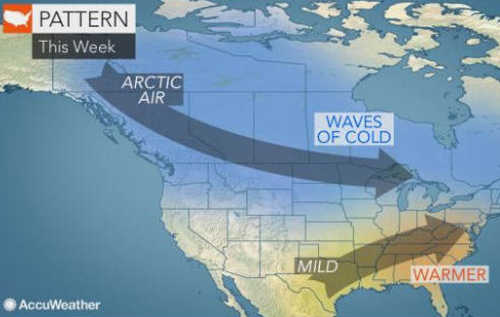
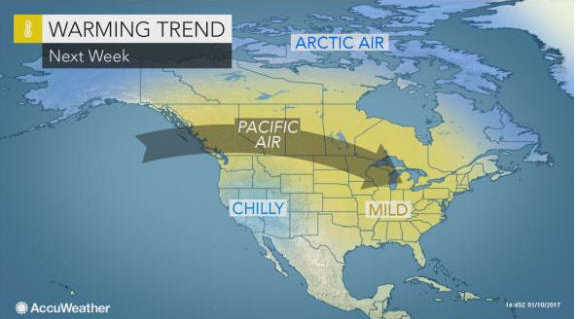
AccuWeather reports following snow and cold in 49 states during the first 10 days of January, cold air will retreat in parts of the United States but hold on with stormy consequences in others for the rest of the month.
The upcoming pattern for the remainder of the month will have some people in the South shedding winter coats, while others in the northern tier will be changing up their outerwear on a daily basis.
In many parts of the nation, early January lived up to its wintry reputation.
Temperatures plummeted to minus 30 F with AccuWeather RealFeel Temperatures as low as minus 40 in parts of Montana, North Dakota and Minnesota. Actual temperatures plunged to nearly minus 50 in parts of Colorado.
Northern California was hit with drought-busting rain and flooding, while yards of snow buried the high country of the Sierra Nevada, Cascades and Rockies.
At one point this past weekend, snow was on the ground and freezing temperatures existed in every state except Florida, thanks to a snowstorm that swept from the Northwest to the Southern states and then to the coastal Northeast.
Arctic air will sound the retreat in much of the southern half of the nation during the middle of the month. Highs most days in Atlanta will be in the 60s. The normal high is in the lower 50s.
"The main branch of the jet stream will retreat to near the border of Canada and the U.S.," said AccuWeather Senior Meteorologist Brett Anderson.
The jet stream is a high-speed river of air at the level in the atmosphere where jet aircraft cruise. South of the jet stream, the weather is generally warm. North of the jet stream, the weather is generally cold.
"There will still be some dips in the jet stream, which will allow pockets of arctic cold air to periodically sink southward into parts of the nation, including across the Upper Midwest and Northeast," Anderson said.
During the middle 10 days of January, highs in Chicago will generally range from the 20s to the 40s. In New York City, highs most days will be in the 30s and 40s with an exception here and there. For both cities, it will neither be bitterly cold nor warm for very long. Normal highs are near freezing in Chicago and in the upper 30s for New York City.
Sometimes, where the boundary of cold versus mild air sets up, episodes of snow, ice and rain can occur.
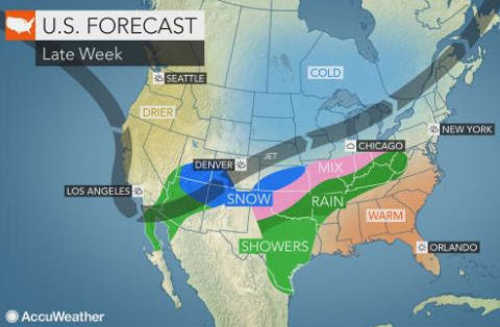
One such weather battlefield will set up from the southern Plains to portions of the Midwest and the Northeast from late this week into early next week.
In the Southwest, a storm will manufacture cold air and unleash wintry precipitation for a time during the middle of the month.
The formation of the storm over the interior Southwest will allow the weather to dry out for several days for weather-weary areas of California, Oregon and Nevada.
Around Los Angeles, high temperatures during the balance of the month will generally range from the middle 60s to the lower 70s, or within a few degrees of average. Likewise, in Seattle, highs will trend to near average, which is in the 40s.
The overall pattern first appears to be mild for much of the nation during the latter part of the month, unless the polar vortex comes into play.
"There are some indications that the polar vortex may weaken enough to allow a southward discharge of arctic air prior to the end of the month," according to AccuWeather Lead Long-Range Meteorologist Paul Pastelok.
"Even in cases when there is certainty about the weakening of the polar vortex, you never know for sure where the discharge of cold air will be directed, such as western versus eastern U.S.," Pastelok said.
If the polar vortex remains strong, then it will keep the arctic air locked up in the Arctic and more places in the lower 48 states may trend warmer rather than colder late in the month.
"We believe the eastern part of the U.S. will trend colder and stormier again toward the end of the month, but the question is how much," Pastelok said.
Alex Sosnowski is a senior meteorologist for www.AccuWeather.com .