How to resolve AdBlock issue?
Refresh this page
How to resolve AdBlock issue?
Refresh this page
Lake County News,California
  • Home
    • Registration Form
  • News
    • Education
    • Veterans
    • Community
      • Obituaries
      • Letters
      • Commentary
    • Police Logs
    • Business
    • Recreation
    • Health
    • Religion
    • Legals
    • Arts & Life
    • Regional
  • Calendar
  • Contact us
    • FAQs
    • Phones, E-Mail
    • Subscribe
  • Advertise Here
  • Login

News

Padilla, Murkowski introduce bipartisan bill to create Atmospheric River Forecasting Program

On Tuesday, U.S. Senators Alex Padilla (D-Calif.) and Lisa Murkowski (R-Alaska) announced bipartisan legislation that will reduce flood risks and bolster emergency preparedness by improving atmospheric river forecasting to more precisely predict the timing and location of these storms.

The Improving Atmospheric River Forecasts Act would require the National Oceanic and Atmospheric Administration, or NOAA, to establish a forecast improvement program within the National Weather Service.

The legislation was announced as major atmospheric river storms bring high winds and heavy rain and snowfall to California.

Atmospheric rivers — often described as “rivers in the sky” that are hundreds of miles wide and can carry water vapor equivalent to multiple Mississippi Rivers — cause more than 80 percent of flood damage across the West.

Climate change will only make these storms increasingly catastrophic: by 2090, atmospheric rivers are expected to cost $2.3 to $3.2 billion in annual damages and increase in width by nearly 25 percent.

Over 50 atmospheric rivers made landfall across the West Coast from Oct. 1, 2023, to Sept. 30, 2024.

“For the past several years, California communities have witnessed firsthand the ongoing threat of destructive flooding caused by increasingly intense and frequent atmospheric river storms,” said Sen. Padilla. “California has led the way in improving our understanding of these storms, and this bipartisan bill will strengthen forecasts to reduce flood risks while bolstering our water supply and drought resilience.”

“With greater frequency, we are seeing that atmospheric rivers instill dangerous climate conditions that pose deadly threats to Alaska communities,” said Sen. Murkowski. “While there are numerous atmospheric river observatories in the Lower 48, none are in Alaska. This bill ensures that all states along the West coast, including Alaska, have at least one atmospheric river observatory. Along with improved modeling, data collection, and risk communication, this legislation will help protect our communities and ultimately save lives across Alaska.”

“Atmospheric rivers are responsible for 30-50% of annual precipitation along the western U.S. and cause the majority of the flooding, with more than $1 billion in annual average flood damage in the western 11 states,” said Marty Ralph, founding director of the Center for Western Weather and Water Extremes at UC San Diego’s Scripps Institution of Oceanography. “The introduction of this act is critically important to advance forecasts of atmospheric rivers to enable more flexible and resilient water management, improved warning around flooding and overall improvements to public safety. It will also enhance the opportunities for reservoir operators to safely implement Forecast-Informed Reservoir Operations at more reservoirs to save additional water after a storm for the dry summer, or release it to mitigate flood risk if an AR storm is predicted in the next few days.”

Specifically, the Improving Atmospheric River Forecasts Act would direct NOAA to establish a standalone atmospheric river forecast improvement program that would:

• Develop accurate, effective, and actionable storm forecasts and warnings in collaboration with public and private partners across the weather forecasting sectors;
• Evaluate innovative observation tools and emerging technologies to improve atmospheric river analysis, modeling, forecasts, and warnings;
• Authorize NOAA to procure equipment, aircraft, and personnel contracts to fully monitor atmospheric river events each winter; and
• Improve atmospheric river hazard communication.

The Improving Atmospheric River Forecasts Act is endorsed by the Association of California Water Agencies, Bay Planning Coalition, Central Valley Flood Protection Board, Contra Costa Water District, Covington Water District, Irvine Ranch Water District, Kings River Conservation District, the National Association of Flood and Stormwater Management Agencies, Orange County Water District, Pajaro Regional Flood Management Agency, San Bernardino Valley Municipal Water District, Sacramento Area Flood Control Agency, San Diego County Water Authority, San Mateo County Flood and Sea Level Rise Resiliency District, Santa Clarita Valley Water Agency, Scripps Institution of Oceanography, San Francisco Public Utilities Commission, Sofar Ocean Technologies, Solano County Water Agency, Sonoma Water, Union Sanitary District, Valley Water, WindBorne Systems and Yuba Water.

Sen. Padilla has prioritized working with California communities devastated by atmospheric river flooding. Last year, Padilla urged the Biden Administration to prioritize sustained federal investment in the Pajaro River Flood Risk Management Project to protect disadvantaged communities along the central coast of California. Padilla also introduced the Atmospheric Rivers Reconnaissance, Observation and Warning Act to bolster West Coast atmospheric river forecasting, which was passed into law as part of the National Defense Authorization Act for Fiscal Year 2024.

Padilla has also championed funding for programs such as the Forecast-Informed Reservoir Operations to improve U.S. Army Corps of Engineers reservoir operations to increase water conservation and reliability at Lake Sonoma and Prado Dam, for example, while maintaining flood control and enhanced public safety during extreme precipitation events.

Atmospheric river results in flooding, mudslides; flood watches and advisory remain in effect

LAKE COUNTY, Calif. — The heavy rainfall continuing to fall across Lake County has brought flooding and mudslides, and led the National Weather Service to expand a flood advisory to cover the south county.

The agency’s Eureka office announced the action shortly before 2:30 p.m. Tuesday.

Lake County residents have been told to expect minor flooding of small streams in low lying and poor-drainage areas and rock and mudslides as moderate to heavy rain continues this afternoon. The public also is urged not to drive through flooded roads.

That advisory, in effect until 5:30 p.m. Tuesday, built on a flood watch and advisory issued earlier for Lake County. The flood watch remains in effect until 8 p.m. Tuesday.

The National Weather Service reported that at 1:25 p.m. Tuesday Doppler radar and automated rain gauges had indicated heavy rain, with minor flooding ongoing or expected to begin in the advisory area. Between 2 and 4 inches of rain had fallen at that point, with another one inch expected.

The rain is the result of a prolonged atmospheric river event that the National Weather Service said will continue to bring moderate to heavy rain in northern and central California and heavy mountain snow in the Sierras, southern Cascades and northern Rockies through Wednesday.

About an hour before the flood advisory was extended, the city of Lakeport reported that Martin Street was closed due to flooding at Estep Street, with the public asked to follow the detour signs that Public Works had set up.

The city of Clearlake also reported on Tuesday that it had limited sandbag supply available immediately at its Public Works corporation yard at 6820 Old Highway 53.

The California Highway Patrol reported that there was roadway flooding at Highway 29 and Highway 53 on Tuesday afternoon, a mudslide on Highway 20 near Saratoga Springs near Upper Lake that took out a telephone pole and a mudslide just across the fog line on Highway 29 at Cruikshank Road in Kelseyville, and the unpaved portion of Highland Springs Road near Lakeport is flooded.

The Lake County Public Works Department reported on Tuesday afternoon that Mesa Drive in Clearlake Oaks from Stubbs Road to 1,000 feet up from Lakeview Drive was closed due to a landslide.

In Hidden Valley Lake, Spruce Grove Road Extension is closed near USS Liberty Lane (Quarry Road) due to a road slipout.

In Kelseyville, Bell Hill Road is closed at the low water crossing due to water across the roadway. Likewise, in Middletown, the seasonal closure at the lower water crossing on Dry Creek Cutoff Road is in effect.

In Lakeport, Scotts Valley Road is closed from Hendricks Road to the fruit exchange due to roadway flooding.

Rainfall totals in inches for the 72-hour period ending at 3.15 p.m. Tuesday are as follows:

— Hidden Valley Lake: 5.47.
— High Glade Lookout (above Upper Lake): 2.71.
— Kelseyville: 4.32.
— Knoxville Creek: 4.27.
— Lake Pillsbury: 7.72.
— Lower Lake: 3.13.
— Lyons Valley: 3.62.
— Middletown: 7.02.
— Nice: 3.01.
— Whispering Pines: 6.68.

The U.S. Geological Survey’s gauge on Clear Lake shows that the lake’s level, which was just over 6 feet on the Rumsey gauge — the special measure for Clear Lake — on Jan. 31, and by Tuesday afternoon had risen to 6.87 feet Rumsey. The lake is considered full at 7.56 feet Rumsey.

Email Elizabeth Larson at This email address is being protected from spambots. You need JavaScript enabled to view it.. Follow her on Twitter, @ERLarson, and on Bluesky, @erlarson.bsky.social. Find Lake County News on the following platforms: Facebook, @LakeCoNews; X, @LakeCoNews; Threads, @lakeconews, and on Bluesky, @lakeconews.bsky.social.

Lakeport City Council to discuss pension issues, contracts

LAKEPORT, Calif. – The Lakeport City Council will discuss pension obligations and new and updated contracts when it meets this week.

The council will meet Tuesday, Feb. 4, at 6 p.m. in the council chambers at Lakeport City Hall, 225 Park St.

The agenda can be found here.

If you cannot attend in person, and would like to speak on an agenda item, you can access the Zoom meeting remotely at this link or join by phone by calling toll-free 669-900-9128 or 346-248-7799.

The webinar ID is 973 6820 1787, access code is 477973; the audio pin will be shown after joining the webinar. Those phoning in without using the web link will be in “listen mode” only and will not be able to participate or comment.

Comments can be submitted by email to This email address is being protected from spambots. You need JavaScript enabled to view it.. To give the city clerk adequate time to print out comments for consideration at the meeting, please submit written comments before 3:30 p.m. on Tuesday, Feb. 4.

On Tuesday, the council will hear a presentation from NHA Advisors regarding the city’s CalPERS unfunded accrued liabilities and its pension program.

Unfunded accrued liabilities are defined as the difference between the cost of the city’s future benefit obligations and the assets that the city has set aside to pay for them.

NHA’s report said the city has a projected $6.4 million in CalPers unfunded accrued liability, plus $7.1 million in outstanding pension obligation bonds. NHA will explain those figures and how the city can address them during the presentation.

Under business, the council will consider approving a second amendment to the professional services agreement with WMH Corp., the San Jose firm conducting design services for the Lakeport Boulevard Phase 1 project.

“The Lakeport Blvd Improvement Project, initially aimed at constructing a roundabout at Lakeport Blvd and South Main St., has evolved significantly over the past decade,” Public Works Director Ron Ladd said in his report to the council. “Due to financial constraints and community feedback, the project's focus shifted from a roundabout construction to repaving and sidewalk improvements.”

The amendment is budgeted to cost up to $77,575.

The council also will consider a professional services agreement with JJACPA Inc., the Fort Bragg-based firm that has served as the city’s independent auditor for several years. The company assists with financial reporting and compliance review.

Staff is recommending the council approve the contract with JJACPA for three years, with an annual fee of $44,000 if a single audit is required or $35,000 annually if a single audit is not
required.

In other business, the council will get an update on communications team statistics for 2024, hear about water and wastewater operations and challenges for the city’s roadways.

On the consent agenda — items considered noncontroversial and usually accepted as a slate on one vote — are ordinances; receipt and filing of the draft minutes of the MZAC regular meeting of Jan. 15, 2025; and approval of application 2025-006, with staff recommendations, for the Memorial Day Craft Fair.

Email Elizabeth Larson at This email address is being protected from spambots. You need JavaScript enabled to view it.. Follow her on Twitter, @ERLarson, and on Bluesky, @erlarson.bsky.social. Find Lake County News on the following platforms: Facebook, @LakeCoNews; X, @LakeCoNews; Threads, @lakeconews, and on Bluesky, @lakeconews.bsky.social.

Mendocino College strengthens commitment to diversity and student safety

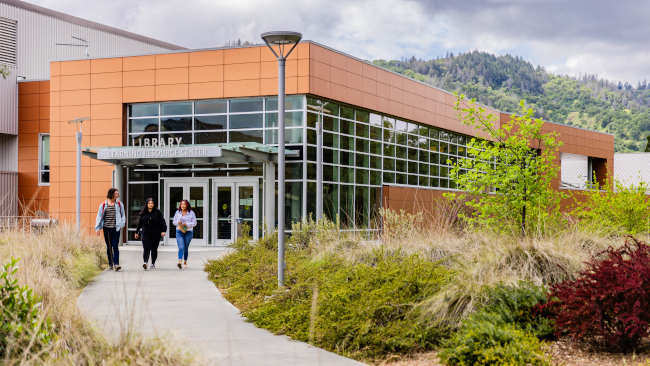
Mendocino College. Courtesy photo.

NORTH COAST, Calif. — Mendocino College, a Hispanic Serving Institution, said it is taking proactive steps to ensure the safety and well-being of its diverse student body in response to recent changes in federal immigration enforcement guidelines.

The college has reaffirmed its dedication to creating a supportive and inclusive environment for all students, regardless of immigration status.

As part of its commitment, Mendocino College has established comprehensive guidelines to address concerns related to immigration enforcement actions on campus. These guidelines are designed to protect the rights of students and ensure their safety.

If federal immigration officials, such as U.S. Immigration and Customs Enforcement, or ICE, agents, seek access to any of the college's campuses or request student information, college personnel are instructed to refer the request to the Office of the Superintendent/President. The office will work with legal services to determine the lawfulness of the request.

Additionally, any presence of ICE officials on campus should be reported immediately to campus security.

The college emphasizes the importance of students being aware of their rights in interactions with immigration officials. Key points include the right to remain silent, the right not to open the door for immigration agents, and the right to legal counsel before signing any documents.

Mendocino College provides various resources to support its students, including guidance from the California Attorney General’s Office and free Red Cards from the Immigrant Legal Resource Center, which offer reminders for asserting rights and protecting oneself in various situations.

“We are deeply committed to supporting the safety and educational needs of our students and college community,” said Tim Karas, president of Mendocino College. “Our diverse student body is our greatest strength, and we will continue to uphold our commitment to creating a welcoming and secure learning environment for everyone. Together, we will ensure that all students have access to the resources and information they need to thrive."

Mendocino College's proactive measures reflect its dedication to fostering a diverse and inclusive community.

As a Hispanic Serving Institution, the college has a demonstrated commitment to its Hispanic community and other people of color. The college's efforts to protect the rights and well-being of its students underscore its mission to provide a safe and supportive educational environment for all.

Mendocino-Lake Community College District was formed in 1973 to serve students in Mendocino and Lake Counties. Mendocino College offers over 100 degree and certificate programs, and has campuses in Ukiah, Willits, Fort Bragg, and Lakeport, and is a dedicated Hispanic Serving Institution.

Governor Newsom proclaims Black History Month

SACRAMENTO – Gov. Gavin Newsom on Monday issued a proclamation declaring February 2025 as Black History Month.

The text of the proclamation and a copy can be found below:

PROCLAMATION


This month, we pay homage to the rich history and contributions of Black Americans who have shaped our state and nation in countless ways through centuries of struggle and triumph. First proposed by scholar Carter G. Woodson in 1926, Black History Month lifts up the Black experience in a fuller telling of America’s story, and selects a theme to highlight facets of history that merit particular attention.

This year’s theme, Black Americans and labor, examines the intersection of employment and work with the Black American experience. From the atrocity of slavery to the rich legacy of Black entrepreneurship, the profound impact of Black labor in building and shaping our nation cannot be overstated.

American and Californian history has no shortage of Black business owners, labor leaders, CEOs, workers, and more. From the first years of California’s statehood, we have been home to changemakers like Mary Ellen Pleasant, one of the first self-made Black millionaires in the country, who owned numerous businesses and used her money to help fund the Underground Railroad and other abolition work.

Black communities and businesses have flourished throughout California. Altadena became the special community it is, home to a thriving middle-class community of professionals familiar with shattering glass ceilings. With twice the national Black homeownership rate, Altadena is home to scores of generational wealth and wide-reaching, beloved businesses. And as Altadena recovers from the devastation of the Eaton fires, we recognize, as a state, our responsibility to help support that recovery.

Black Americans have always contributed to our shared communities, our state, and our nation. In every role, from labor leaders to essential workers to CEOs, Black Californians have helped make this state the fifth-largest economy in the world, a leader in workers’ rights, and a state that stands for and supports workers and work across the board.

During Black History Month, let us reflect on our shared history, and draw inspiration from the progress made as we continue together on the path toward equality, liberty, and opportunity for all.

NOW THEREFORE I, GAVIN NEWSOM, Governor of the State of California, do hereby proclaim February 2025, as “Black History Month.”

IN WITNESS WHEREOF I have hereunto set my hand and caused the Great Seal of the State of California to be affixed this 3rd day of February 2025.

GAVIN NEWSOM
Governor of California

ATTEST:
SHIRLEY N. WEBER, Ph.D.
Secretary of State

How satellites and AI help fight wildfires today


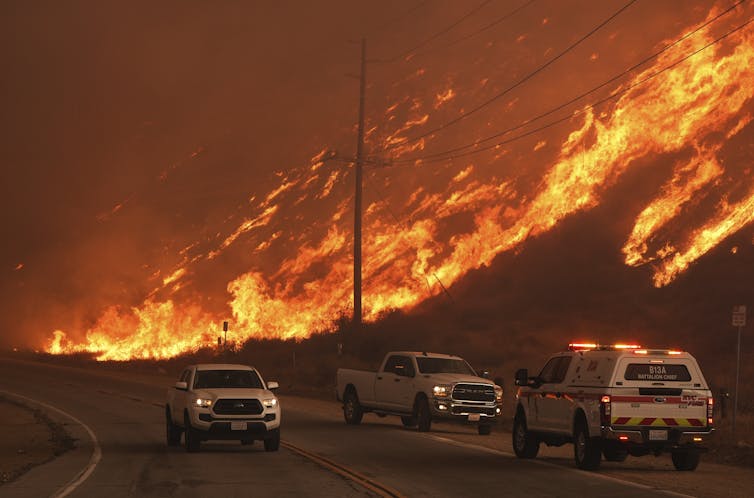
The wind and terrain can quickly change how a fire, like this one near Los Angeles in January 2025, behaves. AP Photo/Marcio Jose Sanchez

As wind-driven wildfires spread through the Los Angeles area in January 2025, fire-spotting technology and computer models were helping firefighters understand the rapidly changing environment they were facing.

That technology has evolved over the years, yet some techniques are very similar to those used over 100 years ago.

I have spent several decades studying combustion, including wildfire behavior and the technology used to track fires and predict where wildfires might turn. Here’s a quick tour of the key technologies used today.

Spotting fires faster

First, the fire must be discovered.

Often wildfires are reported by people seeing smoke. That hasn’t changed, but other ways fires are spotted have evolved.

In the early part of the 20th century, the newly established U.S. Forest Service built fire lookout towers around the country. The towers were topped by cabins with windows on all four walls and provided living space for the fire lookouts. The system was motivated by the Great Fire of 1910 that burned 3 million acres in Washington, Idaho and Montana and killed 87 people.

Two people stand on a fire tower with windows on all sides, looking out over the forest.
Before satellites, fire crews watched for smoke from fire towers across the national forests. K. D. Swan, U.S. Forest Service

Today, cameras watch over many high-risk areas. California has more than 1,100 cameras watching for signs of smoke. Artificial intelligence systems continuously analyze the images to provide data for firefighters to quickly respond. AI is a way to train a computer program to recognize repetitive patterns: smoke plumes in the case of fire.

NOAA satellites paired with AI data analysis also generate alerts but over a wider area. They can detect heat signatures, map fire perimeters and burned areas, and track smoke and pollutants to assess air quality and health risks.

Forecasting fire behavior

Once a fire is spotted, one immediate task for firefighting teams is to estimate how the fire is going to behave so they can deploy their limited firefighting resources most effectively.

Fire managers have seen many fires and have a sense of the risks their regions face. Today, they also have computer simulations that combine data about the terrain, the materials burning and the weather to help predict how a fire is likely to spread.

Fuel models

Fuel models are based on the ecosystem involved, using fire history and laboratory testing. In Southern California, for example, much of the wildland fuel is chaparral, a type of shrubland with dense, rocky soil and highly flammable plants in a Mediterranean climate. Chaparral is one of the fastest-burning fuel types, and fires can spread quickly in that terrain.

For human-made structures, things are a bit more complex. The materials a house is made of – if it has wood siding, for example – and the environment around it, such as how close it is to trees or wooden fences, play an important role in how likely it is to burn and how it burns.

How scientists study fire behavior in a lab.

Weather and terrain

Terrain is also important because it influences local winds and because fire tends to run faster uphill than down. Terrain data is well known thanks to satellite imagery and can easily be incorporated into computer codes.

Weather plays another critical role in fire behavior. Fires need oxygen to burn, and the windier it is, the more oxygen is available to the fire. High winds also tend to generate embers from burning vegetation that can be blown up to 5 miles in the highest winds, starting spot fires that can quickly spread.

Today, large computer simulations can forecast the weather. There are global models that cover the entire Earth and local models that cover smaller areas but with better resolution that provides greater detail.

Both provide real-time data on the weather for creating fire behavior simulations.

Modeling how flames spread

Flame-spread models can then estimate the likely movement of a fire.

Scientists build these models by studying past fires and conducting laboratory experiments, combined with mathematical models that incorporate the physics of fire. With local terrain, fuel and real-time weather information, these simulations can help fire managers predict a fire’s likely behavior.

Examples of how computer modeling can forecast a fire’s spread. American Physical Society.

Advanced modeling can account for fuel details such as ground-level plant growth and tree canopies, including amount of cover, tree height and tree density. These models can estimate when a fire will reach the tree canopy and how that will affect the fire’s spread.

Forecasting helps, but wind can change fast

All these tools are made available to firefighters in computer applications and can help fire crews as they respond to wildfires.

However, wind can rapidly change speed or direction, and new fires can start in unexpected places, meaning fire managers know they have to be prepared for many possible outcomes – not just the likely outcomes they see on their computer screens.

Ultimately, during a fire, firefighting strategy is based on human judgment informed by experience, as well as science and technology.The Conversation

John W. Daily, Research Professor in Thermo Fluid Sciences, University of Colorado Boulder

This article is republished from The Conversation under a Creative Commons license. Read the original article.

  • 261
  • 262
  • 263
  • 264
  • 265
  • 266
  • 267
  • 268
  • 269
  • 270

Community

  • Lake County Wine Alliance offers sponsor update; beneficiary applications open 

  • Mendocino National Forest announces seasonal hiring for upcoming field season

Public Safety

  • Lakeport Police logs: Thursday, Jan. 15

  • Lakeport Police logs: Wednesday, Jan. 14

Education

  • Woodland Community College receives maximum eight-year reaffirmation of accreditation from ACCJC

  • SNHU announces Fall 2025 President's List

Health

  • California ranks 24th in America’s Health Rankings Annual Report from United Health Foundation

  • Healthy blood donors especially vital during active flu season

Business

  • Two Lake County Mediacom employees earn company’s top service awards

  • Redwood Credit Union launches holiday gift and porch-to-pantry food drives

Obituaries

  • Rufino ‘Ray’ Pato

  • Patty Lee Smith

Opinion & Letters

  • The benefits of music for students

  • How to ease the burden of high electric bills

Veterans

  • CalVet and CSU Long Beach team up to improve data collection related to veteran suicides

  • A ‘Big Step Forward’ for Gulf War Veterans

Recreation

  • Wet weather trail closure in effect on Upper Lake Ranger District

  • Mendocino National Forest seeking public input on OHV grant applications

  • State Parks announces 2026 Anderson Marsh nature walk schedule 

  • BLM lifts seasonal fire restrictions in central California

Religion

  • Kelseyville Presbyterian to host Ash Wednesday service and Lenten dinner Feb. 18

  • Kelseyville Presbyterian Church to hold ‘Longest Night’ service Dec. 21

Arts & Life

  • Auditions announced for original musical ‘Even In Shadow’ set for March 21 and 28

  • ‘The Rip’ action heist; ‘Steal’ grounded in a crime thriller

Government & Politics

  • Lake County Democrats issue endorsements in local races for the June California Primary

  • County negotiates money-saving power purchase agreement

Legals

  • March 3 hearing on ordinance amending code for commercial cannabis uses

  • Feb. 12 public hearing on resolution to establish standards for agricultural roads

How to resolve AdBlock issue?
Refresh this page