How to resolve AdBlock issue?
News
CLEARLAKE, Calif. – Police arrested a Clearlake man on Saturday night for breaking into the home of his ex-girlfriend and violating a restraining order.
Robert Bosche, 52, was arrested in the case, according to a report from Det. Ryan Peterson of the Clearlake Police Department.
At 7:30 p.m. Saturday Clearlake Police Officers were dispatched to a residence in the 3600 block of Cottonwood Street for a report of a male breaking into a residence, Peterson said.
Peterson said that male subject later was identified as Bosche. Officers are familiar with Bosche and had been looking for him in connection to an investigation from the day prior.
On Friday it was reported that Bosche had broken into the same residence on Cottonwood Street and taken items, Peterson said.
Peterson said the residence belongs to Bosche’s ex-girlfriend, who is a protected party in a served domestic violence protective order against Bosche. Additionally, Bosche is currently on county probation out of Mendocino County for assault with a deadly weapon.
On Saturday Bosche’s ex-girlfriend reported that he was attempting to break into the residence again. Peterson said she was able to escape from the residence and was calling from a neighboring home.
As officers arrived at the residence, Bosche’s vehicle was observed parked approximately two houses away. Peterson said officers approached the front of the residence and observed the front door was open.
Due to the fact Bosche was on probation for assault with a deadly weapon, he was currently being sought for violating a domestic violence protective order and burglary from the previous day, Officer Travis Parson responded with his K-9 partner “Bear” to conduct a search of the residence.
Officer Parson gave several announcements into the open door of the residence, demanding anyone inside make themselves known. Peterson said no one responded to Officer Parson’s commands and Parson sent Bear into the residence to conduct a search of the building.
Bear located Bosche inside the residence, hiding under blankets on a futon couch. With the assistance of Bear, officers were able to apprehend Bosche, Peterson said.
Peterson said Bosche was transported to St. Helena Hospital Clear Lake’s emergency room for treatment of injuries he sustained while being apprehended by Bear.
Bosche later was booked into the Lake County Jail on the charges of burglary, violating a domestic violence protective order, resisting or dealing a police officer. Additional charges will be pending review by Mendocino County probation, Peterson said.
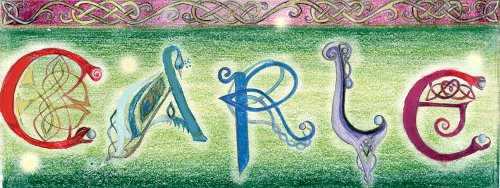
LOWER LAKE, Calif. – Lance Christensen, the new math teacher at Carlé, began teaching math at the beginning of this year.
He began teaching at continuation schools and really enjoyed helping children recover; he wanted to continue teaching at a continuation school so he came to Carlé.
Christensen taught science before he began teaching math, if he were to teach something other than math he said he would teach science or industrial arts. However he enjoys teaching math.
He went to college as a biology major. However, he switched to electrical engineering because at the time they made more money. Also, he was already working for a company where he was doing engineering for 20 years making industrial equipment for surgery such as cameras and fixing computers used in medicine.
After he took engineering he went on the get his teaching credential and started teaching science and math. He is now taking college courses online for a master’s degree in math.
I asked him for some advice to give the students about achieving their goals. “We need to recognize the things we struggle with and push past those things to achieve ours goals, never give up on something you love or believe in,” he said.
In conclusion, Christensen is a really good teacher and a really smart guy. All of us at Carlé are glad to have such a brilliant math teacher. Thank you, Lance.
Lydia Pogue, a volunteer with Totes for Teens, visited Carlé to ask the students who received a tote what they thought was more useful and what they didn’t use so much.
She also gave the students who spoke with her forget-me-not seeds to commemorate her mother Grace Bala, who hand-knitted the hats and much more in the totes. Thank you Grace, we will always remember you.
As mentioned in the last article Jonathan and Lia visited Carlé last week, they are from the Lake Family Resource Center with a California prep program. They presented an evidence-based program called the SHARP program (sexual health adolescent risk prevention).
This program is designed to help kids and young adults make brighter decisions for their future well-being. This includes condom use, drug and alcohol awareness, and even relationship building with your partner.
This program is really beneficial to have to educate the students at Carlé and we are really glad you (Jonathan and Lia) keep returning to us.
We at Carlé would like to give a special thanks to Dr. Barry Munitz and the Cotsen Foundation for the art of Teaching for a very generous donation of $4,000 to the media program at Carlé. Thank you so much for supporting the media program.
Dr. Munitz’s last donation helped fun a new press and all of the awards we created to thank those that helped on the Clayton fire. We were able to produce 68 plaques and 135 key chains to show our appreciation and we could not have done this without such generosity.
In addition this donation will allow us to make senior graduation plaques for each graduate. We also fund all our sustainability awards and school contests with this.
Teacher Alan Siegel met Dr. Munitz when they were both members of the state P-16 council and have had a special relationship ever since.
Last weeks chilly winner was Ashton Legg awarded by Alan Siegel, congrats on winning hope your candle was really cool.
Last Thursday, Feb. 9, was a collaborative day, so we were let out of school early. Scoring of the writing samples about animal research were done on Thursday.
On Feb. 13 and 20 there will be no school because of Lincoln’s birthday and Presidents Day, have fun.
Olga Paselk (our schools translator and aide) returns to school from Costa Rica. Glad to have you back, Olga, we missed you.
A senior student at Carlé and former writer of the Carlé Chronicle presented her portfolio on Feb. 7 and with that Brianna Legg was able to graduate and start her new life as a college student at Woodland Community College. Congratulations Brianna we will miss you at Carlé and best of luck.
The winner of this week’s student of week was Nick Phipps. Nick has taken over the duty of writing an article about the goings on at Carlé each week. He is a voracious reader and deep thinker who truly enjoys this special award.
Nicholas Phipps is a student at Carlé Continuation High School.
This week in history features Chicago mobsters and America’s original “fake news.”
Feb. 14, 1929
La Cosa Nostra, the Mafia, the Mob – take your pick. However you label it, there are few things so uniquely American than the organized crime syndicates of Chicago and New York City of the 1920s.
The image of a well-dressed, tommy-gun-wielding Mafioso leaning out of a racing Ford Model T is as iconically American as a masked bandit astride his horse.
Since the early 1930s, Hollywood has romanticized the brutal truth of these gangsters; the courteous swagger of Marlon Brando certainly plays better on screen than the egomaniacal, ill-tempered Vito Genovese of reality.
By far the most popularized mobster of the 20th century is “Scarface” Al Capone and on this day in 1929, the actions of his cronies sent him to the top of the charts as the most wanted man in Chicago.
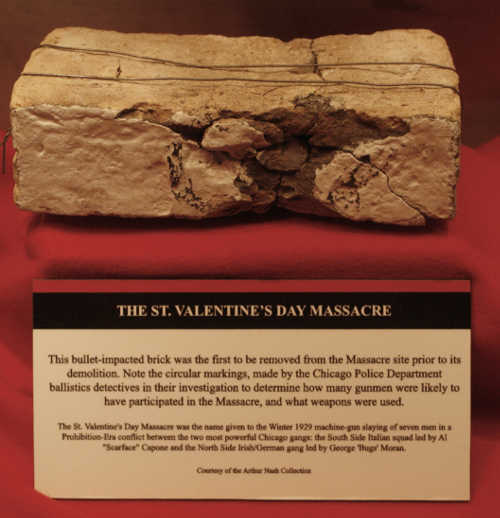
Feb. 14, 1929 was the day of the St. Valentine’s Day Massacre.
The massacre itself was the culmination of a long-running gang war between Al Capone and his rival Bugs Moran.
Moran was a career criminal who ran the Irish-American North Side gang in Chicago during the lucrative bootlegging years of prohibition.
Moran and Capone, who ran the competing South Side gang, had repeatedly fought each other over control of the bootlegging industry of the city.
Both men had also repeatedly survived each other’s assassination attempts. In one noteworthy instance, Moran and his men had riddled a restaurant where Capone was lunching with hundreds of bullets.
The St. Valentine’s Day Massacre actually remains to this day an unsolved murder case, although it has been widely assumed that Capone was the mastermind behind it.
Under this theory, the massacre transpired like this: The last straw for Capone was Moran placing a $50,000 bounty on his head. Wishing finally to knock his competition out of the running, Capone ordered his men to a garage on the morning of February 14 where he had learned Moran and his men would be waiting for the arrival of a shipment of hooch. Dressed as police officers, Capone’s cronies entered the garage and lined the seven men found lounging inside up against a wall.
Although Moran himself was not one of the seven, several of his top advisors were among the unfortunate victims, including his bookkeeper, two top hitmen and brother-in-law.
Pulling out a tommy gun, shotgun and revolver, the “policemen” opened fire. When the last spent cartridge lay still on the cold floor of the garage, 90 bullets had ripped into the seven men and in one bold act, Capone had cut his primary competition down to size.
With his gang in shambles, Moran’s control over the bootlegging traffic in Chicago slipped and Capone was quick to pick up the slack. The public was astonished at the brazen brutality of the massacre.
Although he had been in Florida at the time of the crime, Capone was immediately suspected of being behind it and this “Public Enemy Number One” was put firmly in the crosshairs of justice.
Within two years, Capone would be rotting in prison for tax evasion – a far less Hollywood-esque ending than a bullet-riddled car.
Feb. 15, 1898
It seems more than ever that this country’s politicians and the media that report on them are at an impasse.
Each one seems unable to trust the other. In an atmosphere of such partisanship and distrust, we should all look for common ground – wherever it might be.
Call it overly optimistic of me, but there does appear to be one thing that politicians and the media can agree on: the perfidious influence of “fake news.”
These unethical and unfounded reports have increasingly insinuated themselves into the newsfeed of innocent Americans.
We used to be able to safely identify fake news by its relative location in the grocery store: the closer it was to the checkout line, the more dubious its authenticity.
Immediately to the left of the conveyor belt was the Enquirer and other tabloids but the New Yorker and national newspapers were either in their own aisle or outside in a coin-operated machine.
Now, however, Facebook and the Internet as a whole have broken down these safety nets and given rise to fake news.
Well, not quite. In fact, fake news is not only not a 21st-century invention, but it used to be far worse than it is today. In fact, on this day in 1898, fake news had a large part in thrusting America into a war and onto the world-stage as a new empire.
On Feb. 15, 1898, the U.S. Destroyer Maine was docked at the port of Havana, Cuba. At the time still a territory of Spain, Cuba had been in the process of a years-long revolution to rid itself of the colonial power.
America, disturbed at the economic and political instability of a region so close to her, and eager to expel another European power from North and South America, began to agitate against Spain.
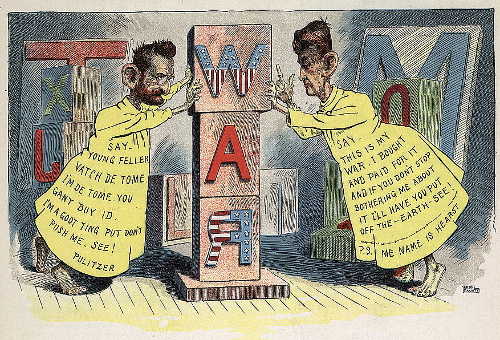
At the forefront of this American dissent were several newspapers – especially those owned by Joseph Pulitzer and William Randolph Hearst.
The battle between these two newspaper publishers over the New York market led to the creation of the term “yellow journalism.”
“Yellow Kid,” was the name of a cartoon character created by Richard Outcault for Pulitzer’s newspaper. The popular cartoon significantly boosted sales of Pulitzer’s paper, at a loss to Hearst. Hoping to boost his own sales, Hearst hired Outcault away from Pulitzer and the battle raged on.
The constant one-upping between the papers inevitably resulted in sensationalized news as eye-catching headlines were favored over actual substantive stories. So was born “yellow journalism.”
When the Maine was sunk on the night of Feb. 15 by an explosion of unknown origins, the newspapers went wild.
Injecting the story with a healthy dose of unsubstantiated rumor, Hearst and Pulitzer published headlines that blamed the destruction of the ship on Spanish saboteurs. These stories whipped the public into a furor and by May of that year America was at war with Spain.
Although not the sole cause of the conflict, the sensationalist newspapers of the day certainly went a ways towards convincing the American public that war was the just answer to a cowardly act of sabotage.
One-hundred and twenty years later and we are back in the streets of New York, the newsboys hocking their papers to us unsuspecting and gullible consumers.
Instead of neatly arranged typeface, we are easily drawn in by clickbait titles on our Facebook feed. The means have changed, but the results look to be the same.
Antone Pierucci is curator of the Lake County Museums in Lake County, Calif.
LAKE COUNTY, Calif. – Anyone looking for a new canine pal can find a wide variety of dogs available to new homes at Lake County Animal Care and Control.
This week’s dogs include mixes of Alaskan Malamute, border collie, bullmastiff, Chihuahua, cocker spaniel, German Shepherd, Great Pyrenees, Labrador Retriever, shepherd, spaniel and wirehaired terrier mix.
Dogs that are adopted from Lake County Animal Care and Control are either neutered or spayed, microchipped and, if old enough, given a rabies shot and county license before being released to their new owner. License fees do not apply to residents of the cities of Lakeport or Clearlake.
If you're looking for a new companion, visit the shelter. There are many great pets hoping you'll choose them.
The following dogs at the Lake County Animal Care and Control shelter have been cleared for adoption (additional dogs on the animal control Web site not listed are still “on hold”).

Terrier-Chihuahua mix
This male terrier-Chihuahua mix has a short black and brown coat.
He’s in kennel No. 2, ID No. 6950.

‘Michael’
“Michael” is a male cocker spaniel with a medium-length brown coat.
He already has been neutered.
He’s in kennel No. 5, ID No. 6895.

‘Ray’
“Ray” is a male Chihuahua mix with a short black coat.
He already has been neutered.
He’s in kennel No. 6, ID No. 6943.

German Shepherd mix
This male German Shepherd mix has a short black and brown coat.
He’s in kennel No. 8a, ID No. 6944.
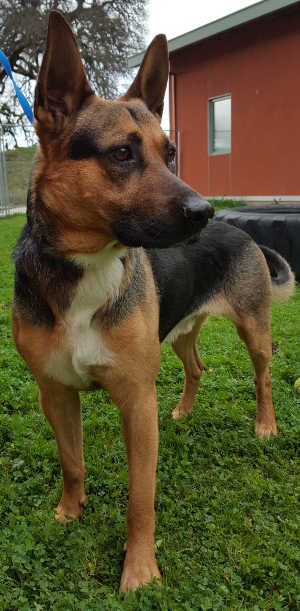
German Shepherd mix
This male German Shepherd mix has a short brown and white coat.
He’s in kennel No. 8b, ID No. 6945.

Female pit bull terrier
This female pit bull terrier mix has a short black and brown coat.
She is in kennel No. 9, ID No. 6884.
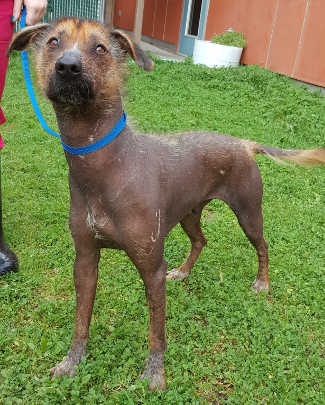
Shepherd mix
This male shepherd mix has a short brown and white coat.
Shelter staff said he is good with other dogs but would do best in a home with no cats.
He’s in kennel No. 10, ID No. 6936.

Shepherd mix
This male shepherd mix has a short brown and white coat.
Shelter staff said he is good with both cats and dogs.
He’s in kennel No. 14a, ID No. 6935.

Labrador Retriever-spaniel
This female Labrador Retriever-spaniel mix has a medium-length black coat.
Shelter staff said she is heartworm positive. She is good with other large dogs both male and female, although she does not do well with rough playing. They said she would do best in a home with older children over age 10.
She's in kennel No. 15, ID No. 6812.
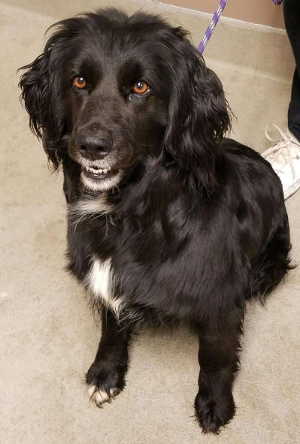
Female spaniel
This female spaniel has a curly black coat with white markings.
Shelter staff said she is heartworm positive. She is great with other dogs, shows submissive behavior and loves to play. They said she would do great in a home with children ages 10 and above. She allows some handling but isn't used to constant attention so she does get overstimulated. She has been an outside dog so she needs a patient home with a family willing to teach her how to live indoors.
She's in kennel No. 16, ID No. 6813.

'Miles'
“Miles” is a young male pit bull terrier mix with a short brindle coat and gold eyes.
Shelter staff said he is great with other dogs and a little shy of people, but show him some kindness and he will learn to trust you. He would do great in a home with children ages 10 years old and up. They also believe he would be OK with cats. He’s looking for a calm, quiet home.
She's in kennel No. 19, ID No. 6875.
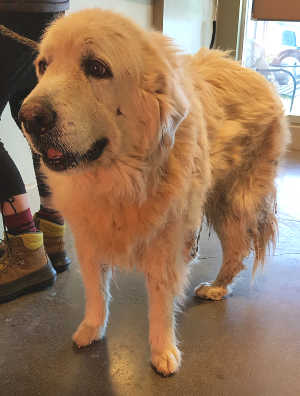
Great Pyrenees
This senior female Great Pyrenees has a medium-length white coat.
She is in kennel No. 20, ID No. 6885.

Mastiff-pit bull terrier
This male mastiff-pit bull terrier has a short brown coat.
Shelter staff said he is a mellow boy that has been reserved when introduced to other dogs.
He's in kennel No. 22, ID No. 6835.

Husky-border collie mix
This male husky-border collie mix has a short black and white coat.
Shelter staff said he is a very sweet boy with a low energy level. He is very curious about new places but is polite and patient at the same time. Has not been assessed with other dogs and would do best in a home with no cats.
He's in kennel No. 25, ID No. 6797.

'Bronco'
“Bronco” is a young male Labrador Retriever-pit bull terrier mix.
He has a short black coat with white markings.
Shelter staff said he has been successfully introduced to other dogs and cats, and he loves to play. They recommend him for an active family.
He's in kennel No. 26, ID No. 6842.

Border collie-terrier mix
This male border collie-terrier mix has a short tan and white coat.
Shelter staff said he will do fine with other dogs once he learns that nobody will hurt him, as he has been very afraid. He would do best in a home with children ages 10 and above. He knows how to walk on a leash, and does not pull or try to get away.
He's in kennel No. 27, ID No. 6841.

‘Ralph’
“Ralph” is a Labrador Retriever-wirehaired terrier mix with a medium-length brown coat.
He already has been neutered.
He’s in kennel No. 30, ID No. 6787.

Pit bull terrier mix
This male pit bull terrier mix has a short gray and white coat.
He already has been altered.
He’s in kennel No. 30b, ID No. 6713.
‘Balto’
“Balto” is a male Alaskan Malamute mix with a long black and white coat.
Shelter staff said he is in kennel No. 34, ID No. 6867.
To fill out an adoption application online visit http://www.co.lake.ca.us/Government/Directory/Animal_Care_And_Control/Adopt/Dog___Cat_Adoption_Application.htm .
Lake County Animal Care and Control is located at 4949 Helbush in Lakeport, next to the Hill Road Correctional Facility.
Office hours are Monday through Friday, 11 a.m. to 5 p.m., and 11 a.m. to 3 p.m., Saturday. The shelter is open from 11 a.m. to 4 p.m. Monday through Friday and on Saturday from 11 a.m. to 3 p.m.
Visit the shelter online at http://www.co.lake.ca.us/Government/Directory/Animal_Care_And_Control.htm .
For more information call Lake County Animal Care and Control at 707-263-0278.
Email Elizabeth Larson at
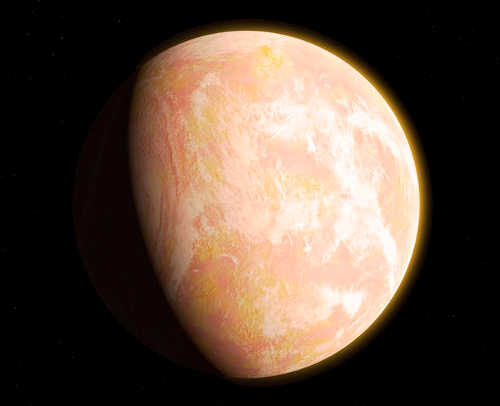
For astronomers trying to understand which distant planets might have habitable conditions, the role of atmospheric haze has been hazy.
To help sort it out, a team of researchers has been looking to Earth – specifically Earth during the Archean era, an epic 1-1/2-billion-year period early in our planet’s history.
Earth’s atmosphere seems to have been quite different then, probably with little available oxygen but high levels of methane, ammonia and other organic chemicals.
Geological evidence suggests that haze might have come and gone sporadically from the Archean atmosphere – and researchers aren’t quite sure why.
The team reasoned that a better understanding of haze formation during the Archean era might help inform studies of hazy earthlike exoplanets.
“We like to say that Archean Earth is the most alien planet we have geochemical data for,” said Giada Arney of NASA’s Goddard Spaceflight Center in Greenbelt, Maryland, and a member of the NASA Astrobiology Institute’s Virtual Planetary Laboratory based at the University of Washington, Seattle. Arney is the lead author of two related papers published by the team.
In the best case, haze in a planet’s atmosphere could serve up a smorgasbord of carbon-rich, or organic, molecules that could be transformed by chemical reactions into precursor molecules for life. Haze also might screen out much of the harmful UV radiation that can break down DNA.
In the worst case, haze could become so thick that very little light gets through. In this situation, the surface might get so cold it freezes completely.
If a very thick haze occurred on Archean Earth, it might have had a profound effect, because when the era began roughly four billion years ago, the sun was fainter, emitting perhaps 80 percent of the light that it does now.
Arney and her colleagues put together sophisticated computer modeling to look at how haze affected the surface temperature of Archean Earth and, in turn, how the temperature influenced the chemistry in the atmosphere.
The new modeling indicates that as the haze got thicker, less sunlight would have gotten through, inhibiting the types of sunlight-driven chemical reactions needed to form more haze. This would lead to the shutdown of haze-formation chemistry, preventing the planet from undergoing runaway glaciation due to a very thick haze.
The team calls this self-limiting haze, and their work is the first to make the case that this is what occurred on Archean Earth – a finding published in the November 2016 issue of the journal Astrobiology.
The researchers concluded that self-limiting haze could have cooled Archean Earth by about 36 degrees Fahrenheit (20 Kelvins) – enough to make a difference but not to freeze the surface completely.
“Our modeling suggests that a planet like hazy Archean Earth orbiting a star like the young sun would be cold,” said Shawn Domagal-Goldman, a Goddard scientist and a member of the Virtual Planetary Laboratory. “But we’re saying it would be cold like the Yukon in winter, not cold like modern-day Mars.”
Such a planet might be considered habitable, even if the mean global temperature is below freezing, as long as there is some liquid water on the surface.
In subsequent modeling, Arney and her colleagues looked at the effects of haze on planets that are like Archean Earth but orbiting several kinds of stars.
“The parent star controls whether a haze is more likely to form, and that haze can have multiple impacts on a planet’s habitability,” said co-author Victoria Meadows, the principal investigator for the Virtual Planetary Laboratory and an astronomy professor at the University of Washington.
It looks as if the Archean Earth hit a sweet spot where the haze served as a sunscreen layer for the planet. If the sun had been a bit warmer, as it is today, the modeling suggests the haze particles would have been larger – a result of temperature feedbacks influencing the chemistry – and would have formed more efficiently, but still would have offered some sun protection.
The same wasn’t true in all cases. The modeling showed that some stars produce so much UV radiation that haze cannot form. Haze did not cool planets orbiting all types of stars equally, either, according to the team’s results.
Dim stars, such as M dwarfs, emit most of their energy at wavelengths that pass right through atmospheric haze; in the simulations, these planets experience little cooling from haze, so they benefit from haze’s UV shielding without a major drop in temperature.
For the right kind of star, though, the presence of haze in a planet’s atmosphere could help flag that world as a good candidate for closer study. The team’s simulations indicated that, for some instruments planned for future space telescopes, the spectral signature of haze would appear stronger than the signatures for some atmospheric gases, such as methane. These findings are available in the Astrophysical Journal as of Feb. 8.
“Haze may turn out to be very helpful as we try to narrow down which exoplanets are the most promising for habitability,” said Arney.
For more information about the NASA Astrobiology Institute, visit https://nai.nasa.gov/ .
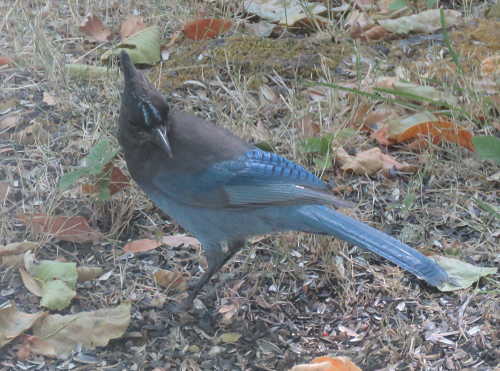
"My heart is like a singing bird." – Christina Rossetti
LAKE COUNTY, Calif. – After the pounding, driving rain subsides, birds of all description emerge from their shelters to feed on fat earthworms and grubs which the rains have washed up.
Robins concertize in the fields, while the toyon and other shrubbery hum with the activity of birds flying to and fro to “make hay while the sun shines.”
Rain returns, whispering like secret lovers, but that doesn't deter birds' activity. They will keep feeding so long as the showers don't pound them back to their dry stumps, or their stalwart vigils where they perch on foliage to save energy until the next reprieve.
Birds are blessed with the ability to shed water via the composition of their flight feathers. They preen while using the oil from a gland under their tail feathers to stay waterproof. Preening keeps feathers “aligned” and in place to allow them to discard rain like a rain gutter.
Birds are adapted to survive also, by the amazing variety of their bills. The bird bill is a multipurpose tool, much like a Swiss Army knife. The bill is used not only to feed and preen, but to aid in nest building, and, in some cases it is used to attack.
Many birds enjoy a menu with variety, while some birds specialize in foods, depending on availability.
Insectivores, those birds with slim bills, like wrens and warblers can garner bugs from bark or brush piles.
Seed and nut eating birds like goldfinches and juncos use their conical beaks to crack open seeds and nuts. Carnivores like hawks and eagles use their specially adapted beaks to tear off meat when they feed.
Steller's jays’ diet is varied since they are omnivores, and their beaks allow them to eat eggs, baby birds, acorns, seeds, fruit, small lizards and insects.
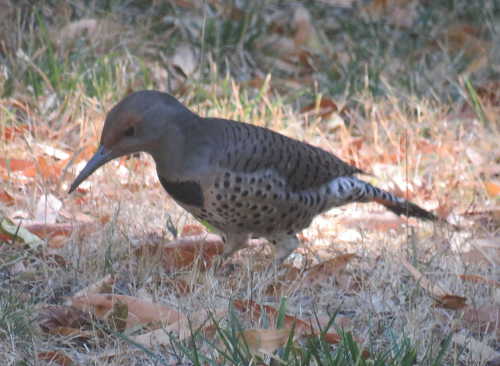
Northern flickers dine on nutritious larvae, ants, fruits and seeds. They jack-hammer the ground like their relative, the woodpecker, to get at the underground insects.
Birds bring into play another remarkable use for their bills – that of ornithophily, or bird pollination of flowering plants.
Hummingbirds are nectarivores who, while in the process of feeding on sugar-rich nectar from flowering plants, can pollinate plants at the same time.
According to National Geographic Magazine, a bird that belonged to the Pumiliornis tessellatus family, which is now extinct and lived over 47 million years ago, has been found to be the earliest bird pollinator. Its fossilized form, just three inches in length, was found with grains of pollen in its stomach.
Birds have small brains, but you most certainly cannot call them bird-brained creatures!
For more avian information see the Cornell Lab of Ornithology Facebook page at https://www.facebook.com/cornellbirds .
The Cornell Lab of Orinthology's Magazine "Living Bird of Winter" can be downloaded, and even has a coloring page: https://www.allaboutbirds.org/living-bird-winter-2017-table-of-contents/#_ga=1.93317150.2082424952.1486407917 .
Another good resources is the local Redbud Audubon Chapter, http://www.redbudaudubon.org/ and https://www.facebook.com/redbudaudubon?fref=ts .
Kathleen Scavone, M.A., is a retired educator, potter, writer and author of “Anderson Marsh State Historic Park: A Walking History, Prehistory, Flora, and Fauna Tour of a California State Park” and “Native Americans of Lake County.” She also writes for NASA and JPL as one of their “Solar System Ambassadors.” She was selected “Lake County Teacher of the Year, 1998-99” by the Lake County Office of Education, and chosen as one of 10 state finalists the same year by the California Department of Education.