 How to resolve AdBlock issue?
News
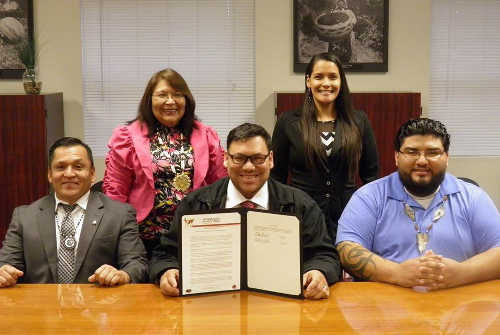
NICE, Calif. – In a move that may be a first in Indian Country, the Robinson Rancheria Citizens Business Council has taken action to reinstate the membership of dozens of people who were the target of a bitterly contested 2008 disenrollment action.
Based on direction from a majority vote of tribal members, on Feb. 1 the tribal council, led by Chairman Eddie “EJ” Crandell, voted in favor of a resolution that allows for the reinstatement of about 60 individuals who had been ousted from the tribe following a disputed 2008 tribal election.
Crandell said notices will be sent out to the impacted individuals, who will then be asked to come and sign their reenrollment resolutions.
The tribe will conduct enrollment proceedings on Feb. 27, with Crandell adding that he hopes to have everything finalized on March 2.
On March 3, the tribe will hold a community dinner to discuss its five-year plan with a consultant. Crandell said the reenrolled members will be invited to participate so they can be a part of the tribe’s future development.
While it’s hoped that that the action will begin healing and reunite the tribe, Crandell acknowledges that there are some issues that will not be resolved, such as housing.
Some of these who were disenrolled lost their homes on the rancheria, as they were evicted subsequent to the previous council’s 2008 action, he said.
For Crandell and the families who found themselves stripped of membership and tribal identity – some of them Crandell’s close relatives – the effort to bring back those who were disenrolled has been a long time in coming.
Crandell said he had been trying to convince the membership to take the step for a long time.
“This was really the right path to take,” said Wanda Quitiquit, who along with many members of her family were removed from the tribal rolls. She added that such reinstatement actions are unheard of.
“This is a first and this is historic,” said Gabe Galanda, an attorney who has advocated to bring attention to the disenrollment issue confronting tribes on the West Coast.
The Robinson tribal council’s action appears unique in that the tribal council reversed itself as opposed to a court ruling against it.
That was the case in August, when the Grand Ronde Tribal Court of Appeals in Oregon reversed the disenrollment of 66 people, finding that the tribe had waited too long to correct an alleged enrollment error. Galanda represented the 66 people who had been targeted for disenrollment in that case.
Last week, Galanda was involved with launching a social media campaign titled #stopdisenrollment that included a number of celebrities, as well as tribal leaders like Crandell, speaking out against the practice.
The roots of the disenrollment
The roots of the disenrollment go back to June of 2008, when Crandell ran for the tribal chair seat against then-Tribal Chair Tracey Avila.
Crandell won the election, but the results later were thrown out following a dispute, allowing Avila to retain her seat.
In December 2008 – a month after the tribal council changed its enrollment ordinance – disenrollment proceedings were initiated by the council against members of the Quitiquit family, who had supported Crandell in the election.
Eventually, approximately 67 tribal members – including the Quitiquits’ deceased mother, elders and some of the tribe’s last native speakers, and even a 2-year-old child – were disenrolled in an action upheld by the Bureau of Indian Affairs in April of 2010.
In 2011, Avila was arrested following a federal investigation that found she had stolen more than $60,000 from the Elem Colony of Pomo Indians in Clearlake Oaks between February 2006 and September 2008, while she had worked as the tribe’s fiscal officer. Despite the arrest, she remained tribal chair, a post she held until her death in late 2013.
As members of the disenrolled families fought the BIA or even moved on to join other tribes, Crandell had worked quietly for years to try to put the broken tribal family back together.
In time, he was elected into the tribal leadership, becoming Robinson’s tribal chair in January 2015. Outside of the tribe he also has assumed a community leadership role, with Supervisor Jim Steele appointing him in September to the Lake County Planning Commission.
In 2016, the tribe had slowly started to bring back some of those who had been disenrolled. Crandell estimated about six or seven individuals were reenrolled at that time, including two of his aunts and the three adult children of former Tribal Chair Clayton Duncan.
Crandell said that the action the council took earlier this month was precipitated in part by in-depth research conducted by tribal member Adrien Malicay.
It was Malicay who, during a recent meeting of the membership, moved to bring the disenrolled members back home, Crandell said.
The vote was 54 to 25 to direct the tribal council to reenroll those who had their membership stripped in 2008, according to Crandell. That vote was ratified by the council’s resolution on Feb. 1.
The Quitiquits said that Crandell was in contact with them to let them know that a move toward reinstatement was under way.
“I’m somewhat elated over the decision to be reenrolled,” said Marion Quitiquit, Wanda Quitiquit’s brother.
However, the issues with the disenrollment and the BIA’s upholding of the action in 2010 have left him angry.
Marion Quitiquit, who lives with wife Dora in Lucerne, said he wasn’t totally dependent on the tribe for support, so he didn’t suffer as much damage as others did.
He said the disenrollment had no regard for those who had children or other dependents, adding that he believed the BIA ignored the appeals of those were were the target of the action.
“We did lose three family member due to this disenrollment,” he said, referring to brother Larry, and sisters Pat and Luwana.
Luwana Quitiquit, who had been a respected Pomo artisan and basketmaker as well as a former member of the tribal council, had been exhausted from fighting the Robinson Rancheria council, her brother said.
At the time of her death, she was fighting an effort by the tribe to evict her from her house. “I think that was the final thing that really stressed her out,” Marion Quitiquit said.
Several months after her death in December 2011, her family was evicted from the home.
Despite his anger at the treatment of himself and his family, Marion Quitiquit can see some hope ahead for the tribe. “I think we’re heading in the right direction as far as getting it back in order and the way it's supposed to operate.”
“The majority vote was the first step in healing,” said Wanda Quitiquit, who added that she and those who are being reinstated feel like they won’t believe it until it becomes a reality.
“It’s hard to get my feelings around it. This is bittersweet,” she said, also recalling her siblings who have died and “the fact that they didn't get justice.”
“Things could have been different for them,” she said. “That needs to be said.”
Now, it’s about healing. “I really salute the tribal members who voted to reenroll us. It's about the tribal members who need to do the right thing, be on the right side of history,” she said.
Over the last eight years, she said she has felt like a refugee, as with the disenrollment the federal government no longer recognized her American Indian status, which took away some of her civil rights as a tribal member.
For those who were disenrolled, there also was the loss of programs for elders and education, tribal jobs, per capita earnings and housing, she said.
A lot of California’s Indians are suffering due to disenrollment, Quitiquit said.
“Indian Country is going to be facing some big challenges these next few years, so it's important to do the right thing,” she added.
An important and unprecedented step
Tim Harjo, Robinson’s attorney, has experience working with tribal governments, their constitutions and governance, assisted Robinson Rancheria’s council with reviewing the constitutional issues associated with the disenrollment.
Disenrollment in general is a very uncommon thing, said Harjo, adding that it’s more common in California than other places.
Putting people who have been removed from their tribes back into membership also is rare, he said.
In the tribe’s latest action, Harjo said his role was to provide another set of eyes and review the constitution, and to assist the council in replacing language in the tribal constitution that the previous council had removed in November 2008.
The new resolution passed on Feb. 1 explains that in 2008 the tribal council claimed there was a conflict between the tribal constitution and the tribe’s enrollment ordinance regarding adding members through adoption.
While the constitution, drafted around 1980, didn’t contain specific language about adding membership through adoption, the tribe had desired to to add members whose families had been listed in the 1940s Robinson Rancheria census rolls, according to discussions Harjo had with tribal elders involved in drafting the document. He said the BIA had told them they didn’t need to add that language.
The enrollment ordinance, which like the constitution was approved by the BIA, did contain such language about membership through adoption in one of its sections. In 2008 the tribal council passed a resolution to strike that section of the ordinance, arguing that it had been an error to grant people membership in that way, Harjo said.
The new resolution says that the tribal constitution authorizes discretionary authority to the business council “to prescribe rules and regulations governing the adoption of members into the tribe.”
It said the council had properly exercised its authority in enacting the enrollment ordinance in 1982, and that the current council is restoring those rules.
The document ends by stating that the 2008 council’s action to amend the enrollment ordinance “was a lawful exercise of discretionary authority by the Business Council and individuals applying for membership who may have been removed from membership following the 2008 amendments shall have no claim or rights in tribal benefits or services following removal from membership.”
With those actions taken, Harjo said the tribe can now move forward and let the individuals who were disenrolled rejoin the tribe’s membership. “And that’s where we’re at.”
“What they’re doing is very remarkable,” Harjo said. “It’s very rare to see something like this happen.”
He added, “They’re doing the right thing,” and it shows in the tribe, where healing is starting to happen. “They’re coming back together as a community.”
Galanda, originally from Round Valley and an enrolled member of the Round Valley Indian Tribes, now lives and works in Seattle, where a large part of his practice is representing disenrollees.
He estimated that over the past four years he’s worked with 600 American Indians in Washington, Oregon and Idaho who have been targeted for disenrollment.
He also wrote an article published in 2015 in the Arizona Law Review titled, “Curing the Tribal Disenrollment Epidemic: In Search of a Remedy.”
The #stopdisenrollment effort that Galanda is involved with has had support from many opponents of the practice, who call it a kind of genocide that is self-defeating for tribes, a way of diminishing tribal sovereignty, a perpetuation of injustice and colonialism, and an act that leaves cultural resources and people extremely vulnerable.
In his experience, Galanda said the abuse of power and greed are the two common denominators in disenrollments. Often, gaming tribes are involved.
Capitalism and individualism have overcome tribalism, “and that’s by federal design of at least 200 years,” said Galanda.
He said foreign, nonindigenous notions of commerce and culture have been foisted upon tribes. When he comes into a community facing disenrollment, Galanda asks if their language has a word for it. He said there are no native words to describe the process.
“This is not something that has existed with tribes until the last, really, few decades,” he said. “California Indians made disenrollment a nationwide tribal trend.”
With Robinson’s action, Galanda said Northern California Indians, and Pomo tribes in particular, are now reversing that “horrific trend.”
“That’s the beauty of what Chairman Crandell and Robinson have accomplished, in my estimation,” Galanda said.
That’s empowering other tribal leaders to step up and speak out, which Galanda said is critical because he believes intertribal silence has allowed for the disenrollment epidemic.
While it’s historically been taboo for one tribe to speak out against another sovereign tribe, “They’re now saying enough is enough,” as disenrollment breeds more human rights issues, said Galanda.
“What Robinson has accomplished signals that the tide is turning on disenrollment nationally,” he said.
Email Elizabeth Larson at
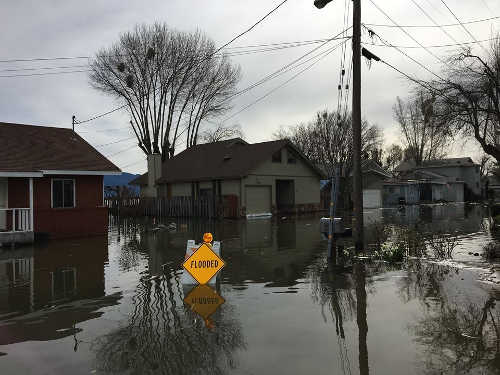
LAKE COUNTY, Calif. – Despite a slightly receding lake level and drier conditions, numerous roads remain closed throughout the county.
Early Tuesday, Clear Lake’s elevation was at 9.73 feet Rumsey, according to the US Geological Survey.
Local officials reported the following road closures remain in effect until further notice.
CLEARLAKE
Lower Lakeshore Drive at Lakeshore Drive: Closed due to flooding and debris in the roadway.
CLEARLAKE OAKS
Twin Valley Road: Closed due to mudslide.
New Long Valley Road: Open with slide activity.
Old Long Valley Road: Open with slide activity.
COBB
Maple Shadows: Closed at the south end from Highway 175 to Parnassus due to culvert failure.
Socrates Mine Road: Road slip out at MPM 3.8. Down to one lane in this area.
LAKEPORT (CITY)
Third, Fourth and Fifth street parking lots and access roads: Closed from the entrance of the parking lots to the lake. Parking for Park Place will remain open.
Lakeshore Boulevard: Closed between Lange Street and Giselman Street. Northbound traffic, detour by using Giselman Street to Lange Street; southbound traffic, detour by using Lange Street to Giselman Street. Please be aware that the detours are going past the schools; use extreme caution in the area.
Closed from South Main Street to Esplanade Street: E Street, Esplanade Street, K Street, Konocti Avenue, Lily Cove Avenue, Lupoyoma Avenue, Helena Avenue and Oak Knoll Avenue.
Library Park remains closed as well as all city boat launches.
LAKEPORT (UNINCORPORATED COUNTY)
Hill Road: Between Sutter Lakeside Hospital entrance and Lakeshore Boulevard due to mudslides across the roadway.
Lakeshore Boulevard: Closed from Park Way to Crystal Lake Way due to flooding.
Nice/Lucerne Cutoff: Open with flooding.
Reeves Lane: Closed at Land’s End due to flooding.
NICE
Lakeshore Boulevard: Closed from Hammond Avenue to Stokes Avenue due to flooding.
Stokes Avenue: Open with flooding.
UPPER LAKE
Bartlett Springs Road: Closed at MPM 18.0 due to mudslide.
Elk Mountain Road: Roadway closed at MPM 29.6 due to road washout. No estimate of when road will be reopened.
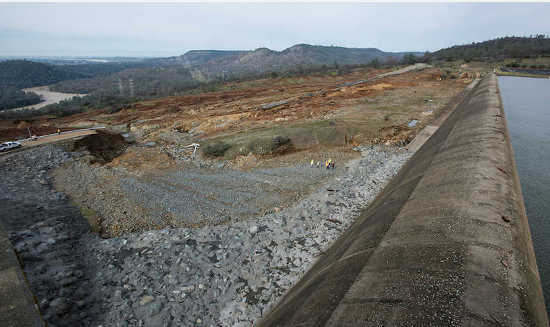
NORTHERN CALIFORNIA – The U.S. Department of Homeland Security’s Federal Emergency Management Agency, or FEMA, through its Regional Response Coordination Center in Oakland and its National Response Coordination Center in Washington, D.C., are monitoring impacts of the severe weather in California and the erosion to the Oroville Dam spillway and remains in close coordination with state and tribal officials in affected areas.
FEMA is coordinating support for the state of California in its preparation and response to the potential Auxiliary Spillway failure near Oroville in Butte County.
The FEMA Regional Response Coordination Center located in Oakland has activated in response to the emergency with a 24-hour operational tempo.
“We activated to ensure we’re postured to rapidly respond to any needs that California may have to protect life and property,” said Acting FEMA Administrator Dr. Ahsha Tribble. “We encourage residents in the affected to area to follow the direction of local authorities, and if told to stay out of evacuated areas, please do so.”
A FEMA Incident Management Assistance Team, or IMAT, is onsite at the California State Operations Center in Sacramento. The IMAT is an emergency response strike team comprised of specialists in the fields of operations, logistics, external affairs, finance and administration, and other key management positions.
According to the National Weather Service, an active weather pattern will return to Northern and Central California for the middle to latter portion of the week as a series of storm systems track across the region.
The National Weather Service forecasts the heaviest precipitation is expected Wednesday night into Thursday morning and again Friday into Friday night.
Additional rainfall may cause excessive runoff within the river basins and may pose additional stress on the Oroville Dam spillway situation.

The state requested and FEMA logistics will supply 150,000 one-liter bottles of water; 20,000 blankets; and 10,000 cots to the state today.
FEMA’s Liaison Officers continue to work with the California Office of Emergency Services Operations Center and the California Department of Water Resources State-Federal Flood Operations Center.
FEMA encourages those in the areas affected, or potentially affected by the severe weather to monitor local radio, TV stations or official social media accounts for updated emergency information, and to follow the instructions of state, tribal and local officials.
As of Monday evening, the California Department of Water Resources advised that the primary spillway continued to flow at 100,000 cubic feet per second and lake levels have dropped to 894 feet.
After evaluating the erosion on the emergency spillway, a plan was put in place to prevent further erosion. Utilizing trucks and helicopters, crews moved large rocks and gravel to fill erosion on the emergency spillway. Department of Water Resources staff continues to inspect and evaluate the emergency and primary spillways for further erosion.
Total discharges from the reservoir remain consistent with flood control releases at this time of year under these weather conditions. Department of Water Resources does not expect the discharge from the reservoir to exceed the capacity of any channel downstream.

When Punxsutawney Phil failed to see his shadow on Feb. 2, 2016, that indicated an early start to spring for the United States.
The decision marks only the 18th time Pennsylvania's most famous groundhog hasn't seen his shadow since the tradition began in 1887.
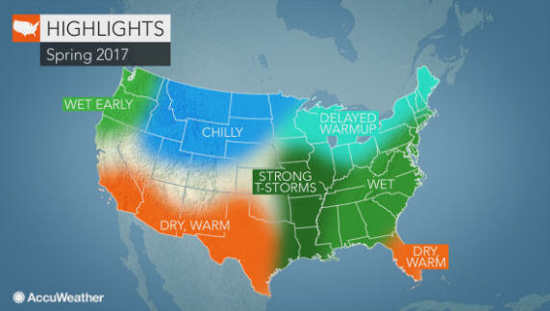
For the Northeast and mid-Atlantic, AccuWeather meteorologists are concerned for just the opposite, as cold air and the potential for snow will linger into the start of March. Elsewhere, springlike severe weather isn't predicted to become widespread until April.
Cold air and snow possible for mid-Atlantic, Northeast into March; Drought may develop for Great Lakes, Ohio Valley
Warm weather lovers in the mid-Atlantic and Northeast will have to be patient, as winter plans to linger into March across both regions.
Cold air and stormy weather will take the stage from late February into the start of March, opening the door for a potential late-winter snowstorm.
"There could be a last surge of winter before we see the transition into spring," AccuWeather Long-Range Meteorologist Paul Pastelok said. "For the Northeast, there's still an opportunity for some snow, although there's a higher chance that we'll see a cold snap rather than a big snowstorm."
A quick warmup will follow, however, allowing milder air to arrive faster than it has in the past two years for both regions.
"A lack of arctic air in the region and the sun getting higher and higher in the sky will make it feel pretty nice, I think, by mid-March in the Northeast," Pastelok said.
Through April, the weather pattern will lend itself to the occasional damp and dreary day before a turnaround in May.
"Big cities around the Great Lakes will have nice weather for outdoor projects and early planting in May," Pastelok said. "Expect mild temperatures, frequent sunshine and cooler nights."
May could also yield drought concerns for the Great Lakes and Ohio Valley, prompting some early season heat. During the same month, the threat for severe weather will loom for the mid-Atlantic.
Severe weather outbreaks to target Southeast, Gulf Coast, Tennessee Valley; Chance for early tropical impact low
Spring will kick off with periods of wet weather across the Southeast, increasing the risk for flooding throughout the region. Florida, Georgia and South Carolina will be at an especially high risk.
From late February through March, the threat for severe thunderstorms will ramp up in Florida. Elsewhere however, severe weather will get a slow start with below-normal tornado totals predicted for the month.
Come April, warmer air will help to fuel severe storms, allowing multiple, widespread outbreaks to occur. Atlanta, Charlotte, North Carolina, and Chattanooga and Nashville, Tennessee, are all in the line of fire.
In the Gulf Coast states, the severe weather may turn into flooding events during April and May.
Those concerned for early tropical development can breathe a sigh of relief: The chance for an early impact will be low.
Severe weather to ramp up in April for Plains, Mississippi Valley, Midwest
Stable air in place across the central Plains and the Mississippi Valley during March and early April will help to hold back severe weather.
However, that will change as April progresses and storms track from the Southwest, leading to increased severe weather in the central and southern Plains, Mississippi Valley and Midwest.
"Intense warmth ahead of these storms coming out of the West is going to promote severe weather. Those are the ingredients you need," Pastelok said.
"The thing that worries me the most is that it could turn into heavy rain producers that could lead to flooding. And we've seen lots of flooding already over this past winter season in the Mississippi Valley."
Across the southern Plains states, flooding this year is not predicted to be as severe as last year, when between 15 and 20 inches of rain inundated Oklahoma and Texas.
Western drought woes to continue into spring
An El Nino weather pattern has delivered rain and mountain snow to the western United States this winter, and that trend will largely continue during spring.
Drier-than-normal conditions will affect the Northwest in March; however, the rest of the West may continue to have surges of moisture into April.
Snow is forecast to fall across the high ground of the central and southern Rockies in March. In California, abundant precipitation could lead to additional flooding problems.
"Throughout the winter, the focus for precipitation has been on both northern and central California. While this will continue to be the case into spring, one or two systems are on the radar for Southern California in March," Pastelok said.
Rain and mountain snow have helped to ease short-term drought woes in the Golden State, but the long-term water crisis will continue.
"We've gotten the snow in the Sierra. We've gotten the rain in the short term. It will continue through the end of the wet season, which is good news as well," Pastelok said.
"That will help out agriculture in the short term. That will help out the drinking water situation. However, will it relieve all the other problems that occurred over the last four and a half years? Probably not. I think we need another season like this."
CLEARLAKE, Calif. – The Clear Lake/Callayomi Masonic Lodge No. 183, Free and Accepted Masons, hosts the “best breakfast in Lake County” on the third Sunday of each month at the Masonic Center, located at 7100 South Center Drive in Clearlake.
The next breakfast will take place on Sunday, Feb. 19.
The lodge serves a full, sit-down breakfast from 8 to 11 a.m.
Choose your breakfast from a large menu including eggs (any style), omelets, hash browns, biscuits and gravy, hot cakes, breakfast meat, toast, juice and coffee.
The cost is $8 for adults, $4 for children ages 6 to 12. Children under age 6 may eat for free and are served a special “kids” breakfast.
LAKEPORT, Calif. – The Clear Lake High School Class of 2017 Sober Grad Committee will present its crab feed and live auction on Saturday, Feb. 25.
The event will take place at the Little Theater at the Lake County Fairgrounds, 401 Martin St. in Lakeport.
Doors open at 6 p.m., with dinner at 6:30 p.m.
The all-you-can-eat dinner includes crab, pasta and salad dinner, and a no-host bar.
Tickets cost $50 per person or $500 for a reserved table for eight with wine and dessert.
Purchase tickets at Linda’s Hallmark on 11th Street, Lakeport Elementary School or Pyorre’s Insurance on Main Street.